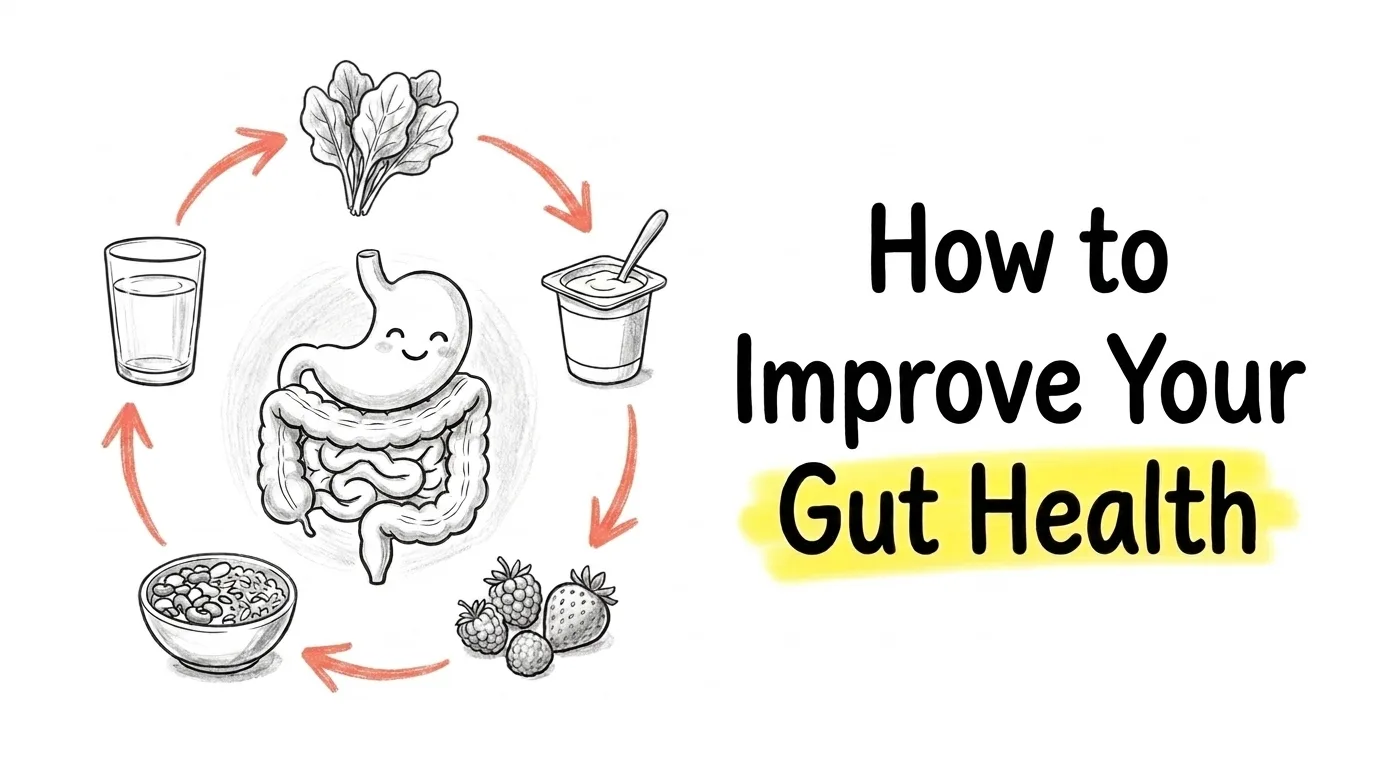
If you search "how to improve gut health," you'll drown in cleanses and $40 supplements promising a reset. Almost none of it actually matters. Your gut is home to trillions of bacteria (your microbiome), and what they actually want is boring and cheap: fiber, and plenty of different plants to get it from. The rest is mostly leaving them alone.
And the effort is lopsided. Most of it is what you eat. Sleep, stress, movement, and water help a little around the edges, and the stuff in a bottle does close to nothing.
Start with fiber
If you do one thing, eat more fiber. It's the part of plants your body can't break down, so it slides all the way to your large intestine, where your gut bacteria are waiting to eat it. They turn it into short-chain fatty acids that calm inflammation and feed your gut lining. That's all "prebiotic" means: food for your bacteria. Fiber is the main one.
Aim for about 26 grams a day if you're a teenage girl and closer to 38 if you're a teenage boy, and know that most teenagers get about half of that. Don't count grams, just eat real food: beans, lentils, whole grains, vegetables, fruit, nuts, seeds. If you barely eat fiber now, ramp up slowly and drink water with it, or you'll be gassy and bloated for a week while your gut adjusts (that's covered in How to Get Rid of Bloating). For which foods do the most, The 10 Best Foods for Your Gut Health.
Eat lots of different plants
Different bacteria eat different fibers, so variety feeds a wider range of them. In one big citizen-science study, people who ate more than 30 kinds of plants a week had more diverse gut bacteria than people who ate 10 or fewer. Take that with a grain of salt, it's a correlation, and people who eat 30 plants a week tend to do a lot of other things right. Still, mixing up your plants is free and can't backfire. Beans today, berries tomorrow, a different vegetable tonight. Variety is the point.
Add a little fermented food
Fermented foods (yogurt with live cultures, kefir, kimchi, sauerkraut) carry live bacteria. In a 2021 Stanford study, 36 adults who ate them for 10 weeks grew more diverse gut bacteria and had lower inflammation in their blood. That's only 36 people over 10 weeks, so it's a hint, not proof. But it's affordable food you'd eat anyway, so there's little reason not to. One catch: heat kills the cultures, so check the label for "live and active cultures" and keep it cold.
Go easy on the ultra-processed stuff
Feeding the good bacteria only helps if you're not burying them under the bad. Ultra-processed food, heavy on sugar and additives and light on fiber, more often than not leads to a thinner, less healthy microbiome. That's mostly correlation, so one soda won't wreck anything, but when ultra-processed food becomes the base of your diet, your bacteria stop getting the fiber and variety they run on. The 10 Worst Foods for Your Gut Health goes through the worst offenders, and Are Seed Oils Bad for Your Gut? talks one popular panic back down.
Your daily habits matter too
What you eat is the biggest piece, but a few other everyday habits matter too:
- Move. Walking and exercise physically push food through your gut, which is why a walk helps when you're backed up. Active people also seem to have more diverse gut bacteria, though that research is still early. No gym required.
- Sleep. Skimping on sleep throws off your circadian rhythm (your body's internal clock), and your gut feels it. Get 7 to 9 hours. The gut-microbiome link is still thin, but you should be sleeping anyway.
- Manage stress. Your gut and brain talk constantly, so stress turns into cramps, bloating, and digestion that races or stalls. It won't remodel your microbiome, but the day-to-day effect is real. (Why You Get Butterflies In Your Stomach is the whole story.)
- Drink water. It keeps things moving and helps fiber do its job, which is half of not being constipated. It's more about digestion than your microbiome, but drink it.
Protect the bacteria you already have
Antibiotics are the fastest way to set your gut back. They're also important and sometimes lifesaving, so take the ones a doctor prescribes and finish the course, always. The problem is that they can't tell your good bacteria from the bad and wipe out both. You can't help that when you actually need them. You can skip them when you don't: colds and the flu are viruses, and antibiotics do nothing to viruses, so don't push your doctor for them.
Skip the shortcuts
Nearly everything sold as a gut fix is a waste of money. Probiotic supplements help in a few narrow cases and do little for general "gut health" (Do Probiotics Actually Work? has the details). Cleanses and detoxes clear out nothing your body wasn't already handling on its own. "Leaky gut" cures charge you for a condition that isn't even a recognized diagnosis (Is Leaky Gut Real?). Spend the money on vegetables instead.
When to see a doctor
None of this fixes an actual medical problem, and some symptoms need a doctor, not a diet change. Go see one if you get belly pain that keeps coming back, symptoms that last more than a couple of weeks, blood in your stool, or weight loss you didn't try for. Those can point to something treatable, and no amount of yogurt replaces a diagnosis.
The bottom line
There's no secret and no product. Eat a lot of fiber and a wide range of plants, add some fermented food, keep ultra-processed food from taking over, and cover the basics: sleep, stress, movement, water. Do that most of the time and your gut mostly runs itself. Boring wins, and it beats every powder on the shelf.
Sources
- Harvard T.H. Chan School of Public Health, The Nutrition Source: Fiber
- National Academies (Institute of Medicine), Dietary Reference Intakes: Macronutrients summary table
- USDA Agricultural Research Service, Usual Nutrient Intake from Food and Beverages, WWEIA/NHANES 2015-2018, Table A6
- Harvard Health Publishing, Feed your gut
- The role of short-chain fatty acids in gut and metabolic health (review), Gut Microbes (2021)
- American Gut Project (McDonald et al.), mSystems (2018), via UC San Diego
- Stanford Medicine, Fermented-food diet increases microbiome diversity, decreases inflammatory proteins (2021)
- Cleveland Clinic, 4 Things You Can Do To Improve Gut Health
- Cleveland Clinic, Gut Microbiome
- American Psychological Association, Stress effects on the body
- Harvard Health Publishing, The gut-brain connection
- NIDDK, Constipation: Eating, Diet & Nutrition
- MedlinePlus (U.S. National Library of Medicine), Antibiotic resistance
- NIH News in Health, Keeping Your Gut in Check (2017)

.svg)
.webp)
.webp)



.webp)


.webp)
.webp)