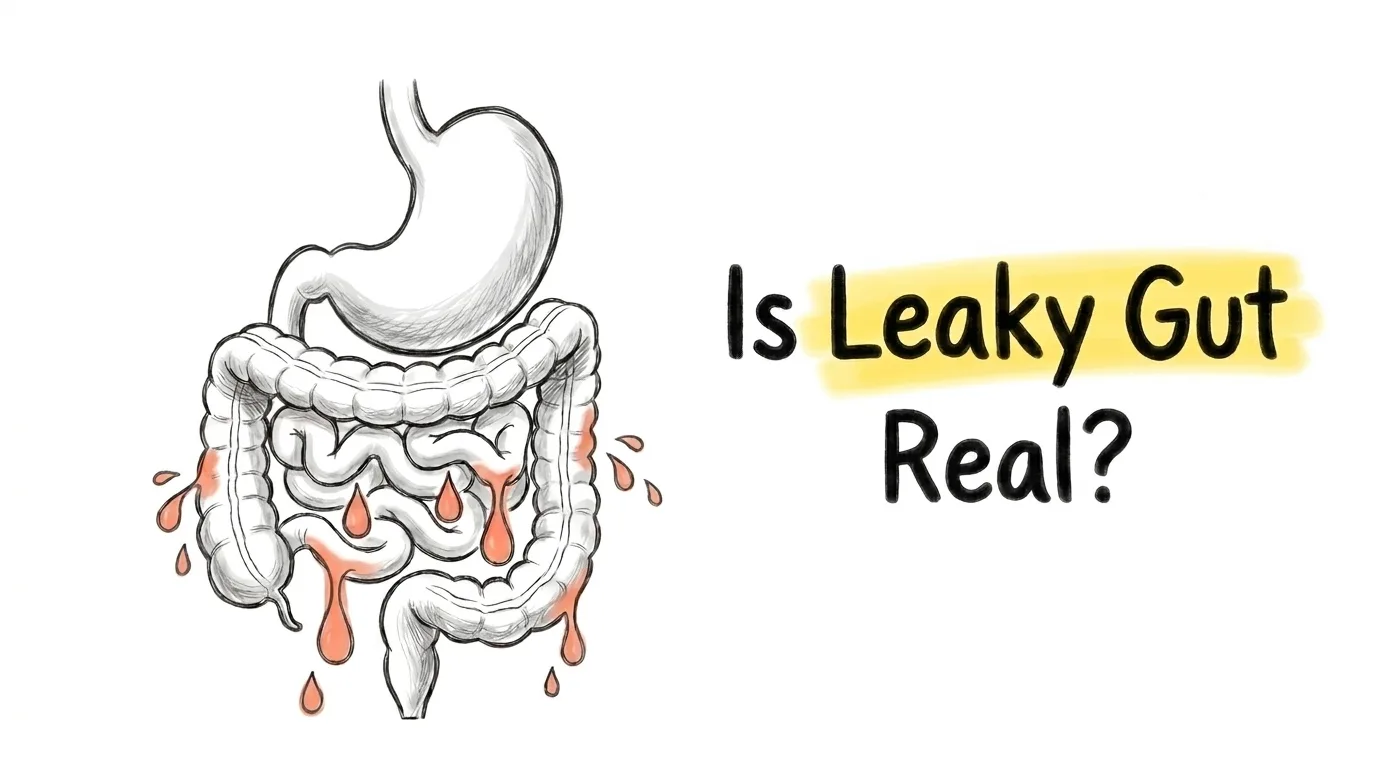
If you've spent any time in the health corners of the internet, you've heard that a "leaky gut" is behind your bloating, your acne, your tiredness, your mood, maybe an autoimmune disease, and that the fix is a stack of supplements. It's one of the most common gut buzzwords out there. So is leaky gut actually real? The answer has two halves that usually get mashed together. One is solid science. The other is mostly marketing, and they tend to get sold as the same thing.
What "leaky gut" even means
Start with the gut lining. The inside of your intestines is covered by a single layer of cells packed tightly together, and that layer is picky on purpose. As Harvard describes it, the lining "acts like a security system and decides what gets absorbed into the bloodstream and what stays out." Nutrients and water get waved through; bacteria, toxins, and half-digested food are supposed to be held back.
The seams between those cells can loosen. When they do, the barrier gets more porous and lets through things it usually wouldn't. Scientists call this increased intestinal permeability, and "leaky gut" is just the nickname for it. That much is real, established biology, and no serious doctor disputes it.
The part that's real
A leaky gut lining is not made up. Increased permeability genuinely shows up in a handful of real, diagnosable conditions, especially celiac disease, Crohn's disease and other inflammatory bowel disease, and irritable bowel syndrome (IBS). Harvard notes that increased permeability "plays a role in" exactly those conditions. So when someone tells you the gut barrier can weaken, they're right.
The catch is what that actually means. In those diseases, the leakiness usually shows up as part of the illness rather than the thing that started it. A Cleveland Clinic explainer puts it bluntly: in these cases scientists "generally consider it to be a symptom, not a cause." The inflammation damages the lining, and a more permeable lining is the result.
What actually makes a gut leaky
So what damages the barrier in the first place? Mostly, it's the same serious stuff that causes real gut trouble. Cleveland Clinic's list of things that can increase intestinal permeability includes chronic inflammatory diseases like IBD and celiac, and "chronic overuse of alcohol or NSAIDs, such as aspirin and ibuprofen." That word, chronic, matters. A single ibuprofen or one late night isn't going to wreck your gut lining; it's heavy, long-term use that does the damage. A bad gut infection (a rough bout of food poisoning or a stomach bug) can also leave the barrier more permeable for a while afterward.
Diet and stress get blamed constantly, and they might play a part, but might is as far as the evidence goes. The authoritative sources hedge on these: Cleveland Clinic says everyday factors like diet and stress "may cumulatively wear down your intestinal lining," and Harvard says a low-fiber, high-sugar, high-fat diet "may initiate this process." Those are possible contributors, and the sources are careful not to call them proven causes.
The part that's oversold
Now the other half. The internet doesn't stop at "the gut barrier can weaken." It sells "leaky gut syndrome," a single hidden condition supposedly behind a huge list of unrelated problems: chronic fatigue, migraines, asthma, arthritis, allergies, skin conditions, autoimmune diseases, even autism and mood disorders. That version is not a recognized diagnosis. Cleveland Clinic calls leaky gut syndrome "a hypothetical condition that's not currently recognized as a medical diagnosis."
The theory behind it does have a certain logic. The idea goes like this: if the barrier is leakier, bits of the bacteria living in your gut can slip into your bloodstream, your immune system reacts to them, and that creates a low, constant simmer of inflammation all over your body, which supposedly surfaces as all those scattered symptoms. Scientists have actually studied a version of this, a leaky barrier letting bacterial "endotoxins" into the blood, so it isn't invented out of nothing.
The trouble is the evidence. That mechanism has been studied mostly in animals, often mice fed extreme high-fat diets, and even the researchers who work on it call it controversial and hard to measure reliably. Where it does seem to matter in people, the conditions tied to it are things like type 2 diabetes and fatty liver disease, not the acne, fatigue, and autoimmune problems the supplements promise to fix. Harvard's writeup says plainly that for that broader list, "we do not yet have clinical studies in humans showing such a cause and effect." Nobody has shown that a leaky gut is what's causing your acne or your tiredness. It might turn out to matter someday. Today, that link is unproven.
Why the tests and cures should make you skeptical
Because leaky gut syndrome isn't a defined diagnosis, there's no real test you can buy for it. Cleveland Clinic notes there is "no standard test to measure intestinal permeability directly in patients." The at-home "leaky gut tests" and "zonulin" blood panels sold online aren't validated ways to tell you anything reliable.
The cures are the same story. Supplements, gut-healing powders, and special protocols get marketed to "seal" your gut, and there's no good evidence they do. Cleveland Clinic is direct about it: "Treatments that target the intestinal lining independently have not been shown to improve these diseases." The only thing that reliably repairs a damaged lining is treating the disease behind it. As they put it, "the only known cure for a leaky gut is to treat the underlying condition that causes it." So be skeptical of anything sold to fix a condition that doctors can't even test for.
This also explains the testimonials. People often do feel better after starting a leaky-gut protocol, and the reason has nothing to do with sealing the gut. These plans usually cut out processed junk and load up on whole foods, which makes most people feel better anyway, and some of the lift is the placebo effect. The Gastrointestinal Society warns that feeling better this way can "postpone diagnosis of the real cause of symptoms."
What actually helps your gut lining
None of this means you're stuck. The things that actually help your gut lining are the familiar, unglamorous ones.
Fiber is the big one. When the bacteria in your gut ferment fiber, they make short-chain fatty acids, which are a main fuel for the cells lining your intestine. So a varied, whole-food diet with plenty of fiber (vegetables, fruit, beans, whole grains, nuts) does more for your gut barrier than any supplement aimed at it. Cleveland Clinic's advice is simply that "a balanced diet ... can help fortify your gut."
And if there's a real condition underneath, treating that is the actual repair job. Get the diagnosis, deal with it, and the lining recovers along with it.
When it's worth seeing a doctor
Persistent gut symptoms are worth taking seriously, because some of them point to real, treatable conditions like celiac disease or IBD, and those are worth catching early. See a doctor rather than self-diagnosing "leaky gut" if you have things like:
- Diarrhea, constipation, or belly pain that keeps coming back or won't go away
- Symptoms that stick around for more than a couple of weeks
- Blood in your stool, or black, tarry stool
- Losing weight without trying
- Ongoing bloating, gas, or greasy, foul-smelling stools (these can be signs of celiac disease)
None of these mean you have a leaky gut. They mean your gut is worth a real look from someone who can actually test for what's going on.
So, is leaky gut real?
Both halves at once. A leaky gut, meaning a more permeable gut lining, is real, and it shows up in genuine conditions like celiac disease and IBD, usually as a result of them. "Leaky gut syndrome," the catch-all diagnosis blamed for everything and treated with supplements, isn't established, can't be tested for, and isn't worth buying.
So if your gut's been off, skip the cleanse and the zonulin test. Eat a varied, high-fiber diet, and if symptoms stick around, see a doctor who can find out what's actually going on.
Sources
- Cleveland Clinic, Leaky Gut Syndrome
- Harvard Health Publishing, What is leaky gut syndrome?
- Harvard Health Publishing, Leaky gut: What is it, and what does it mean for you? (Campos, 2023)
- Harvard T.H. Chan School of Public Health, The Nutrition Source: Fiber
- National Institute of Diabetes and Digestive and Kidney Diseases (NIDDK), Celiac Disease: Symptoms & Causes
- NHS, Symptoms of bowel cancer (general digestive warning signs and see-a-doctor thresholds)
- Role of Metabolic Endotoxemia in Systemic Inflammation and Potential Interventions, Frontiers in Immunology (2021)
- Intestinal barrier function in health and gastrointestinal disease (review), U.S. National Library of Medicine (PMC)
- Gastrointestinal Society (badgut.org), Debunking the Myth of "Leaky Gut Syndrome"

.svg)
.webp)
.webp)



.webp)


.webp)
.webp)