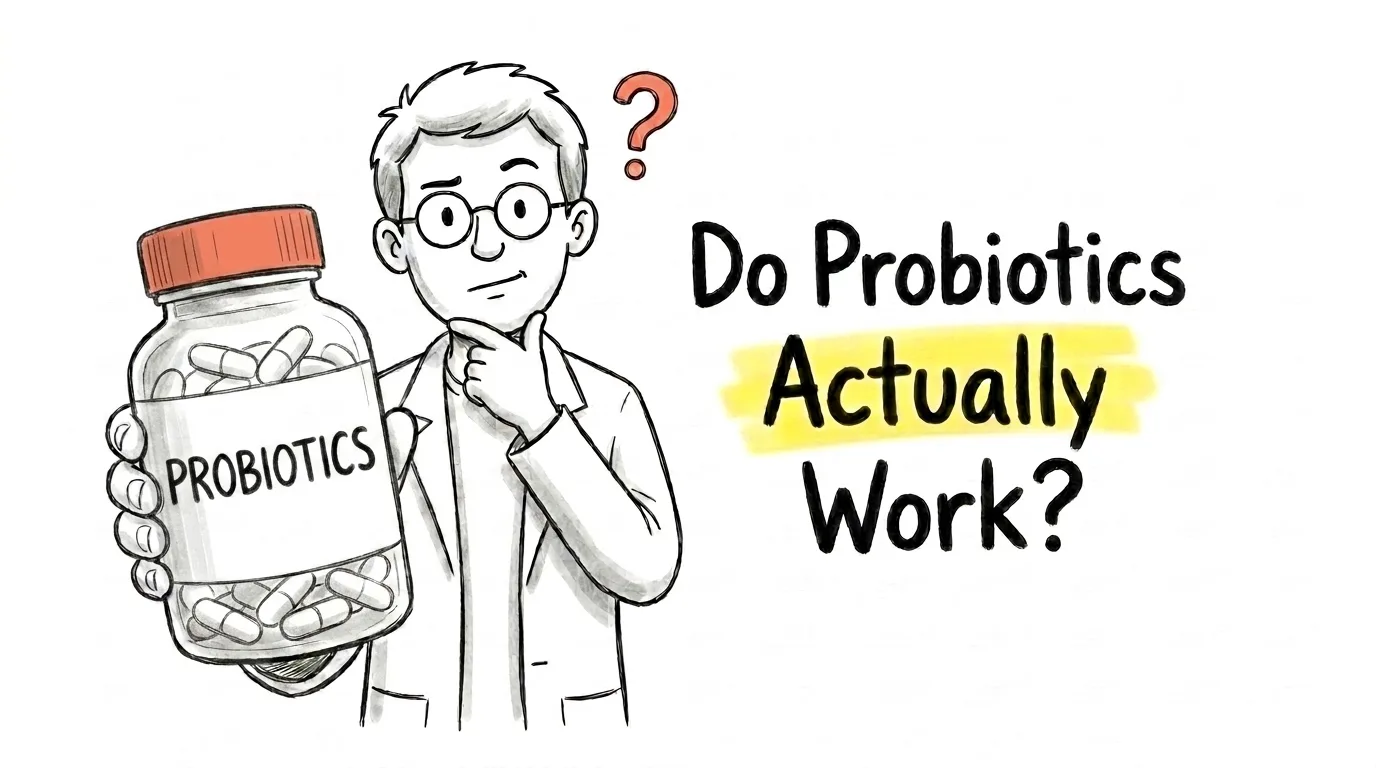
Probiotics are everywhere now. Pills, powders, drinks, and yogurts, all promising a healthier gut. The ads make it sound simple: swallow the bacteria, fix the gut. It’s a huge business, but for something this popular, the evidence behind it is thinner than the marketing makes it look.
A probiotic is a live microorganism, usually a bacterium or a yeast, the same kind of tiny life already living in your gut by the trillions (your gut microbes, together called your microbiome). The thought process behind taking them is straightforward: your gut is full of bacteria, some of it helpful, so adding more of the helpful kind should make things better. You’ll find probiotics two ways, as supplements in a bottle and in fermented foods like yogurt and kimchi.
So do they work?
Yes and no. The American Gastroenterological Association, the main group of gut doctors in the US, looked into this in 2020. They reviewed the research and published guidelines, and for most digestive problems, they don't recommend probiotics.
The evidence that probiotics actually help doesn’t really exist, and the group noted that these supplements cost real money for potential benefits that have never been proven.
That doesn’t mean probiotics never help. They do, but the places they clearly help are few and specific. The guidelines found good evidence for only a few situations:
- Preventing a specific infection called C. diff in people on antibiotics
- Preventing a serious intestinal illness in premature babies
- Managing a complication after a certain gut surgery
The reasons most people actually buy probiotics (like everyday bloating, general “gut health,” smoother digestion, more energy) aren't on it at all.
Why the science is so messy
Bacteria come in strains, which are like specific breeds within a species (think a German shepherd and Chihuahua). One strain might do something useful, but that tells you nothing about a different strain, even a closely related one (a German shepherd can work a police shift; a Chihuahua probably can’t). The AGA said it plainly: the effects are strain-specific. So a study showing one strain helped with one problem doesn't mean that the bottle on the shelf, with a different mix inside, does anything at all.
Probiotics are also hard to trust for another reason. A probiotic counts as a supplement rather than a medicine, and supplements are held to a much lower standard. A medicine has to prove to the FDA (Food and Drug Administration) that it's safe and that it works before it can be sold. A supplement doesn't, so a probiotic can reach the shelf without that sign-off. With no one verifying what's inside, the number of live bacteria (listed as CFUs, or colony-forming units) varies a lot from one product to the next, and two bottles both labeled "probiotic" can hold completely different bacteria in completely different amounts.
Food does it cheaper (and safer)
If you want the upside of probiotics without the cost or the risk, food is the place to start. Fermented foods like yogurt, kefir (a drinkable fermented milk), kimchi, and sauerkraut all contain live bacteria, and they come as actual food instead of a forty-dollar bottle. The evidence here is still limited, so this isn’t a miracle either. But it’s cheap, it’s food you’d eat anyway, and it comes with fiber and nutrients your gut microbes feed on. One catch: heat and pasteurization kill the live cultures, so shelf-stable versions often have none left. Look for “live and active cultures” on the label, and you’ll usually find the most in yogurt and kefir.
When a probiotic supplement is actually worth it
If there's a reason to take one, it's antibiotics. Taking a probiotic alongside them has been shown to cut the risk of antibiotic-related diarrhea by about half, and to lower the risk of a C. diff infection. If you’re starting a course of antibiotics, it’s a reasonable thing to ask your doctor about.
Probiotics aren't risk-free for everyone
For most healthy people probiotics are low-risk, and there are no official recommendations for healthy people to take them at all. But if someone is seriously ill or has a weakened immune system, probiotics can occasionally cause real infections, and the FDA has warned about severe cases in premature infants. If you’re that sick, “it’s just bacteria, it can’t hurt” isn’t true, and a doctor should help you make your decision.
The bottom line
If you’re healthy and curious, there’s no harm in trying a probiotic. Just don’t expect a lot. And if something's actually wrong, like a gut problem that keeps coming back, blood in your stool, weeks of pain, or losing weight without trying, go see a doctor. A probiotic can help with a few specific things, but it won't fix a gut that's genuinely struggling.
Sources


.svg)
.webp)
.webp)



.webp)


.webp)
.webp)