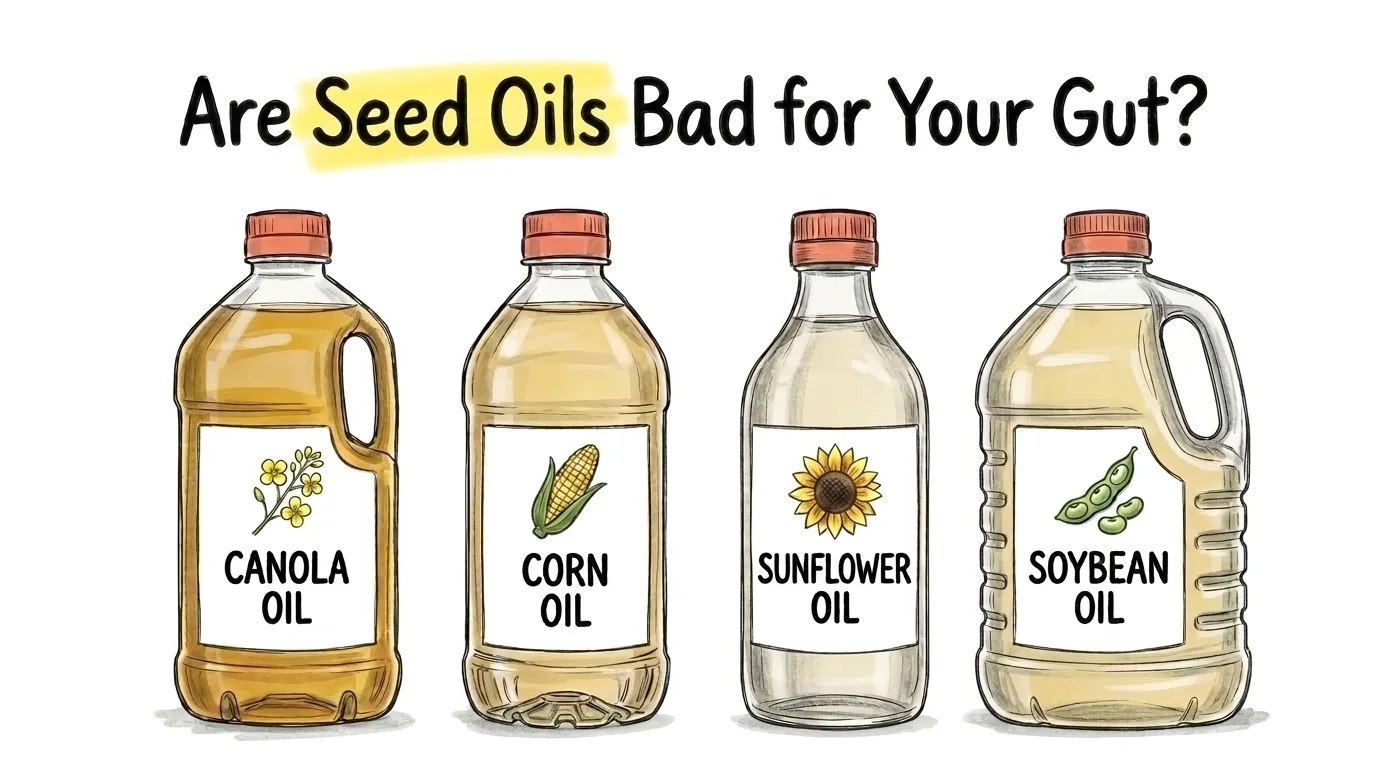
Somewhere in the last few years, seed oils became the thing everyone online loves to fear. Canola, soybean, sunflower, corn: if you spend five minutes on health TikTok, you'll hear they're toxic, inflammatory, and behind half the diseases you can name. That's a big claim about foods that are in nearly everything, so it's fair to ask what the research actually shows. Most of the scary claims fall apart once you look at studies in people. A couple of smaller, more boring concerns actually hold up.
What a seed oil is (and where it hides)
Seed oils are exactly what they sound like: oils pressed from the seeds of plants like soybeans, corn, sunflowers, and canola. What sets them apart from olive or avocado oil is the kind of fat inside. Seed oils are high in omega-6, while olive and avocado oil are mostly monounsaturated fat, a different type entirely.
If you don’t know what omega-6 and omega-3 are, they're both types of polyunsaturated fat, and both are "essential," which means that your body can't make them on its own and has to get them from food. Omega-6 is the one packed into seed oils (the main one is called linoleic acid, which comes up a lot below). Omega-3 is the kind you've probably heard about in fish, and in foods like flaxseed and walnuts. You need both. Most of the seed-oil argument is really about whether we now get too much omega-6 and too little omega-3, and that's where it starts.
They're also everywhere. Soybean oil alone is more than half linoleic acid, and it turns up in restaurant fryers, packaged snacks, salad dressings, and most processed food. Americans eat far more of this fat than they did fifty years ago, almost all of it from these oils. So this isn't a niche question. If seed oils were as bad as the panic says, it would show up all over the health data. Mostly, it doesn't.
The scary claims that don't hold up
Three claims drive most of the fear. Each has a kernel of something real in it, and each falls apart when you look closely.
"They cause inflammation"
This is the big one. The theory has real biochemistry behind it: your body can turn omega-6 (linoleic acid) into another fat called arachidonic acid, which is a building block for compounds that fuel inflammation. So on paper, more omega-6 should mean more inflammation.
In the body it doesn't work that cleanly. The step that converts linoleic acid into arachidonic acid is tightly controlled, so eating more omega-6 doesn't actually raise the amount of arachidonic acid in your tissues. A 2011 review of human studies found that raising dietary linoleic acid, even several times over, didn't move tissue arachidonic acid at all. And when researchers pool together randomized trials (the strongest kind of nutrition study), more linoleic acid doesn't raise the markers doctors use to measure inflammation, like CRP. A 2012 review of 15 of these trials found "virtually no evidence" that adding linoleic acid raises inflammation in healthy people. Some research even points the other way, linking more linoleic acid to slightly lower inflammation.
So the inflammation claim is real in a test tube and in some animal studies, but it keeps failing to appear in humans. The American Heart Association reviewed the evidence in 2024 and said there's no reason to avoid seed oils, and Harvard nutrition researchers have pushed back on the inflammation claim directly.
"The omega-6 to omega-3 ratio is off"
You'll hear that we now eat far more omega-6 than omega-3 than our ancestors did (some estimates put the modern ratio near 15 or 20 to 1, against something closer to even long ago), and that the imbalance drives disease. There's a kernel of a real idea in there, but the ratio is a shaky way to measure it. The same ratio can describe completely different diets, so it hides more than it shows.
The bigger tell is what the experts actually recommend. Major health bodies like the American Heart Association don't tell people to cut omega-6 to fix the ratio. Their advice runs the other way: cutting omega-6 would more likely raise your heart-disease risk than lower it. If you care about this, the better move is getting enough omega-3 (the kind in fish, especially), not slashing omega-6. The actual amounts matter more than the ratio between them. And if you'd rather skip the whole debate, olive and avocado oil aren't high in omega-6 to begin with.
"They're full of hexane and chemicals"
This one is about how seed oils are made, and it's actually fair to raise. Olive oil is basically pressed juice from olives. Most seed oils are made in a factory: the seeds are crushed, mixed with a solvent called hexane that pulls the oil out efficiently, then refined, bleached, and deodorized so the oil comes out neutral and shelf-stable.
"Hexane" sounds alarming, and it is a real industrial solvent. But almost all of it is driven off during refining (hexane boils at around 69°C, well below any cooking temperature), and only a trace can remain. The European Union caps that trace at 1 milligram per kilogram of oil, and regulators consider refined oil safe at those levels. The catch is that the residue data are thin and some safety studies are old, so "very low and considered safe" is more accurate than "proven to be zero risk." Even so, the hexane scare is the weakest part of the whole case.
The parts that are actually true
Clear away the viral claims and a few real, smaller concerns are left. These are the ones worth acting on.
Reused frying oil actually is bad for you
This is probably the part your stomach actually notices. Oils high in polyunsaturated fat (most seed oils) are fragile at high heat. Fry with them, especially oil that's been reused over and over the way it is at a lot of restaurants, and they break down into compounds called aldehydes. Researchers heating oils to frying temperature have found that these toxic aldehydes build up in the oil and soak into the food, and that the more polyunsaturated oils (like sunflower) produce them faster than olive oil does.
One thing to keep straight: this is about repeatedly heated frying oil, not the splash of raw oil in a salad dressing. A basket of fries cooked in oil that's been in the fryer since last week is a completely different thing from the canola in your dressing. Those aldehydes have been linked to health problems, though that's still an association scientists are working out, not proof that fried food causes disease. Either way, if greasy, deep-fried food leaves your stomach unhappy, that reaction is real.
Refined oils lose their nutrients
That factory refining does one thing worth knowing about: it strips out some of the good stuff. Deodorizing and bleaching remove a good chunk of the vitamin E (studies put the loss around a third), along with some of the plant compounds that were in the raw oil. So a refined seed oil is closer to a plain cooking fat than a source of nutrients.
This is where "cold-pressed" comes in. A cold-pressed (or expeller-pressed) oil is squeezed out mechanically, without the hexane and without the high-heat refining, so it keeps more of those nutrients and its natural flavor (part of why it costs more and tastes like something). That's the upside. The catch is that it doesn't make the oil better for cooking. Skipping the refining leaves a lower smoke point and more delicate compounds, so a cold-pressed seed oil breaks down faster in a hot pan than its refined version does. Cold-pressed is the better pick for a salad dressing or low heat, and a refined oil (higher smoke point, steadier under heat) is the safer bet when you're searing or frying.
The gut evidence is real, but it's mostly in mice
Do seed oils do anything to your gut on their own, apart from the whole inflammation argument? Almost all the evidence so far comes from mice. In one UC Riverside study, mice fed a diet very high in soybean oil for months lost good gut bacteria, grew more of a harmful E. coli strain, and developed a leakier gut lining. There's even a mechanism for it: that E. coli can feed on linoleic acid. But a mouse living on soybean oil is very different from a person cooking with a normal amount, and no solid human study has shown that everyday seed-oil use harms your microbiome. For now it stays an open question in people, one to follow as more research comes in.
So what should you do?
Not much, and nothing drastic. The inflammation claim doesn't hold up in people, and normal amounts of seed oil in normal food are fine. The concerns with real evidence are smaller, and a few habits cover all of them:
- Match the oil to the heat. For high heat (searing, stir-frying, roasting, deep-frying), reach for a more heat-stable, monounsaturated-rich oil like avocado or refined (light) olive oil. Save extra-virgin olive oil for dressings and finishing, where the heat won't wreck it.
- Don't reuse frying oil over and over. That's where the aldehydes pile up, and it's the single most evidence-backed worry here.
- Go easy on deep-fried and heavily processed food. Not because of the oil by itself, but because that's where the reused oil, the low fiber, and the rest of it all show up together.
- Don't lose sleep over the canola in a salad dressing. It isn't the thing hurting your gut.
And if seed oils genuinely upset your stomach, trust that. Everyone's gut is a little different, and "this bothers me" is reason enough to skip something, with or without a study behind it.
Sources
- American Heart Association, There's no reason to avoid seed oils and plenty of reasons to eat them (2024)
- Harvard T.H. Chan School of Public Health, Are seed oils healthful or harmful? (2025)
- Johnson GH, Fritsche K, Effect of Dietary Linoleic Acid on Markers of Inflammation in Healthy Persons: A Systematic Review of Randomized Controlled Trials, Journal of the Academy of Nutrition and Dietetics (2012)
- Rett BS, Whelan J, Increasing dietary linoleic acid does not increase tissue arachidonic acid content in adults consuming Western-type diets: a systematic review, Nutrition & Metabolism (2011)
- Framingham Offspring Study analysis, Associations of red blood cell linoleic acid with inflammatory biomarkers, Nutrients (2025)
- American Heart Association Science Advisory, Omega-6 Fatty Acids and Risk for Cardiovascular Disease, Circulation (2009)
- European Food Information Council (EUFIC), Is hexane in food a cause for concern?
- Effects of refining steps on tocopherols and phytosterols in rapeseed oil, PLOS ONE (2019)
- Harvard Health Publishing, Expand your healthy cooking oil choices
- Potential Adverse Public Health Effects Afforded by the Ingestion of Dietary Lipid Oxidation Product Toxins: Significance of Fried Food Sources, U.S. National Library of Medicine (PMC) (2020)
- University of California, Riverside, Widely consumed vegetable oil leads to an unhealthy gut (2023, mouse study)
- Increase in Adipose Tissue Linoleic Acid of US Adults in the Last Half Century, U.S. National Library of Medicine (PMC)



.svg)
.webp)
.webp)



.webp)


.webp)
.webp)