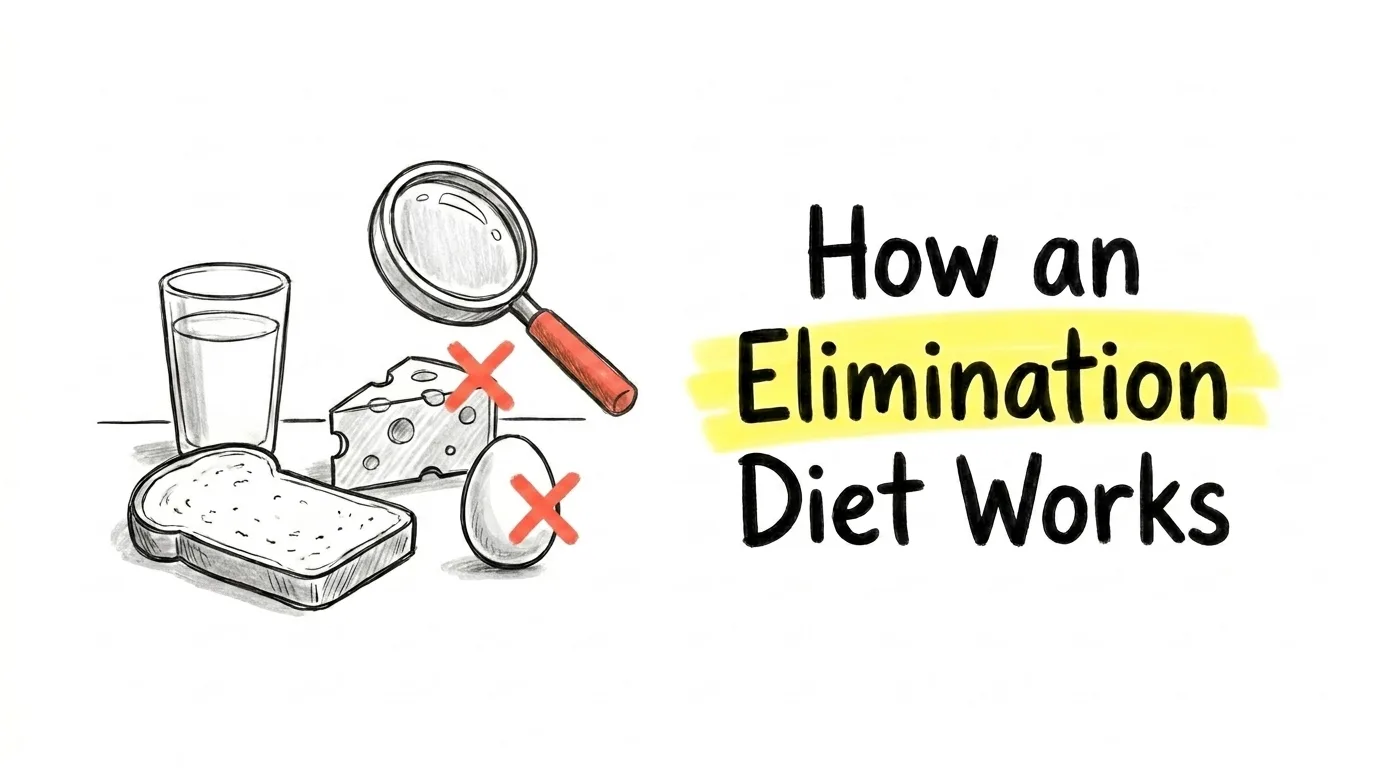
If a certain meal keeps leaving your stomach a mess, at some point you want to know exactly which food is doing it. An elimination diet is the structured way to find out. You pull the suspected foods for a set stretch of time, then add them back one at a time and watch how your body reacts. Cleveland Clinic calls it "the gold standard for figuring out which food[s] don't agree with you."
Be clear about one thing up front: this is a short-term test to find a trigger, not a way to eat less or eat "clean." It has a start and a finish, and a successful one ends with you eating more foods, not fewer.
What it actually is
An elimination diet has two phases, and both matter.
First, the elimination phase: you stop eating one or more suspected foods for a few weeks. The Academy of Nutrition and Dietetics describes the goal simply, "to see if by restricting these foods your symptoms go away." The usual suspects are the foods most likely to cause trouble, things like dairy and wheat.
Then the reintroduction phase, which is where the answer comes from. You add the foods back one at a time, a small amount to start, watching for symptoms before moving to the next one. Cutting a food and feeling better doesn't prove that food was the problem, because plenty of things can make you feel better over a few weeks. The real test is what happens when it goes back in. If your symptoms return with a specific food, you've found your trigger.
When it's worth doing (and when it isn't)
An elimination diet is for a real, repeating symptom that seems tied to eating: consistent bloating, gas, pain, or diarrhea that shows up after meals. It's a tool for pinning down a food intolerance.
It is not for weight loss, and it isn't a general "healthy eating" reset. Cutting foods when you don't have a specific symptom to chase doesn't make you healthier, it just makes your diet smaller. If you can't name the symptom you're trying to solve, you don't need this.
The FODMAP version
The most common structured elimination diet is the low-FODMAP diet, built at Monash University for people with IBS. FODMAPs are a group of carbs that "are not completely digested or absorbed in our intestines." In sensitive people, gut bacteria ferment them, which makes gas and pulls in water, so that "the extra gas and water cause the intestinal wall to stretch." That stretching is where the pain and bloating come from.
The low-FODMAP diet runs in the same two-part shape: a two-to-six-week elimination phase, a slow reintroduction to find which specific FODMAPs bother you, and then a personalized long-term diet that's as unrestricted as possible. Monash is clear that it's meant to be temporary, and Cleveland Clinic puts it plainly: "even if you feel great on the elimination phase, it's not meant to be permanent." Staying in the strict phase long-term can even "reduce levels of certain beneficial bacteria in the gut." (For more on FODMAPs and easing bloating, see How to Get Rid of Bloating.)
Do it with a professional, especially as a teenager
Every authority on elimination diets says the same thing: do it with guidance. Cleveland Clinic is direct, "the most important thing to know before starting an elimination diet is that you should only do it with the guidance of a medical professional." The reason is that cutting foods on your own can hide a real problem, since "you could be delaying treatment or masking symptoms by changing your diet," and it can leave gaps in your nutrition.
That's true for anyone, and it matters more while you're still growing. Children's Hospital Colorado is blunt: "cutting out a major food group can significantly impact a child's total nutrient intake and can impact growth," and these diets "are not safe for kids without guidance." A registered dietitian can run the process so you find your trigger without shorting yourself on things like calcium or iron.
One food you should not cut on your own: gluten
If you suspect gluten, don't quietly go gluten-free before seeing a doctor. Testing for celiac disease only works while you're still eating gluten. The Celiac Disease Foundation explains why: "diagnostic tests for celiac disease require that you be on a gluten-containing diet so that the test can detect gluten antibodies." Cut gluten first and the test can come back falsely normal, and you'd have to go back on gluten for weeks just to get a real answer. Get tested first.
Where this can go wrong
Restrictive diets and disordered eating are closely linked, and the link is stronger for teenagers. The National Eating Disorders Collaboration calls dieting "one of the strongest predictors for the development of an eating disorder," and notes that adolescents who diet are five times more likely to develop one than those who don't. A 2023 review in Nutrients found that "trials of exclusionary diets (e.g., gluten-free, dairy-free) to treat symptoms or improve disease control can act as a catalyst for more general restrictive eating," because for some people, "restriction begets restriction," and it gets hard to keep the cutting limited to the one food that started it.
There's a name for when healthy eating tips into obsession: orthorexia, "an unhealthy fixation on eating 'pure' foods." The warning signs, per the Academy of Nutrition and Dietetics, include "cutting out an increasing number of foods or food groups" and "showing high levels of distress when 'healthy' foods aren't available." Cleveland Clinic draws the line at "the ability (or inability) to practice moderation, and whether the drive to eat healthily creates distress."
So watch for the flip. An elimination diet is supposed to have an end date, and to widen what you can eat rather than keep shrinking it. If the list of foods you'll eat keeps getting shorter, if food starts causing real anxiety, or if the point quietly becomes eating less instead of solving a symptom, stop and talk to someone: a parent, a doctor, or a registered dietitian. If you need help, the National Alliance for Eating Disorders runs a free helpline staffed by licensed therapists at 1-866-662-1235.
When to skip the diet and see a doctor
Some symptoms aren't a job for a food experiment. See a doctor instead of running an elimination diet if you have belly pain that keeps getting worse or won't go away, you're losing weight without trying, there's blood in your stool (or it looks black and sticky), or you're vomiting. Those can point to something that needs a real diagnosis, and no amount of cutting foods replaces getting checked.
The bottom line
An elimination diet is a good tool for one specific job: finding the food behind a real, repeating symptom. It's short and structured, and the reintroduction phase is where the answer comes from. Do it with a professional, don't use it to eat less, test for celiac before you drop gluten, and if the restricting starts to feel bigger than the symptom you were solving, stop and get help. Used right, it ends with you eating more foods with confidence, not fewer.
Sources
- Cleveland Clinic, Why and How To Start an Elimination Diet
- Academy of Nutrition and Dietetics, What Is an Elimination Diet?
- Monash University, FODMAPs and Irritable Bowel Syndrome
- Monash University, The 3 phases of the low FODMAP diet
- Monash University, Low FODMAP diet FAQ
- Cleveland Clinic, Low-FODMAP Diet
- Celiac Disease Foundation, Why You Should Be Tested Before Going Gluten-Free
- National Eating Disorders Collaboration, Disordered Eating & Dieting
- Canadian Paediatric Society, Dieting in adolescence
- Kumar MM, Eating Disorders in Youth with Chronic Health Conditions, Nutrients (2023)
- Academy of Nutrition and Dietetics, Orthorexia: An Obsession with Eating Pure
- Cleveland Clinic, Orthorexia
- Children's Hospital Colorado, What You Need to Know About Elimination Diets for Kids
- NHS, Stomach ache
- National Alliance for Eating Disorders

.svg)
.webp)
.webp)



.webp)


.webp)
.webp)