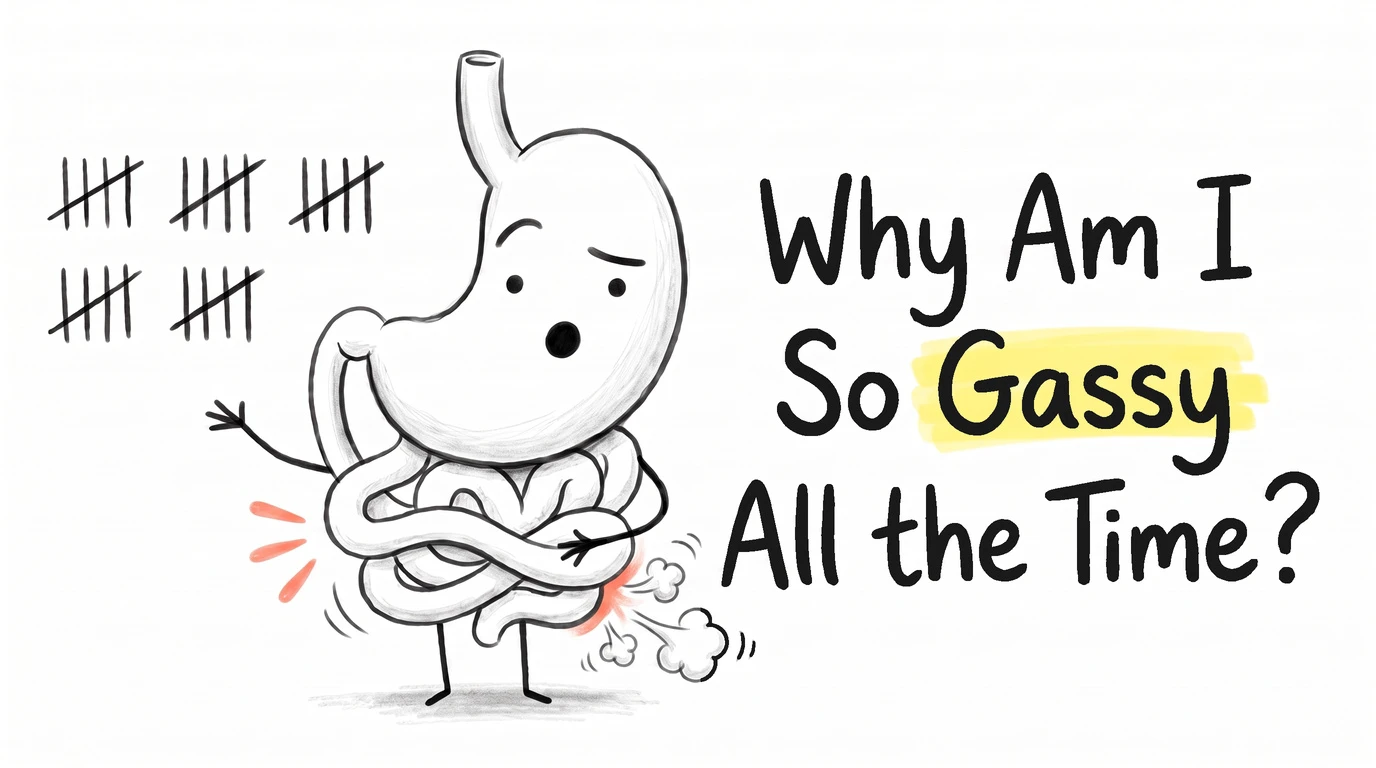
If you start typing "is it normal to fart" into Google, it finishes the question for you: "a lot," "everyday," "50 times a day," and "100 times a day." Almost always, the gas is normal. It comes from two places, the air you swallow and the bacteria in your large intestine, and most of what changes how much of it you have is what you eat and how you eat it.
How much gas is normal?
The NIDDK (the US government's institute for digestive diseases) says that people pass gas "an average of 8 to 14 times a day," and that "experts consider passing gas up to 25 times a day to be normal." Cleveland Clinic uses the same 25. The NHS (England's public health service) doesn't give a number at all: "What's normal is different for everyone."
The 25 is a rule of thumb. NIDDK's sources for it are a textbook chapter and a 2006 review article. The closest thing to a direct count is a 1996 study where 25 healthy adults recorded every time they passed gas for a week while eating their usual food. They averaged 10 a day, and the researchers put the upper limit of normal at 20. When they added 10 grams a day of lactulose (a sugar the body can't absorb, so all of it reaches the gut bacteria), the average jumped to 19. Age and gender made no difference, but "some subjects consistently passed gas more often than did others," which the authors put down partly to differences in how much gas each person's bacteria made from the same food. Twenty-five adults is a small study, and none of them were teenagers, so 20 is a rough line.
Burping has a bigger allowance. NIDDK says that people "typically belch up to 30 times a day."
By volume, a 1991 study in the journal Gut collected every bit of gas from 10 healthy adults over 24 hours (through a tube). The median was 705 milliliters, about two cans of soda's worth, and the range ran from 476 to 1,491. The gas kept coming during sleep, at around half the daytime rate, so if you've searched "is it normal to fart in your sleep," the answer is yes, just less often.
Where the gas comes from
Everyone swallows some air when they eat and drink, and NIDDK says that swallowed air "that doesn't leave your stomach when you belch may move into your intestines and pass through your anus." That's the first source. The second is your large intestine, where trillions of bacteria break down the carbohydrates (sugars, starches, and fiber) that your stomach and small intestine didn't fully digest, and make gas while they do it.
The bacteria are responsible for most of it. In the 1991 Gut study, putting the same volunteers on a liquid diet with no fiber for two days cut their daily gas from a median of 705 milliliters to 214, and "practically eradicated" the hydrogen, one of the gases bacteria make. The authors concluded that "fermentation gases make the highest contribution to normal flatus volume."
If the problem is feeling full and tight rather than passing gas, the bloating article covers that.
Why you burp
Every swallow of food or drink brings some air with it. Cleveland Clinic explains that the air stretches your stomach "until it can't hold any more," and then a muscle at the bottom of your esophagus (the tube from your throat to your stomach) relaxes and lets it out through your mouth. Swallowing more air means more burps, and Cleveland's list of what makes you swallow more includes eating or drinking too fast, talking while you eat, chewing gum, sucking on hard candy, fizzy drinks, and breathing through your mouth. It also lists "chronic postnasal drip or congestion," which is probably why "why do I burp so much when I have a cold" is one of Google's suggestions.
A supragastric belch (supragastric means above the stomach) works differently: air gets sucked into the esophagus and pushed right back out before it ever reaches the stomach. Two gastroenterologists who study belching describe people with the extreme version belching "up to 20 times per minute." Healthy people do it rarely. When the same group monitored 10 healthy volunteers for 24 hours, only 5 did it at all, and those 5 did it a median of twice.
In kids and teens, doctors call a habit of swallowing too much air aerophagia. Rome IV (the international standard for diagnosing gut disorders in kids and teens) says that "in older children, large amounts of air can be swallowed while chewing gum or drinking very quickly," and that "anxiety can be a cause for excessive air swallowing." In a large US survey that the Rome IV committee cites, parents' reports put it at 4.2% of children. The American Gastroenterological Association (the main group of gut doctors in the US) lists treatments for the supragastric kind that include diaphragmatic breathing (slow breathing from your belly) and speech therapy.
Why some days are worse
NIDDK lists these foods and drinks as ones that can lead to extra gas:
- fruits like apples, peaches, and pears, and fruit juices
- cruciferous vegetables (broccoli, cauliflower, kale, and their relatives)
- beans, peas, and lentils
- dairy, like milk, ice cream, and yogurt
- whole grains, like whole wheat
- drinks with high-fructose corn syrup, which NIDDK says includes "fruit juices, soft drinks, sports drinks, and energy drinks"
- sweeteners ending in "-ol," like sorbitol, xylitol, and erythritol, which show up in sugar-free gum and candy
Most of those contain carbs your small intestine doesn't absorb well, the group that a low-FODMAP diet is built around. If dairy is reliably the one that gets you, lactose may be why. And if you've just started eating a lot more fiber, you'll be gassier for a while, so go up slowly. MedlinePlus (the US National Library of Medicine's health site) notes that "insoluble fiber (such as bran) causes more gas than soluble fiber (such as psyllium)." The NHS also lists some medicines, including ibuprofen, that can cause "excessive or smelly wind" as a side effect.
Beans get easier
A nutrition researcher at Arizona State University and a colleague pooled three studies where adults ate half a cup of beans every day for 8 to 12 weeks. With pinto beans or baked beans, fewer than half said they were gassier in the first week, and "seventy percent or more of the participants who experienced flatulence felt that it dissipated by the second or third week." A few people (3 to 11%) reported more gas on the comparison diets too, where they ate no beans at all.
Beano, the enzyme you take with a meal to break down the sugars in beans, was tested in a small 1994 trial with 19 adults. It cut gas after a bean meal by a small amount, and the authors called it "somewhat beneficial." Among the 10 people who said beans usually gave them gas, it made no significant difference.
Why it smells
Almost all of the volume is hydrogen, carbon dioxide, nitrogen, and in some people methane, which a 1998 study called the "non-odoriferous components" of gas (the ones with no smell). The smell comes mainly from sulfur gases. In that study, researchers at the Minneapolis VA had two judges rate the smell of gas samples from 16 healthy adults, and how bad a sample smelled tracked with how much hydrogen sulfide was in it. The US Agency for Toxic Substances and Disease Registry describes hydrogen sulfide as a gas "that smells like rotten eggs," and says that bacteria in your digestive tract make it while digesting "food containing vegetable or animal proteins." Two of Google's completions for "why do my farts smell" are "like rotten eggs" and "like sulfur," and both describe hydrogen sulfide exactly. The study's authors add that sulfur gases are "the major, but not the only," source of the smell.
The NHS says that a pharmacist can point you to underwear and pads that absorb the smell. In a 2005 test of those products in six healthy volunteers, the only one that caught "virtually all" of the sulfur gas was underwear made from activated carbon fiber. Pads worn inside regular underwear caught 55 to 77%, and most seat cushions caught about 20%.
Feeling gassy vs having more gas
In a 1975 study published in the New England Journal of Medicine, researchers measured how much gas was sitting in the intestines of 12 people with long-term complaints about gas and 10 people without them. The amounts were about the same (176 milliliters in the complainers and 199 in the others), and so was the makeup of the gas. The differences showed up when researchers pumped gas in. The complainers who got pain felt it at amounts that the others handled fine, and the six with the worst pain moved the gas through their gut more slowly. The authors concluded that the complaints "may result from disordered intestinal motility in combination with an abnormal pain response to gut distention rather than from increased volumes of gas." It was a small study, done while fasting with gas pumped in through a tube, so it can't tell you about your own gut after lunch. It does suggest that someone who feels gassy all the time may have a gut that moves gas slowly or feels it more, rather than one that makes extra. NIDDK says that IBS and similar conditions can "affect how gas moves through your intestines."
If you search Reddit for "why am I so gassy," one of the results is a post in a SIBO forum titled "I found my cure." SIBO (small intestinal bacterial overgrowth) means too many bacteria in the small intestine. In 2024, five gastroenterologists wrote a review, endorsed by the European and American societies for gut-movement disorders, concluding that breath testing to diagnose SIBO in people with IBS "is inaccurate and should be abandoned as a diagnostic test for this purpose." They note that breath tests are now sold "direct to consumers," that one can cost "up to $300 US" and a course of antibiotics "over $1000.00 US," and that many people repeat both. NIDDK describes SIBO as "most often a complication of other health conditions."
Cleveland Clinic's belching page suggests taking a probiotic supplement to prevent burping. The American Gastroenterological Association's advice to doctors says that "probiotics should not be used to treat abdominal bloating and distention," and the same group doesn't recommend them for most other digestive problems either.
What helps
The NHS's list is mostly about swallowing less air and giving your bacteria less to work with at once:
- eating smaller meals more often
- chewing and drinking slowly, with your mouth closed
- exercising regularly
- not chewing gum
- drinking peppermint tea
MedlinePlus adds skipping fizzy drinks and taking a walk "10 to 15 minutes after eating." If one food keeps setting you off, write down what you eat and when the gas shows up. NIDDK says that a doctor may ask you for that exact diary, so starting one yourself gives you something to bring.
When to see a doctor
NIDDK says to talk with a doctor if your gas symptoms bother you, if they "change suddenly," or if they come with belly pain, constipation, diarrhea, or weight loss. The NHS adds blood in your poop, and farting that is "affecting your life" after self-help and pharmacy treatments haven't worked. The NHS also lists celiac disease, lactose intolerance, and IBS as health conditions that can cause extra gas.
Burping on its own isn't a typical heart attack sign, according to Cleveland Clinic, but chest pain that is "severe, crushing or radiating to other areas like your arm or jaw" along with burping means getting care right away.
Sources
- NIDDK, Symptoms & Causes of Gas in the Digestive Tract
- NIDDK, Eating, Diet, & Nutrition for Gas in the Digestive Tract
- NHS, Farting (flatulence)
- Cleveland Clinic, Flatulence (Farting)
- Cleveland Clinic, Belching
- MedlinePlus, Gas - flatulence
- Furne JK, Levitt MD, Factors influencing frequency of flatus emission by healthy subjects, Digestive Diseases and Sciences, 1996
- Tomlin J, Lowis C, Read NW, Investigation of normal flatus production in healthy volunteers, Gut, 1991
- Bredenoord AJ, Smout AJ, Physiologic and pathologic belching, Clinical Gastroenterology and Hepatology, 2007
- Hemmink GJ et al., Supragastric belching in patients with reflux symptoms, American Journal of Gastroenterology, 2009
- Hyams JS et al., Childhood Functional Gastrointestinal Disorders: Child/Adolescent (Rome IV), Gastroenterology, 2016
- Moshiree B, Drossman D, Shaukat A, AGA Clinical Practice Update on Evaluation and Management of Belching, Abdominal Bloating, and Distention, Gastroenterology, 2023
- Winham DM, Hutchins AM, Perceptions of flatulence from bean consumption among adults in 3 feeding studies, Nutrition Journal, 2011
- Ganiats TG et al., Does Beano prevent gas? A double-blind crossover study, Journal of Family Practice, 1994
- Suarez FL, Springfield J, Levitt MD, Identification of gases responsible for the odour of human flatus, Gut, 1998
- ATSDR, ToxFAQs for Hydrogen Sulfide
- Ohge H et al., Effectiveness of devices purported to reduce flatus odor, American Journal of Gastroenterology, 2005
- Lasser RB, Bond JH, Levitt MD, The role of intestinal gas in functional abdominal pain, New England Journal of Medicine, 1975
- Kashyap P et al., Critical appraisal of the SIBO hypothesis and breath testing, Neurogastroenterology & Motility, 2024


.svg)
.webp)
.webp)



.webp)


.webp)
.webp)