A doctor on TikTok, answering a commenter, writes that more than 40% of people "would have this bacteria at one point in our life (including me)," and that it "is ranked by WHO as a group 1 carcinogen." The post carries the hashtags #stomach and #cancer and has 6,777 likes. Both halves of what he wrote are accurate.
Then you go looking yourself. Type "does h pylori" into Google and the sixth suggestion finishes the question as "cause cancer." Type "can h pylori" and it lands second. Keep typing and the box offers "do i have stomach cancer quiz." On r/HPylori, a 19-year-old who had just tested positive wrote, "I keep seeing horror stories about cancers like in the throat stomach," and then described weeks of barely eating. On r/Gastritis, somebody asking about a teenager wanted "the lifetime risk in percentage of someone who is young suppose like less than 18 years old."
Nobody has measured that percentage for a teenager, because there is almost nothing to measure. What the cancer registries can tell you is who actually gets stomach cancer, and when.
What the Group 1 label covers
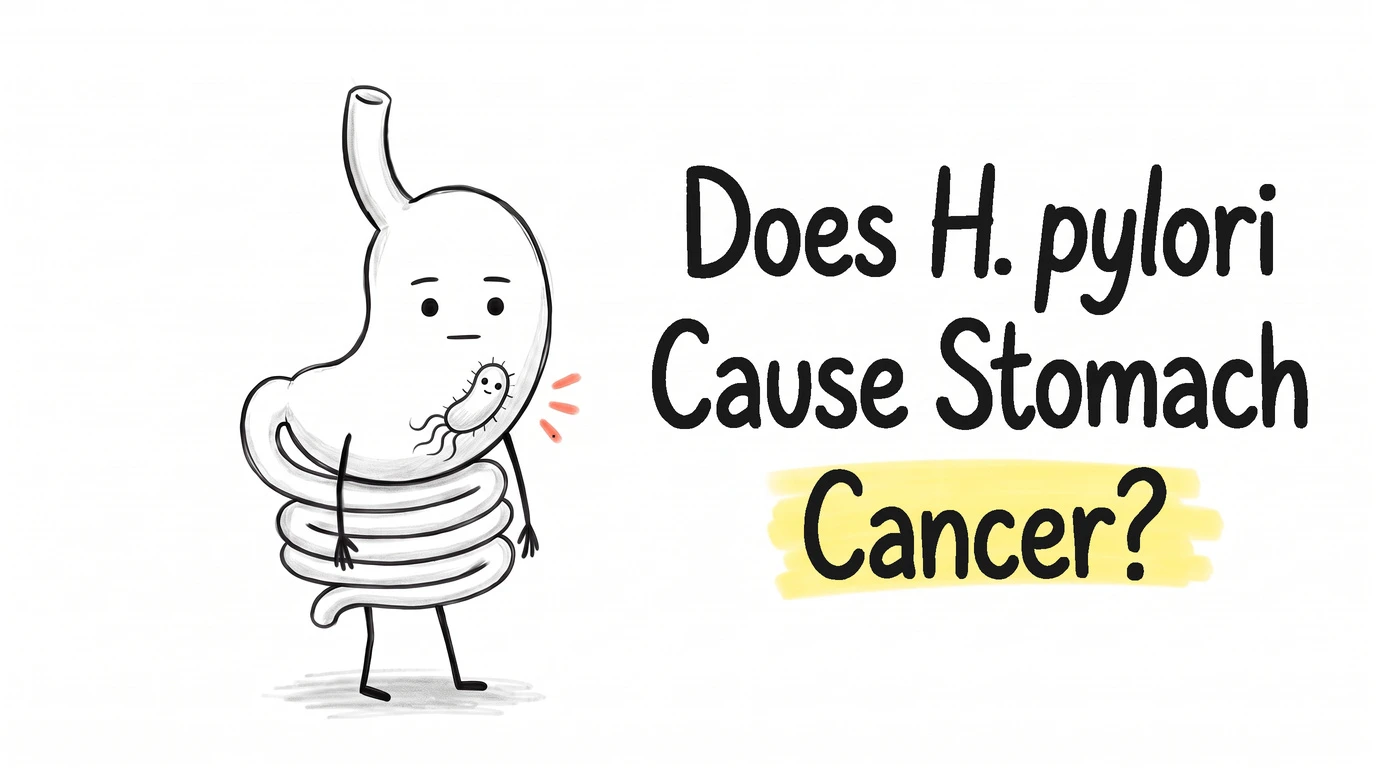
H. pylori is a spiral bacterium that lives in the lining of your stomach, and it is behind most stomach ulcers. IARC (the World Health Organization's cancer agency, which reviews the evidence and sorts things by how sure it is that they can cause cancer in people) looked at H. pylori and wrote that "there is sufficient evidence in humans for the carcinogenicity of chronic infection with Helicobacter pylori," and that chronic infection "causes non-cardia gastric carcinoma and low-grade B-cell MALT gastric lymphoma."
Group 1 is where IARC puts something once it is confident that the thing can cause cancer at all. The label reports how strong the evidence is. It says nothing about your own odds, and the category holds things whose actual risks are wildly far apart. The American College of Gastroenterology, the group of US gut doctors, puts the link plainly in its 2024 treatment guideline: H. pylori "is a prevalent, global infectious disease that causes dyspepsia, peptic ulcer disease, and gastric cancer."
H. pylori does cause stomach cancer. A frightened 19-year-old and a 68-year-old carrying the same bacterium are still nowhere near the same situation.
Who actually gets stomach cancer
SEER (the US government's cancer registry program) puts the rate of new stomach cancer cases at 7.5 per 100,000 people per year, and the median age at diagnosis at 68. The new cases break down by age like this:
| Age | Share of new cases |
|---|
| Under 20 | 0.1% |
| 20 to 34 | 1.7% |
| 35 to 44 | 5.0% |
| 45 to 54 | 11.0% |
| 55 to 64 | 22.1% |
| 65 to 74 | 29.5% |
| 75 to 84 | 21.7% |
| Over 84 | 9.0% |
SEER's summary line is that "stomach cancer is most frequently diagnosed among people aged 65-74." The American Cancer Society estimates about 31,510 new US cases and about 10,740 deaths in a year, and says that "about 6 of every 10 people diagnosed with stomach cancer each year are 65 or older." Across a whole lifetime it puts the risk at "about 1 in 104" for men and "about 1 in 153" for women.
Those percentages are shares of the case pile rather than rates for each age group, so they describe who fills the clinic rather than your personal odds. Even so, 0.1 percent of roughly 31,510 cases works out to something like thirty diagnoses a year in everyone under twenty in the country, and that is every cause of stomach cancer combined, not only the H. pylori kind.
The route from infection to cancer has steps, and most people never finish them
Stomach cancer does not arrive directly from an infection. It runs through a sequence: long-term inflammation of the stomach lining, then atrophic gastritis (the lining thinning and losing its working glands), then intestinal metaplasia (the lining being replaced by cells that belong in the intestine), then dysplasia (cells that look genuinely abnormal), and then cancer.
A 2024 review in Clinical Gastroenterology and Hepatology pooled 44 studies published between 1990 and 2023, covering 167,286 patients who already had one of those changes found on an endoscopy. Among the 57,403 people with atrophic gastritis, 1.1 percent developed stomach cancer over follow-up that averaged 6.8 years. Among the 94,359 with intestinal metaplasia, 1.3 percent did, over an average of 6.2 years. The authors also modeled ten-year probabilities, which came out at 2.07 percent for atrophic gastritis, 2.85 percent for intestinal metaplasia, and 9.6 percent for dysplasia. Those ten-year figures are projections built by assuming a steady rate over time, since most of the studies did not actually run for ten years.
The dysplasia figure reads the other way round too. Somebody whose biopsy already shows the last stage before cancer has, on that model, roughly a 90 percent chance of not developing cancer over the following decade. Everybody in that review had a diagnosed precancerous change in the first place, which most infected people never get, because most infected people never have an endoscopy and never needed one.
The American Cancer Society says the same thing in one sentence: "many people are infected with H pylori, and most people who carry this germ in their stomach never develop cancer." Cancer Research UK writes that H. pylori "causes a very small number of cancer cases in the UK" and that "in most people, a H. pylori infection will not cause cancer."
Does getting rid of it lower the risk?
Cochrane (an international group that pools the results of medical trials and is unusually careful about it) reviewed seven randomized trials covering 8,323 healthy, infected adults who had no symptoms. Stomach cancer showed up in 68 of the 4,206 people given treatment, which is 1.6 percent, against 125 of the 4,117 given a placebo or nothing, which is 3.0 percent. Deaths from stomach cancer followed the same direction, 1.1 percent against 1.9 percent. Deaths from any cause did not measurably change.
Six of those seven trials were run in Asian populations, in places where stomach cancer is far more common than it is in the US. The review's own conclusion says that eradication "reduces the incidence of gastric cancer and death from gastric cancer in healthy asymptomatic infected Asian individuals, but we cannot necessarily extrapolate this data to other populations." It goes further: "the only trial conducted in a non-Asian population failed to demonstrate any benefit of such an approach."
No trial measuring stomach cancer as an outcome has been run in a Western country, a low-incidence population, or anyone young. The trials that exist enrolled adults in their late thirties through their seventies. The longest of them, in a high-risk rural county in Shandong, China, followed people for 22 years and found fewer cancers and fewer deaths in the treated group, and its authors wrote in their own limitations that "extrapolation to a well nourished population or a population with low incidence of gastric cancer might be problematic."
The one situation where somebody young does get tested
Having a parent or sibling diagnosed with stomach cancer changes the math. In a trial at Korea's National Cancer Center, 1,838 infected first-degree relatives of stomach cancer patients were randomly given either eradication treatment or a placebo, then followed for a median of 9.2 years. Stomach cancer developed in 1.2 percent of the treatment group against 2.7 percent of the placebo group. Among the people whose infection was actually cleared, it was 0.8 percent, against 2.9 percent in those who stayed infected.
Treatment was not free in that trial. Side effects hit 53.0 percent of the treatment group against 19.1 percent on placebo, and the researchers calculated that about 66 people had to be treated to prevent one cancer over the study.
The joint European and North American pediatric guideline is the only one written about people your age, and it carves out this exact case: it suggests "that children with history of GC in a first-degree relative have a noninvasive test for H. pylori." That is a conditional recommendation resting on low to moderate evidence, and the trial behind it was run in adults.
Should you get tested otherwise?
Not on the strength of cancer risk. The same pediatric guideline notes that these complications "are rare in children" compared with adults, and its 2024 update added a new, strong recommendation: "we recommend against screening for H. pylori in children belonging to racial/ethnic groups at increased risk for GC that are living in North America/Europe." It also states that "no consensus statement to date has advocated for a population-based screening for H. pylori in asymptomatic adults or children," and that screening for H. pylori to prevent stomach cancer "does not meet the World Health Organization guidelines for screening programs," because there is no test that reliably sorts the infected people who will get cancer from the ones who won't.
In the US there is no recommendation at all. The US Preventive Services Task Force, which decides what gets screened for nationally, opened a draft research plan on H. pylori screening and then shelved it, writing that it "will not move directly into the final research plan stage and evidence review at this time." The page is filed under "Inactive."
Where adult guidelines do set an age for testing on cancer grounds, it starts at 45 or 50. Japan is the one country that screens some teenagers, through school health checkups at ages 13 and 14, which is tied to Japan's unusually high stomach cancer rates and to cutting transmission between family members rather than to any view that a healthy 13-year-old elsewhere should be checked. Even within Japan the professional bodies have not read this the same way, with a 2020 pediatric gastroenterology guideline recommending against test-and-treat in symptom-free children while a 2024 guideline from a Helicobacter-focused society backs adolescent screening.
The argument running the other way
Not everyone thinks clearing H. pylori out of every human stomach is straightforwardly good. Martin Blaser, a microbiologist who has spent decades on the question, argued in 1999 that the bacterium "has apparently colonized the human stomach since time immemorial and is superbly adapted for persistence," and pointed out that as rates of infection, ulcers, and stomach cancer have fallen in wealthy countries, reflux, Barrett's esophagus, and cancers of the esophagus and the top of the stomach have climbed. He proposed that some strains protect against those.
The randomized trials give that idea a partial test and do not find the trade. In the two Cochrane trials that tracked it, esophageal cancer turned up in 16 of 1,947 treated people and 13 of 1,941 untreated ones, close enough to call no difference. A 2018 review by Li and Perez-Perez in Frontiers in Microbiology describes Blaser's position as an open question in the field rather than settled either way.
There is also a mismatch nobody has fully explained. Parts of Africa and South Asia carry very high H. pylori infection rates alongside low stomach cancer rates, a pattern named the African enigma in 1992. Infection rates alone plainly do not set a population's cancer rate, which means that diet, strain differences, other infections, and genetics are all doing something the simple story leaves out.
Stomach cancer rates in people under 50 have been rising in some countries even as overall rates fall. The National Cancer Institute calls it "an unexplained increase in incidence of non-cardia gastric cancer" in young non-Hispanic White and Hispanic people and attributes it to nothing in particular. IARC, reporting increases in under-50s across 15 of 34 countries, adds that the numbers "require careful interpretation, because some of the observed increases may be due to the redistribution of unspecified tumours," meaning part of the rise may be a change in how tumors get coded. Under 50 is also not under 20.
What to actually do with this
If you have tested positive, take the full course you were prescribed and get the follow-up test that confirms it worked. That is the action the cancer link justifies, and it is the reason the American College of Gastroenterology treats testing and treating as one decision rather than two.
If a parent or sibling has had stomach cancer, say so to your doctor, because that is the one piece of family history that changes what is recommended for someone young.
A stomach ache that sent you into the search results is a different situation again. The cancer sits decades away from you, and the route to it runs through steps that most people with a diagnosed precancerous change never finish. The infection itself is curable. Pain that keeps going still deserves a doctor, for the ordinary reasons rather than this one.
Sources
- IARC Monographs on the Evaluation of Carcinogenic Risks to Humans, Volume 100B: Helicobacter pylori, World Health Organization International Agency for Research on Cancer, 2012
- Chey WD, Howden CW, Moss SF, Morgan DR, Greer KB, Grover S, Shah SC, ACG Clinical Guideline: Treatment of Helicobacter pylori Infection, American Journal of Gastroenterology, 2024
- National Cancer Institute SEER Program, Cancer Stat Facts: Stomach Cancer
- American Cancer Society, Key Statistics About Stomach Cancer
- American Cancer Society, Stomach Cancer Risk Factors
- Cancer Research UK, Does H. pylori cause cancer?
- Hahn A et al., Global Progression Rates of Precursor Lesions for Gastric Cancer: A Systematic Review and Meta-Analysis, Clinical Gastroenterology and Hepatology, 2024
- Ford AC, Yuan Y, Forman D, Hunt R, Moayyedi P, Helicobacter pylori eradication for the prevention of gastric neoplasia, Cochrane Database of Systematic Reviews, 2020
- Li WQ et al., Effects of Helicobacter pylori treatment and vitamin and garlic supplementation on gastric cancer incidence and mortality: follow-up of a randomized intervention trial, BMJ, 2019
- Choi IJ, Kim CG, Lee JY, Kim YI, Kook MC, Park B, Joo J, Family History of Gastric Cancer and Helicobacter pylori Treatment, New England Journal of Medicine, 2020
- Homan M et al., Updated joint ESPGHAN/NASPGHAN guidelines for management of Helicobacter pylori infection in children and adolescents, Journal of Pediatric Gastroenterology and Nutrition, 2024
- US Preventive Services Task Force, Helicobacter Pylori Infection: Screening (inactive)
- National Cancer Institute, Helicobacter pylori (H. pylori) and Cancer
- Morgan E, Clifford G, Park JY, The global epidemiology of gastric cancer and Helicobacter pylori: current and future perspectives for prevention, IARC Handbooks of Cancer Prevention, 2024
- Blaser MJ, Hypothesis: The Changing Relationships of Helicobacter pylori and Humans: Implications for Health and Disease, Journal of Infectious Diseases, 1999
- Li J, Perez-Perez GI, Helicobacter pylori the Latent Human Pathogen or an Ancestral Commensal Organism, Frontiers in Microbiology, 2018
- Ghoshal UC, Chaturvedi R, Correa P, An overview of the epidemiology of Helicobacter pylori infection, Indian Journal of Gastroenterology, 2010
- School-Based Helicobacter pylori Screening for Adolescents in Japan: Current Status, Challenges, and Implications, 2026


.svg)
.webp)
.webp)



.webp)


.webp)
.webp)