Bacteria have a bad reputation. You wash them off your hands, cook them out of your food, and scrub them off your dishes. Everything about how you treat them says they’re the enemy. So it’s strange that over 39 trillion of them live in your gut, and they’re actually keeping you alive.
If the thought of 39 trillion living things inside you makes your skin crawl a little, that's a normal reaction. But these microbes are supposed to be there, and wiping them all out wouldn't make you cleaner. It would actually make you sick.
They're easy to overlook for a reason. A microbe is a living thing too small to see without a microscope, and each one is far smaller than a single one of your cells. All 39 trillion of them together weigh only a couple of pounds. You're carrying an entire community in your gut, and it weighs about as much as a loaf of bread.
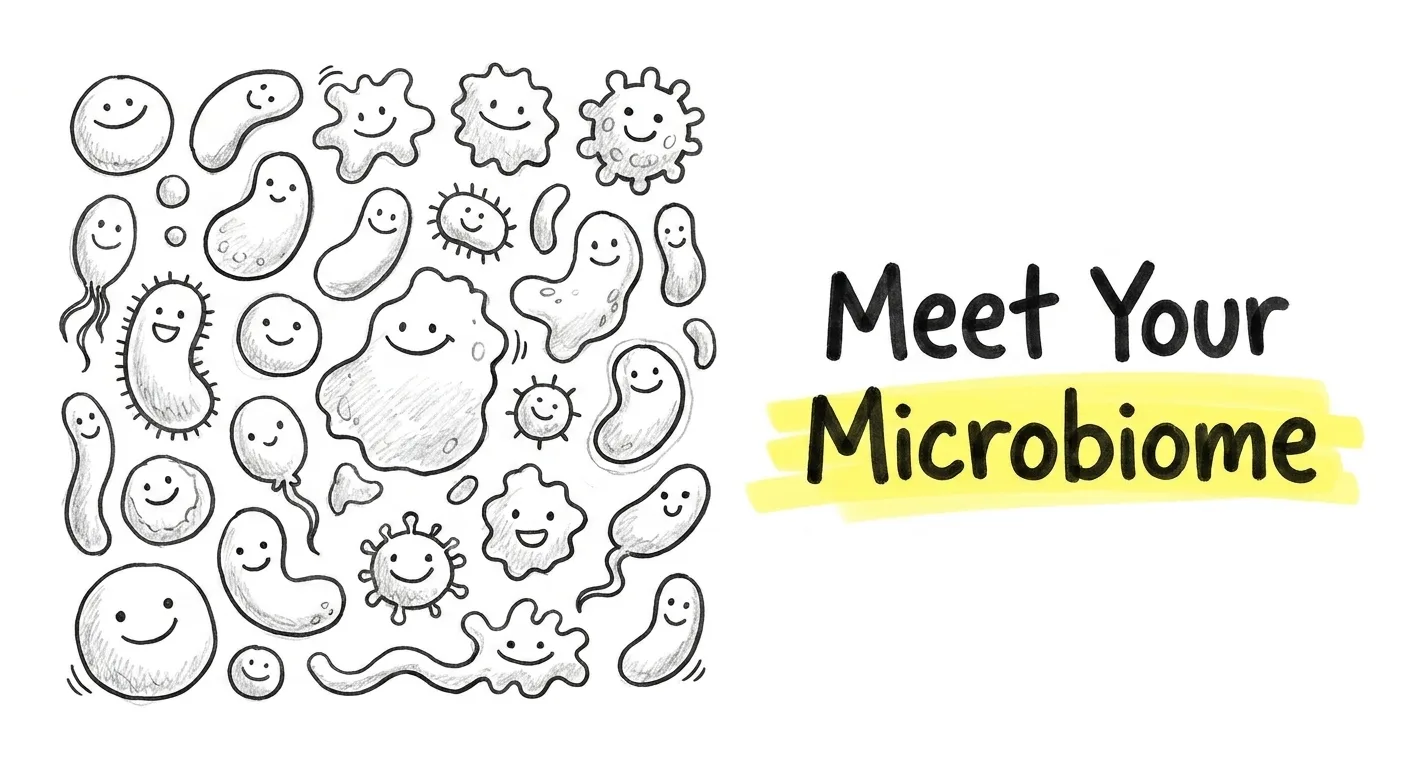
Most of them are bacteria, although there are fungi and viruses down there too. Together they're called your gut microbiome, and your gut alone holds hundreds or even thousands of different species. Scientists spent decades treating this community as background noise. In the last twenty years or so, they've started to figure out how much of your daily health it actually has a hand in, and the answer keeps turning out to be more than anyone expected.
What your microbes do for you
A community that big doesn't live in you for free. Your microbes earn their keep, and in more ways than you'd guess.
First, they ferment fiber. Fiber is the part of plants your body can't break down on its own, the tough material in vegetables, beans, fruit, and whole grains. Your own digestive system has no tool for it, so it reaches your large intestine basically untouched. That's where your microbes come in. They ferment it, which just means they break the fiber apart for energy. In doing so, they release compounds called short-chain fatty acids that feed the cells of your gut wall and help keep it healthy.
That fermenting comes with a side effect you've definitely noticed: gas. When your microbes ferment certain fibers, they produce gas as a byproduct, and it has to go somewhere. It collects in your intestines until it leaves in the two ways you’d expect, and when a lot builds up at once, you feel bloated, that tight, too-full feeling in your belly. Just remember, feeling gassy after a high-fiber meal is normal—it means your microbes are eating well.
They also build vitamins you need, including vitamin K and several of the B vitamins, which get absorbed right there in your gut.
Then there's what they do in your immune system, the network of cells that defends your body against germs and other threats. A large share of it sits in and around your gut, and your microbes help train it, teaching it which things are harmless and which are worth attacking. This training seems to matter most when you're young. Children who grow up with less exposure to a range of microbes tend to have more allergies and asthma later, although scientists are still figuring out exactly how much of that the microbiome explains and how much comes down to other factors in a child’s upbringing.
Finally, your microbes guard their own turf, which protects you in the process. By taking up the space and eating the food along your gut wall, they make it harder for harmful bacteria to move in and take over when you swallow something you shouldn't have. A well-populated gut is a hard place to invade, which is why wiping out your gut can leave you more open to getting sick.
Why variety matters
Your microbiome is unlike anyone else's, and the amount of variety inside it matters. People whose guts hold a wide range of different species tend to be healthier, on average, than people whose guts are dominated by just a few.
Researchers keep finding the same link: people with a varied microbiome tend to be healthier. What nobody can say yet is why. Maybe a varied microbiome protects your health. Maybe being healthy is just what lets a varied microbiome grow. Until we know for sure, you should be careful: any guru or product promising to “boost your gut diversity” and fix your health is promising something the science simply can’t back up yet.
What does seem clear is that variety tends to drop when a gut is fed the same narrow diet day after day, especially one low in fiber and high in heavily processed food. The microbes that depend on the fibrous plants you stop eating slowly starve out, and you’re left with a less varied gut.
What helps vs. hurts your gut
Here's the part you actually have control over. Your microbiome changes based on how you treat it, and the biggest factor is what you eat.
What helps:
- Eat a wide range of plants. The single best thing you can do, and it beats anything you can buy. Different microbes feed on different kinds of fiber, so the more types of plants you eat, the more types of microbes you support. Variety matters more than amount.
- Feed the microbes you already have before trying to add new ones. You'll see two words on labels, prebiotics and probiotics, and they're easy to mix up. Prebiotics are food for your existing microbes, which mostly means fiber. Probiotics are live microbes themselves, the kind in yogurt, kefir, kimchi, and sauerkraut. Both can help, but for most people, feeding the microbes already living in you does more than importing new ones.
Quick word on the supplements you’ll see everywhere: probiotic drinks and supplements promise to fix or reset our gut, but the evidence that they do anything is much thinner than the packaging suggests, and many of the microbes in them pass through without ever settling in. A daily pill to "boost your gut" is mostly a marketing promise. Real food does more than a supplement for most people.
What hurts:
- Antibiotics you don't actually need. Antibiotics kill bacteria, and they can't tell your helpful microbes from the ones making you sick, so a single round clears out large parts of your microbiome along with the infection. Take them when a doctor prescribes them, since an untreated bacterial infection is far more dangerous than a temporarily thinned-out gut, which usually rebuilds within weeks to months. Just don't push for them when you don't need them. They do nothing against viruses, so taking them for a cold or the flu wipes out your microbes for nothing.
- A long stretch of low-fiber, processed eating. You don't have to eat perfectly, but months of mostly processed food with little plant variety slowly narrows your microbiome, starving the microbes that live on fiber. The fix is the same as the first thing on the helps list: more kinds of plants.
You have more say than you think
You'll never see your microbiome, and there’s no way to check on it day-to-day. But it's there every time you eat, breaking down what you can't, training your immune system, and helping run a body you think of as entirely your own.
The good news is how much of it is in your hands. The microbes you carry depend heavily on what you feed them, which means every meal you eat is also feeding 39 trillion others. Think about them every time you take a bite!

.svg)
.webp)
.webp)



.webp)


.webp)
.webp)