If you type "what happens if a celiac" into Google, all ten of the suggestions it offers are about eating gluten anyway: "accidentally eats gluten," "eats a small amount of gluten," "eats gluten once in awhile," "gets glutened." People who already know what celiac disease is want to know how much a mistake costs.
The answer turns out to depend on how much gluten, how often, and whether anybody is checking your gut afterward, which for most people with celiac is less often than it should be.
Your immune system attacks your own intestine
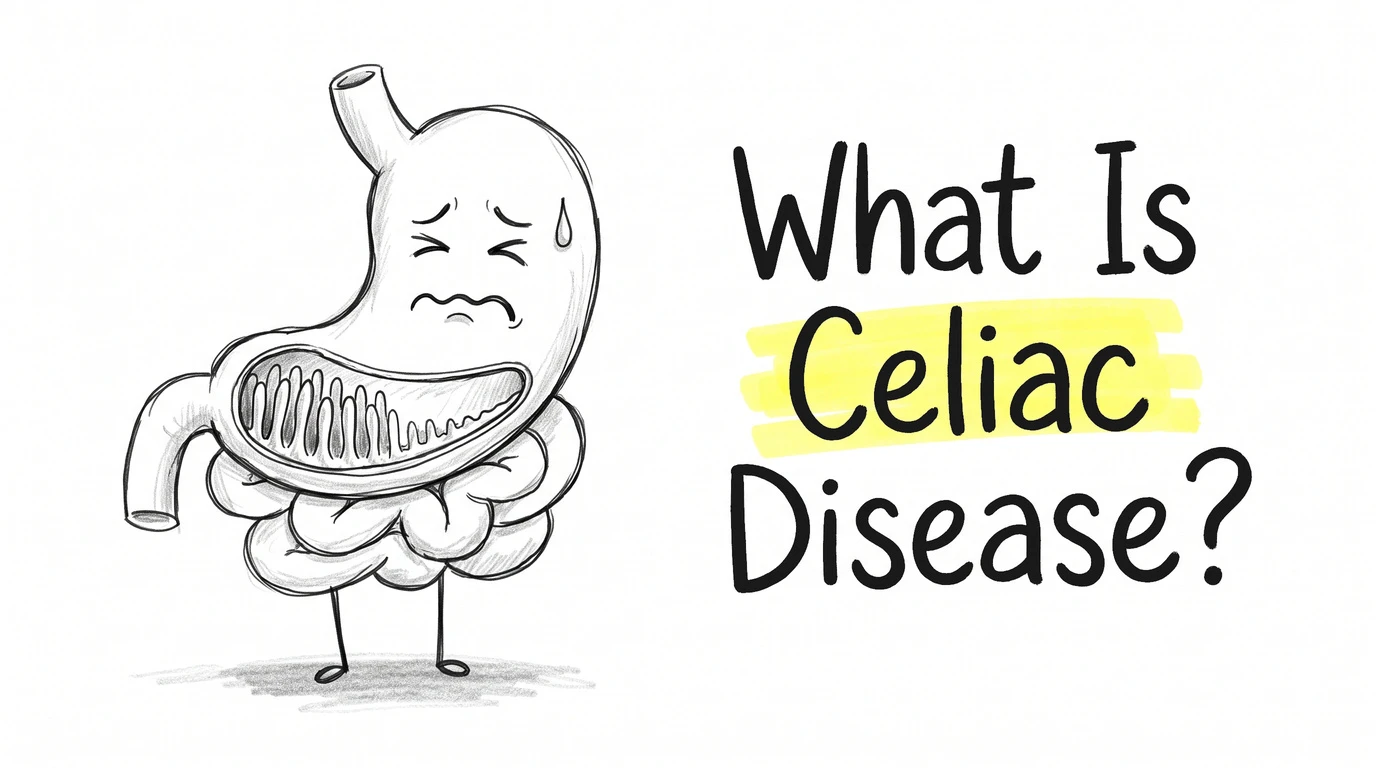
Celiac disease is autoimmune, which means that the immune system goes after the body it's supposed to protect. The Celiac Disease Foundation, the biggest US patient organization for the condition, describes what happens when someone with celiac eats gluten (a protein in wheat, barley, and rye): "their body mounts an immune response that attacks the small intestine."
The target is the villi, "small fingerlike projections that line the small intestine," which pull nutrients out of your food as it passes (there's more on how they work in What's Wrong With My Gut?). Boston Children's Hospital describes where the damage ends up: the villi break down, "leaving a smooth lining that can no longer absorb nutrients." Because the lining stops absorbing, celiac can show up as anemia, constant tiredness, or slow growth with no stomach complaint at all, in someone who eats plenty and still takes in too little of it.
People call it a gluten allergy all the time, and it isn't one. NIDDK (the US government's institute for digestive diseases) says that a wheat allergy and celiac both involve the immune system reacting to wheat, but "wheat allergies also do not cause long-term damage to the small intestine." Allergies can also fade as you grow up, and celiac doesn't. Boston Children's again: "Children may outgrow certain food allergies beginning in infancy, while celiac disease is a life-long condition."
Who gets it
You need certain genes to get celiac, but most people who carry them never develop it (the numbers are in Is It Gluten, or Is It Something Else?). Family history is the one risk factor you can look up. The Celiac Disease Foundation puts the risk at "1 in 10" if a parent, sibling, or child has it. The American College of Gastroenterology (ACG, the main professional group for US gut doctors) cites a wider range for relatives, from 5% in one large US study to as high as 20% for siblings in community-based studies, and tells newly diagnosed patients to let their family know so that relatives can get tested.
A pooled analysis of 96 studies, covering more than a quarter of a million people worldwide, found celiac confirmed by biopsy in 0.7% of them. It was more common in girls and women than in boys and men (0.6% vs 0.4%), and more common in children than in adults (0.9% vs 0.5%). It's also getting more common. A review of 50 studies from Canadian researchers found new diagnoses rising by 7.5% a year over the past several decades, although nearly all of that data comes from Western countries.
Most people who have it haven't been told. The Celiac Disease Foundation estimates that "only about 30% are properly diagnosed."
"Can you get celiac later in life" is another of Google's top suggestions. Diagnosis certainly happens later: in a Mayo Clinic study of 241 adults with celiac, the middle age at diagnosis was 47. The number tells you when people found out, which isn't necessarily when the disease started.
How it gets diagnosed
The standard route is a blood test for the antibodies your immune system makes when it's attacking your gut, and then a biopsy, where a doctor passes a camera down your throat and takes a few tiny samples of the small intestine. The full process, and why you have to keep eating gluten until it's finished, is covered in Is It Gluten, or Is It Something Else?.
For kids, the biopsy is sometimes skippable. The ACG suggests that children can be diagnosed on blood work alone when the main antibody test (tTG-IgA) comes back at more than 10 times the upper limit of normal and a second antibody test, on a separate blood sample, is also positive. For adults it's more cautious and accepts that route only "as a diagnosis of likely CD" for people who can't or won't have the camera test, because in an international study of adults, a result that high was right 95% of the time. For a diet you'll follow for the rest of your life, the guideline says that "may be unacceptably low." The recommendation is written for children, so if you're 16 or 17, ask your doctor which route applies to you.
The only treatment is what you eat
The Celiac Disease Foundation: "Currently, the only treatment for celiac disease is lifelong adherence to a strict gluten-free diet." The ACG guideline notes that "there are no prescription medications to treat the condition."
Drugs are being tested, and the furthest-along one failed. Larazotide reached the last stage of human trials before its developer, 9 Meters Biopharma, stopped the trial halfway through enrollment, saying that the number of extra patients needed to show a difference from placebo was "too large to support trial continuation."
Meanwhile, pills that claim to break down gluten in your stomach (GliadinX, Gluten Cutter, etc.) are sold as backup for accidental exposure. The National Celiac Association, a US patient group, says there's "no good evidence" that the enzymes currently on the market "can protect people with celiac disease from even small amounts of gluten."
One study went looking for people whose celiac had gone away. It followed 61 people who had been diagnosed as children, had gone back to eating gluten, and had no symptoms. On biopsy, 48 of them still had damaged villi. Thirteen had none, and two of those thirteen relapsed later on. The authors concluded that this kind of symptom-free stretch "can be transient and thus a regular follow-up is mandatory." Everyone in the study had been symptom-free, so 48 of the 61 felt fine while their intestine was still being damaged.
How much gluten is too much
An Italian trial measured it. Forty-nine adults whose celiac was under control on a gluten-free diet were assigned to take a capsule every day for 90 days, containing either no gluten, 10 milligrams, or 50 milligrams (a twentieth of a gram). In the 50 mg group, the villi measurably shrank. The 10 mg group was harder to read, and the researchers called that dose a "gray" area, partly because people varied so much: "Some CD patients showed a clear-cut worsening of the small-intestinal architecture after ingesting only 10 mg gluten/d, whereas others had an apparent improvement" on 50. Their conclusion was that gluten from contamination "should be kept lower than 50 mg/d."
The US gluten-free label is built on the same idea of a trace amount most people can handle. A packaged food labeled gluten-free has to contain less than 20 parts per million of gluten, and the FDA explains that "most individuals with celiac disease can tolerate variable trace amounts" below that level. The rule covers packaged food, though. The FDA says it "applies to packaged foods," and only recommends that restaurants making a gluten-free claim follow the same definition.
Until recently, nobody had measured what a kiss does. Anne Lee, a nutrition researcher at Columbia University who ran the first study, said that "no one really looked at what happens when you kiss afterwards." Her team had 10 couples, each with one partner who has celiac, test kissing: the partner without celiac ate 10 saltine crackers and then the couple kissed for 10 seconds. Across the 20 kisses tested, only 2 left more than 20 parts per million of gluten in the saliva of the partner with celiac, and both came from the round without water. When the partner who ate the crackers drank 4 ounces of water first, "none of the saliva samples tested >20 ppm." Lee's advice to patients: "You don't have to go to extreme measures." Ten couples and one kind of cracker is a small study, so treat it as a first answer rather than a final one.
Feeling better doesn't mean you've healed
The NHS (the UK's public health service) says that symptoms "should improve considerably within weeks" of going gluten-free, but "it may take up to a few years for your digestive system to heal completely." The Mayo Clinic study measured how long. Of the 241 adults, 34% had healed villi two years after diagnosis and 66% after five. Most of them (82%) felt at least somewhat better on the diet, but feeling better "was not a reliable marker" of whether the gut had healed. Kids do better. The same paper cites earlier work finding that "up to 95%" of children diagnosed with celiac may heal completely within two years.
A study of 76 newly diagnosed adults at several hospitals in Spain checked more closely. The patients met with the research team every six months for two years to have their diet checked. At the end, biopsies found damaged villi in 53% of them, "whereas 72.5% were asymptomatic and 75% had negative serology" (a normal antibody blood test). Their stool samples explain part of it: 69% of patients had gluten fragments in at least one sample, even while they were trying hard to avoid it.
If you have celiac and eat gluten once in awhile, you may not feel a thing, and your blood test may come back normal, while your villi keep getting damaged.
Cancer shows up in the autocomplete as well. Beyond Celiac, a US research and advocacy group, says that "developing cancer due to celiac disease is quite rare. The vast majority of those with celiac disease will never develop these related cancers." The risk is lower in people whose intestines have healed. The rare form that doesn't respond to the diet at all, called refractory celiac disease, makes up "<1% of patients" according to the ACG.
After the diagnosis
"Most adult patients are not followed," according to the American Gastroenterological Association (AGA, the other big group of US gut doctors), which cites a Minnesota study where only 35% of patients were still in follow-up four years after diagnosis. The guidelines ask for a handful of things:
A dietitian, early
The ACG: "A visit with a dietitian after diagnosis is mandatory." Gluten turns up in foods that don't look anything like bread, and a dietitian who knows celiac is how you learn to read a label without guessing.
Blood tests on a schedule
The AGA advises antibody tests "6 and 12 months after diagnosis, and yearly thereafter." A positive result later on usually means that gluten is still getting in somewhere.
A pneumonia vaccine
The ACG suggests that people with celiac get the pneumococcal vaccine, because the spleen (an organ that helps clear certain bacteria out of your blood) works less well than it should in "approximately one-third" of people with celiac.
Oats, if they're labeled gluten-free
The ACG makes this a strong recommendation: "We recommend consumption of gluten-free oats." Oats don't contain gluten, but ordinary oats are often contaminated with wheat, barley, or rye during growing and processing, which is why the NHS says that many people with celiac avoid them. Stick to oats labeled gluten-free.
Gluten-testing gadgets, probably not
There are pocket devices that test a bite of your food for gluten. The ACG suggests against using them routinely, partly because they may not be able to tell a trivial amount of gluten from one that matters. The one study that measured whether they help, a 30-person pilot with no comparison group, found that adults felt better about living with celiac after three months with one, "but not teenagers."
The AGA puts the teenage problem plainly: "teenagers are less satisfied with the impact of CD on their lives and even less adherent to a GFD." A review of 49 studies covering 7,850 children found that adolescents were at risk of slipping, and that kids whose parents knew more about celiac stuck to the diet better, which is a good reason to make sure your family knows what the diet involves.
School, college, and the dining hall
"Is celiac a disability" shows up twice in the autocomplete, and the US Department of Justice has answered it once for a college. Lesley University in Massachusetts reached an agreement with the Justice Department under the Americans with Disabilities Act (the federal law against disability discrimination). The Justice Department's announcement of the settlement states that "food allergies may constitute a disability under the ADA" and names celiac specifically. Lesley agreed to, among other things, "provide a dedicated space in its main dining hall to store and prepare gluten-free and allergen-free foods and to avoid cross-contamination," and to pay $50,000 to students with celiac disease or food allergies who had been affected.
If you're heading to a college with a required meal plan, contact the dining office and the disability services office before you arrive, and ask what they can do for a student with celiac.
Sources
- Celiac Disease Foundation, What is Celiac Disease?
- NIDDK, Symptoms & Causes of Celiac Disease (last reviewed October 2020)
- Boston Children's Hospital, Celiac Disease
- NIDDK, Definition & Facts for Celiac Disease (last reviewed October 2020)
- Rubio-Tapia A, Hill ID, Semrad C, Kelly CP, Greer KB, Limketkai BN, Lebwohl B, American College of Gastroenterology Guidelines Update: Diagnosis and Management of Celiac Disease, Am J Gastroenterol 2023;118(1):59-76
- Singh P et al., Global Prevalence of Celiac Disease: Systematic Review and Meta-analysis, Clin Gastroenterol Hepatol 2018;16:823-836
- King JA et al., Incidence of Celiac Disease Is Increasing Over Time: A Systematic Review and Meta-analysis, Am J Gastroenterol 2020;115(4):507-525
- Rubio-Tapia A, Rahim MW, See JA, Lahr BD, Wu TT, Murray JA, Mucosal Recovery and Mortality in Adults With Celiac Disease After Treatment With a Gluten-Free Diet, Am J Gastroenterol 2010;105(6):1412-1420
- 9 Meters Biopharma, press release on the larazotide Phase 3 interim analysis, SEC Form 8-K exhibit, June 2022
- National Celiac Association, What is GliadinX product (digestive enzyme supplement)?
- Matysiak-Budnik T et al., Long-term follow-up of 61 coeliac patients diagnosed in childhood: evolution toward latency is possible on a normal diet, Gut 2007;56(10):1379-86
- Catassi C et al., A prospective, double-blind, placebo-controlled trial to establish a safe gluten threshold for patients with celiac disease, Am J Clin Nutr 2007;85:160-6
- FDA, Questions and Answers on the Gluten-Free Food Labeling Final Rule (last updated 06/30/2022)
- Lee AR, Chen Z, Jossen J, et al., A Prospective Study of Gluten Transfer Through Kissing in Celiac-Discordant Couples, Gastroenterology 2026;170(7):1600-1605
- Digestive Disease Week, To Kiss Or Not To Kiss: Can Gluten Pass Through A Smooch?
- NHS, Coeliac disease: Treatment (last reviewed 31 March 2023)
- Fernández-Bañares F et al., Persistent Villous Atrophy in De Novo Adult Patients With Celiac Disease and Strict Control of Gluten-Free Diet Adherence: A Multicenter Prospective Study (CADER Study), Am J Gastroenterol 2021;116(5):1036-1043
- Beyond Celiac, Celiac Disease and Cancer
- Husby S, Murray JA, Katzka DA, AGA Clinical Practice Update on Diagnosis and Monitoring of Celiac Disease, Gastroenterology 2019;156(4):885-889
- Myléus A, Reilly NR, Green PHR, Rate, Risk Factors, and Outcomes of Nonadherence in Pediatric Patients With Celiac Disease: A Systematic Review, Clin Gastroenterol Hepatol 2020;18(3):562-573
- US Department of Justice, Justice Department and Lesley University Sign Agreement to Ensure Meal Plan Is Inclusive of Students with Celiac Disease and Food Allergies


.svg)
.webp)
.webp)



.webp)


.webp)
.webp)