If you type "does ibs go away" into Google, the first three suggestions are "on its own," "with age," and "and come back." If you search r/ibs for "diagnosed," you get posts titled "Got diagnosed this morning :(" and "Just diagnosed - not convinced."
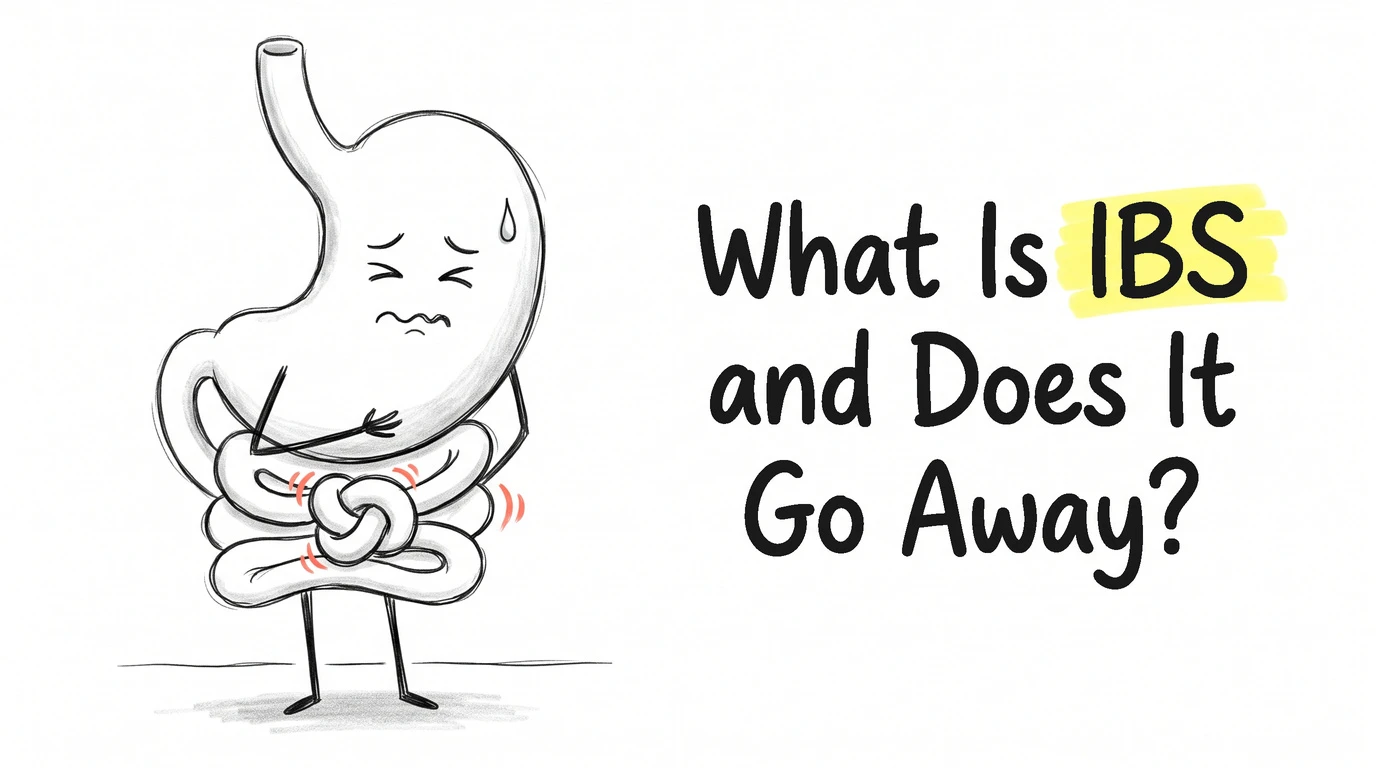
IBS (irritable bowel syndrome) is common, it doesn't damage your gut, and it usually gets better with the right mix of treatment. It also tends to come and go, and for a lot of people it doesn't disappear for good.
What's actually going on in your gut
NIDDK (the US government's institute for digestive diseases) describes IBS as "a group of symptoms that occur together, including repeated pain in your abdomen and changes in your bowel movements," which you have "without any visible signs of damage or disease in your digestive tract." Doctors now call it a disorder of gut-brain interaction, meaning that it's "related to problems with how your brain and your gut work together."
Cleveland Clinic's IBS page says that "communication challenges between your brain and gut" cause two things you can feel. The first is how the gut moves: the colon muscle "tends to contract more in people with IBS," and those contractions are what cause the cramping. The second is how the gut feels: people with IBS can have "extra-sensitive nerves" in the gut and "tend to have a lower pain tolerance," so things like gas or a full meal can hurt when they wouldn't for someone else.
The oversensitive nerves can be measured. In a 2007 study, researchers inflated a small balloon in the rectum of 109 adults with IBS to find the point where it became uncomfortable and then painful, and compared them with 29 people without IBS. About 61% of the IBS group had altered sensation, and they more often reported moderate or severe pain and bloating than the rest of the IBS group. The researchers concluded that it's "not just a reflection of the psychological state of the patient." The other 39% had normal sensation, so oversensitivity is common in IBS without being the whole story.
For how this differs from inflammatory bowel disease, where the immune system does damage the gut, see IBS vs IBD.
What it feels like
The NHS lists four main symptoms: "stomach pain or cramps," bloating, diarrhea, and constipation. The pain is usually "worse after eating and better after doing a poo." Bloating means "your tummy may feel uncomfortably full and swollen." With diarrhea you can "need to poo suddenly," and with constipation you can "feel like you cannot empty your bowels fully."
The Crohn's & Colitis Foundation lists "constipation alternating with diarrhea" as an IBS symptom, and NIDDK notes that "many people with IBS have normal bowel movements on some days and abnormal bowel movements on other days." Doctors sort IBS into types by which pattern you mostly have: IBS with constipation (IBS-C), IBS with diarrhea (IBS-D), and IBS with mixed bowel habits (IBS-M).
The less obvious ones
The NHS also lists "farting," "pooing mucus," "tiredness and a lack of energy," nausea, "backache," "pelvic pain," bladder trouble like "needing to pee often," and "not always being able to control when you poo." Some of them are hard to bring up with anyone, so it helps to know that they're on the NHS's list.
None of it is constant. In the NHS's words, "there may be days when your symptoms are better and days when they're worse."
The same symptoms can come from other conditions, including celiac disease and IBD. The NHS says that doctors may run tests "to rule out other possible causes of your symptoms," and a list like this one can't tell you on its own that you have IBS. Bleeding, weight loss you can't explain, and fever point away from IBS altogether.
Why you have it
Nobody knows exactly. The NHS (England's national health service) says "the exact cause is unknown" and that IBS has been linked to "food passing through your gut too quickly or too slowly, gastroenteritis, oversensitivity in your gut, stress and a family history of IBS."
A few of the possible causes have been studied closely.
- A 2017 review of 45 studies found that 10.1% of people who'd had a gut infection had IBS a year later. (More on that in food poisoning vs a stomach bug.)
- A study of about 6,000 pairs of twins found that genes play a part, but having a parent with IBS predicted it more strongly than having a twin with it. The authors concluded that "social learning (what an individual learns from those in his or her environment) has an equal or greater influence" than heredity. In other words, what you pick up from the people around you may matter as much as your genes.
- NIDDK lists "stressful or difficult early life events" among the problems that are "more common in people with IBS." More common means that they show up together, which is different from one causing the other.
Is it just anxiety?
"Is ibs just anxiety" and "is ibs just in your head" are both Google suggestions. The name change to "gut-brain interaction" happened partly because of that idea. The Rome Foundation (the international group that writes the rules for diagnosing these conditions) says that the old word, "functional," was "potentially stigmatizing for being viewed as 'nonorganic' or even psychiatric."
Anxiety and IBS do travel together, in both directions. A 12-year study of about 1,000 Australian adults found that anxiety predicted who would develop gut problems later, and gut problems predicted who would develop anxiety later. The authors concluded that "the central nervous system and gut interact bidirectionally." A separate one-year study of 1,900 Australians estimated which came first: "in one-third of individuals a mood disorder precedes FGID but in two-thirds an FGID precedes the mood disorder." (FGID is the older name for IBS and conditions like it.) For most people in that study, the gut trouble came first.
So stress can make IBS worse, and IBS can make you more anxious, and neither of those means that it's in your head.
What sets off a flare
Nemours KidsHealth (a children's health site run by a US children's hospital system) lists "milk, chocolate, drinks with caffeine, gassy foods, and fatty foods" as common food triggers, and adds "infections, anxiety, and stress." To work out your own, Cleveland Clinic's page on IBS in kids and teens suggests tracking what you eat and when, what your poop looks like, your pain, your stress, your sleep, and your period if you have one.
In a US study of women with IBS who kept daily symptom diaries across a full cycle, "many of the symptoms examined differed by predominant bowel pattern and menstrual cycle phase, not just the GI symptoms."
Does it go away?
It depends on who you ask. The NHS calls it "usually a lifelong problem." Cleveland Clinic says symptoms "come and go throughout your life," and also that "nearly everyone with IBS can find a treatment that helps them over time."
The long-term studies land in between. A 2021 review of the research found that the share of people whose symptoms resolved "varies amongst population-based studies from 17% to 55%," and that the type of IBS shifts a lot: in one trial group, "only one in four patients retained their baseline classification," so constipation-type IBS can become mixed-type or the other way around. A 12-year study of about 1,400 adults in Minnesota found that among people who had gut symptoms at the start, "approximately 20% had the same symptoms, 40% had no symptoms, and 40% had different symptoms at follow-up." The authors added that "many episodes of symptom disappearance were due to subjects changing symptoms rather than total symptom resolution."
All of that is adult data. There's no good long-term study that follows teens with IBS specifically, so nobody can tell you your odds of outgrowing it. Cedars-Sinai (a large Los Angeles hospital) says "most children with IBS continue to grow and develop normally."
How it's treated
Treatment starts with an explanation. The 2025 treatment guideline from the European and North American societies of children's gut doctors (ESPGHAN and NASPGHAN), written for ages 4 to 18, says that education "should focus on the positive nature of the diagnosis" and on "the relevance of the connection between the gut and brain." The British Society of Gastroenterology (the UK's main group of gut doctors) makes the same recommendation for adults.
Therapy that works on the gut-brain connection
For kids and teens, the pediatric guideline gives its strongest rating to hypnotherapy: "Strong recommendation, Moderate certainty evidence." In its words, hypnotherapy "induces a relaxed and focused state in patients, making them more receptive to therapeutic suggestions." In a Dutch trial of 53 kids aged 8 to 18, 85% of those who got hypnotherapy counted as successfully treated a year later, compared with 25% of those who got standard medical care. Cognitive behavioral therapy (CBT, a kind of talk therapy that works on how you respond to the pain) is also recommended, with weaker evidence behind it.
In adults the evidence is less clean. The biggest adult trial, run in 11 Dutch hospitals, found that about 41% of people who got one-on-one hypnotherapy reported adequate relief after three months, compared with about 17% of people who got educational sessions instead. A 2025 review of 12 adult studies concluded that hypnotherapy "may improve global symptoms of IBS," but the studies disagreed with each other a lot, and none of them can hide from patients whether they're being hypnotized.
Fiber, food, and exercise
- Soluble fiber supplements, like psyllium, are "suggested as a treatment option for IBS only" in the pediatric guideline, with moderate certainty evidence.
- A strict low FODMAP diet (cutting a group of hard-to-digest carbs, then adding them back one at a time) was suggested against for kids and teens because there wasn't enough data, even though the American College of Gastroenterology recommends "a limited trial" for adults. If you try it, how an elimination diet works explains why it should be done with a dietitian.
- Exercise gets a push from the British Society of Gastroenterology, which says that "all patients should be advised of the potential benefits of regular exercise." In a Swedish trial of 102 adults with IBS, the group told to be more active improved more than the group told to keep their usual routine, and fewer of them got worse.
- The guidelines split on probiotics. The pediatric guideline gives certain multi-strain probiotics a weak "may be suggested," and the American College of Gastroenterology suggests against them for adults. Do probiotics actually work? has the general picture.
Medicine
One post on r/ibs reads: "Diagnosed with ibs and Dr prescribed this pills that seems to be for depression… any thoughts? I don't feel depressed." Doctors do sometimes prescribe a low dose of an older antidepressant like amitriptyline for IBS, for a different reason than depression. The British Society of Gastroenterology says that these drugs are used "at low doses for their pain modulatory properties and peripheral effects on gastrointestinal function, rather than at a dose that is used to treat common mental disorders." For kids and teens, the pediatric guideline rates amitriptyline "Conditional recommendation, Low certainty evidence" and says it "should only be prescribed by experienced caregivers in the field."
For constipation-type IBS, linaclotide (sold as Linzess) is now approved by the FDA for "adults and pediatric patients 7 years of age and older," at half the adult dose. In its trial in kids, diarrhea was the most common side effect, in 7% of those taking it.
The evidence in teens is thin or missing for a lot of other IBS medicines. The pediatric guideline notes that antispasmodics (drugs that relax gut muscle cramps) are commonly used, "but there is no evidence supporting or rejecting their use as a treatment."
What to be skeptical of
Anything that claims to have fixed someone's IBS deserves a second look, because in IBS a sugar pill works surprisingly often. Across 17 trials of approved drugs for diarrhea-type IBS, 40.2% of people on the placebo still counted as having less stomach pain. A single success story, or a small study with no comparison group, can't tell you much.
A few popular fixes don't hold up:
- Home "food sensitivity" blood tests (the IgG kind) aren't recommended. The American College of Gastroenterology says "serum IgG panels have not been validated and cannot be recommended at present."
- Fecal transplants (moving stool from a healthy donor into your gut) haven't been shown to help. A 2023 review of eight trials found "insufficient evidence to support or refute the use of FMT for IBS."
- There's no proven way to "fix your microbiome" for IBS. A 2019 review of 24 studies found some bacteria more or less common in people with IBS, but concluded that "studies are needed to determine whether these microbes are a product or cause of IBS."
School, and what you're entitled to
In the US, the Americans with Disabilities Act lists "digestive" and "bowel" functions among the "major bodily functions" it covers. That's why IBS can qualify for accommodations under Section 504 at public schools and at colleges that receive federal funding. The law names the bodily function rather than IBS itself, so whether you qualify gets decided case by case.
The North American society of children's gut doctors (NASPGHAN) has a school sheet that names IBS specifically and lists common accommodations: "unlimited bathroom access," the "ability to leave the classroom to take medications as needed," short breaks "to practice stress and pain management techniques," and "thoughtful reduction of make-up work and/or extended deadlines following absences." It says to submit the request to your school in writing, along with a letter from your doctor.
Outside of school, Illinois has a restroom access law that lets you use a store's employee bathroom under certain conditions (for example, when the store has no public restroom), and it names "irritable bowel syndrome" explicitly. If you live somewhere else, check whether your state has a similar law and what it covers.
If your friend has IBS
Two r/ibs posts with hundreds of upvotes each are titled "It's "just" IBS" and "I feel like no one takes IBS seriously." Cedars-Sinai notes that kids with IBS can feel embarrassed and "may not want to go to school or play with friends."
So drop the "just," believe them when they cancel, keep inviting them anyway, and don't make them explain their bathroom trips.
When to get help now
IBS doesn't cause bleeding, weight loss, or fever. The Crohn's & Colitis Foundation lists "anemia, bleeding, weight loss, and fever" as "symptoms of IBD, not IBS." The NHS says to ask for an urgent appointment if you've "lost a lot of weight for no reason" or are "bleeding from your bottom or have bloody diarrhoea." If you already have an IBS diagnosis and one of those shows up, go back to your doctor rather than assuming it's the same IBS.
Sources
- NIDDK, Definition & Facts for Irritable Bowel Syndrome
- NIDDK, Symptoms & Causes of IBS
- Cleveland Clinic, Irritable Bowel Syndrome (IBS)
- Posserud I et al., Altered rectal perception in irritable bowel syndrome is associated with symptom severity, Gastroenterology, 2007
- NHS, What is IBS (irritable bowel syndrome)
- Klem F et al., Prevalence, Risk Factors, and Outcomes of Irritable Bowel Syndrome After Infectious Enteritis, Gastroenterology, 2017
- Levy RL et al., Irritable bowel syndrome in twins: heredity and social learning both contribute to etiology, Gastroenterology, 2001
- The Rome Foundation, What is a Disorder of Gut-Brain Interaction (DGBI)?
- Koloski NA et al., The brain-gut pathway in functional gastrointestinal disorders is bidirectional: a 12-year prospective population-based study, Gut, 2012
- Koloski NA, Jones M, Talley NJ, Evidence that independent gut-to-brain and brain-to-gut pathways operate in the irritable bowel syndrome and functional dyspepsia, Alimentary Pharmacology & Therapeutics, 2016
- Nemours KidsHealth, Irritable Bowel Syndrome (for Teens)
- Cleveland Clinic, IBS in Kids and Teens: Symptoms and Treatments
- Heitkemper MM et al., Symptoms across the menstrual cycle in women with irritable bowel syndrome, American Journal of Gastroenterology, 2003
- Yadav YS, Eslick GD, Talley NJ, Review article: irritable bowel syndrome: natural history, bowel habit stability and overlap with other gastrointestinal disorders, Alimentary Pharmacology & Therapeutics, 2021
- Halder SL et al., Natural history of functional gastrointestinal disorders: a 12-year longitudinal population-based study, Gastroenterology, 2007
- Cedars-Sinai, Irritable Bowel Syndrome (IBS) in Children
- Groen J et al., ESPGHAN/NASPGHAN guidelines for treatment of irritable bowel syndrome and functional abdominal pain-not otherwise specified in children aged 4-18 years, Journal of Pediatric Gastroenterology and Nutrition, 2025
- Vasant DH et al., British Society of Gastroenterology guidelines on the management of irritable bowel syndrome, Gut, 2021
- Vlieger AM et al., Hypnotherapy for children with functional abdominal pain or irritable bowel syndrome: a randomized controlled trial, Gastroenterology, 2007
- Flik CE et al., Efficacy of individual and group hypnotherapy in irritable bowel syndrome (IMAGINE): a multicentre randomised controlled trial, Lancet Gastroenterology & Hepatology, 2019
- Adler EC et al., Gut-Directed Hypnotherapy for Irritable Bowel Syndrome: A Systematic Review and Meta-Analysis, Neurogastroenterology and Motility, 2025
- Lacy BE et al., ACG Clinical Guideline: Management of Irritable Bowel Syndrome, American Journal of Gastroenterology, 2021
- Johannesson E et al., Physical activity improves symptoms in irritable bowel syndrome: a randomized controlled trial, American Journal of Gastroenterology, 2011
- DailyMed, LINZESS (linaclotide) prescribing information
- Barberio B et al., Placebo Response Rates in Trials of Licensed Drugs for Irritable Bowel Syndrome With Constipation or Diarrhea: Meta-analysis, Clinical Gastroenterology and Hepatology, 2022
- Halkjær SI et al., Fecal microbiota transplantation for the treatment of irritable bowel syndrome: A systematic review and meta-analysis, 2023
- Pittayanon R et al., Gut Microbiota in Patients With Irritable Bowel Syndrome: A Systematic Review, Gastroenterology, 2019
- 42 U.S.C. § 12102, Definition of disability (Americans with Disabilities Act), via Cornell Legal Information Institute
- NASPGHAN / GIKids, School Accommodations for Pain-Predominant Functional Gastrointestinal Disorders
- Illinois Compiled Statutes, Restroom Access Act (410 ILCS 39)
- Crohn's & Colitis Foundation, IBS vs IBD
- NHS, Symptoms of irritable bowel syndrome (IBS)

.svg)
.webp)
.webp)



.webp)


.webp)
.webp)