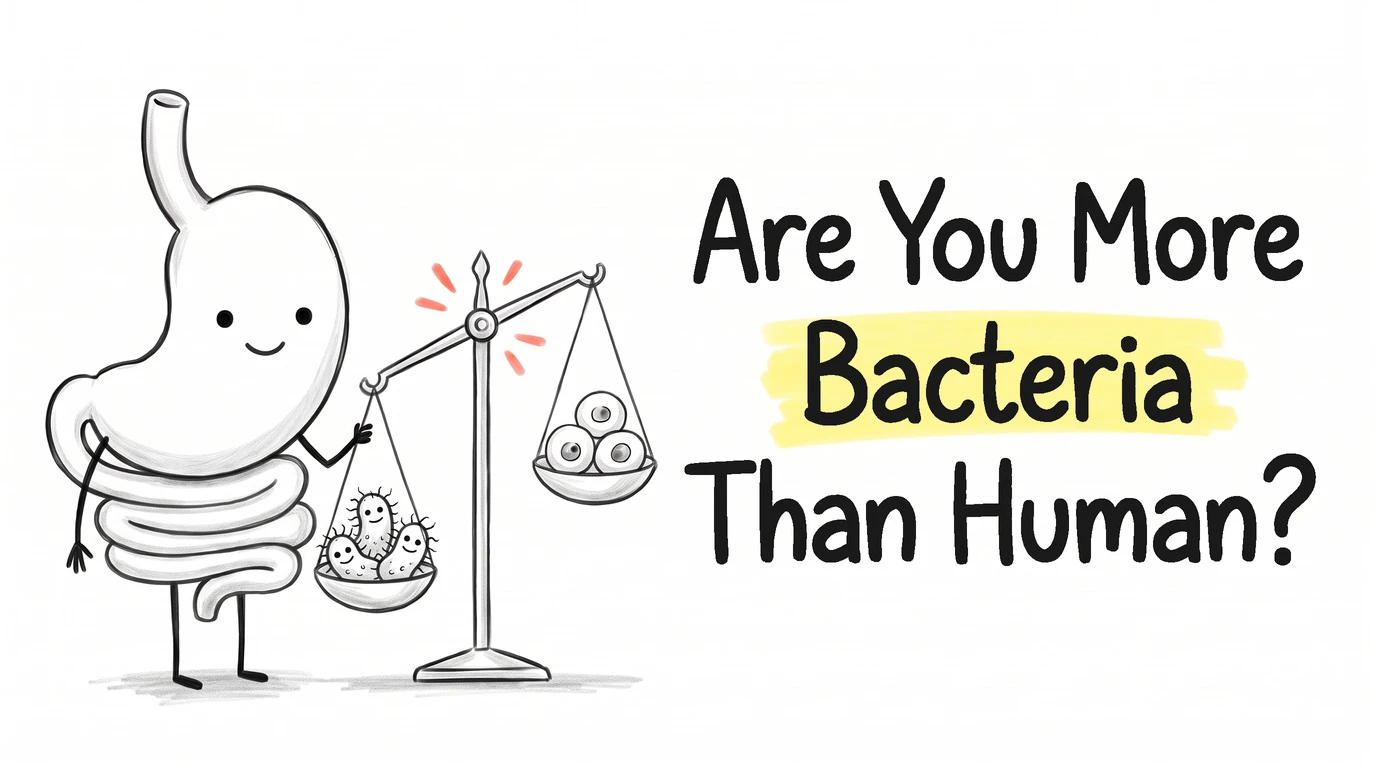
If you type "are we more bacteria" into Google, the first suggestion finishes the sentence as "than human," and a little further down you'll find "are we 90 bacteria." On r/sciencememes, a post titled "your body contains more bacteria cells than human cells" has over a thousand upvotes. The fact is everywhere, and it's off by nearly a factor of ten.
The best count available comes from a 2016 paper by Ron Sender, Shai Fuchs, and Ron Milo at the Weizmann Institute of Science in Israel. They estimated that a typical young man carries about 38 trillion bacteria and about 30 trillion of his own cells. That works out to 1.3 bacteria for every human cell, which the authors round to "about 1:1," and they write that it "should replace the 10:1 or 100:1 values" still found in scientific papers. By cell count, you're a little over half bacteria.
Where did ten to one come from?
It traces back to one rough calculation from 1972. According to Sender's team, who tracked down the original, a scientist named Thomas Luckey assumed that the whole digestive tract holds about a liter of material and multiplied that by the number of bacteria in a gram of gut contents (around 100 billion). That gave roughly 100 trillion bacteria. Most sources put the number of human cells at 10 trillion, and dividing one by the other gives you ten to one, or, in the words of the Cell commentary Sender's team wrote alongside their paper, "a cell population composed of at least 90% bacteria."
Five years later, a review by Dwayne Savage repeated the estimate, and that review has been "referenced over 1,000 times in the literature," usually for exactly this point. Sender's team calls Luckey's math "an illuminating example of a back-of-the-envelope estimate" (a rough calculation meant to land in the right ballpark, the kind you could scribble on the back of an envelope) that "was probably never meant to serve as the cornerstone reference number to be cited decades later." Judah Rosner questioned the ratio in a 2014 letter to the microbiology magazine Microbe, and the Weizmann paper came out two years after that.
The US government picked the number up along the way. When the National Institutes of Health announced the results of its Human Microbiome Project in 2012, the press release said the body's microorganisms were "outnumbering human cells by 10 to 1." The NIH Common Fund's page for that same project still says that "microbial cells outnumber human cells by about ten to one." That page is marked as an archive that "will not be updated on a regular basis," but anyone can still read it. A newer page from NIGMS (the NIH institute that funds basic biology research) says scientists "used to think" the microbiome had 10 to 100 times more cells, and that "we have about as many bacterial cells as human cells in our bodies." The Microbiology Society (the UK's professional body for microbiologists) goes further and calls the ten-to-one figure "a myth."
What went wrong with the old math?
Luckey counted the whole digestive tract as if it were packed with bacteria. Your stomach and small intestine hold very few, and almost all of your bacteria live in your colon (the last stretch of your large intestine). Sender's team drew on MRI scans to estimate how much the colon actually holds, which came out to about 0.4 liters in an adult man, and multiplied that by the bacteria count in stool. That gave them 38 trillion bacteria, a bit over a third of Luckey's 100 trillion.
On the human side, about 84% of your cells are red blood cells, which are among the smallest cells in your body but so numerous that they outnumber every other kind of cell in you combined. Counting them carefully gives about 30 trillion human cells.
Google also autocompletes "how many pounds of bacteria in the human body." The 2012 NIH press release said 2 to 6 pounds in a 200-pound adult. Sender's team puts it at about 0.2 kilograms ("about 0.3% of the overall body weight"), which is around 7 ounces, or roughly the weight of a hamster.
It depends on what you count as a cell
Red blood cells don't have a nucleus (the control center that holds a cell's DNA), so some scientists don't treat them as full cells. Sender's team writes that some people think of them as "bags full of hemoglobin" (hemoglobin is the protein that carries oxygen in your blood). If you leave them out and count only the human cells that have a nucleus, you're down to about 3 trillion, and the paper says outright that in that case "the ratio will be about 10:1."
So the old number comes back if you decide that most of the cells in your blood don't count. Sender's team counts them ("We view red blood cells as bona fide cells, as their name suggests"), and so did the older human cell counts the ten-to-one figure was built on, which is why the 1:1 figure is the fair comparison.
Does the number change during the day?
Every time you poop, your colon loses a quarter to a third of what's in it, bacteria included. In the Cell commentary, the authors point out that the ratio is so close to even that each bowel movement "may flip the ratio to favor human cells over bacteria." You're a little more bacteria right before you go than right after.
The 1.3 figure is for what researchers call the "reference man," a standard body used for calculations like this one, who is 20 to 30 years old, 5'7", and 154 pounds. For a reference woman, the paper's estimate is 2.2 bacteria per human cell, mostly because women have less blood and so fewer red blood cells. Across every group the team modeled (women, babies, older adults, and people with obesity), the ratio stayed between 1.3 and 2.3, so it varies from person to person as well.
Nobody has run these numbers for a teenager. The closest thing is a 2023 recount of human cells by Ian Hatton and colleagues in PNAS (one of the main US science journals), which put the total at about 36 trillion in a man, 28 trillion in a woman, and 17 trillion in a 10-year-old. Set the man's 36 trillion next to Sender's 38 trillion bacteria and the two numbers are almost even.
What about genes?
By gene count, you are mostly microbe. A 2010 study in Nature sequenced gut bacteria from the stool of 124 people in Denmark and Spain and found a set of genes "150 times larger than the human gene complement" (the full set of human genes). The 2012 NIH press release put it at "360 times more bacterial genes than human genes."
That multiplier moves around depending on who's counting and how they decide what counts as a separate gene. A 2016 National Geographic piece collected estimates running "from about 150-to-1 to nearly 500-to-1," while one geneticist put it closer to 30-to-1 by counting only the microbiome's most dominant species. Every one of those estimates still puts bacterial genes far ahead of yours.
Does the ratio matter?
For what your gut bacteria do, no. Dropping the ratio from ten to one down to about one to one "does not take away from the biological importance of the microbiota," according to Sender's team. The bacteria in your colon still break down fiber your body can't, make vitamins, and help train your immune system, which Meet Your Microbiome walks through, and they started moving in around the time you were born, which Are You Born With Your Microbiome? covers.
Sender's team fixed the number anyway, because "a number widely stated should be based on the best available data."
Sources
- Sender R, Fuchs S, Milo R, Revised Estimates for the Number of Human and Bacteria Cells in the Body, PLOS Biology, 2016
- Sender R, Fuchs S, Milo R, Are We Really Vastly Outnumbered? Revisiting the Ratio of Bacterial to Host Cells in Humans, Cell, 2016
- National Human Genome Research Institute (NIH), NIH Human Microbiome Project defines normal bacterial makeup of the body, 2012
- NIH Common Fund, Human Microbiome Project (HMP)
- National Institute of General Medical Sciences (NIH), Cells by the Numbers, 2024
- Hatton IA et al., The human cell count and size distribution, PNAS, 2023
- Microbiology Society, What are Bacteria?
- Qin J et al., A human gut microbial gene catalogue established by metagenomic sequencing, Nature, 2010
- Michael Greshko, National Geographic, How Many Cells Are in the Human Body, and How Many Microbes?, 2016


.svg)
.webp)
.webp)



.webp)


.webp)
.webp)