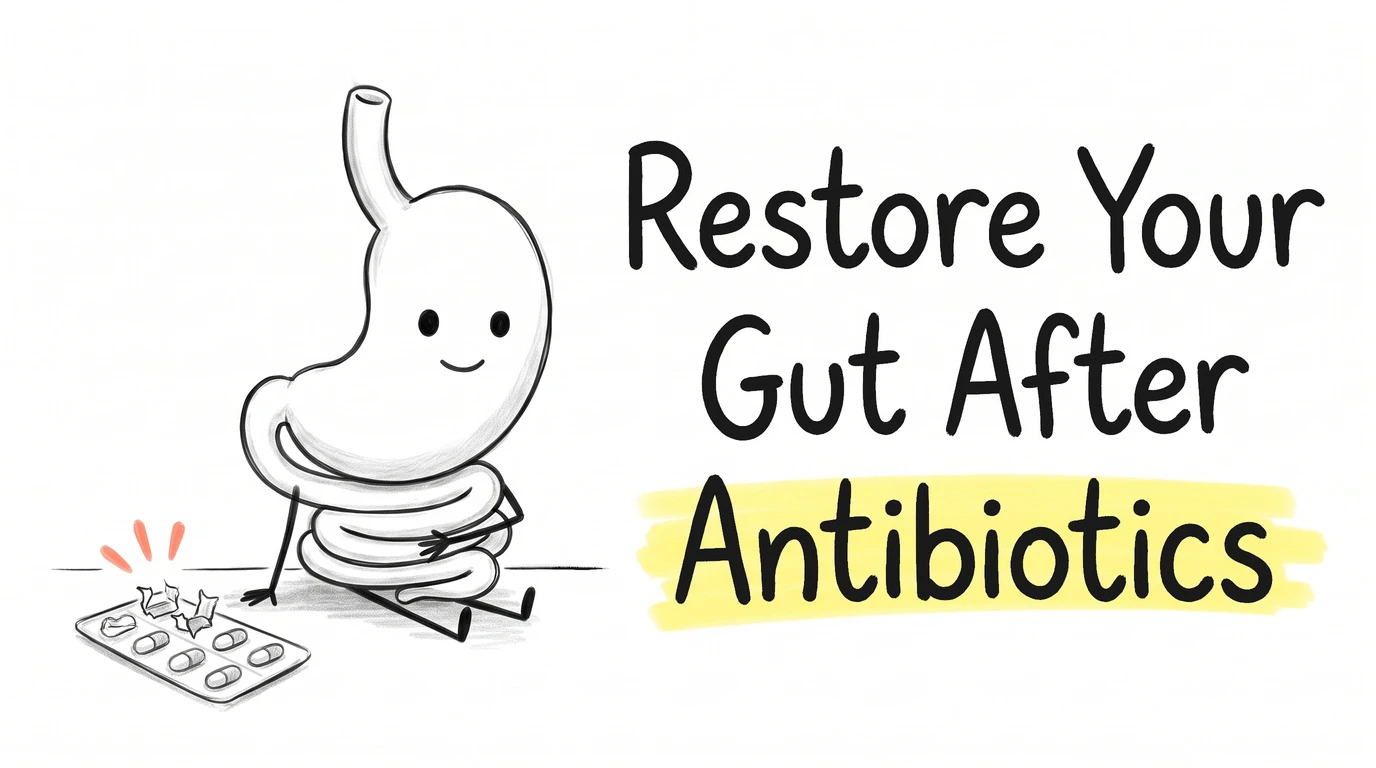
If you type "antibiotics ruined my gut" into Google, it offers to finish the thought with "antibiotics destroyed my gut" and "antibiotics messed up my gut." Type "how to restore gut after antibiotics" and it suggests swapping in "repair" or "reset." All of them assume that a course of antibiotics breaks something and that you have to do something to put it back. In healthy people, the gut does most of the rebuilding on its own, and the best-known study of probiotics taken after antibiotics found that they slowed it down.
How long does it take your gut to come back?
In a 2018 study in Denmark, researchers gave 12 healthy young men four days of three "last-resort" antibiotics (meropenem, gentamicin, and vancomycin, the drugs kept for infections other antibiotics can't handle) and then followed their gut bacteria for six months. Their gut bacteria "recovered to near-baseline composition within 1.5 months," so about six weeks. Nine common species that every one of the men had before the antibiotics were still undetectable in most of them at six months.
That mix is much stronger than a normal prescription, and the study only included adult men, so it can't tell you exactly how long your gut takes after one antibiotic for strep throat.
Whether losing a few species matters for your health is less settled than the searches make it sound. A panel of scientists organized by ISAPP (the International Scientific Association for Probiotics and Prebiotics, a group of researchers who study probiotics) noted that higher gut diversity, which is the number of different kinds of bacteria you carry, "has not been causally linked to good health in humans."
Is diarrhea from antibiotics normal?
Usually, yes. Antibiotics kill bacteria without sorting the helpful ones from the ones making you sick, and CDC (the Centers for Disease Control and Prevention) says that this reduces "the number and variety of helpful germs" in your gut. The NHS (England's public health service) lists diarrhea and feeling sick as side effects and says that they're "usually mild and should pass once you finish your course of treatment."
Call whoever prescribed the antibiotic before you stop taking it because of diarrhea. CDC's advice is to take antibiotics "exactly as prescribed," and the NHS says to contact your doctor about side effects beyond the common ones.
When is diarrhea something more?
The one to know about is C. diff (Clostridioides difficile, a bacterium that can take over when antibiotics have cleared out the bacteria that normally keep it in check). CDC says that people are "up to 10 times more likely to get C. diff infection while taking an antibiotic and during the month after finishing," so diarrhea that starts a week or two after your last pill still counts.
C. diff is most common in hospitals and nursing homes, in people 65 and older, and in people with weakened immune systems, but CDC adds that "you can still get C. diff infection even if you have none of these risk factors."
The NHS is more cautious on its C. diff page than on its general antibiotics page. It says to ask for an urgent appointment if "you have diarrhoea and you're taking, or have recently taken, antibiotics," if you have "bloody diarrhoea or bleeding from the bottom," or if you've had "diarrhoea for more than 7 days." Those are UK instructions, but the same signs are worth a call to your doctor in the US.
Should you take a probiotic after antibiotics?
Culturelle's version costs $21.99 and promises to "rebuild bacterial balance lost to antibiotic use." Further down, the same page says that "these statements have not been evaluated by the Food and Drug Administration" and that the product "is not intended to diagnose, treat, cure, or prevent any disease."
A 2018 study in the journal Cell gave healthy volunteers antibiotics and then split them up. Some took nothing, some took an 11-strain probiotic, and some got a transplant of their own gut bacteria collected before the antibiotics. Compared with taking nothing, the probiotic caused "a markedly delayed and persistently incomplete" return of the volunteers' own bacteria, and the transplant brought them back "within days."
ISAPP pushed back on the study, pointing to "n=8 in the probiotic arm" (eight people), "a single, very aggressive antibiotic regime," and the fact that it tested one probiotic product. So the study doesn't show that every probiotic slows recovery.
Nothing shows the opposite, either. ISAPP's panel, which included Jotham Suez, the lead author of the 2018 study, concluded that "current evidence does not support the conclusion that probiotics studied so far help restore the gut microbiota to its pre-antibiotic-challenged state," and added that "studies adequately designed to directly address this question are rare." A 2023 review in BMC Medicine pooled five trials (335 patients) and found that probiotics taken during antibiotics didn't keep gut diversity from dropping. Its authors wrote that the trials "cannot support probiotic supplementation during antibiotic therapy" for that purpose.
Taking one during the course is a separate question
Cochrane (an international group that pools every trial on a medical question) reviewed 33 trials in kids and teens from 3 days to 17 years old. Diarrhea hit 8% of those taking a probiotic alongside their antibiotics and 19% of those who weren't. The two best-supported options were Lactobacillus rhamnosus or Saccharomyces boulardii (a yeast) "at 5 to 40 billion colony forming units/day," which is the count of live organisms printed on the label.
Even that benefit doesn't mean that your gut bacteria recovered faster. ISAPP's panel wrote that the protection against diarrhea and C. diff has "not been shown to be causally linked" to any change in the gut's bacteria.
For C. diff specifically, a 2025 Cochrane review found that probiotics helped in trials of people at high risk, and that trials where the risk started at 0% to 2% "did not show any difference." CDC's list of higher-risk groups (hospital patients, people 65 and older, and people with weakened immune systems) doesn't describe most healthy teenagers.
If you and your doctor decide to try one, ISAPP's guide for doctors says that the trials usually started the probiotic within a day or two of the antibiotic, and that continuing it for 7 to 14 days after the antibiotics ended was "a commonly tested dosing strategy." It also suggests a "2-hour gap" between the antibiotic and a bacterial probiotic so that the antibiotic doesn't kill it, and notes that yeast probiotics like S. boulardii aren't affected. There's more on how probiotic products vary in Do Probiotics Actually Work?
What about yogurt and kefir?
MedlinePlus (the US National Library of Medicine's health site) suggests that you "talk to your health care provider about taking supplements containing healthy bacteria (probiotics) or eating yogurt" to prevent diarrhea from antibiotics. That's as far as the official advice goes. The NHS's antibiotics pages and CDC's page of antibiotic do's and don'ts don't mention yogurt, kefir, fermented food, or fiber. The everyday habits that feed your gut bacteria are in How to Improve Your Gut Health, and they apply after antibiotics the same way they do any other week.
Can you stop once you feel better?
For years the advice was to finish every pill so that bacteria wouldn't become resistant. CDC's current page doesn't say that anymore. It says to take antibiotics "exactly as prescribed." In 2017, a group of UK doctors and researchers argued in the BMJ (a major British medical journal) that "there is no evidence for any common bacterial infection that stopping antibiotic treatment early increases a patient's risk of resistant infection." The resistance risk, they wrote, comes "when antibiotic treatment is given for longer than necessary."
That doesn't make the length your call. The NHS tells people being treated for C. diff to keep taking the antibiotic "until you've finished all your tablets, capsules or liquid, even if you feel better," because "if you stop your treatment early, your symptoms could come back." If you think your course is longer than it needs to be, ask the person who prescribed it.
CDC also says "do not save them for later" and "do not take antibiotics prescribed for someone else," since "taking the wrong medicine for a future illness may delay correct treatment and can cause severe side effects." The same page points out that "antibiotics will NOT make you feel better if you have a virus," and Meet Your Microbiome explains why taking them for a cold costs your gut bacteria for nothing.
Sources
- Palleja A et al., Recovery of gut microbiota of healthy adults following antibiotic exposure, Nature Microbiology, 2018
- Suez J et al., Post-antibiotic gut mucosal microbiome reconstitution is impaired by probiotics and improved by autologous FMT, Cell, 2018
- ISAPP, ISAPP panel concludes that more evidence is needed to determine whether probiotics help restore an antibiotic-disrupted microbiota
- ISAPP, Probiotics with antibiotics: Let's follow the evidence
- ISAPP, Probiotic use alongside antibiotics: A guide to clinical FAQs
- Probiotic supplementation during antibiotic treatment is unjustified in maintaining the gut microbiome diversity: a systematic review and meta-analysis, BMC Medicine, 2023
- Guo Q et al., Probiotics for the prevention of pediatric antibiotic-associated diarrhea, Cochrane Database of Systematic Reviews, 2019
- Esmaeilinezhad Z et al., Probiotics for the prevention of Clostridioides difficile-associated diarrhea, Cochrane Database of Systematic Reviews, 2025
- Llewelyn MJ et al., The antibiotic course has had its day, BMJ, 2017 (open-access accepted manuscript)
- CDC, Healthy Habits: Antibiotic Do's and Don'ts
- CDC, About C. diff
- NHS, Antibiotics: Side effects
- NHS, Clostridium difficile (C. diff)
- MedlinePlus, Drug-induced diarrhea
- Culturelle, Ultimate Balance for Antibiotics Capsules


.svg)
.webp)
.webp)



.webp)


.webp)
.webp)