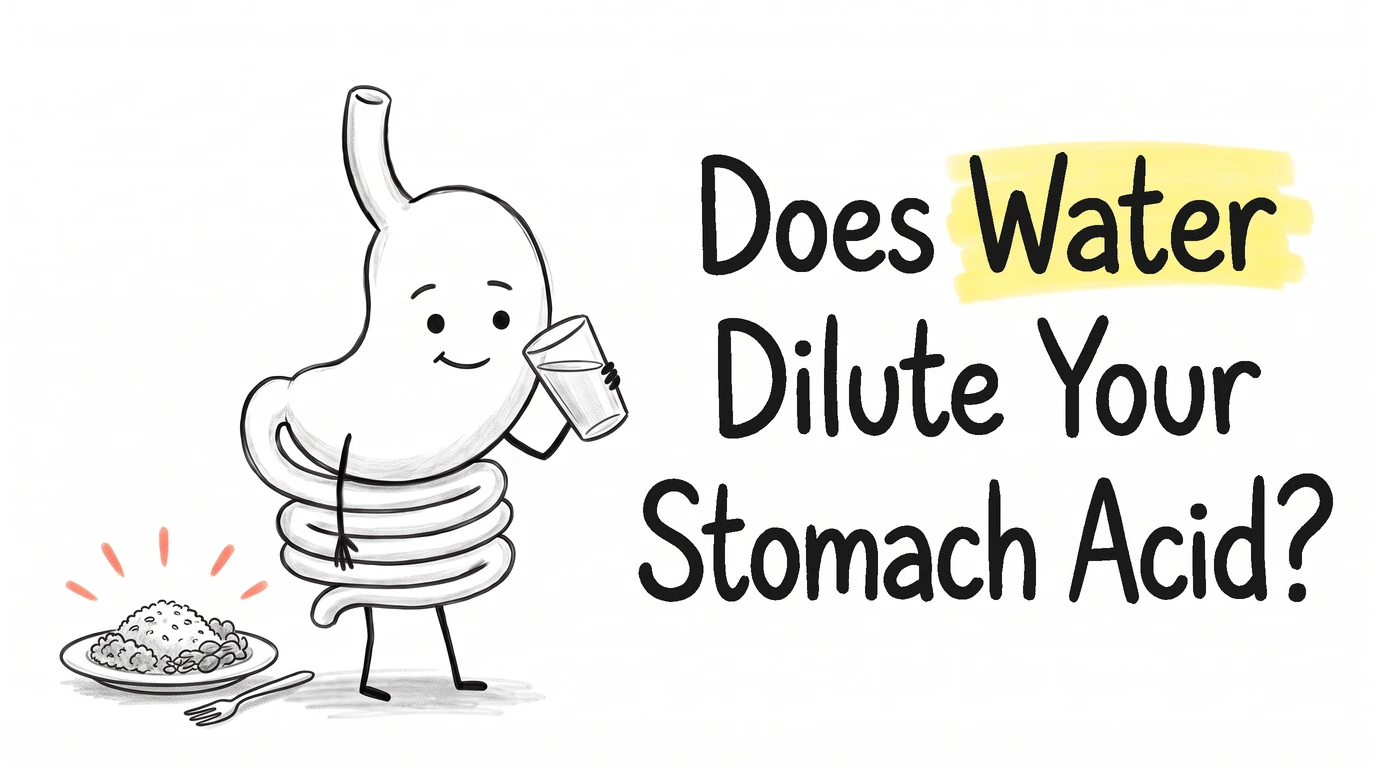
If you type "does water dilute" into Google, the first thing it suggests is "stomach acid," ahead of alcohol, caffeine, and drug tests. "Is it bad to drink water" finishes with "while eating" before it gets to "before bed." The worry has a tidy logic to it, and the Ayurvedic wellness brand Blue Nectar puts it about as plainly as anyone: "You know how pouring a bucket of water on a small fire makes the flames die down? Similarly, drinking water right after your meals weakens your digestive fire." (The same page ends with "Recommended Products by Blue Nectar," led by its own green tea "with Digestive Aniseed.")
For a healthy stomach, water with a meal doesn't hurt digestion. It does weaken the acid for a few minutes, but the food you're eating weakens it more, and your stomach makes acid in response to that food. Mayo Clinic's answer to this exact question opens with "Water doesn't cause problems with digestion or thin body fluids used in digestion," and adds that "Water is part of the stomach acid that helps digestion."
What a glass of water does to the acid
Stomach acid usually sits around a pH of 1.5 to 3.5 (what is the gut, really? walks through the scale), where pure water is a 7 and every step down is ten times more acidic.
A team of gastroenterologists in Athens tested what one glass of water (200 mL, a little under a cup) does to that number. They put a pH sensor into the stomachs of 12 healthy adults, average age 26, and had them drink it on an empty stomach. In 10 of the 12, the pH rose above 4 within a minute. It stayed above 4 for about 3 minutes. An antacid tablet, tested the same way, lasted 12. The study was about how fast reflux medicines start working, and the water went into an empty stomach with no food in it, which is a different situation from sipping through lunch.
Food raises the pH more than water does
Food is a buffer (something that soaks up acid and keeps the pH from dropping, the way a sponge soaks up a spill). A 2001 study in Glasgow measured the pH in different parts of the stomach in healthy volunteers after they ate. In the main body of the stomach, where the meal sits, it was 4.7. That's past the line the glass of water crossed in Athens, and it's the ordinary state of a stomach in the middle of digesting lunch. (The researchers also found a small pocket of acid floating on top of the food near the top of the stomach, at 1.6, which they tied to reflux damage at that spot.)
Your stomach makes acid on demand, rather than pouring it from a fixed tank that water could thin out. According to TeachMePhysiology (a reference site for medical students), seeing and chewing food starts it, the stomach stretching as it fills pushes it further, and bits of protein from your meal trigger cells that release gastrin (a hormone that tells the acid-making cells to speed up). Once the stomach gets acidic enough, other cells release somatostatin, which turns gastrin back down. It works like a thermostat set by how acidic the stomach is. Rucha Shah, a gastroenterologist at HonorHealth, put it more simply to Parade: your stomach "adjusts its secretions based on what's in there."
Rosario Ligresti, chief of gastroenterology at Hackensack University Medical Center, told Parade that "The idea that it dilutes digestive juices to the point of hindering digestion is a myth." His reason is the physiology ("Your stomach is incredibly efficient at regulating its environment"), since the experiment that would settle it (one meal eaten with water and without, with digestion or nutrient absorption measured afterward) doesn't appear to have been run.
Where "don't drink with meals" comes from
Part of it is Ayurveda, the traditional medicine of India, which describes digestion as agni (a "digestive fire" that water after a meal can dampen).
The other part is a medical rule written for a different stomach. After surgery that removes or bypasses a large part of the stomach (e.g., gastric bypass), people can get dumping syndrome, where food floods the small intestine too fast and brings on nausea, cramps, diarrhea, and dizzy spells. The American Motility Society's diet sheet for those patients says to "Limit fluid consumption during meals" and to drink liquids 30 to 60 minutes before or after "instead of with meals." Cleveland Clinic gives the reason in four words: "Fluids encourage motility," meaning that they speed up how fast the stomach empties. The 2013 guideline for weight-loss surgery patients, from three obesity and surgery societies, says fluids should be taken "preferably at least 30 minutes after meals to prevent gastrointestinal symptoms." All three rules are about how fast a surgically changed stomach empties, and none of them gives acid as the reason.
Heartburn is the one place it gets complicated
Johns Hopkins Medicine tells people with reflux almost the opposite of the popular claim. Its GERD diet page says that "Eating foods that contain a lot of water can dilute and weaken stomach acid," and recommends celery, cucumber, watermelon, and broth-based soups for that reason. That's the same short-lived effect the Athens team measured, used on purpose to take the edge off heartburn.
Dr. Ligresti adds a second catch for people with reflux: "For some individuals with GERD, drinking large amounts of any liquid with meals can increase stomach volume and pressure, potentially worsening reflux symptoms."
Plain water doesn't seem to cause reflux on its own. Researchers at Massachusetts General Hospital followed 48,308 women, ages 42 to 62, in the Nurses' Health Study II (a long-running study that tracks the health of US nurses), and found that water "was not associated with GER symptoms," while more coffee, tea, and soda was. Swapping two servings a day of coffee, tea, or soda for water went with a lower risk. All of them were middle-aged women, so treat it as a hint for a teenager rather than a finding. If reflux is the reason you're asking, our heartburn article covers what helps.
Does water at meals help you eat less?
Mayo Clinic says that drinking water with meals "can help you feel full without added calories," and that's the usual advice. A 2026 analysis from Cornell and Penn State points the other way. Researchers pooled two lab experiments where 86 adults ate as much spicy chili or chicken tikka masala as they wanted, with water, while being filmed. The more water people drank, the more food they ate, and the authors write that the result "challenges the widespread dietary advice to drink water with meals to reduce food intake." The amount of water each person drank wasn't controlled, so the study shows a link rather than cause and effect.
Drinking before the meal gave a different result in a small UK study, where 14 lean young men who drank a pint of water right before an oatmeal breakfast ate almost a quarter less of it than on a morning with no water first.
What to do with this
Drink water with meals if you want it. If a big glass leaves you uncomfortably full or bloated, Dr. Ligresti's advice is that "it's perfectly fine to drink smaller sips or to drink more between meals." If you've had stomach surgery, follow the fluid timing your care team gave you, since that rule exists for your stomach specifically. And Mayo Clinic notes that people with heart, kidney, or liver disease "may need to limit the amount of water they drink," which is a question for their doctor.
Sources
- Karamanolis G et al., A glass of water immediately increases gastric pH in healthy subjects, Digestive Diseases and Sciences, 2008
- Fletcher J et al., Unbuffered highly acidic gastric juice exists at the gastroesophageal junction after a meal, Gastroenterology, 2001
- Mayo Clinic Staff, Water after meals: Does it disturb digestion?, Mayo Clinic, 2025
- TeachMePhysiology, Gastric Acid Production
- Parade (via Yahoo Health), Does Drinking Water During Meals Help or Hurt Digestion? (quotes from Dr. Rucha Shah and Dr. Rosario Ligresti)
- Blue Nectar, Ayurvedic way of drinking water
- Parrish CR, Lin HC, Parkman H, Dietary and Nutritional Recommendations for Patients with Dumping Syndrome, American Motility Society and IFFGD
- Cleveland Clinic, Dumping Syndrome
- Mechanick JI et al. (AACE, TOS, ASMBS), Clinical Practice Guidelines for the Perioperative Nutritional, Metabolic, and Nonsurgical Support of the Bariatric Surgery Patient, 2013 Update, Surgery for Obesity and Related Diseases, 2013
- Johns Hopkins Medicine, GERD Diet: Foods That Help with Acid Reflux (Heartburn)
- Mehta RS, Song M, Staller K, Chan AT, Association Between Beverage Intake and Incidence of Gastroesophageal Reflux Symptoms, Clinical Gastroenterology and Hepatology, 2020
- Cunningham PM, Hayes JE, Water intake, switching between bites and sips, and drinking behavior are associated with food intake across meals varying in spiciness, Appetite, 2026
- Corney RA, Sunderland C, James LJ, Immediate pre-meal water ingestion decreases voluntary food intake in lean young males, European Journal of Nutrition, 2016

.svg)
.webp)
.webp)



.webp)


.webp)
.webp)