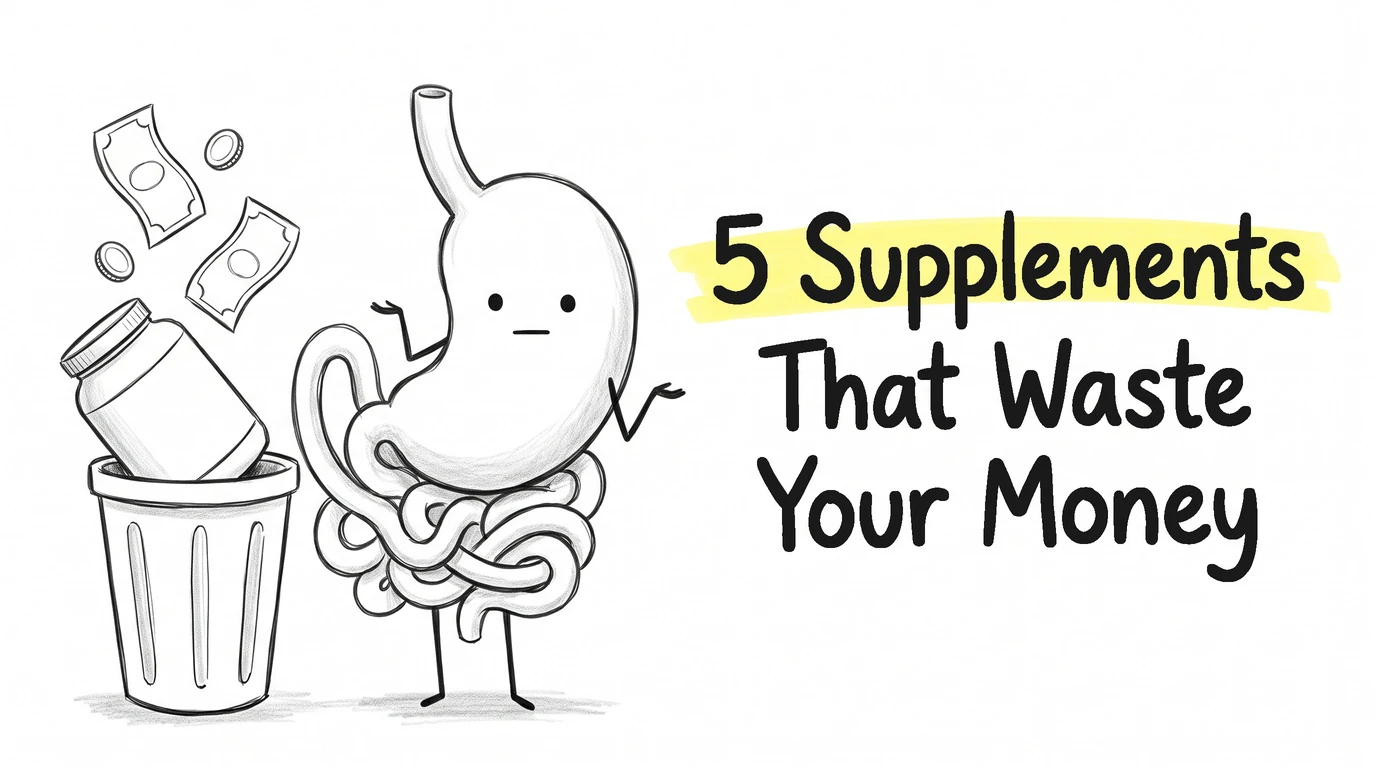
If you type "are gut supplements" into Google, the first thing it suggests is "worth it." Type "are probiotics a waste" and it finishes the sentence with "of money." For a healthy student, the five below mostly are. Each one has a group of people it does help, and in almost every case that group has a diagnosis, a specific infection, or a prescription, which is a very different situation from buying a tub because your stomach felt off last week.
None of them had to prove that it works before going on sale. The FDA (Food and Drug Administration) says that it "does not have the authority to approve dietary supplements before they are marketed," which is why a gut supplement can promise a stronger gut and then print, in smaller type, "These statements have not been evaluated by the Food and Drug Administration."
1. Colostrum
Colostrum is the first milk a cow makes after giving birth, dried into a powder. No one has tested what it does for a healthy teenager's gut. When researchers at Yonsei University in Seoul gave it to adults with IBS (irritable bowel syndrome) for four weeks, they concluded that it "had no benefits in relieving symptoms." In a trial at Alder Hey Children's Hospital in Liverpool, which enrolled kids and teens (ages 8 to 17) with Crohn's disease, "symptoms, clinical and laboratory variables and quality of life were similar in the two arms."
Most of the trials behind the barrier claim were done in athletes. In one from the University of South Australia, 30 men who ran three times a week took colostrum, whey protein, or nothing for eight weeks. A lab marker of how much the gut was leaking went up about 251% in the colostrum group and about 21% in the whey group, and the authors concluded that colostrum "increased intestinal permeability compared with whey protein and a control."
The version that clearly worked is a different product. Hyperimmune colostrum comes from cows vaccinated against a specific germ. In a trial where volunteers swallowed a strain of E. coli on purpose, tablets made from the colostrum of cows vaccinated against that kind of E. coli gave "90.9% protection against diarrhea." A general colostrum powder isn't that. Does Colostrum Actually Do Anything for Your Gut? has the full set of trials.
2. Greens powders
AG1 costs $99 for a month's supply if you buy it once. The company paid for a trial in 20 adults who lift weights, and six of the paper's nine authors work for AG1. After two weeks on AG1 and two weeks on a placebo powder, the researchers found "no significant differences in overall community composition" of their gut bacteria. A handful of bacteria did go up on AG1, and when 10 of the volunteers stopped taking it, the paper says those gains "were lost."
A UCLA Health dietitian, Yasi Ansari, says that people who find it hard to eat enough fruits and vegetables, "or who have limited access to fresh produce may benefit" from a greens powder. Julia Zumpano, a dietitian at Cleveland Clinic, puts the limit on it: "You never want powdered greens to take the place of eating whole fruits and vegetables." Are Greens Powders Worth It? breaks down what's actually in a scoop.
3. Digestive enzyme blends
Your pancreas makes far more enzymes than you need. The FDA explains that food only starts passing through undigested once "the pancreatic enzyme output level is reduced by more than 90 percent." A Cleveland Clinic gastroenterologist, Alison Schneider, says that "in most cases, you don't need to worry about your body making enough."
Enzymedica's Digest Gold says that each capsule "can digest up to" 34 grams of fat. The next line on its page reads, "These amounts are theoretical; many variables influence digestion."
People whose pancreas has stopped working (a condition called exocrine pancreatic insufficiency, often from cystic fibrosis or pancreatitis) do need enzymes, and what they take is a prescription drug that's dosed and tested. Two single-purpose enzymes have some evidence for one food each: lactase for milk, and Beano's enzyme for beans. Digestive Enzymes: Who Actually Needs Them? covers both.
4. Probiotics for everyday gut health
Seed's page for its DS-01 capsule says that it "reduces bloating and gas," at $49.99 a month. The British Dietetic Association (the professional group for dietitians in the UK) says in its probiotics fact sheet, "If you are healthy, it is unlikely a probiotic supplement will be beneficial."
A 2016 review in Genome Medicine gathered seven trials in healthy adults that measured gut bacteria directly, and it found "a lack of evidence for an impact of probiotics on fecal microbiota composition in healthy adults." After antibiotics, a 2018 study in the journal Cell found that a multi-strain probiotic caused "a markedly delayed and persistently incomplete" return of people's own gut bacteria, compared with taking nothing. How to Restore Your Gut After Antibiotics goes through that study and the pushback on it.
Taking one during a course of antibiotics has better evidence behind it. A Cochrane review (a study of studies from the group that sets the standard for how those are done) pooled trials in kids and teens (3 days to 17 years old) and found that diarrhea hit 8% of those taking a probiotic alongside their antibiotics, compared with 19% of those who weren't. If you're starting antibiotics, that's worth asking your doctor about. Do Probiotics Actually Work? covers why the strain on the label matters.
5. "Leaky gut" repair powders
Gundry MD's Total Restore lists L-glutamine (an amino acid, one of the building blocks of protein) first among its key ingredients and says that it helps "support a strong gut barrier." Its page also says that intestinal permeability (a leakier gut lining) "has been linked to triggering fatigue, digestive discomfort, skin issues, mind fog, and weight gain."
Cleveland Clinic calls leaky gut syndrome a condition "not currently recognized as a medical diagnosis," and says that "the only known cure for a leaky gut is to treat the underlying condition that causes it." In 2013, the FDA wrote to Metagenics, a company selling a product for "leaky gut syndrome," that it "is not aware of any distinctive nutritional requirement for patients with leaky gut syndrome." Is Leaky Gut Real? separates the biology from the marketing.
In a 2019 trial published in Gut and funded by the NIH (the US government's medical research agency), 106 adults finished eight weeks of glutamine or a placebo. Every one of them had developed diarrhea-type IBS after a stomach infection, and every one had a urine test showing that their gut was leaking. Symptoms improved enough to count in 79.6% of the glutamine group and 5.8% of the placebo group. The dose was 5 grams three times a day, and the authors wrote that large trials "should now be done to validate these findings."
A 2024 review pooled 10 trials of glutamine in people with a range of diseases, and found that glutamine "did not significantly affect intestinal permeability."
If your gut really is bothering you
The things with evidence behind them are cheaper: fiber, a variety of plants, and regular meals, which How to Improve Your Gut Health goes through. If a symptom keeps coming back, or you see blood in your stool, lose weight without trying, or have belly pain that lasts for weeks, see a doctor instead of trying another supplement.
Sources
- ARMRA, homepage and 30-day supply pricing
- FDA, Questions and Answers on Dietary Supplements
- Yoon JY, Park SJ, Cheon JH, Effect of Colostrum on the Symptoms and Mucosal Permeability in Patients with Irritable Bowel Syndrome, Intestinal Research, 2014
- Allen SJ et al., Dietary Therapy to Improve Nutrition and Gut Health in Paediatric Crohn's Disease; A Feasibility Study, Nutrients, 2022
- Buckley JD et al., Bovine colostrum supplementation during running training increases intestinal permeability, Nutrients, 2009
- Otto W et al., Randomized control trials using a tablet formulation of hyperimmune bovine colostrum to prevent diarrhea caused by enterotoxigenic Escherichia coli in volunteers, Scandinavian Journal of Gastroenterology, 2011
- AG1, AG1 Next Gen product page
- Townsend J et al., AG1 supplementation improves gut microbiome composition and function in highly active adults, Journal of the International Society of Sports Nutrition, 2025
- UCLA Health, Are greens powders worth it?
- Cleveland Clinic, Powdered Greens: Do They Really Work?
- FDA, Exocrine Pancreatic Insufficiency Drug Products, Federal Register 69(82), 2004
- Cleveland Clinic, Digestive Enzymes 101: Why They're Important (Alison Schneider, MD)
- Enzymedica, Digest Gold with ATPro product page
- NIDDK, Symptoms & Causes for Exocrine Pancreatic Insufficiency
- Seed, DS-01 Daily Synbiotic product page
- British Dietetic Association, Probiotics and gut health: Food Fact Sheet
- Kristensen NB et al., Alterations in fecal microbiota composition by probiotic supplementation in healthy adults: a systematic review of randomized controlled trials, Genome Medicine, 2016
- Suez J et al., Post-antibiotic gut mucosal microbiome reconstitution is impaired by probiotics and improved by autologous FMT, Cell, 2018
- Guo Q et al., Probiotics for the prevention of pediatric antibiotic-associated diarrhea, Cochrane Database of Systematic Reviews, 2019
- Gundry MD, Total Restore product page
- Cleveland Clinic, Leaky Gut Syndrome
- FDA, Warning Letter SEA 13-27 to Metagenics, Inc., 2013 (archived copy)
- Zhou Q et al., Randomised placebo-controlled trial of dietary glutamine supplements for postinfectious irritable bowel syndrome, Gut, 2019
- Abbasi F et al., A systematic review and meta-analysis of clinical trials on the effects of glutamine supplementation on gut permeability in adults, Amino Acids, 2024

.svg)
.webp)
.webp)



.webp)


.webp)
.webp)