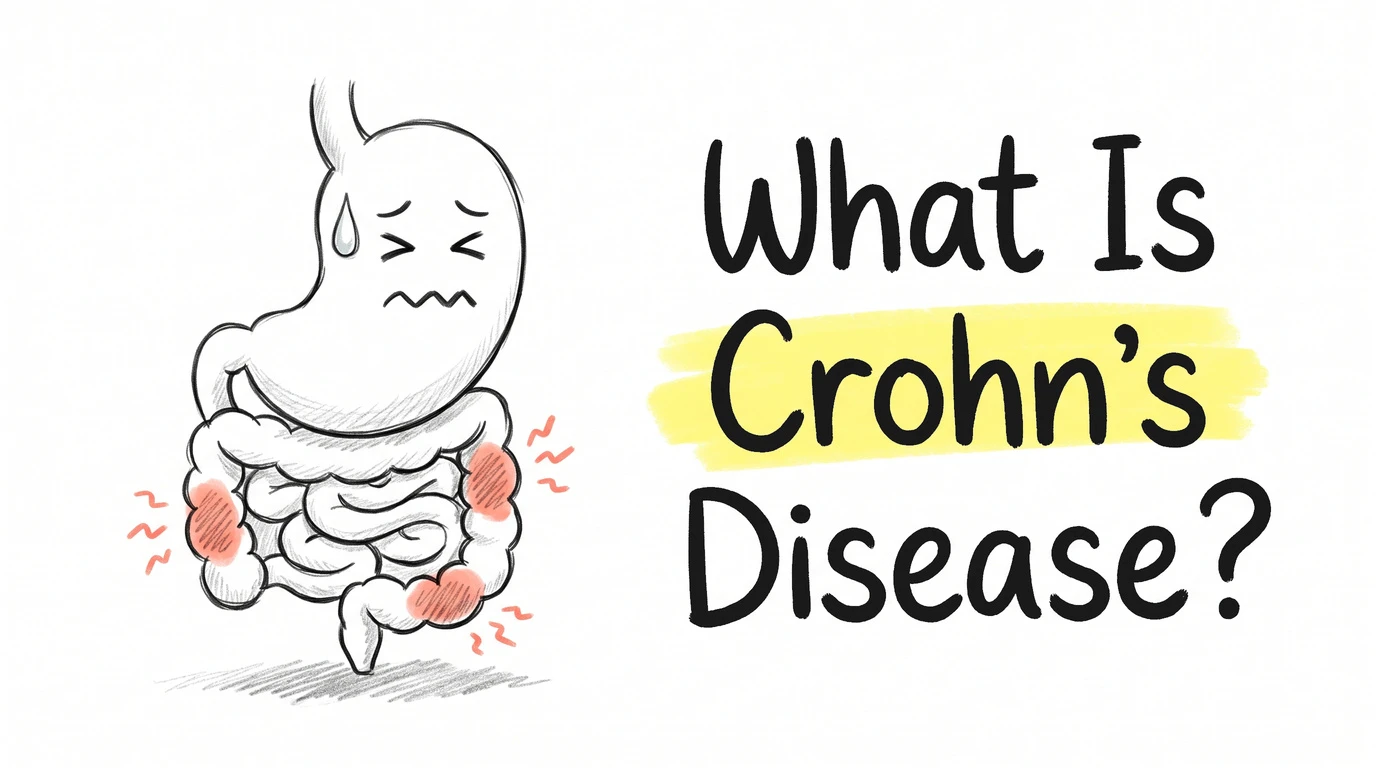
Most people meet the phrase "Crohn's disease" on the day a doctor says it to them, or to someone they care about. It arrives with a lot of words attached, none of which anybody explains: flare, remission, biologic, calprotectin, terminal ileum. Then you search it and land on forums full of people having their worst weeks.
What Crohn's actually is
Crohn's is a long-term condition where the immune system attacks the digestive tract and causes inflammation. The NIDDK, the US government's institute for digestive diseases, defines it as "a chronic disease in which abnormal reactions of the immune system cause inflammation in your digestive tract."
Two details make Crohn's different from the other main type of inflammatory bowel disease, ulcerative colitis.
It can appear anywhere from the mouth to the anus, and it shows up in patches. In the Crohn's & Colitis Foundation's words, the inflammation can "skip," leaving "normal areas in between patches of diseased intestine." Ulcerative colitis doesn't do that.
It also goes deeper. Ulcerative colitis affects only the innermost lining of the colon. Crohn's "can also affect the entire thickness of the bowel wall." That depth is why Crohn's can cause tunnels and narrowing, which we'll come back to.
The most common place for it is the last stretch of the small intestine, called the ileum. If a doctor writes "terminal ileal Crohn's" in your notes, Crohn's & Colitis UK has the sentence worth reading before you panic-search it: "Terminal may sound worrying but in this context, it does not mean end of life." Terminal just means the end of the ileum.
For how Crohn's compares to IBS and the other conditions it gets confused with, we wrote a guide to what's going wrong in your gut.
Nothing you did caused this
The Crohn's & Colitis Foundation puts it in the second person and with an exclamation mark, which medical organizations almost never do: "Nothing that you did made you get Crohn's disease. You didn't catch it from anyone. It wasn't something that you ate or drank that brought the symptoms on. Leading a stressful lifestyle didn't cause it. So, above all, don't blame yourself!"
NIDDK's page on what causes Crohn's lists four things: an abnormal immune reaction, environment, genes, and the microbiome. Diet and stress aren't on the list at all.
Stress is associated with symptom flares, not with causing the disease. Even there the evidence is shakier than people assume. When researchers looked at IBD patients in the zone damaged by the Great East Japan Earthquake, comparing the two months before with the two months after, relapses in ulcerative colitis roughly doubled. In Crohn's, "the relapse rate did not differ from that of the corresponding period in the previous year."
Diet is the same story. NIDDK: "Researchers have not found that specific foods cause or worsen Crohn's disease symptoms." The Crohn's & Colitis Foundation leaves more room for food: "Diet and stress may aggravate Crohn's disease, but do not cause the disease." If a food keeps making you feel worse, that's worth tracking, but it isn't what gave you the disease.
So what does cause it? Nobody knows. Genes matter, but all 163 known genetic regions linked to inflammatory bowel disease together explain about 13.6% of the variation in Crohn's risk. Having a parent or sibling with Crohn's raises your own risk close to eightfold, which sounds enormous until you notice it's eightfold on a small number, and that in a study of the entire Danish population only about 12% of IBD cases were family cases at all. Most people with Crohn's have nobody in their family with it.
Who gets it
Crohn's is often described as an adult disease, and the data says otherwise for the age group reading this.
In the US, the number of children aged 2 to 17 diagnosed with inflammatory bowel disease more than doubled between 2007 and 2016, from 33 per 100,000 to 77 per 100,000. Among children, Crohn's is twice as common as ulcerative colitis. The rise was driven almost entirely by 10 to 17 year olds.
In northern France, where a regional registry has tracked every case since 1988, Crohn's incidence in 10 to 19 year olds rose 71% over twenty years, while the overall rate rose 29%. The researchers' conclusion was blunt: "studies on Crohn's disease risk factors should focus on the population under 20 years of age."
Estimates of how many people with Crohn's are diagnosed before adulthood vary a lot depending on who's counting, from around 10% to around 25%, and none of the figures come from a clean registry count. Whatever the exact share, Crohn's frequently starts in the teens, and it's starting in teenagers more often than it used to.
What it feels like
The common symptoms are diarrhea, cramping and abdominal pain, and weight loss.
The less advertised symptoms make people feel like they're imagining things. NIDDK lists anemia, eye redness or pain, fatigue, fever, joint pain, nausea and loss of appetite, and tender bumps under the skin. Cleveland Clinic adds mouth sores, and notes that "in children and teens, Crohn's may delay growth or puberty."
Crohn's doesn't stay in the digestive tract. Crohn's & Colitis UK estimates that up to half of people with Crohn's develop problems elsewhere in the body, most often joints, eyes, and skin; the Crohn's & Colitis Foundation puts the figure at 25 to 40%. Those two don't agree, and neither cites a source, so treat it as somewhere between a quarter and a half.
Eye inflammation called uveitis or scleritis is, in Crohn's & Colitis UK's words, "serious and can lead to loss of vision if they're not treated." A painful, red, light-sensitive eye is something to get looked at rather than wait out.
The symptoms people are too embarrassed to mention
Crohn's can affect the area around the anus, and roughly 1 in 3 people with Crohn's develop a fistula, which is a small tunnel that forms between the bowel and the skin or another organ. Around the anus, these leak pus or stool and are usually painful.
Other things in the same category: fissures (small tears that hurt and bleed when you go), skin tags, and abscesses (pockets of pus that swell and hurt and can cause a fever).
All of it is embarrassing to bring up, and people put it off for exactly that reason, which makes it worse. It's also common enough that a gastroenterologist has heard about it many times this month. The physical exam for Crohn's often includes the anus, so it's better to know that in advance than to be surprised by it.
How it gets diagnosed
The NHS says, "There's no single test to diagnose Crohn's disease. It often takes time to get a diagnosis, as the symptoms vary and can be similar to other conditions."
The lack of a single test is why so many people with Crohn's spend months or years being told that it's anxiety, or stress, or an eating disorder, before anybody looks properly. If that's happening to you, the tests below are objective. They don't depend on anyone believing you.
Blood tests look for anemia, a raised white cell count, and C-reactive protein, which goes up when there's inflammation somewhere.
A stool test for something called fecal calprotectin shows whether there's inflammation in the intestines specifically. Despite how it's often described online, it isn't a diagnostic test on its own. The Crohn's & Colitis Foundation says these markers "may be more helpful for guiding invasive testing, detecting flares, and optimizing medical therapies than for diagnosing IBD."
A colonoscopy is the main event, and it's how Crohn's is usually confirmed. A doctor passes a thin camera through the colon and into the end of the small intestine, and takes tiny tissue samples called biopsies, which you don't feel. Results from the biopsies can take up to a week.
The prep is the part people actually dread. NIDDK says, "The bowel prep will cause diarrhea, so you should stay close to a bathroom. This part of the bowel prep can be challenging, but it is important to finish the prep completely." The procedure itself usually takes under an hour. Adults get sedation; children and teens are generally given general anesthesia instead, so most people don't remember it.
Scans, usually an MRI or CT enterography, show the parts of the small intestine a camera can't reach, and they're what picks up narrowing, tunnels, and abscesses. MRI takes longer and is more confining, but it avoids radiation, which is why it's often preferred for younger patients.
A capsule endoscopy is a pill with a camera in it. You swallow it, it photographs your small intestine on the way through, and it leaves in a bowel movement.
How it's treated
Treatment has two separate jobs: getting inflammation under control now (induction), and keeping it away (maintenance). Different drugs do each.
The treatment that's just food
For children and teenagers with active Crohn's in the intestine, the European pediatric guidelines recommend food. Specifically, "dietary therapy with exclusive enteral nutrition [EEN] is recommended as first line for induction of remission."
Exclusive enteral nutrition means drinking a complete liquid formula as your only food for six to eight weeks, with no other food alongside it. If you can't drink enough of it, it can be given through a tube.
It works about as well as steroids for getting symptoms under control: pooled analyses found "no statistical difference in clinical remission." Its advantages are elsewhere. It heals the intestinal lining better in small trials, it's better for growth, and it avoids steroids entirely. The catch is that more people quit it than quit steroids, because drinking only formula for two months is hard, and the guideline says so plainly.
That is a pediatric specialty recommendation, though. The UK's general Crohn's guideline still defaults to steroids and treats liquid-diet therapy as something to consider for children specifically. Adult guidelines barely engage with it. So if your doctor doesn't lead with it, that isn't negligence.
Steroids, and why they're temporary
Steroids like prednisolone bring inflammation down fast, and every guideline agrees they should be stopped once that's done. The UK's NICE guideline is a single sentence: "Do not offer a conventional glucocorticosteroid or budesonide to maintain remission." The American College of Gastroenterology says the same with a strong recommendation behind it.
On side effects, the pediatric guideline notes: "when asked, the side effects of most importance to users are weight gain, insomnia, and Cushingoid facies." Cushingoid facies is the medical name for what patients call moon face, the roundness in the cheeks that steroids cause. People apologize for caring about it. You don't have to. The doctors writing the guidelines put it at the top of the list too, and it goes away after the steroids stop.
The drugs that keep it away
Immunomodulators (azathioprine, mercaptopurine, methotrexate) don't work for getting a flare under control, but they help hold remission. Methotrexate's pooled one-year maintenance remission rate is about 37%.
Biologics are the newer class, given by injection or by an infusion through a drip. For patients whose disease looks likely to be severe, guidelines now recommend starting with these rather than climbing a ladder of weaker drugs first. The American guideline that recommends this grades its own evidence as "very low certainty." It's a reasonable bet, not a settled fact.
"I feel fine" is not the same as healed
The pediatric guideline states that "approximately half of patients in clinical remission will still have residual mucosal ulceration."
Feeling better and being healed come apart often enough that doctors stopped trusting symptoms alone. It's why the stool tests and the repeat scopes keep happening after you feel normal, and why stopping medication because you feel fine is a bad idea.
What happens long-term
A lot of what's online will scare you with numbers that are thirty years old.
The statistic that circulates is that about a third of children with Crohn's need surgery within five years. That comes from a group diagnosed between 1988 and 2002, before modern drugs existed. The same French registry followed the same disease into the modern era and found that the five-year surgery risk had dropped from 35% to 22%. A meta-analysis across all ages puts the contemporary five-year figure at 18%, down from 28% historically.
In a study of 913 children across 28 hospitals in the US and Canada, newly diagnosed and followed for three years, 9% developed a stricture or fistula, which means that 91% didn't.
None of that means Crohn's is mild. The same French study found that hospitalizations for flares didn't fall at all across those decades. Crohn's is a serious condition that needs ongoing treatment. But the trajectory people are shown is often the pre-1990s one, and that isn't the disease being treated today.
On growth, which is the most Crohn's-specific worry for teenagers: at diagnosis, about 9.5% of children in a French population study had height more than two standard deviations below normal, and about a third were underweight by the same measure. At follow-up, most of that had compensated, though not all of it, and the researchers flagged young boys with heavy inflammation as the group at highest risk. Growth is one of the main reasons that doctors treat pediatric Crohn's aggressively and try to avoid long steroid courses.
On life expectancy, since this is the thing people search privately and rarely ask out loud. Cleveland Clinic says life expectancy with Crohn's "is generally normal," and most people with Crohn's live full lives. The registry data is slightly less tidy: studies following large populations find inflammatory bowel disease associated with a modest reduction in average lifespan, and one Swedish study of people diagnosed as children found a higher relative death rate compared with matched peers. The absolute numbers in that study were 2.1 deaths a year for every 1,000 patients versus 0.7 for every 1,000 of their peers, in a group whose average age at the end of follow-up was 30. Small numbers, and a difference that doesn't disappear.
What doesn't work
Crohn's is a chronic illness with no cure that mostly hits young people, which makes it one of the most heavily targeted conditions in alternative medicine.
In 2005, a study gave whipworm eggs to 29 people with Crohn's and reported that 72% went into remission, with no control group. It launched an industry. When researchers ran the proper version, 252 people, randomized and blinded, the highest dose produced remission in 47.2% of people, and the placebo produced it in 42.9%.
When four in ten people improve on a fake treatment, every testimonial for every Crohn's remedy is worthless as evidence, including the sincere ones.
Briefly, on the rest:
- Probiotics. The American Gastroenterological Association recommends them in Crohn's "only in the context of a clinical trial." The entire Cochrane evidence base for inducing remission is two trials totaling 46 people. This matches what we found about probiotics generally.
- Glutamine and "gut healing" supplements. Tested in Crohn's, and didn't improve remission or intestinal permeability.
- The Specific Carbohydrate Diet. The largest trial found it no better than a Mediterranean diet, and in both groups, almost nobody's inflammation markers actually moved. In a pediatric study, complete healing of the intestinal lining "was not seen in any patient."
- Fecal transplants. Useful for a different infection, and promising in ulcerative colitis. For Crohn's, Cochrane found that no study had even tested it for inducing remission.
- Cannabis. In the best-designed trial, people felt meaningfully better and their endoscopy scores, CRP, and calprotectin were unchanged. Symptoms improved; the inflammation didn't.
- Raw milk. CDC lists people with weakened immune systems among those at higher risk from raw milk. Most Crohn's treatment works by suppressing the immune system, which puts treated patients in that group.
- Colloidal silver. The FDA has warned it "isn't safe or effective for treating any disease or condition," and it can permanently turn your skin grey.
The idea that a bacterium called MAP causes Crohn's has more behind it than the rest: MAP is found more often in Crohn's tissue. But an independent two-year antibiotic trial found no sustained benefit and concluded the short-term improvement was probably just a general antibacterial effect. A later positive trial exists, and it was funded by the company selling the drug and co-authored by the hypothesis's leading advocates. It's unsettled, not proven.
Accutane does not appear to cause Crohn's. Of everything in that literature, Crohn's is the outcome with the least support.
School, and what you're entitled to
If you're in the US at a public school or a college that receives federal funding, Crohn's can qualify you for accommodations under Section 504. The US Department of Education published a factsheet on this in December 2024.
Being in remission doesn't disqualify you: "an impairment that is episodic or in remission is a disability if it would substantially limit a major life activity when active." Neither does medication that's working, because "the beneficial effects of mitigating measures, such as medication, used by an individual, must be disregarded."
The accommodations the factsheet lists include "allowing the student to leave class to use the restroom as needed," "allowing the student to make up work, without penalty, and excusing late arrivals and absences," and "providing preferred seating or a preferred testing location to facilitate access to the restroom, and pausing the clock if the student needs to use the restroom during an exam."
It also covers harassment, noting it "could be related to a student's frequent trips to the restroom."
The bar is deliberately low. The factsheet says whether an impairment substantially limits a major life activity "should not demand extensive analysis," and that "a school may always accept that a student has a disability without any documentation or medical tests." Start with a counselor or principal. (The factsheet notes of itself that it "does not have the force and effect of law," and Section 504 applies to schools that receive federal funding, so it doesn't reach every private school.)
If your friend has Crohn's
A few things come up constantly from people trying to be kind, and they all land badly.
Don't give diet advice. Someone whose doctor has them on a specific plan does not need to hear about turmeric, gluten, or raw vegetables, and "have you tried cutting out dairy" lands badly on someone who has already tried everything.
Don't say "but you don't look sick." Crohn's is mostly invisible, and people get told this both when they've lost a lot of weight and when they haven't.
Avoid reducing it to the bathroom. Some version of "oh, so you just poop a lot" is the single most common complaint people with Crohn's have about how it gets discussed.
Instead, keep inviting them, believe them when they cancel, and don't make them explain.
When to get help now
Contact your doctor promptly for new or worsening symptoms, blood in your stool, continued diarrhea or belly pain, fever, or weight loss you didn't intend.
Seek care immediately for severe abdominal pain, signs of a blockage (vomiting, or not passing gas or stool), or heavy bleeding.
The short version
Crohn's is the immune system attacking the digestive tract, anywhere from mouth to anus, in patches, through the full thickness of the wall. Nobody knows what causes it, and nothing you ate or felt or did brought it on.
It's diagnosed with objective tests, which is useful if people have been telling you it's in your head. It's treated in two stages, and for teenagers the first-line treatment is often a liquid diet rather than a drug. Feeling fine isn't the same as being healed, which is why the monitoring continues.
The long-term numbers are better than what you'll find online, because most of what you'll find online was measured before the current treatments existed. Fewer than one in five people need surgery in the first five years now, and in a modern study of newly diagnosed kids, nine in ten had no serious complication after three years.
It's a serious illness and it doesn't go away. It's also one that most people end up living a normal life with.
Sources
- NIDDK, Definition & Facts for Crohn's Disease
- NIDDK, Symptoms & Causes of Crohn's Disease
- NIDDK, Diagnosis of Crohn's Disease
- NIDDK, Eating, Diet, & Nutrition for Crohn's Disease
- NIDDK, Colonoscopy
- CDC, Crohn's Disease Basics
- CDC, What Causes IBD
- CDC, Raw Milk
- NHS, Crohn's disease (reviewed 14 April 2025)
- Cleveland Clinic, Crohn's Disease (updated 23 April 2026)
- Crohn's & Colitis UK, Crohn's Disease (updated November 2025)
- Crohn's & Colitis Foundation, Causes of Crohn's Disease
- Crohn's & Colitis Foundation, Living with Crohn's Disease (brochure, 2018)
- Crohn's & Colitis Foundation, Diagnosing and Monitoring IBD (brochure, 2018)
- US Department of Education, Office for Civil Rights, Section 504 Protections for Students with Inflammatory Bowel Disease (December 2024)
- van Rheenen PF et al., The Medical Management of Paediatric Crohn's Disease: an ECCO-ESPGHAN Guideline Update, J Crohns Colitis, 2021
- Shouval DS et al., Management of pediatric Crohn's disease: an ECCO-ESPGHAN guideline update, J Crohns Colitis, August 2026
- NICE, Crohn's disease: management (NG129)
- Lichtenstein GR et al., ACG Clinical Guideline: Management of Crohn's Disease in Adults, 2018
- Scott FI et al., AGA Living Clinical Practice Guideline on the Pharmacologic Management of Moderate-to-Severe Crohn's Disease, 2025
- Su GL et al., AGA Clinical Practice Guidelines on the Role of Probiotics in the Management of Gastrointestinal Disorders, 2020
- Ye Y et al., Prevalence of IBD in Pediatric and Adult Populations, United States 2007-2016, Inflamm Bowel Dis, 2020
- Chouraki V et al., The changing pattern of Crohn's disease incidence in northern France, Aliment Pharmacol Ther, 2011
- Ley D et al., New Therapeutic Strategies Have Changed the Natural History of Pediatric Crohn's Disease, Clin Gastroenterol Hepatol, 2022
- Tsai L et al., Contemporary Risk of Surgery in Patients With Ulcerative Colitis and Crohn's Disease, Clin Gastroenterol Hepatol, 2021
- Kugathasan S et al., Prediction of complicated disease course for children newly diagnosed with Crohn's disease, Lancet, 2017
- Vasseur F et al., Nutritional status and growth in pediatric Crohn's disease, Am J Gastroenterol, 2010
- Olén O et al., Increased Mortality of Patients With Childhood-Onset Inflammatory Bowel Diseases, Gastroenterology, 2019
- Kuenzig ME et al., Life expectancy and health-adjusted life expectancy in people with inflammatory bowel disease, CMAJ, 2020
- Jostins L et al., Host-microbe interactions have shaped the genetic architecture of inflammatory bowel disease, Nature, 2012
- Moller FT et al., Familial risk of inflammatory bowel disease: a population-based cohort study 1977-2011, Am J Gastroenterol, 2015
- Shiga H et al., Life-event stress induced by the Great East Japan Earthquake was associated with relapse in ulcerative colitis but not Crohn's disease, BMJ Open, 2013
- Schölmerich J et al., A Randomised, Double-blind, Placebo-controlled Trial of Trichuris suis ova in Active Crohn's Disease (TRUST-2), J Crohns Colitis, 2017
- Summers RW et al., Trichuris suis therapy in Crohn's disease, Gut, 2005
- Limketkai BN et al., Probiotics for induction of remission in Crohn's disease, Cochrane, 2020
- Akobeng AK et al., Glutamine for induction of remission in Crohn's disease, Cochrane, 2016
- Lewis JD et al., Crohn's Disease Exclusion Diet / DINE-CD trial, Gastroenterology, 2021
- Imdad A et al., Fecal transplantation for treatment of inflammatory bowel disease, Cochrane, 2023
- Naftali T et al., Oral CBD-rich Cannabis Induces Clinical but Not Endoscopic Response in Patients with Crohn's Disease, J Crohns Colitis, 2021
- Selby W et al., Two-year combination antibiotic therapy with clarithromycin, rifabutin, and clofazimine for Crohn's disease, Gastroenterology, 2007
- Feller M et al., Mycobacterium avium subspecies paratuberculosis and Crohn's disease: a systematic review and meta-analysis, Lancet Infect Dis, 2007
- NCCIH (NIH), Colloidal Silver: What You Need To Know

.svg)
.webp)
.webp)



.webp)


.webp)
.webp)