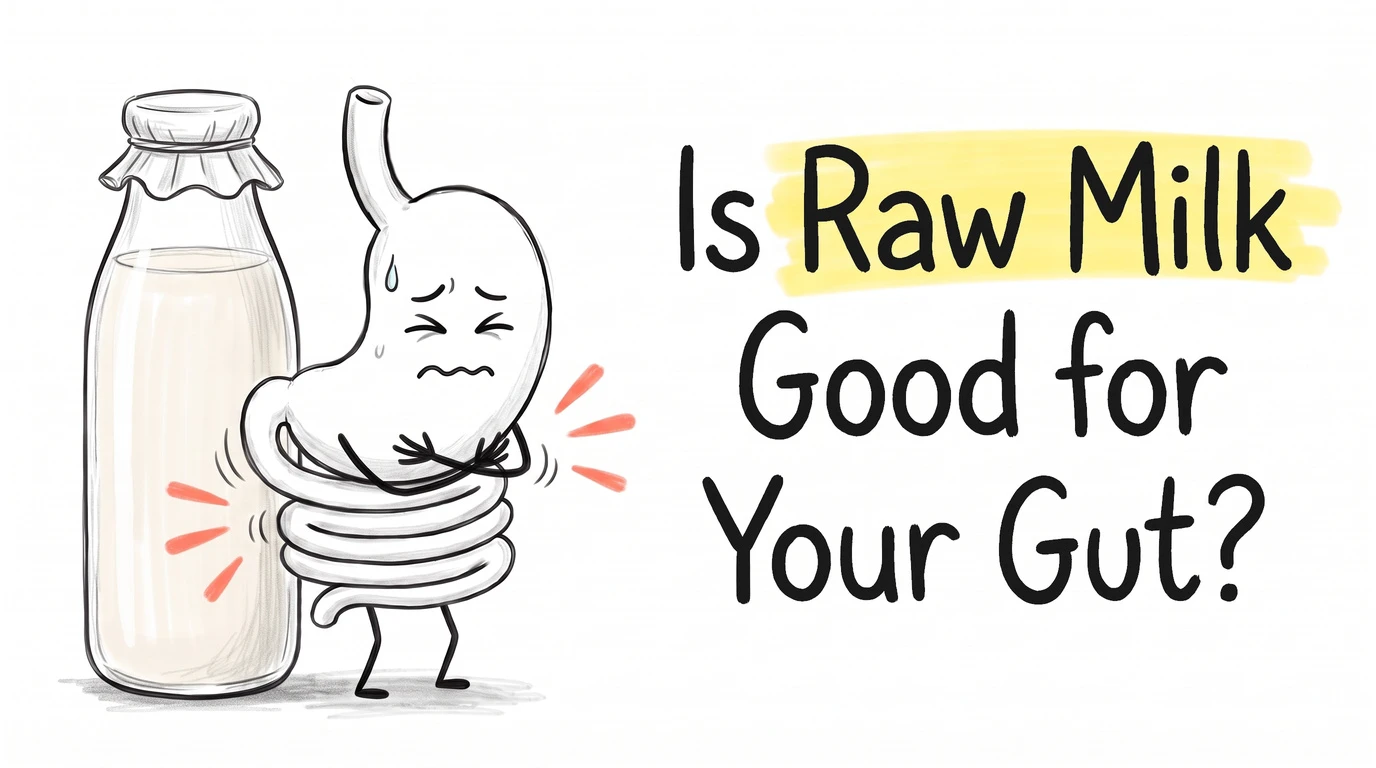
If you start typing "raw milk gut" into Google, it offers to finish the thought with "gut health," "gut healing," "gut microbiome," and "gut bacteria." If you type "does raw milk," one of the suggestions is "have probiotics." The people selling it say yes: Raw Farm, the largest raw milk dairy in the US, describes its whole milk as "complete with bioavailable vitamins, minerals, enzymes, beneficial bacteria."
Nobody has shown that raw milk improves a healthy person's digestion. The one trial that tested a gut claim (that raw milk is easier to digest if you're lactose intolerant) found that it wasn't. What raw milk has been shown to do to guts, over and over, is make them sick, and in US outbreaks from 2013 to 2018, about half of the people who got sick were 19 or younger.
What makes raw milk different?
Raw milk is milk that hasn't been pasteurized. Pasteurization means heating milk briefly to kill germs. The Academy of Nutrition and Dietetics (a professional organization for dietitians) describes the usual method as heating milk "to 161°F for at least 15 seconds" and then cooling it quickly. Without that step, more of the milk's bacteria survive, including some lactobacilli (relatives of the bacteria used to make yogurt), according to the Stanford team behind the lactose trial below.
The probiotic claim rests on those surviving bacteria, and it doesn't hold up well. A probiotic is a specific, tested strain that does something useful once you swallow it, and our probiotics article explains why the exact strain matters so much. The bacteria in raw milk are whatever came from the cow, the barn, and the milking equipment, and nobody chose or tested them. The FDA's page on raw milk myths is blunt: "There are no beneficial bacteria in raw milk for gastrointestinal health." The Academy of Nutrition and Dietetics is a little more careful and says the bacteria in raw milk are "not usually probiotic." An infectious disease doctor writing for the Infectious Diseases Society of America says that raw milk "may contain bacteria, but the presence of live microorganisms does not make a food beneficial or safe."
Does raw milk help if you're lactose intolerant?
Lactose is the only gut claim that anybody has put through a trial. The Campaign for Real Milk, a site published by the Weston A. Price Foundation (a nutrition advocacy group that promotes raw milk), says on its health page that "Raw milk contains lactase, an enzyme that allows us to digest lactose."
Milk doesn't come with lactase. Your small intestine makes it. The FDA says "There is no indigenous lactase in milk," and the American Medical Association adds that all milk, raw or pasteurized, "contains lactose and can cause lactose intolerance in sensitive people." (If you're trying to work out whether you're lactose intolerant in the first place, our lactose article covers how to test it.)
In 2010, researchers at Stanford ran the trial. They recruited adults who said they were lactose intolerant and confirmed it with a breath test (bacteria in your large intestine produce hydrogen when they ferment lactose you didn't absorb, so more hydrogen on your breath means more undigested lactose). Sixteen of them drank raw milk, pasteurized milk, and soy milk for eight days each, in random order, working up to 24 ounces in a day, without being told which milk was which.
Raw milk "failed to reduce lactose malabsorption or lactose intolerance symptoms compared with pasteurized milk," the authors concluded. On the first day, it produced more hydrogen than pasteurized milk did, which means more lactose went undigested. By day 8 the two were even, and symptoms were about the same on both.
The study was small, and the researchers called it a pilot. It was also paid for in part by "an unrestricted gift from the Weston A. Price Foundation," the same group that runs the site making the lactase claim. The paper says the funders had no role in the design or the analysis, and the result went against them anyway.
Before the trial even started, the breath test sorted out who qualified. Of the 63 people who came in believing that they were lactose intolerant, 36 (57%) turned out not to be malabsorbing lactose at all.
Has anyone seen raw milk change a gut?
In a 2020 study from Ireland, 24 adults spent 12 weeks on a residential cookery course at an organic farm, where most of what they ate came from the farm itself, raw milk included. Before the course, one of them drank raw milk. During it, 23 did. By the end, their stool had more Lactobacillus, and the increase tracked how much raw dairy each person had.
It also has a lot of holes. There was no comparison group, so there's no way to separate the milk from everything else that changed (new food, new cooking, a new place to live). The researchers name that confounding as "an obvious limitation" themselves. The overall variety of bacteria in their guts didn't change, and neither did their stool consistency or how satisfied they were with their bowel habits. One of the authors also founded the cookery school.
What about the farm kids with less asthma?
You'll see this one cited as proof that raw milk is good for you, even though it's about lungs rather than guts. Large studies of children growing up on farms in Germany, Austria, and Switzerland found less asthma and hay fever in kids who drank farm milk. The biggest of them, GABRIELA (8,334 children), found that boiled farm milk didn't show the same effect, which is a point for raw milk. It also found something that undercuts the probiotic story: the "total viable bacterial counts" in the milk "were not significantly related to asthma or atopy" (atopy is a tendency toward allergies). The link ran through whey proteins instead, and a follow-up study pointed at omega-3 fats. A 2019 review of that research notes that the study design "could not determine" how raw milk affects "the gut microflora and immune system."
When German researchers finally wanted to test the idea in babies, they didn't use raw milk. They wrote that "as raw milk bears potential health hazards, it cannot be recommended for prevention," and built their trial around a milk that was made safe from germs in a different way.
What can raw milk do to your gut?
A CDC team counted every outbreak linked to raw milk that health departments reported from 1998 to 2018. There were 202 outbreaks and 2,645 people sickened, with 228 hospitalized and 3 deaths. In the last six years of that window, 48% of the people who got sick were 19 or younger, and there were ten cases of hemolytic uremic syndrome (a kidney condition where destroyed red blood cells clog the kidneys' filters). NIDDK, the US government's institute for digestive and kidney diseases, says that E. coli infection of the digestive system is its most common cause in children.. Campylobacter was behind more of those outbreaks than any other germ.
Pasteurized milk isn't perfect either. Over the same 21 years, it was linked to 9 outbreaks, and one of those, in California in 2006, sickened 1,644 people on its own. But far fewer people drink raw milk. A separate CDC-published analysis estimated that raw milk, drunk by only 3.2% of Americans, caused 96% of the illnesses from contaminated milk and cheese. Those numbers only count outbreaks, so anybody who got sick alone and recovered at home without a test isn't in them.
ProPublica counted at least 233 people sickened in eight outbreaks that regulators have connected to Raw Farm (the dairy advertising "beneficial bacteria") since 2006, and the founder's pitch to the reporter included the line that raw milk "makes you feel good (the gut-brain serotonin and dopamine cycle)." ProPublica also reports that Robert F. Kennedy Jr., the US health secretary, has said that he is "advocating" for raw milk, and that the federal government dropped its efforts to take action against Raw Farm without publicly stating a reason. Research has "confirmed that pasteurization inactivates the virus" behind bird flu (H5N1), according to the FDA, which first detected it in dairy cows in March 2024. Whether it can reach people through raw milk is still an open question, since the FDA says it doesn't know "if the HPAI H5N1 virus can be transmitted to humans through consumption of raw milk" and advises strongly against drinking it.
On raw milk forums, people who get diarrhea after switching sometimes call it a "detox phase." None of the sources above describe anything like that. NIDDK lists diarrhea, bloody diarrhea, vomiting, belly pain, and fever as the common symptoms of food poisoning. Those are signs of food poisoning, and our guide to food poisoning vs a stomach bug covers when to get help.
So what should you drink?
Pasteurization doesn't strip out much. A 2011 review of 40 studies found that it lowers a few vitamins, but that "the effect of pasteurization on milk's nutritive value was minimal because many of these vitamins are naturally found in relatively low levels." The Infectious Diseases Society of America's advice to doctors ends on the same point: "Pasteurized milk provides the nutritional benefits of milk without the avoidable infectious risks of raw milk."
If what you want is live bacteria, yogurt and kefir with "live and active cultures" on the label are the better bet. Their bacteria are added on purpose. The FDA notes that the yogurts shown to help people digest lactose carried around 10 million or more of two specific bacteria in every milliliter, and that "these microorganisms were purposely inoculated."
Sources
- Raw Farm, Whole Raw Milk product page
- US Food and Drug Administration, Raw Milk Misconceptions and the Danger of Raw Milk Consumption (2024)
- Academy of Nutrition and Dietetics (eatright.org), Is Raw Milk Healthy? (2026)
- Doron S, Talking to patients about raw milk: What clinicians should know, IDSA Science Speaks (2026)
- A Campaign for Real Milk (Weston A. Price Foundation), Health page
- American Medical Association, Raw milk: Questions patients may have and how to answer (2024)
- Mummah S et al., Effect of raw milk on lactose intolerance: a randomized controlled pilot study, Annals of Family Medicine (2014)
- Butler MI et al., Recipe for a Healthy Gut: Intake of Unpasteurised Milk Is Associated with Increased Lactobacillus Abundance in the Human Gut Microbiome, Nutrients (2020)
- Loss G et al., The protective effect of farm milk consumption on childhood asthma and atopy: the GABRIELA study, Journal of Allergy and Clinical Immunology (2011)
- Brick T et al., ω-3 fatty acids contribute to the asthma-protective effect of unprocessed cow's milk, Journal of Allergy and Clinical Immunology (2016)
- Sozańska B, Raw Cow's Milk and Its Protective Effect on Allergies and Asthma, Nutrients (2019)
- Weber M et al., Prevention of allergies and infections by minimally processed milk in infants: the MARTHA feasibility and safety trial, Pediatric Allergy and Immunology (2024)
- Koski L et al., Foodborne illness outbreaks linked to unpasteurised milk and relationship to changes in state laws, United States, 1998–2018, Epidemiology and Infection (2022)
- Costard S et al., Outbreak-Related Disease Burden Associated with Consumption of Unpasteurized Cow's Milk and Cheese, United States, 2009–2014, Emerging Infectious Diseases (2017)
- NIDDK, Hemolytic Uremic Syndrome in Children
- NIDDK, Symptoms & Causes of Food Poisoning
- Waldman A, The Milkman, ProPublica (2026)
- US Food and Drug Administration, Investigation of Avian Influenza A (H5N1) Virus in Dairy Cattle
- Macdonald LE et al., A systematic review and meta-analysis of the effects of pasteurization on milk vitamins, and evidence for raw milk consumption and other health-related outcomes, Journal of Food Protection (2011)

.svg)
.webp)
.webp)



.webp)


.webp)
.webp)