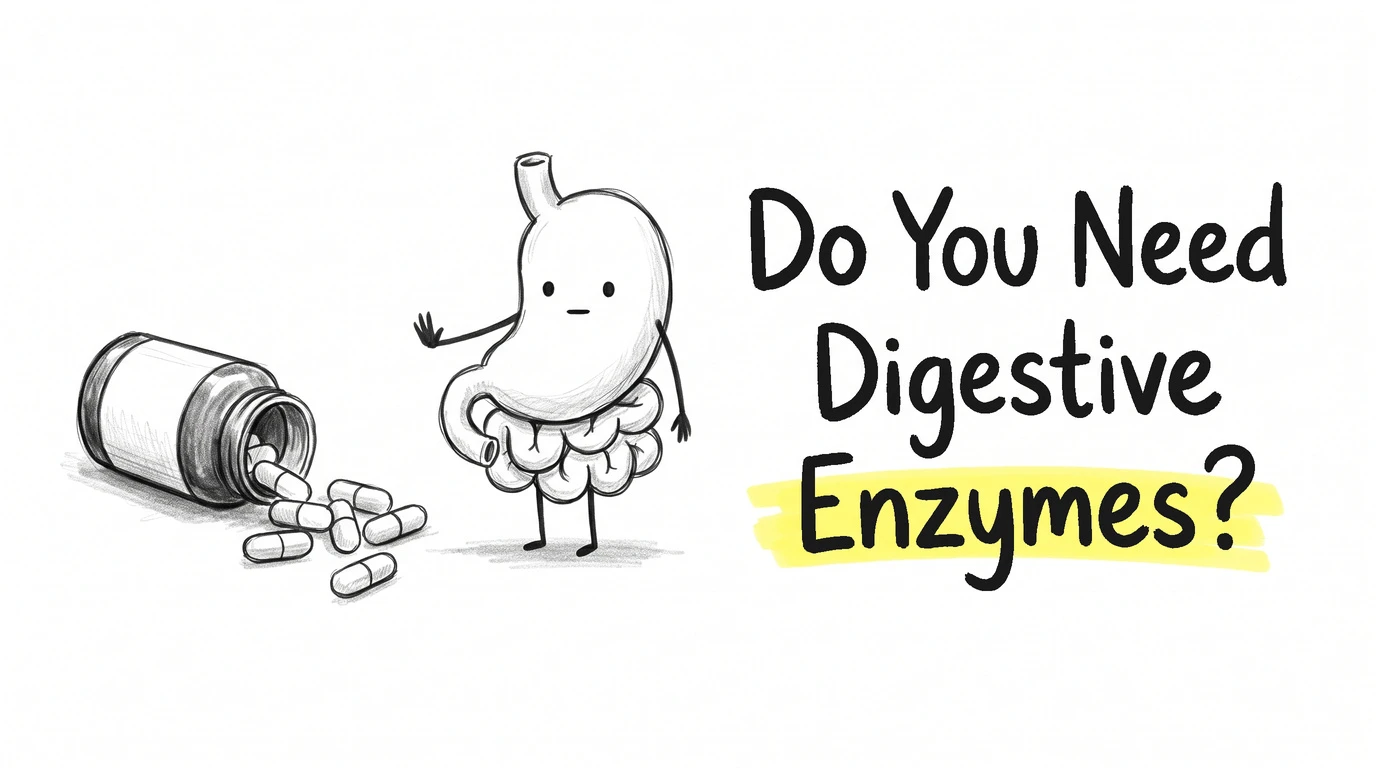
If you type "do digestive enzymes" into Google, it finishes the sentence with "work," "help with bloating," "actually work," and "really work." Another completion asks "does everyone need digestive enzymes," and the answer to that one is no. The people who genuinely need enzymes have a diagnosed condition, and what they take is a prescription drug, dosed and tested in a way that nothing on the supplement shelf is. A couple of single-purpose enzymes help a little with one specific food each. The broad blends sold for everyday bloating have thin evidence, and much of it was paid for by the companies selling them.
What your body already makes
An enzyme is a protein that speeds up one specific chemical reaction (if you want the full trip food takes, what is the gut, really? walks through it). Digestive enzymes cut food into pieces small enough to absorb: amylase for starch, protease for protein, lipase for fat. Your saliva and small intestine make some of them, but the big supplier is your pancreas, which Cleveland Clinic says makes "about 1 to 4 liters (L) of enzyme-rich juice each day."
It also makes far more than you need. The FDA, in the notice it used to regulate prescription enzyme drugs, explains that malabsorption (food passing through without being properly broken down and absorbed) "does not occur until the pancreatic enzyme output level is reduced by more than 90 percent." Cleveland Clinic gastroenterologist Alison Schneider puts the everyday version plainly: "in most cases, you don't need to worry about your body making enough." Morgan Denhard, a registered dietitian at Johns Hopkins, says the same about the pills: "a healthy person really doesn't need to take digestive enzyme supplements."
If you're wondering whether your enzymes run low as you get older, a 2018 review of the aging pancreas in the Journal of Internal Medicine found that the pancreas grows through childhood, stays at "a plateau between 20 and 60 years," and declines after that. Enzyme shortfall in healthy older people does exist, but it shows up in 5% of people over 70 and 10% over 80. At 16, yours hasn't reached that plateau yet.
Who actually needs them
The condition that calls for enzymes is exocrine pancreatic insufficiency, or EPI (the pancreas stops sending out enough digestive enzymes). NIDDK (the US government's institute for digestive diseases) lists chronic and acute pancreatitis (inflammation of the pancreas) and cystic fibrosis among its common causes, and Cleveland Clinic calls cystic fibrosis "the top cause of EPI in infants and children." A Cochrane review (a study of studies from the group that sets the standard for how those are done) says that "80% to 90%" of people with cystic fibrosis need enzyme replacement to prevent malnutrition.
Doctors diagnose EPI with a stool test that measures an enzyme called elastase. The American Gastroenterological Association (the main group of gut doctors in the US) wrote in 2023 that "response to a therapeutic trial of pancreatic enzymes is unreliable for EPI diagnosis." If feeling better on an enzyme pill can't tell a gastroenterologist whether your pancreas is working, it can't tell you either.
People with EPI take pancreatic enzyme replacement therapy (PERT), a prescription drug made from pig pancreas. The same AGA update starts adults at "at least 40,000 USP units of lipase during each meal" (a USP unit measures how much work an enzyme can do), then adjusts for meal size and fat. The dose is that exact because these drugs used to be unreliable. When the FDA moved to require approval for them in 2004, it cited an early study of 16 products on sale that ranged "from 10 to 3,600" units of lipase per pill, and said that uneven products had "resulted in instances of underdosing and overdosing." Since 2010, they've needed FDA approval like any other drug, and even now the label on one of them (Zenpep) says, "Do not substitute other pancreatic enzyme products."
In a 2010 study, researchers ran the stool test on 314 people who'd been diagnosed with diarrhea-type IBS (irritable bowel syndrome), and 19 of them (6.1%) came back low enough to indicate EPI. On prescription-strength enzymes, those 19 had less diarrhea and less stomach pain, while a matched group with IBS and normal tests didn't improve. There was no placebo group, and 6.1% is a small slice of people who already had a diagnosis, so it isn't a reason for a healthy teenager to take anything. For those 19, what looked like IBS was a pancreas problem that only the stool test caught.
The enzymes that help with one food
Two enzymes do a single job each, and you've probably seen both. Lactase breaks down the sugar in milk, and whether it's worth taking depends on how much dairy you're eating (am I lactose intolerant? goes through the numbers). Alpha-galactosidase, sold as Beano, breaks down the sugars in beans that your gut bacteria would otherwise turn into gas.
In a 2007 trial of Beano's enzyme, 8 healthy volunteers ate 420 grams of cooked beans (a little under a pound), and a high dose of the enzyme cut both the gas measured in their breath and how bad their flatulence got. A 2018 trial in 31 people with IBS found that 21 of them got worse on foods high in the sugars that beans carry, and in those 21, the enzyme cut bloating and overall symptoms, though the gas in their breath didn't change. And a 2021 trial in 20 adults with IBS found that it did no better than a placebo (a fake pill) on symptoms or on the gas in their breath. Why am I so gassy? covers what else is behind gas.
The blends on the shelf
The products autocomplete suggests next ("digestive enzymes walmart," "digestive enzymes for bloating") are something else: capsules that mix a dozen or more enzymes and promise to help with whatever you eat. Enzymedica's Digest Gold, which calls itself "America's #1 best-selling digestive enzyme formula," says that each capsule "can digest up to" 34 g of fat, 16 g of protein, and 86 g of carbs. The next line on the page reads, "These amounts are theoretical; many variables influence digestion," and further down sits the sentence supplements print next to their health claims: "These statements have not been evaluated by the Food and Drug Administration."
A supplement doesn't have to prove to the FDA that it works before it's sold, or that the amounts on the label are what's inside (the same problem probiotics have). When ConsumerLab, a company that tests supplements and sells a seal of approval to the ones that pass, checked nine popular enzyme products, "seven of the products had the major enzyme activity claimed, but two did not." Gut doctors who write the guidance on pancreatic enzymes warn that over-the-counter versions are "neither standardized nor regulated and their efficacy and safety are not known."
The trials behind the blends mostly come from the people selling them:
HUM's Flatter Me
HUM Nutrition tested its enzyme and herbal capsule on 20 women aged 18 to 45 who bloated after meals. Each ate a cheese pizza, once with the capsule and once with a placebo. HUM's own write-up says that bloating was 0.57 inches less on average with the capsule than with the placebo, and "as much as 2.06 inches." HUM hired an outside lab to run it, and it measured one meal.
DigeZyme
In a 2018 trial of 40 adults with functional dyspepsia (ongoing upper stomach pain and fullness with no cause doctors can find), an average pain score fell from 7.3 to 2.6 on the enzyme blend and from 7.6 to 5.6 on the placebo, so the placebo did a good share of the work too. The paper's own disclosure says that "the authors are founder/employees of Sami/Sabinsa that manufacture and market DigeZyme."
An independent trial
The strongest result for the blends is a 2023 trial of 120 adults with functional dyspepsia, run mostly out of the pharmacy department at the University of Naples, with no company among the authors' listed affiliations. After two months on a fungal enzyme blend or a placebo, the enzyme group improved on quality of life, pain, and sleep, and the authors called the blend "effective in the reduction of functional dyspepsia symptoms." It was run at one center and hasn't been repeated, and functional dyspepsia is a diagnosis, which is different from feeling heavy after a big dinner. The dyspepsia guideline below came out six years before it.
What the gut doctors' guidelines say
The American College of Gastroenterology's guideline on dyspepsia (upper stomach pain and fullness), written with its Canadian counterpart, doesn't use the word "enzyme" once. The 2025 guideline on IBS and stomach pain in kids and teens from the European and North American children's gut doctors' societies never mentions a digestive enzyme supplement. And a 2025 European consensus (a statement a panel of experts votes on) on bloating brings up enzymes only for testing the pancreas and for lactose, and doesn't recommend an enzyme supplement for bloating.
Are they safe to try?
For most healthy people, an occasional enzyme capsule is unlikely to do much of anything, good or bad. Cleveland Clinic lists constipation, nausea, stomach cramps, and diarrhea as possible side effects, which are some of the same things people take them for.
A capsule can also cover up something worth catching. NIDDK's list of EPI symptoms starts with bloating, stomach pain, diarrhea, and gas, which are the same complaints enzyme blends are sold for. What sets EPI apart is on the rest of that list: "loose, greasy, bad-smelling stools" and weight loss. If you're losing weight without trying, your poop looks greasy, or you have stomach trouble most days, see a doctor before you try the supplement aisle.
Sources
- Cleveland Clinic, Pancreas, 2024
- Cleveland Clinic Health Essentials, Digestive Enzymes 101: Why They're Important (Alison Schneider, MD), 2025
- Johns Hopkins Medicine, Digestive Enzymes and Digestive Enzyme Supplements (Morgan Denhard, MS, RD, LDN)
- US Food and Drug Administration, Exocrine Pancreatic Insufficiency Drug Products, Federal Register 69(82), 2004
- US Food and Drug Administration, Exocrine Pancreatic Insufficiency Drug Products; Extension to Obtain Marketing Approval, Federal Register 72(207), 2007
- Löhr JM et al., The ageing pancreas: a systematic review of the evidence and analysis of the consequences, Journal of Internal Medicine, 2018
- NIDDK, Symptoms & Causes for Exocrine Pancreatic Insufficiency
- NIDDK, Treatment for Exocrine Pancreatic Insufficiency
- Somaraju UR, Solis-Moya A, Pancreatic enzyme replacement therapy for people with cystic fibrosis, Cochrane Database of Systematic Reviews, 2020
- Whitcomb DC, Buchner AM, Forsmark CE, AGA Clinical Practice Update on the Epidemiology, Evaluation, and Management of Exocrine Pancreatic Insufficiency: Expert Review, Gastroenterology, 2023
- Whitcomb DC et al., AGA-PancreasFest Joint Symposium on Exocrine Pancreatic Insufficiency, Gastro Hep Advances, 2022
- DailyMed, ZENPEP label
- Leeds JS et al., Some patients with irritable bowel syndrome may have exocrine pancreatic insufficiency, Clinical Gastroenterology and Hepatology, 2010
- Di Stefano M et al., The effect of oral alpha-galactosidase on intestinal gas production and gas-related symptoms, Digestive Diseases and Sciences, 2007
- Tuck CJ et al., Increasing symptoms in irritable bowel symptoms with ingestion of galacto-oligosaccharides are mitigated by α-galactosidase treatment, American Journal of Gastroenterology, 2018
- Böhn L et al., A randomized double-blind placebo-controlled crossover pilot study: acute effects of the enzyme α-galactosidase on gastrointestinal symptoms in irritable bowel syndrome patients, Neurogastroenterology & Motility, 2021
- Enzymedica, Digest Gold with ATPro product page
- ConsumerLab.com, Tests of Digestive Enzyme Supplements Reveal What Labels Don't, 2015
- HUM Nutrition, Flatter Me clinical trial results
- Majeed M et al., Evaluation of the safety and efficacy of a multienzyme complex in patients with functional dyspepsia, Journal of Medicinal Food, 2018
- Ullah H et al., Efficacy of digestive enzyme supplementation in functional dyspepsia: a monocentric, randomized, double-blind, placebo-controlled, clinical trial, Biomedicine & Pharmacotherapy, 2023
- Moayyedi PM et al., ACG and CAG Clinical Guideline: Management of Dyspepsia, American Journal of Gastroenterology, 2017
- Groen J et al., ESPGHAN/NASPGHAN guidelines for treatment of irritable bowel syndrome and functional abdominal pain-not otherwise specified in children aged 4-18 years, Journal of Pediatric Gastroenterology and Nutrition, 2025
- European Consensus on Functional Bloating and Abdominal Distension: An ESNM/UEG Recommendations for Clinical Management, United European Gastroenterology Journal, 2025

.svg)
.webp)
.webp)



.webp)


.webp)
.webp)