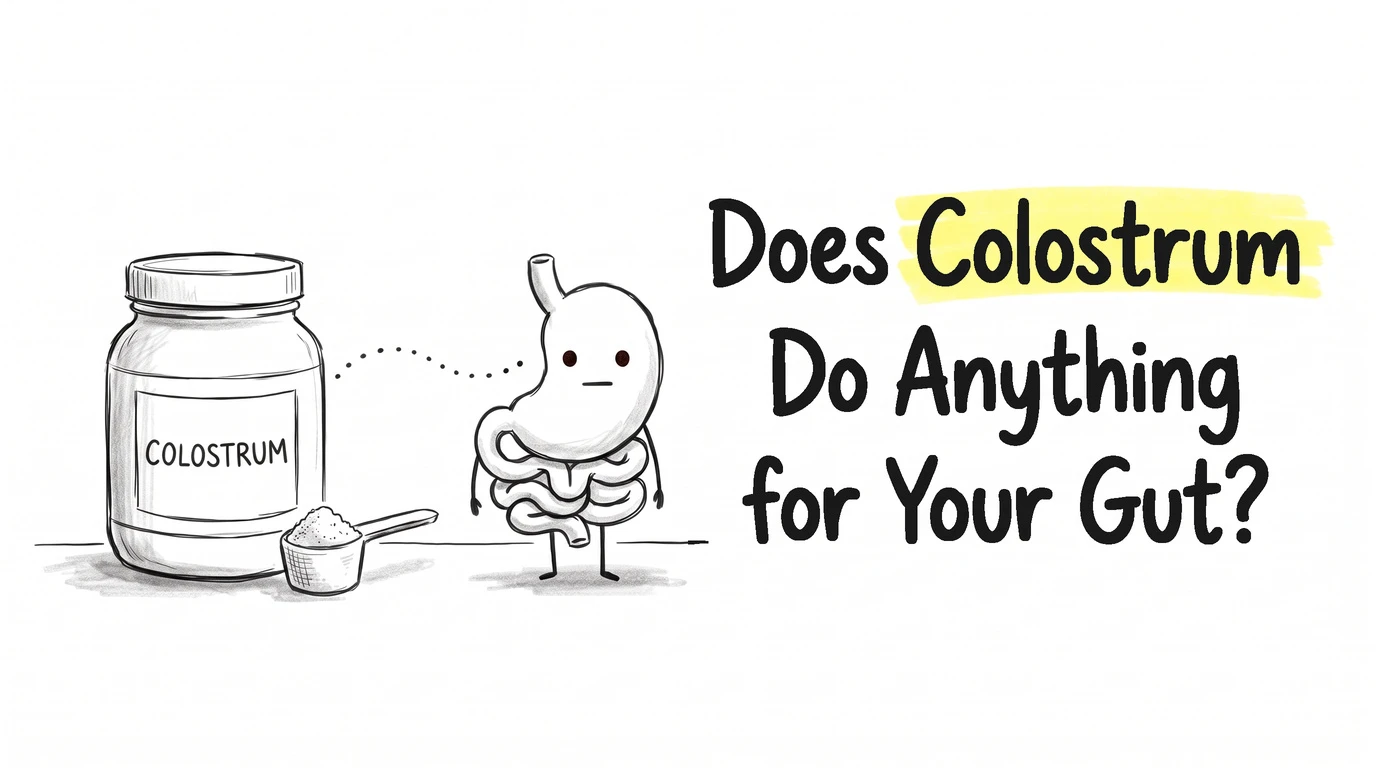
If you type "does colostrum" into Google, "does colostrum make you poop" and "does colostrum help with constipation" come up back to back, and "colostrum bloating" fills in as both "colostrum help bloating" and "colostrum cause bloating." ARMRA, a brand name that keeps showing up in those searches, says its powder "strengthens your body's barriers" and charges $119.99 for a 30-day jar.
No one has tested what colostrum does for a healthy teenager's gut. The trials where it helped mostly used athletes right after hard exercise, people given a painkiller that damages the gut, or a special version of colostrum made to fight one infection. When researchers gave it as a drink to people with IBS or Crohn's disease (one of those trials was in teens), it did about as much as a placebo.
What colostrum is
Colostrum is the first milk a mammal makes after giving birth. The kind sold as a supplement comes from cows (bovine colostrum). Penn State's dairy researchers describe it as the first feed "that allows the calf to be healthy and begin to grow," and say that its most important job is delivering "maternal antibodies that protect calves from disease." In their samples from 55 Pennsylvania dairy farms, it averaged about 15% protein and about 2.5% lactose (the sugar in milk), though the protein ran anywhere from about 7% to 23% depending on the farm.
Supplement brands focus on two things in it: the antibodies, and growth factors (proteins that signal cells to grow and repair themselves). ARMRA says that "reinforcing barrier integrity" leads to "fortified gut health," meaning a gut lining that doesn't leak.
The studies behind the gut-sealing claim
A UK team with Raymond Playford as lead author had already found that colostrum reduced painkiller damage to the gut "in rats and mice," and in 2001 they tested it in people. Seven healthy men took indomethacin (a strong NSAID, the same family as ibuprofen) three times a day for five days, once alongside whey protein and once alongside colostrum.
To measure leaking, researchers use a sugar test. You drink two sugars, one small and one larger, and the larger one (lactulose) mostly gets through the gut lining by squeezing between cells, so more of it turning up in your urine means the gaps have widened. On indomethacin plus whey, the men's ratio tripled. On indomethacin plus colostrum (125 mL of it, three times a day), it didn't rise by a significant amount. The same paper tested 15 patients who'd been taking NSAIDs for a long time, and colostrum made no difference for them, partly because their guts weren't leaking much to begin with.
In a 2011 trial with Playford as an author, 12 men who trained regularly took colostrum or a placebo for 14 days, then did a hard 20-minute run. On the placebo, the sugar ratio went up 2.5 times after the run, and colostrum cut that rise by 80%. The authors disclosed that Fonterra, the company that produced the colostrum, "provided partial financial support," and that Playford had worked as a consultant for the company that imported it.
A team at the University of South Australia ran a longer version and got the opposite result. Thirty men (their average age was 25) ran three times a week for eight weeks while taking 60 grams a day of colostrum, whey protein, or nothing. The colostrum group's sugar ratio went up by about 251%, compared with about 21% for whey, and the authors concluded that colostrum "increased intestinal permeability compared with whey protein and a control." That study was partly funded by Numico, the company that made the colostrum it tested.
Nobody knows yet why the two trials disagree. One tested a single hard run and the other tested two months of training, and the doses and colostrum products were different. A 2024 meta-analysis (a study that pools the results of earlier trials) combined ten trials in athletes and patients and found colostrum lowered the sugar ratio overall. The trials it pooled disagreed with each other so much that the average hides a lot, and a blood marker for damaged gut cells (called I-FABP) showed no difference between colostrum and the comparison groups. The authors wrote that "more randomized clinical trials" are needed. An article from Cedars-Sinai, a Los Angeles hospital, summed up the research this way: "Some showed modest improvement, others showed no effect at all, and one reported an increase in leaky gut."
A gut that leaks a bit more during a hard workout is also a different situation from the "leaky gut" that supplement ads describe. Is Leaky Gut Real? covers that difference.
What happens in people with gut problems
In a trial at Yonsei University in Seoul, 18 adults with IBS (irritable bowel syndrome) drank either colostrum or an artificial milk placebo every morning for four weeks. Symptoms improved about the same in both groups, and the researchers concluded that colostrum "had no benefits in relieving symptoms." The group was small, and the authors pointed out that placebo response rates in IBS trials have ranged from 16% to 71%, so a lot of people feel better on a fake treatment too.
The only trial in teenagers comes from Alder Hey Children's Hospital in Liverpool. Twenty-three kids and teens with Crohn's disease, ages 8 to 17 with a median age of 15, took colostrum or a placebo milk every day for six weeks. "Symptoms, clinical and laboratory variables and quality of life were similar in the two arms," including the same sugar test the athlete studies used. Playford was one of the authors. The trial was designed to find out whether young people would stick with colostrum every day, and the researchers say it was too small to tell whether it works. They also wrote that there isn't enough research yet to even run a systematic review of colostrum for Crohn's.
A 2002 trial in 14 adults with ulcerative colitis (a type of inflammatory bowel disease in the colon) went the other way. A colostrum enema (liquid put in through the rectum) twice a day, on top of regular medication, improved symptom scores more than a placebo enema did. The authors called it a "potential" therapy and said further studies "appear to be warranted."
The colostrum that clearly worked
Hyperimmune colostrum is made by vaccinating cows against a specific germ so that their colostrum carries antibodies to it. In two trials with 90 healthy adults, researchers made tablets from the colostrum of cows vaccinated against 14 strains of E. coli that cause traveler's diarrhea, then had volunteers swallow one of those strains on purpose. In the first trial, the tablets gave "90.9% protection against diarrhea" compared with placebo. The company that made the tablets paid for the study, and one author owned shares in Immuron, the company behind them.
Those tablets were built to fight one infection and tested against that exact infection, so the result doesn't tell you anything about a general colostrum powder. For diarrhea more broadly, the Academy of Nutrition and Dietetics (the main professional group for dietitians in the US) says reviews have found colostrum's effect "inconclusive."
Where the 86% comes from
ARMRA's website says that "86% experienced less bloating" and "78% noticed improvements in their IBS symptoms." The fine print says that the numbers come from "a dual-arm clinical research survey of participants ages 18-65 taking ARMRA Colostrum™ daily for a period of 3 months."
ARMRA has one study registered on ClinicalTrials.gov (the US government's database of clinical trials), and it matches that description. Sixty adults took two 1-gram sachets a day for 12 weeks, split into two groups: people with digestive complaints and people who exercise. Both groups took ARMRA. Nobody got a placebo, nobody was randomly assigned, and everyone knew what they were taking. It was finished in 2023, and no results have been posted to the registry.
Without a group taking a fake powder, there's no way to tell whether people felt less bloated because of the colostrum or because they expected to. The IBS numbers above show how big that expectation effect can be.
In 2019 the FDA sent a warning letter to another colostrum company, Sovereign Laboratories, for saying that "colostrum can correct this leaky gut syndrome," because a supplement that claims to treat a disease is legally being sold as a drug. Beth Czerwony, a dietitian at Cleveland Clinic, told the hospital's health site, "As a dietitian, I look at the science and there isn't enough for me to recommend trying bovine colostrum."
Is it safe to try?
The side effects Cleveland Clinic lists are nausea and gas. Three groups have more to think about.
If you're under 18
Health Canada, which licenses supplements in Canada, only lets colostrum products claim to support the immune system, not the gut. Its rules are written for "adults 18 years and older," and say to ask a doctor before using it for more than 12 weeks.
If you're allergic to milk or sensitive to lactose
Health Canada says not to take it if you have "a known allergy/hypersensitivity to cow's milk." Colostrum also carries lactose, so if milk bothers your stomach, the lactose article covers how to tell whether that's why.
If you're a tested athlete
The Australian Institute of Sport, which rates supplements for athletes, puts colostrum in Group D, its category for products that are "banned or at high risk of contamination with substances that could lead to a positive doping test." Its note on colostrum says that it's "not recommended by WADA (the World Anti-Doping Agency) due to the inclusion of growth factors within its composition." If your sport drug-tests, ask your athletic trainer before taking it.
Czerwony also raised a concern about those growth factors: "The growth factors in colostrum are designed to help newborns grow, and so it's not designed for adults."
What to do if your gut is actually bothering you
If you're bloated, constipated, or just feel off, the things with evidence behind them are cheaper: fiber, a variety of plants, and regular meals, all covered in How to Improve Your Gut Health. If a symptom keeps coming back, or you see blood in your stool, lose weight without trying, or have belly pain that lasts for weeks, see a doctor instead of trying another powder. Probiotics aren't a better bet for everyday symptoms, since they help in a few specific situations and not much outside of them.
Sources
- Penn State Extension, Composition and Hygiene of Colostrum on Modern Pennsylvania Dairy Farms
- ARMRA, homepage
- ARMRA, Clinically Backed
- Playford RJ et al., Co-administration of the health food supplement, bovine colostrum, reduces the acute non-steroidal anti-inflammatory drug-induced increase in intestinal permeability, Clinical Science, 2001
- Marchbank T et al., The nutriceutical bovine colostrum truncates the increase in gut permeability caused by heavy exercise in athletes, American Journal of Physiology: Gastrointestinal and Liver Physiology, 2011
- Buckley JD et al., Bovine colostrum supplementation during running training increases intestinal permeability, Nutrients, 2009
- Bovine Colostrum in Increased Intestinal Permeability in Healthy Athletes and Patients: A Meta-Analysis of Randomized Clinical Trials, Digestive Diseases and Sciences, 2024
- Cedars-Sinai, Are Colostrum Supplements "Liquid Gold" for Adults?
- Yoon JY, Park SJ, Cheon JH, Effect of Colostrum on the Symptoms and Mucosal Permeability in Patients with Irritable Bowel Syndrome, Intestinal Research, 2014
- Allen SJ et al., Dietary Therapy to Improve Nutrition and Gut Health in Paediatric Crohn's Disease; A Feasibility Study, Nutrients, 2022
- Khan Z et al., Use of the "nutriceutical", bovine colostrum, for the treatment of distal colitis: results from an initial study, Alimentary Pharmacology & Therapeutics, 2002
- Otto W et al., Randomized control trials using a tablet formulation of hyperimmune bovine colostrum to prevent diarrhea caused by enterotoxigenic Escherichia coli in volunteers, Scandinavian Journal of Gastroenterology, 2011
- Academy of Nutrition and Dietetics, What Are Colostrum Supplements?
- ClinicalTrials.gov, NCT05831527, An Exploratory Investigation of a Supplement to Promote Gut Health
- FDA, Warning Letter to Sovereign Laboratories, LLC, 2019
- Cleveland Clinic, Bovine Colostrum: Why You Should Skip This Pricey Supplement
- Health Canada, Natural Health Products Ingredients Database, Bovine Colostrum monograph
- Australian Institute of Sport, Supplements: Group D


.svg)
.webp)
.webp)



.webp)


.webp)
.webp)