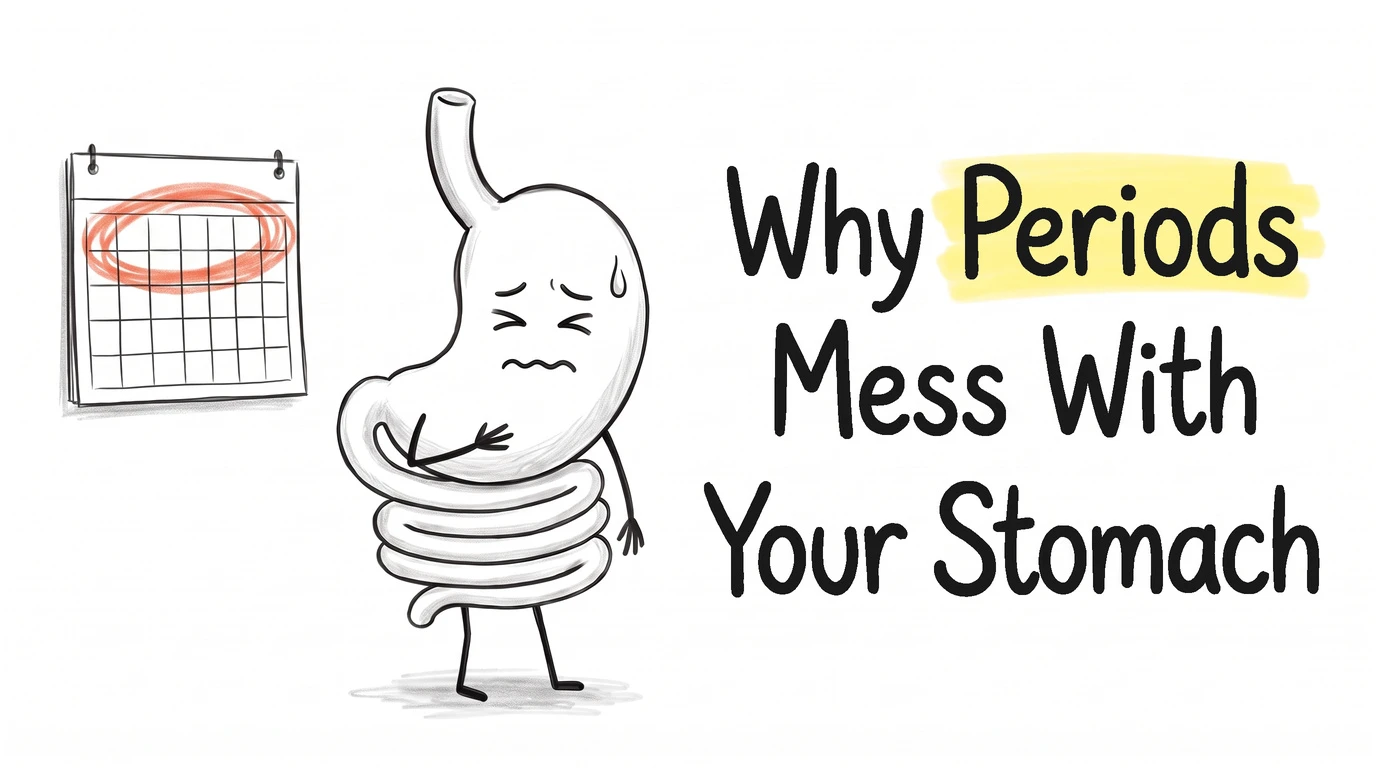
If you type "why do periods make you" into Google, "poop" is the second suggestion, right after "tired," with "bloated," "gassy," and "nauseous" close behind. If you type "why do I get diarrhea on my," Google finishes it with "period," "period first day," and "period endometriosis."
Stomach trouble around your period is common, and the first day is usually the worst. The standard explanation is prostaglandins (chemical messengers your body makes on demand), which build up in the lining of your uterus right before a period and make it squeeze. Drugs made from prostaglandins do cause diarrhea, so the explanation holds together, but the step in the middle, where prostaglandins from your uterus actually get to your intestines, hasn't been shown. The other explanation you'll see everywhere, that progesterone backs you up before your period, rests on gut-speed studies that mostly didn't agree with each other.
How many people get it
In a 2014 Canadian survey of 156 healthy women who came to a gynecology clinic for a routine checkup, 73% had at least one gut symptom (belly pain, diarrhea, constipation, nausea, or vomiting) in the five days before their period or during it. Diarrhea showed up in 24% of them before their period and 28% during it. Those women averaged 32 years old, so the numbers come from people older than you.
The closest match to your age is a 2025 survey of 987 high school students aged 16 to 19 in Oslo, Norway. Among the students with severe cramps (8 or higher on a 0 to 10 pain scale), 47.8% reported vomiting with their periods, compared with 12.5% of the students whose cramps were milder. Vomiting was also the symptom most closely tied to missing school, with nearly twice the odds. Boston Children's Hospital's guide to cramps for teens lists nausea, vomiting, "loose bowel movements/diarrhea," constipation, and bloating as things that can come along with them.
When researchers at the University of Central Florida surveyed 603 college women in 2023 (average age 19) and sorted them by where they were in their cycle, gut symptom scores came out the same across every phase. The one difference was pain in the lower middle of the belly, which was higher during periods. That study took a snapshot of how people felt that week instead of asking what usually happens around their period, which may explain some of the difference. In the Canadian survey, the stomach trouble clustered in the women who said that their periods were usually painful. During their periods, 24% of them had nausea, compared with 3% of women whose periods didn't hurt.
What prostaglandins do
The American College of Obstetricians and Gynecologists (ACOG, the main group of US doctors who treat periods and pregnancy) explains that cramps come from prostaglandins "made in the lining of the uterus," which make its muscle and blood vessels squeeze. "On the first day of a period, the level of prostaglandins is high," and it drops as the lining sheds, which is why the first day or two tend to be the worst. MedlinePlus (the US National Library of Medicine's health site) says that painful periods usually come from "having too many prostaglandins."
They're the same chemicals that ibuprofen shuts down, and your body uses them for plenty of jobs besides cramps, including keeping your stomach lining in good repair. Boston Children's adds that "high levels of prostaglandins may also cause nausea and lightheadedness."
Do they actually reach your gut?
Prostaglandins can make you go. Misoprostol (sold as Cytotec) is a synthetic prostaglandin that doctors prescribe to protect the stomach from ibuprofen-type painkillers. Its FDA label says that the most common gut side effects in its trials "were diarrhea and abdominal pain," with diarrhea in 13% of more than 5,000 patients on average, and more of it at higher doses.
The Canadian researchers wrote that "it is not known whether uterine prostaglandins are transported to the gut," or whether your intestines ramp up their own at the same time.
In a University of Washington study where 53 women kept daily diaries for three cycles, worse cramps went along with more nausea and stomach pain, but not with diarrhea, constipation, or any change in their poop. An earlier diary study from the same group found that stools were loosest during periods for the group as a whole, which included women on the pill and women without bad cramps. And in a 2020 University of Florida study of 78 women aged 18 to 35, all of them on the pill, belly pain and diarrhea were higher on the first day of bleeding than on any other day, though the diarrhea was mild on average. These are small studies, but in them the nausea travels with the cramps, and the loose stools show up with or without them.
What about progesterone?
The other explanation you'll read is that progesterone, a hormone that rises in the second half of your cycle, slows your gut down and backs you up, and then drops right before your period so that everything lets go. Cleveland Clinic's Dr. Donald Ford puts the constipation "around ovulation or a couple of days after" (there's more on that in the constipation article).
In a 1981 study of 15 women, food took longer to move through the gut in the high-progesterone half of the cycle. Later studies didn't find that, including a 1989 one co-written by the lead author of the 1981 study. After measuring how much transit times bounce around in healthy women and men, a 1996 team at the Mayo Clinic concluded that any effect from period hormones "must be small and of doubtful clinical significance." A 2015 review of the transit studies called the results "inconclusive."
Why you feel bloated
A study in Vancouver followed 62 women for a year, 765 cycles in all, and had them rate their fluid retention (how puffy and swollen they felt) every day. The scores peaked on the first day of their period, and they had no link to the women's measured estrogen or progesterone levels. If it's gas more than swelling, why am I so gassy? and how to get rid of bloating cover what you can do.
What helps
MedlinePlus says that NSAIDs (ibuprofen and naproxen) "reduce the amount of prostaglandins that your uterus makes," and ACOG says that they "work best if taken at the first sign of your period or pain." Ibuprofen can bother your stomach on its own, so which painkiller is easiest on your stomach goes through how to take it and what to pick. MedlinePlus also suggests a heating pad or hot water bottle on your lower belly, exercise, and a hot bath.
When it's more than a period
NICE (the body that writes health guidelines for England) tells doctors to suspect endometriosis, including in girls aged 17 and under, when someone has "period-related or cyclical gastrointestinal symptoms, in particular, painful bowel movements." Endometriosis is where tissue similar to the lining of the uterus grows in other parts of the body, sometimes on the bowel. The NHS lists "pain when you poo or pee" and period pain that stops you from doing your normal activities among its symptoms. MedlinePlus says to get help if you have pain "even when you are not getting your period," if your cramps suddenly get worse, or if you have a fever with your period pain.
Period symptoms can also get mistaken for IBS (irritable bowel syndrome). A 2026 survey of 2,926 girls aged 10 to 16 in Colombia who had started their periods found that of the 45 who met the kids' criteria for IBS, 62.2% had symptoms "exclusively during menstruation." The kids' rules don't separate period-only pain from pain the rest of the month, so cramps plus period diarrhea can add up to IBS on paper. If your stomach trouble lines up with your cycle, tell your doctor, since the timing is part of what they need to know. What is IBS? covers the condition itself.
Sources
- Bernstein MT, Graff LA, Avery L, Palatnick C, Parnerowski K, Targownik LE, Gastrointestinal symptoms before and during menses in healthy women, BMC Women's Health, 2014
- Gravdahl OF, Svenningsen R, Majak P, Majak G, Menstrual-related symptoms as red flags for school absenteeism among Norwegian adolescents (MINA): A cross-sectional study, Acta Obstetricia et Gynecologica Scandinavica, 2025
- Center for Young Women's Health, Boston Children's Hospital, Menstrual Cramps
- Mendelson S, Anbukkarasu P, Cassisi JE, Zaman W, Gastrointestinal functioning and menstrual cycle phase in emerging young adult women: a cross-sectional study, BMC Gastroenterology, 2023
- American College of Obstetricians and Gynecologists, Dysmenorrhea: Painful Periods
- MedlinePlus, Period Pain
- Pfizer, Cytotec (misoprostol) prescribing information, DailyMed
- Jarrett M, Cain KC, Heitkemper M, Levy RL, Relationship between gastrointestinal and dysmenorrheic symptoms at menses, Research in Nursing & Health, 1996
- Heitkemper MM, Shaver JF, Mitchell ES, Gastrointestinal symptoms and bowel patterns across the menstrual cycle in dysmenorrhea, Nursing Research, 1988
- Judkins TC, Dennis-Wall JC, Sims SM, Colee J, Langkamp-Henken B, Stool frequency and form and gastrointestinal symptoms differ by day of the menstrual cycle in healthy adult women taking oral contraceptives, BMC Women's Health, 2020
- Cleveland Clinic, Here's the Deal With Period Poops
- Wald A et al., Gastrointestinal transit: the effect of the menstrual cycle, Gastroenterology, 1981
- Hinds JP, Stoney B, Wald A, Does gender or the menstrual cycle affect colonic transit?, American Journal of Gastroenterology, 1989
- Degen LP, Phillips SF, Variability of gastrointestinal transit in healthy women and men, Gut, 1996
- Bharadwaj S, Barber MD, Graff LA, Shen B, Symptomatology of irritable bowel syndrome and inflammatory bowel disease during the menstrual cycle, Gastroenterology Report, 2015
- White CP, Hitchcock CL, Vigna YM, Prior JC, Fluid retention over the menstrual cycle: 1-year data from the Prospective Ovulation Cohort, Obstetrics and Gynecology International, 2011
- NICE, Endometriosis: diagnosis and management (NG73)
- NHS, Endometriosis
- Arrizabalo S et al., Menstrual-Associated Gastrointestinal Symptoms and Their Impact on IBS Diagnosis in Adolescents, Neurogastroenterology and Motility, 2026


.svg)
.webp)
.webp)



.webp)


.webp)
.webp)