You get a headache around nine at night and realize that you haven't eaten since lunch. You take two Advil anyway, because the alternative is lying in the dark waiting for it to pass. Twenty minutes later there's a hot, scraped feeling under your ribs, and you're on your phone trying to work out whether you just did something to your stomach.
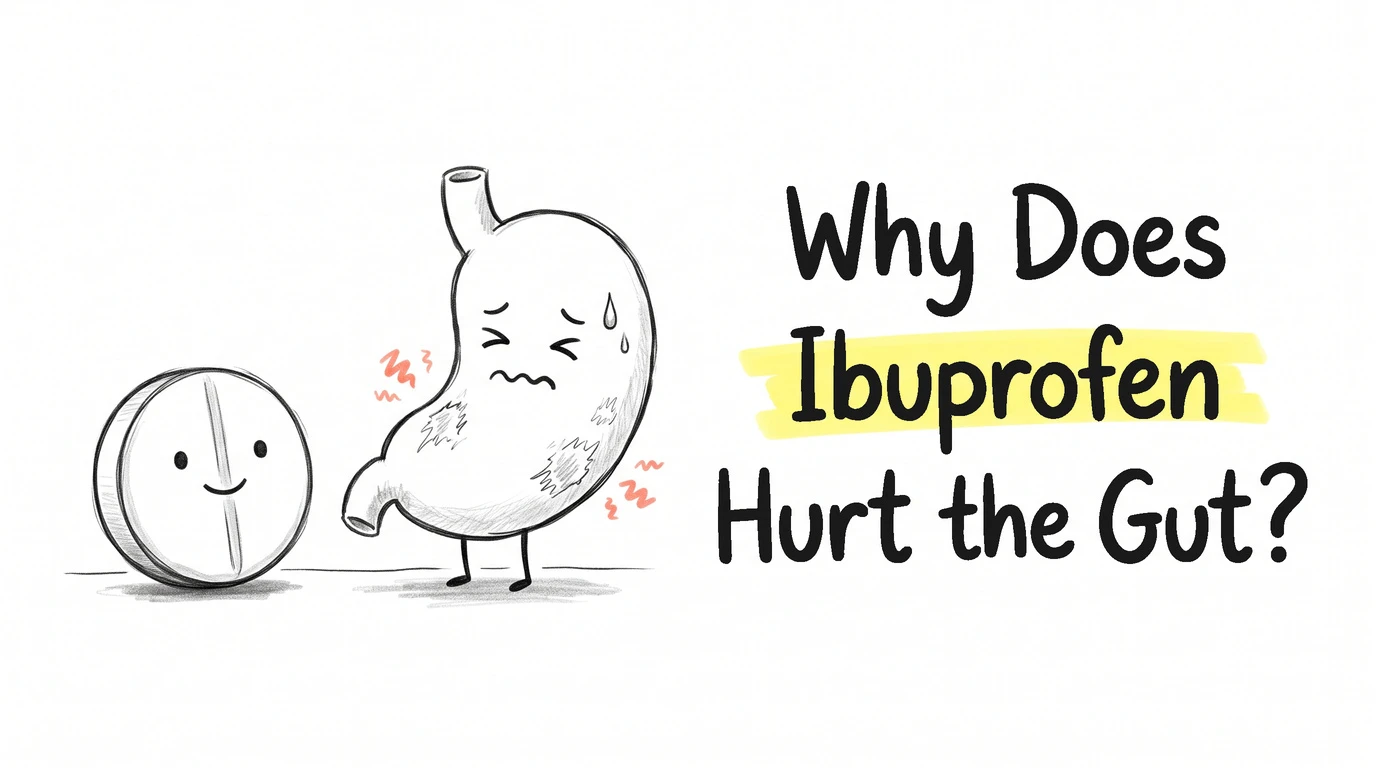
Ibuprofen does damage stomachs. The damage is usually silent, though, and the burning you're feeling right now is probably not it.
Your stomach is made of protein and filled with acid
Gastric acid sits at a pH of about 1.5 to 3.5, strong enough to pull apart the proteins in your food. Your stomach wall is also protein. It doesn't digest itself because it lays down a layer of mucus and bicarbonate (a base, the same compound as baking soda, which neutralizes acid) over its own lining and replaces that layer constantly, while a heavy blood supply keeps the cells underneath fed and repaired.
All of that maintenance runs on prostaglandins, which are signaling chemicals your body builds on demand out of the fats in your cell membranes. Prostaglandins are also part of why a rolled ankle swells and throbs.
Ibuprofen works by blocking the enzyme that makes them. The enzyme is called COX (short for cyclooxygenase), it comes in two versions, and ibuprofen blocks both. One version is the one making the prostaglandins behind your headache. The other is the one your stomach has been using all day to keep the shield in good repair.
So the pain relief and the stomach trouble are the same action, aimed at two places at once. NIDDK, the digestive-disease institute at NIH, puts it in one sentence: NSAIDs (non-steroidal anti-inflammatory drugs, the family ibuprofen belongs to along with aspirin and naproxen) "relieve pain, but they also make the stomach lining more prone to damage and ulcers." The American College of Gastroenterology adds a second effect that matters once something has already torn: NSAIDs "can also interfere with your body's natural blood clotting," and clotting is what stops a small bleed from staying open.
What the coated-aspirin study showed
If you ask around, you'll hear that ibuprofen burns your stomach on contact, which is why the tablets are coated and why you're supposed to put food in first. If that were the whole story, then a pill engineered to skip the stomach entirely should be much safer.
Somebody checked. Aspirin, a close cousin of ibuprofen, is sold in an enteric-coated form, meaning that the coating is built to survive stomach acid and dissolve further down. One study compared 550 people admitted to hospital with serious upper gut bleeding against 1,202 people from population census lists, and sorted them by which kind of aspirin they took. At daily doses of 325 mg or less, the relative risk of bleeding was 2.6 for plain aspirin, 2.7 for enteric-coated, and 3.1 for buffered. Their conclusion: "The assumption that these formulations are less harmful than plain aspirin may be mistaken."
Keeping the pill off of the lining did not help, because the drug doesn't have to touch your stomach to reach it. It gets absorbed into your blood, travels everywhere your blood goes, and turns down prostaglandin production in tissue the tablet never came near.
Eating first, and what it does
If you read the actual box, the advice is narrower than the version you were given. The Advil label, whose warning text the FDA writes into federal regulation, says this under "When using this product": "take with food or milk if stomach upset occurs." That sentence tells you what to do about a symptom you already have. Nowhere does the label tell you to eat first.
The NHS is blunter: "You can eat and drink normally while taking ibuprofen." Cleveland Clinic is the outlier that says otherwise, instructing readers to "always take NSAIDs with food (preferably, a full meal)" to reduce ulcer risk, and its own page cites nothing in particular for that.
Milk has its own problem. In a study of ten people, 240 ml of whole, low-fat, or nonfat milk all produced a significant increase in acid secretion, because milk carries protein and calcium and both of them tell your stomach to make more acid. It does not coat anything.
None of which means that you should ignore your stomach. If eating settles it, eat. Food works here as a comfort measure, and comfort is a decent reason on its own, separate from the question of whether anything is being protected.
Where that gets more complicated
The people who study this for a living stop short of saying that contact has nothing to do with it.
In the current mechanism review in Gastroenterology, six of the field's NSAID researchers argue that COX blocking on its own doesn't account for the damage. In their model, NSAIDs first interact with the phospholipids (the fat molecules that build cell membranes) in the stomach lining and interfere with the mitochondria inside those cells, which is what "impair[s] function of the gastrointestinal barrier." Then, as they put it, "NSAID inhibition of COX enzymes, along with luminal aggressors, results in erosions and ulcers." Luminal aggressors means the acid and the bacteria already sitting in the tube.
So contact starts it and the prostaglandin shutdown is what lets it become a wound. Whoever told you the pill touching your stomach matters was partly right. What they got wrong was the conclusion, since putting a sandwich between the tablet and your stomach wall does nothing about the half of the mechanism that arrives through your bloodstream.
The burning and the damage are two different things
One trial gave 27 healthy adults the maximum over-the-counter dose of ibuprofen, 1,200 mg a day, for seven days, and then looked inside with a camera. More than 30% of the people taking the liquid capsules had what the authors called clinically significant damage: 26% scored numerous areas of erosion, and 4% had an ulcer. Across the whole ibuprofen group, three people reported abdominal pain and none reported indigestion. Not one participant tested positive for blood in the stool.
Most of the people with visible damage felt nothing. NIDDK says the same about ulcers generally: "Many people who have peptic ulcers don't have any symptoms," and often don't develop any until a complication arrives.
In a study of 8,633 people taking painkillers for ordinary pain, at over-the-counter doses for one to seven days, 11.5% of the ibuprofen group reported gut side effects, against 13.1% on paracetamol (acetaminophen, the drug in Tylenol, which has no effect on your stomach's prostaglandins at all). That difference was not significant. Aspirin came in at 18.5%. Stomach complaints after swallowing a pill are common, and ibuprofen at normal doses is not obviously the reason for them.
The American College of Gastroenterology puts the caution plainly: "there are many causes of abdominal pain, so not all pain in the abdomen is an 'ulcer'."
Dose is the thing that actually moves
Ibuprofen has a reputation as the gentle NSAID and it holds up in the data, sort of. A review pooling twelve studies found that ibuprofen "ranked lowest or equal lowest for risk in 10 of the 11 studies" that included it. The authors then explained the ranking away in their own conclusion: the low risk "seems to be attributable mainly to the low doses of the drug used in clinical practice," and "Higher doses of ibuprofen were associated with relative risks similar to those with naproxen and indomethacin." Ibuprofen looks gentle because people take less of it, which stops being true the moment you take more of it.
Six 200 mg tablets in 24 hours is the over-the-counter ceiling, and the label tells you to stop and ask a doctor if pain lasts more than ten days. Look at the FDA's own list of things that raise your chance of severe stomach bleeding: being 60 or older, a history of ulcers or bleeding problems, blood thinners or steroids, other NSAIDs on top, three or more alcoholic drinks a day, and "take more or for a longer time than directed." Five of those six describe somebody who isn't you. The sixth is the one you can walk into by accident, usually at the moment when 400 mg hasn't touched a toothache and the bottle is right there.
Doubling up counts even when the second drug has a different name on it. The NHS is explicit: "Do not take ibuprofen at the same time as other non-steroidal anti-inflammatory drugs (NSAIDs), such as naproxen or aspirin. This can increase the risk of serious side effects like stomach ulcers." Plenty of people don't know that Advil, Motrin, and store-brand ibuprofen are the same drug.
The signs that mean stop and get checked
Bleeding in your stomach announces itself further down, and usually not as pain. The label's list is short: feel faint, vomit blood, bloody or black stools, or stomach pain that does not get better.
The ACG describes what those look like in practice. Blood that has spent hours in your gut comes out as melena, "jet black, sticky stool (often compared to 'roof tar')." Blood coming up looks like "red blood or may look like 'coffee grounds'." Add passing out or feeling lightheaded, and "Symptoms of rapid bleeding represent a medical emergency," meaning 911 or the nearest emergency room rather than a wait-and-see.
Iron supplements and Pepto-Bismol can set off a false alarm, since both turn stool black on their own.
If you already have Crohn's disease or ulcerative colitis, Cleveland Clinic lists both as reasons to avoid NSAIDs, so that conversation goes to your doctor rather than to a search bar. And if you're reaching for ibuprofen most days, whether it's for headaches, cramps, or a joint that hasn't settled down since the season started, the number of days is a bigger deal than any single dose, and it's worth telling somebody about.
What to do the next time your head hurts
Students asking this question online almost always end up at the same follow-up: how much food counts? Does one egg do it? Half a granola bar? Nobody can tell you, because food isn't the thing standing between you and the damage in the first place.
Take the smallest dose that works, which for most pain is 200 to 400 mg rather than a reflexive 800. Take it for as few days as you can. If it upsets your stomach, eat something, and if it doesn't, don't build your dosing schedule around finding a meal. When the first dose feels slow, wait it out instead of stacking another one on top, since that instinct is what walks people into the one risk factor on the FDA's list that applies to a healthy teenager. Don't combine it with another NSAID. If your stomach burns every single time you take it, stop guessing and get it looked at, because persistent upper-gut pain has a long list of causes and most of them are not the pill.
And if a headache hits at nine at night on an empty stomach, taking the ibuprofen is still the reasonable call. Eat something if it makes you feel better. Your stomach lining is not keeping score of that one night.
Sources
- NIDDK (National Institute of Diabetes and Digestive and Kidney Diseases). "Symptoms & Causes of Peptic Ulcers (Stomach or Duodenal Ulcers)."
- American College of Gastroenterology. "Peptic Ulcer Disease." Patient topic page, updated June 2024 by Ami J. Panara, MD, University of Miami
- Kelly JP, Kaufman DW, Jurgelon JM, Sheehan J, Koff RS, Shapiro S. "Risk of aspirin-associated major upper-gastrointestinal bleeding with enteric-coated or buffered product." The Lancet 1996;348:1413-1416
- Haleon US Holdings LLC. Advil (ibuprofen) 200 mg OTC Drug Facts label, DailyMed (US National Library of Medicine), updated March 12, 2026
- US Food and Drug Administration. 21 CFR § 201.326, required stomach bleeding warning for OTC internal analgesics
- NHS. "Ibuprofen for adults (Nurofen)." Last reviewed 27 August 2025
- Cleveland Clinic. "NSAIDs (Nonsteroidal Anti-Inflammatory Drugs)." Last updated 07/24/2023
- Ippoliti AF, Maxwell V, Isenberg JI. "The effect of various forms of milk on gastric-acid secretion." Annals of Internal Medicine 1976;84:286-289
- Bjarnason I, Scarpignato C, Holmgren E, Olszewski M, Rainsford KD, Lanas A. "Mechanisms of Damage to the Gastrointestinal Tract From Nonsteroidal Anti-Inflammatory Drugs." Gastroenterology 2018;154(3):500-514
- Lanza FL, Collaku A, Liu DJ. "Endoscopic comparison of gastroduodenal injury with over-the-counter doses of new fast-dissolving ibuprofen and paracetamol formulations." Clinical and Experimental Gastroenterology 2018;11:169-177
- Rampal P, Moore N, Van Ganse E, Le Parc JM, Wall R, Schneid H, Verrière F. "Gastrointestinal tolerability of ibuprofen compared with paracetamol and aspirin at over-the-counter doses." Journal of International Medical Research 2002;30:301-308
- Henry D, Lim LL, Garcia Rodriguez LA, et al. "Variability in risk of gastrointestinal complications with individual non-steroidal anti-inflammatory drugs: results of a collaborative meta-analysis." BMJ 1996;312:1563-1566


.svg)
.webp)
.webp)



.webp)


.webp)
.webp)