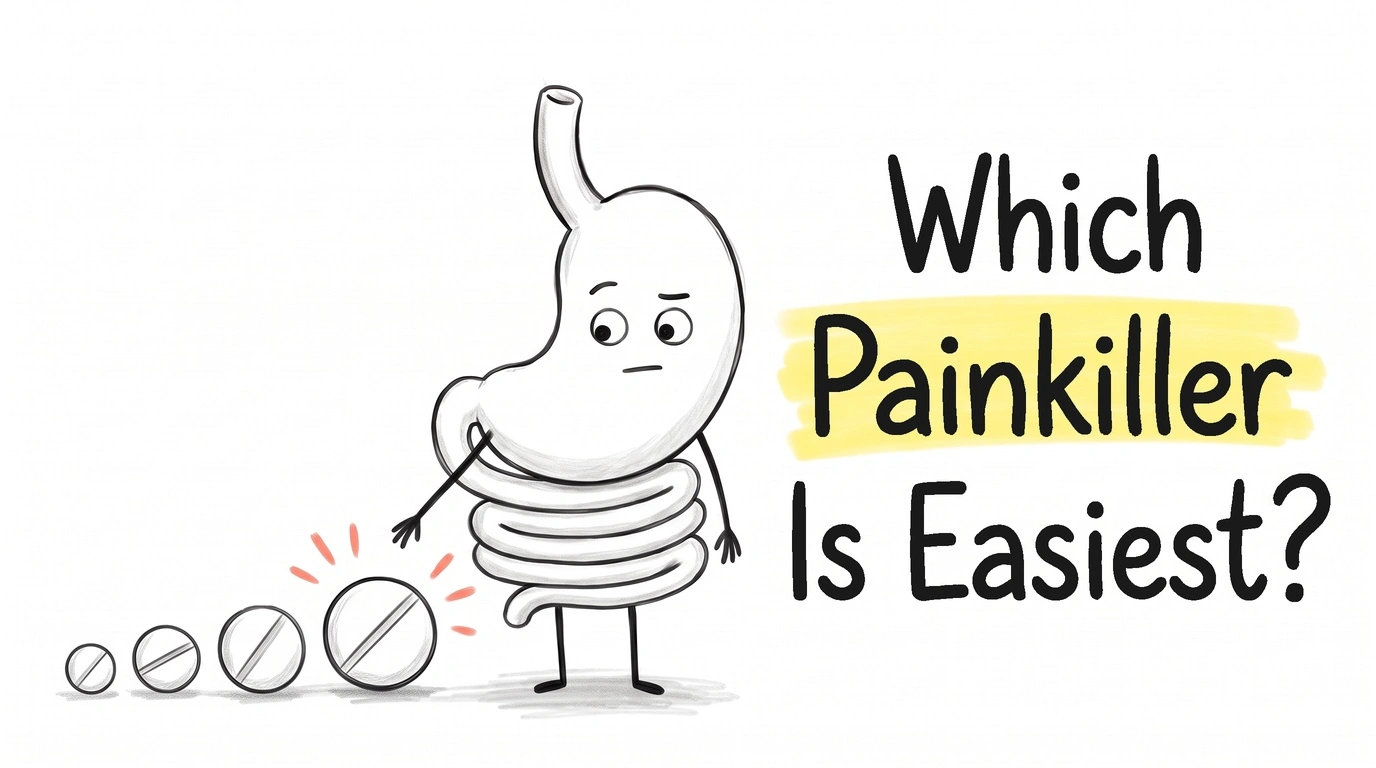
If you start typing "is aleve easier on the stomach" into Google, it finishes the question for you: than ibuprofen, than Advil. If you type "is naproxen harder on" instead, it offers the reverse: harder on the stomach than ibuprofen, harder on the stomach than Advil. People are asking it both ways about the same drug (naproxen is what's in Aleve), which tells you that nobody's sure.
Naproxen is harder. For the serious damage (ulcers and bleeding), the order runs acetaminophen (Tylenol), then ibuprofen (Advil, Motrin), then naproxen, then aspirin. Acetaminophen's lead comes with conditions, though. It depends on how much you take, it doesn't show up for an ordinary stomach ache, and acetaminophen is the weakest choice of the four for period cramps.
How the four drugs rank
Ibuprofen, naproxen, and aspirin are all NSAIDs (non-steroidal anti-inflammatory drugs), and they all ease pain by shutting down the same chemicals your stomach uses to keep its lining repaired. Our article on ibuprofen walks through how that works. Acetaminophen isn't an NSAID and doesn't do this to your stomach, which is why it lands first.
The SOS Project, a European Union-funded meta-analysis (a study that pools the results of many earlier studies), ranked the NSAIDs against each other using 28 studies. It measured the risk of serious upper-gut problems, meaning bleeding or a hole in the stomach or the start of the small intestine, compared with people taking nothing. Ibuprofen users had about 1.8 times the risk. Naproxen users had about 4.1 times the risk. The difference held when the researchers looked only at low and medium doses, where naproxen still came out at 3.6 against ibuprofen's 2.2.
Those numbers come mostly from adults taking the drugs regularly, often for arthritis, so they tell you which drug is harsher and not how likely you are to bleed after a weekend of taking it. For a healthy teenager taking a few doses, the chance is much lower for both, as the trial further down shows.
Naproxen's selling point is that it lasts. Aleve's label says to take one pill "every 8 to 12 hours," with no more than three in a day. That staying power may be part of the problem. A UK study of nearly a million patients, published in Epidemiology, found that NSAIDs which stay in the body a long time carried more stomach risk than ones your body clears quickly (4.5 times the risk of taking nothing, against 3.1).
Aspirin comes last. In the PAIN study, a trial of 8,677 adults who took aspirin, acetaminophen, or ibuprofen at over-the-counter doses for up to seven days, stomach pain showed up in 6.8% of the aspirin group, against 3.9% on acetaminophen and 2.8% on ibuprofen, so at those doses, acetaminophen didn't spare anyone's stomach any better than ibuprofen did. The one ulcer in the whole trial was in the aspirin group. The same trial also counted six minor stomach bleeds, and four of them were on acetaminophen, although six is too few to mean much. The study was funded by Boots Healthcare International, which owned Nurofen, a UK ibuprofen brand, at the time, so the company paying for the trial sold the drug that came out best. If you're 15 or younger, aspirin is off the table anyway. The NHS (the UK's national health service) says not to give it to children 15 or under "because it can cause a serious condition called Reye's syndrome in rare cases."
Where Tylenol's lead runs out
Tylenol's website says that it "doesn't irritate the stomach like naproxen sodium (Aleve®) or even ibuprofen (Advil®, MOTRIN®) can," and there's truth to that. The Tylenol Extra Strength label has a liver warning where the Advil and Aleve labels have a stomach bleeding warning, and the word stomach doesn't appear on it anywhere.
In that same UK study, though, people taking acetaminophen at less than 2,000 mg a day "did not have an increased risk of upper gastrointestinal complications." Above 2,000 mg a day, their risk was 3.6 times that of people taking nothing, which was higher than the 2.4 the same study found for low and medium doses of NSAIDs. An Extra Strength caplet is 500 mg, and the label allows six in a day, so the full label dose lands at 3,000 mg, over the line where the risk started climbing.
That study counted what happened to people rather than assigning them a drug, so it can't fully separate the acetaminophen from the reasons people were taking it. People who already have stomach trouble often get steered toward acetaminophen, which could make it look worse than it is.
A randomized trial (one where chance decides who gets which drug) points the same direction. Researchers gave 892 adults aged 40 and over with knee pain either 3,000 mg of acetaminophen a day, 1,200 mg of ibuprofen a day, or a combination of both, for 13 weeks. The share of people whose blood count dropped by a meaningful amount (a sign of slow bleeding somewhere in the gut) was 20.3% on acetaminophen and 19.6% on ibuprofen, and 38.4% on the higher-dose combination. The authors concluded that acetaminophen at that dose "may cause similar degrees of blood loss as ibuprofen," and that combining the two "appears to be additive." Those were older adults taking the maximum every day for three months, which is a long way from a headache on a Tuesday. It still means that a pill combining the two isn't a free upgrade.
Acetaminophen's bigger danger is to your liver. The FDA sets the ceiling at 4,000 mg a day for anyone 12 and older, and says that "more than 600 medications" contain it. The FDA's own example is somebody who has been taking a cough and flu medicine all day and then grabs a couple of Tylenol for a headache. In a US study of acute liver failure, acetaminophen caused 42% of the cases, and 48% of those overdoses were unintentional. Check the ingredient list on anything else you're taking before you add a Tylenol to it.
For cramps, the ranking flips
The American College of Obstetricians and Gynecologists, the main group of US doctors who treat periods and pregnancy, says that medication is "usually the first step" for painful periods and names two drugs: "Most NSAIDs, such as ibuprofen and naproxen, can be bought over the counter." Its page on period pain doesn't mention acetaminophen at all.
ACOG explains that cramps are caused by prostaglandins "made in the lining of the uterus," and prostaglandins are the chemicals NSAIDs shut down, so NSAIDs go after the source. A Cochrane review (a study of studies from an independent group that grades medical evidence) found that NSAIDs "appeared to be more effective for pain relief than paracetamol," which is acetaminophen's name outside of the US, though that comparison rested on only three trials. The same review found "little evidence of the superiority of any individual NSAID," so for cramps, ibuprofen does the job with less stomach risk than naproxen. The group also says that NSAIDs "work best if taken at the first sign of your period or pain," so the time to take one is when the cramps start rather than once they're bad.
The gel, and what its label says
A gel is meant to treat the sore joint under your skin without sending much of the drug through the rest of your body. A Cochrane review of 61 trials in adults with sprains, strains, and sports injuries found that NSAID gels gave pain relief "probably similar to that provided by oral NSAIDs," with "very few systemic adverse events," meaning side effects anywhere outside of the patch of skin.
The over-the-counter gel in the US is Voltaren (diclofenac), and its label disagrees with that review. Under "Do not use," it lists "strains, sprains, bruises or sports injuries," and says that the product "has not been shown to work for these types of injuries." It's approved "for the temporary relief of arthritis pain ONLY" in the hands, wrists, elbows, feet, ankles, and knees, and it tells you to ask a doctor before using it if you're under 18. It also still carries a stomach bleeding warning, calling the chance "small but higher" in the same groups as the pills. The review pooled trials of many different gels and patches (diclofenac, ibuprofen, ketoprofen, and others), while the label covers one US product and only what the FDA approved it for. Either way, the box in a US drugstore isn't approved for a twisted ankle.
What to reach for
If your worry is ulcers or bleeding, acetaminophen at less than 2,000 mg a day is the safest pick for a headache or a fever. Ibuprofen at the smallest dose that works is the gentlest NSAID, and for a few days of use it's about as easy on your stomach as acetaminophen. For cramps, ibuprofen at the first sign of pain beats both acetaminophen and naproxen. For a twisted ankle, ask a doctor about a gel instead of buying one on your own, since the US label rules out sports injuries and anyone under 18. Skip aspirin for everyday pain.
Whichever one you pick, don't take two NSAIDs together (Advil and Aleve count as two), and don't take two products that both contain acetaminophen. If you have Crohn's disease or ulcerative colitis, or you've ever had an ulcer, the choice between these drugs belongs to your doctor. And if you ever see black, tarry stool or throw up something that looks like coffee grounds after taking any of them, those are the signs of a stomach bleed and they need a doctor that day.
Sources
- Castellsague J et al., Individual NSAIDs and upper gastrointestinal complications: a systematic review and meta-analysis of observational studies (the SOS project), Drug Safety, 2012
- DailyMed (US National Library of Medicine), Aleve (naproxen sodium) Drug Facts label
- Moore N et al., The PAIN Study: Paracetamol, Aspirin and Ibuprofen New Tolerability Study, Clinical Drug Investigation, 1999
- NHS, Aspirin for pain relief
- Kenvue, Acetaminophen and stomach problems, tylenol.com
- DailyMed, Tylenol Extra Strength (acetaminophen) Drug Facts label
- García Rodríguez LA, Hernández-Díaz S, Relative risk of upper gastrointestinal complications among users of acetaminophen and nonsteroidal anti-inflammatory drugs, Epidemiology, 2001
- Doherty M et al., A randomised controlled trial of ibuprofen, paracetamol or a combination tablet of ibuprofen/paracetamol in community-derived people with knee pain, Annals of the Rheumatic Diseases, 2011
- FDA, Acetaminophen (Safe Use of Over-the-Counter Pain Relievers and Fever Reducers)
- FDA, Don't Overuse Acetaminophen
- Larson AM et al., Acetaminophen-induced acute liver failure: results of a United States multicenter, prospective study, Hepatology, 2005
- American College of Obstetricians and Gynecologists, Dysmenorrhea: Painful Periods
- Marjoribanks J et al., Nonsteroidal anti-inflammatory drugs for dysmenorrhoea, Cochrane Database of Systematic Reviews, 2015
- Derry S et al., Topical NSAIDs for acute musculoskeletal pain in adults, Cochrane Database of Systematic Reviews, 2015
- DailyMed, Voltaren Arthritis Pain (diclofenac sodium gel) Drug Facts label

.svg)
.webp)
.webp)



.webp)


.webp)
.webp)