If you type "can ibs turn into" into Google, the suggestions finish the question for you: IBD, cancer, ulcerative colitis, Crohn's disease, colon cancer, and near the bottom, "something worse." If you type "ibs or ibd," one of the suggestions is "which is dangerous."
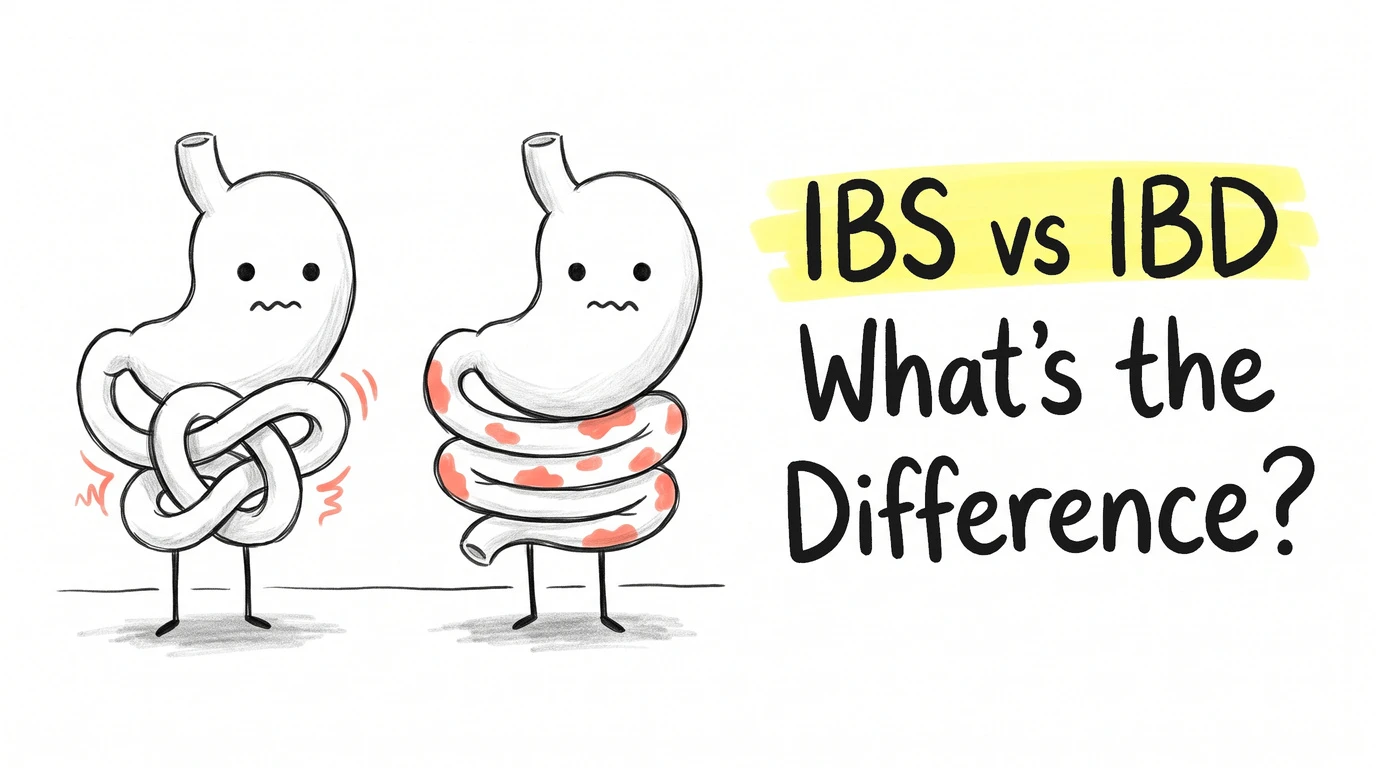
The two names are one letter apart, and they share a lot of symptoms (stomach pain, diarrhea, constipation, bloating, etc.), so it makes sense that people mix them up. They're separate conditions, though, and doctors test for them and treat them differently. IBS doesn't damage your gut. IBD does, and it needs treatment to stop the damage.
What IBS is
IBS stands for irritable bowel syndrome. NIDDK (the US government's institute for digestive diseases) describes it as "a group of symptoms that occur together, including repeated pain in your abdomen and changes in your bowel movements," which can mean diarrhea, constipation, or both. With IBS, NIDDK adds, you have those symptoms "without any visible signs of damage or disease in your digestive tract."
Doctors now call IBS a disorder of gut-brain interaction, meaning that the trouble is in how your gut and your brain work together rather than in the structure of the gut itself. The Crohn's & Colitis Foundation explains where the "irritable" part of the name comes from: "the nerve endings in the lining of the bowel are unusually sensitive, and the nerves that control the muscles of the gut are unusually active." So ordinary things like a big meal, a stressful week, or certain foods can set off pain, cramping, or a sprint to the bathroom that someone else's gut would handle without them noticing. (The gut-brain connection is also why your stomach reacts when you're nervous.)
What IBD is
Inflammatory bowel disease, or IBD, covers two main diseases: Crohn's disease and ulcerative colitis. In Cleveland Clinic's words, "When you have IBD, your immune system mistakenly attacks your body, which causes chronic and harmful inflammation." The Crohn's & Colitis Foundation says that IBD "can cause destructive inflammation and permanent harm to the intestines."
If you want the details on one of the two, we have a full explainer on what Crohn's disease is.
Which one is more common?
IBS, by a lot. The Rome Foundation (the international group that writes the rules for diagnosing gut-brain disorders) surveyed more than 73,000 adults in 33 countries, and among the people who answered online, 4.1% had IBS under the stricter rules doctors were using at the time and 10.1% under the older, looser ones. IBD is much rarer. A 2023 study of US insurance records found that about 7 in every 1,000 Americans have been diagnosed with it (roughly 2.39 million people), and that new cases peak in people's twenties.
Is IBS all in your head?
"Is ibs just in your head," "is ibs just anxiety," and "is ibs just stress" are all Google suggestions. That belief is common enough that it's part of why doctors renamed the whole category. IBS used to be called a "functional" disorder, and the Rome Foundation says that the word was dropped because it's "potentially stigmatizing for being viewed as 'nonorganic' or even psychiatric."
IBS often starts after an infection. A 2017 review pooled 45 studies of more than 21,000 people who'd had a gut infection (the food poisoning or stomach bug kind), and found that 10.1% of them had IBS a year later. In the first year after the infection, their risk of IBS was about four times that of people who hadn't been sick, and after a bacterial infection specifically, 13.8% went on to develop it.
In that same review, people who had anxiety had about twice the odds of developing IBS after an infection, so stress does play a part. The Crohn's & Colitis Foundation's version is that "while stress can aggravate IBS, the syndrome is actually caused by a disturbance between the brain and the gut."
Almost every IBS explainer, Cleveland Clinic's included, also says that IBS "doesn't involve inflammation." That holds at the level a colonoscopy can see. The Rome Foundation's own definition, though, lists "altered mucosal and immune function" (small changes in the gut lining and in how immune cells behave there) as one possible source of IBS symptoms. Those changes are small, and they don't show up as disease the way IBD does.
How a doctor tells them apart
Doctors used to diagnose IBS mostly by ruling everything else out first. The American College of Gastroenterology (the main professional group for gut doctors in the US) now suggests the opposite, diagnosing IBS from the pattern of your symptoms, "a positive diagnostic strategy as compared to a diagnostic strategy of exclusion," so that people start treatment sooner.
The most useful of the simple tests for telling IBS from IBD is a stool test for calprotectin (a protein that some white blood cells release, which shows up in your stool when your intestines are inflamed). For people with IBS symptoms and diarrhea, the ACG suggests checking it along with CRP (a blood marker of inflammation anywhere in the body) "to rule out inflammatory bowel disease." A 2015 analysis found that in adults with IBS symptoms, a calprotectin level at or below 40 μg/g meant a 1% chance or less of having IBD.
A high result doesn't settle it the other way. The British Society of Gastroenterology notes that calprotectin "is not specific to IBD" and can also go up with an infection or with anti-inflammatory painkillers like ibuprofen, so a high number leads to more testing rather than a diagnosis. IBD is usually confirmed with a colonoscopy, where a doctor looks at the inside of your intestine with a small camera and takes tiny tissue samples. IBS doesn't have an equivalent. The Crohn's & Colitis Foundation says that IBS "cannot be confirmed by visual examination or with diagnostic tools and procedures."
Symptoms that point toward IBD
The two overlap a lot, but a few symptoms belong to IBD. The Crohn's & Colitis Foundation lists them in one line: "Anemia, bleeding, weight loss, and fever are symptoms of IBD, not IBS." (Anemia means having too few red blood cells, which often shows up as being tired all the time and looking pale.) The NHS says to ask for an urgent appointment if you've "lost a lot of weight for no reason" or are "bleeding from your bottom or have bloody diarrhoea."
Even without any of those, the NHS says to see a doctor if you think you might have IBS and have had symptoms "for over 4 weeks."
How each one gets treated
Cleveland Clinic sums up IBS treatment as "treat the symptoms and avoid triggers," which can mean diet changes like the low FODMAP diet (a kind of elimination diet), exercise and sleep, and medicine for specific symptoms. For IBD it's "control inflammation and treat any damage from inflammation," usually with medicines that turn down the immune system and sometimes with surgery to remove damaged tissue. In Cleveland Clinic's words, "Both IBS and IBD are treatable but not curable."
Can IBS turn into IBD?
A UK study followed 112,854 people after an IBS diagnosis and compared them with people who didn't have IBS. In the first six months, the IBS group was diagnosed with IBD between 16.8 and 24.5 times as often, depending on age. The researchers read that as IBD that was already there and hadn't been found yet: in those cases, "the IBS code does not reflect a final diagnosis but rather it is part of the clinical pathway to obtaining a final organic diagnosis." In plain terms, some people get told it's IBS while their doctors are still working out what's wrong.
That doesn't explain all of it. Even after leaving out the first year, IBD was about four times as common in the IBS group, and the authors conclude that "a small excess risk of coeliac disease and IBD persists." After 15 years, 1.9% of the IBS group had been diagnosed with IBD, compared with 0.5% of everyone else. That means that about 98 in 100 people with IBS never got an IBD diagnosis in those 15 years, and the study can't say whether the rest had IBD from the start or developed it later.
If you've been told you have IBS and one of the IBD symptoms above shows up (bleeding, weight loss, fever), go back to your doctor rather than assuming it's the same IBS.
Can you have both?
Yes. A 2012 analysis of 13 studies found that 39% of people with IBD had symptoms that met the criteria for IBS, including 35% of those whose IBD was thought to be in remission. That number depends a lot on how remission gets checked. When a 2024 US study only counted people whose remission was confirmed by colonoscopy and biopsy, 11 of 125 met the full IBS criteria. Both studies were in adults.
Which one is more dangerous?
IBD. Cleveland Clinic gastroenterologist Jessica Philpott says that IBS "can hugely impact your quality of life," but "it's not destructive to your GI tract like IBD, and it doesn't threaten your overall health." The Crohn's & Colitis Foundation lists an increased risk of colon cancer for IBD and none for IBS, and in the UK study, people more than five years past an IBS diagnosis had "no increased risk" of colorectal cancer compared with everyone else.
That doesn't make IBS mild. The Crohn's & Colitis Foundation says that its symptoms "can range from mildly annoying to disabling."
Sources
- NIDDK, Definition & Facts for Irritable Bowel Syndrome
- Crohn's & Colitis Foundation, IBS vs IBD
- Cleveland Clinic, Understanding the Differences Between IBD and IBS
- The Rome Foundation, What is a Disorder of Gut-Brain Interaction (DGBI)?
- Sperber AD et al., Worldwide Prevalence and Burden of Functional Gastrointestinal Disorders, Results of Rome Foundation Global Study, Gastroenterology, 2021
- Lewis JD et al., Incidence, Prevalence, and Racial and Ethnic Distribution of Inflammatory Bowel Disease in the United States, Gastroenterology, 2023
- Klem F et al., Prevalence, Risk Factors, and Outcomes of Irritable Bowel Syndrome After Infectious Enteritis: A Systematic Review and Meta-analysis, Gastroenterology, 2017
- Lacy BE et al., ACG Clinical Guideline: Management of Irritable Bowel Syndrome, American Journal of Gastroenterology, 2021
- Menees SB et al., A meta-analysis of the utility of C-reactive protein, erythrocyte sedimentation rate, fecal calprotectin, and fecal lactoferrin to exclude inflammatory bowel disease in adults with IBS, American Journal of Gastroenterology, 2015
- Vasant DH et al., British Society of Gastroenterology guidelines on the management of irritable bowel syndrome, Gut, 2021
- NHS, Symptoms of irritable bowel syndrome (IBS)
- Canavan C, Card T, West J, The Incidence of Other Gastroenterological Disease following Diagnosis of Irritable Bowel Syndrome in the UK: A Cohort Study, PLOS ONE, 2014
- Halpin SJ, Ford AC, Prevalence of symptoms meeting criteria for irritable bowel syndrome in inflammatory bowel disease: systematic review and meta-analysis, American Journal of Gastroenterology, 2012
- Burdine LK et al., Irritable Bowel Syndrome/Inflammatory Bowel Disease Overlap: Less Common Than We Think, Gastro Hep Advances, 2024


.svg)
.webp)
.webp)



.webp)


.webp)
.webp)