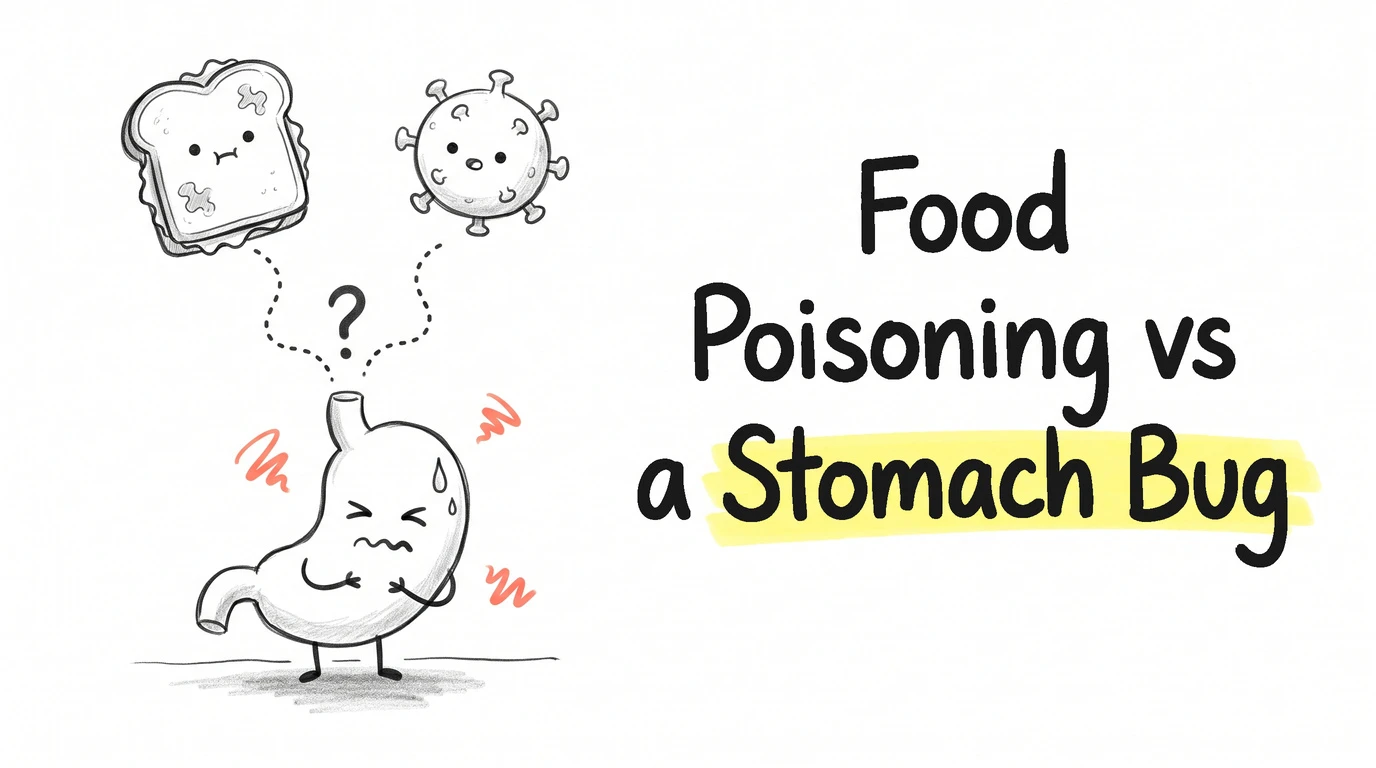
It's two in the morning, you're on the bathroom floor, and you're running the day backward: the chicken sandwich at lunch, the gas station taquito, or that thing your friend made that tasted slightly wrong. Somewhere in the list is the culprit, and if you can name it, you'll know whether you caught something or ate something.
Google finishes the question before you do. If you type "food poisoning or" into Google, the first three completions are "food poisoning or stomach bug," "food poisoning or stomach flu," and "food poisoning or norovirus." If you type "food poisoning but no one else" instead, all ten completions are the same question asked ten ways: "food poisoning but no one else is sick," "why did i get food poisoning but no one else," "can food poisoning affect one person and not another."
The meal you're blaming
The CDC keeps a page about what to do if you think you have food poisoning, and partway down it there's a box headed "Did you know?" The box says: "The food that made you sick is usually not the last food you ate. It often takes 2 to 3 days to start feeling sick after eating a contaminated food. Sometimes, it takes even longer."
The stretch between swallowing a germ and feeling it is called the incubation period, and researchers at the CDC measured it across 4,088 American foodborne outbreaks reported between 1998 and 2013. Staph food poisoning, which comes from a germ that leaves its toxin sitting in the food before you ever eat it, had a median of 4 hours. For Clostridium perfringens it was 10 hours, for Salmonella 32, for Campylobacter (the bacteria most often traced to undercooked chicken) 62, and for Shiga-toxin-producing E. coli 87, which is most of four days.
So the taquito is a suspect. So is everything you ate the day before, and for the slower germs on that list, the day before that.
One germ, both names
The CDC's page on norovirus opens with this line: "Norovirus is the leading cause of vomiting and diarrhea, and foodborne illness in the United States."
Norovirus is the thing people mean by "stomach bug." It's what runs through a dorm floor in February. It's also, by the federal government's own accounting, the single largest cause of American food poisoning: about 5.5 million illnesses a year, ahead of Campylobacter at 1.9 million and Salmonella at 1.3 million, in the CDC's 2019 estimates.
The same page makes the other correction while it's there: "It is sometimes called the 'stomach flu' or the 'stomach bug.' However, norovirus illness is not related to the flu. The flu is caused by the influenza virus." Your flu shot was never going to help with any of it.
The two phrases sound like they name two different infections. What they actually track is the route, meaning whether the germ arrived through food or through a person, and norovirus travels both ways. A norovirus that got to you off of a doorknob and a norovirus that got to you off of a salad someone assembled while sick are the same virus doing the same thing, and the route is the one part you can't see from the bathroom floor.
What timing can separate, and where it quits
If you were fine and then violently sick two or three hours later, the short list is Staph or Bacillus cereus, both of which work by leaving a toxin in food that sat out too long. Nothing viral moves that fast, so a sudden onset inside a few hours points at the food with some confidence.
Past that, the ranges swallow each other. In the CDC outbreak data, norovirus and Salmonella have exactly the same median incubation period, 32 hours, and the researchers checked whether the two distributions differed at all. They did not: the comparison came back at p = 0.19, statistically indistinguishable, while every other pairing they ran came back under 0.001. Salmonella's middle 70% of outbreaks spanned 17 to 67 hours, a range that completely contains norovirus's 27 to 37. The classic bacterial food poisoning and the classic stomach bug arrive, on average, at the same hour.
The rules people use on themselves
"Nobody else got sick, so it can't be the food." That holds only if everyone ate identically, the germ was spread through the whole batch rather than one serving, and everyone at the table is equally susceptible. The CDC notes that your odds of picking up norovirus are partly genetic. One person out of four getting sick off of a shared meal is ordinary.
"Everyone else got sick, so it was the food." A household going down together fits a contaminated dinner. It fits just as well a virus that one of you carried home and handed to the rest over two days.
"Fever means it's a virus," or, depending on who told you, that fever means bacteria. The IDSA guideline for doctors puts fever in a table of clinical clues and calls it "Not highly discriminatory," because viral, bacterial, and parasitic infections can all cause fever.
"If it's over in 24 hours it was food poisoning." The CDC lists norovirus as lasting 1 to 3 days, and Campylobacter and Salmonella, the ones people mean by food poisoning, tend to run longer than that. The rule is closer to backwards than to right.
"I can't have food poisoning, I haven't thrown up." Autocomplete has this one several different ways, including "can i have norovirus without vomiting." You can have either illness without vomiting.
The clues that do hold up
A UK study followed people in the community with gut infections, found a cause in 844 of them, then went back and asked which symptoms predicted which kind of germ. In the group aged 16 to 65, the closest match to anyone reading this, the answers came out clear. Diarrhea with no vomiting made a bacterial cause about three times more likely (odds ratio 3.04). Diarrhea lasting more than three days, about five times (4.90). Visible blood, about six times (6.15).
But in the same data, 13.4% of the bacterial cases had bloody diarrhea, which means that nearly 87% of them did not. Vomiting without diarrhea pointed away from bacteria, but it showed up in only 8.2% of the viral cases, so not having it tells you nothing.
A clue that shifts the odds across four hundred people can still leave any single one of them guessing. The authors wrote the conclusion themselves: "This analysis did not identify symptoms which could be used to adequately differentiate individual IID pathogens. This should act as a caution against making assumptions about the underlying organism on the basis of symptoms alone." And earlier, on why the published outbreak rules don't rescue you: those criteria rest on "the relative prevalence of symptoms occurring within a group of affected people, and as such they cannot be applied to individual cases."
What a doctor would do with the answer
Not much.
The IDSA guideline tells doctors: "Most acute diarrhea episodes in previously healthy, immunocompetent people are of short duration and self-resolving, and are of viral or unknown etiology. Therefore, laboratory investigation generally is not warranted." A healthy teenager who is throwing up will usually not get tested, because the result would land after they were better and would not have changed anything before then.
The NHS makes the same point by accident. Its norovirus page and its food poisoning page each carry an urgent-advice box listing when to call for help, and the two lists are word for word identical, in the same order, on both pages.
The answer does change what you take for it. Imodium's label says in bold not to use it if you have bloody or black stool, and to ask a doctor first if you have a fever. The IDSA goes further and says antimotility drugs like loperamide "should not be given to children <18 years of age with acute diarrhea." Pepto-Bismol's label opens its warnings with a Reye's syndrome notice naming this exact group: "Children and teenagers who have or are recovering from chicken pox or flu-like symptoms should not use this product." Read the box before you reach for either one.
When to get help
The CDC's list, for either illness. See a doctor if you have bloody diarrhea, diarrhea lasting more than three days, a fever over 102°F, or vomiting so constant that you cannot keep liquids down.
Go too if you're showing signs of dehydration (running low on body fluid), which the CDC describes as "not urinating (peeing) much, a dry mouth and throat, and/or feeling dizzy when standing up." Dehydration is what actually sends people to a hospital with a stomach bug, and it builds while your attention is on the vomiting.
Still contagious after you feel fine
Two days is the number to remember, and it starts when your symptoms stop rather than when they start. The CDC's guidance is to wait at least that long before preparing food for anyone or caring for someone, and on the same page it says plainly that "you can still spread norovirus for 2 weeks or more after you feel better."
In a study where sixteen volunteers were deliberately infected, virus was still detectable in stool for a median of 28 days, and in 11 of them the highest concentrations turned up after their symptoms had already cleared. Detectable is not the same as infectious, and the researchers were careful to say so.
The CDC adds one line that undoes most people's reflex: "Hand sanitizer does not work well against norovirus." Wash your hands with soap and water for twenty seconds instead.
What this means for you
You will probably never know which one you had. Of the roughly 179 million cases of acute gastroenteritis in the United States each year, about 142 million, or 79% of them, are never traced to a cause. The test that would tell you is rarely worth running, and the clues you'd use are solid at the scale of hundreds of people and useless at the scale of one.
So stop interrogating lunch. The meal you're blaming is unlikely to be the meal that did it, and the answer wouldn't change your evening either way. Drink small amounts often, keep drinking after it starts to feel pointless, and watch for the handful of signs above that mean the thing has stopped being ordinary.
If your friends start dropping over the next two days, you'll know it was something catching, which is as much as most people ever find out.
Sources
- CDC, About Norovirus (page dated April 24, 2024)
- CDC, What to Do if You Think You Have Food Poisoning (page dated Nov. 25, 2025)
- CDC, Food Poisoning Symptoms (page dated Nov. 24, 2025)
- CDC, How to Prevent Norovirus (page dated January 13, 2025)
- Chai SJ, Gu W, O'Connor KA, Richardson LC, Tauxe RV, Incubation periods of enteric illnesses in foodborne outbreaks, United States, 1998-2013, Epidemiology and Infection, 2019
- Scallan Walter EJ et al., Foodborne Illness Acquired in the United States, Major Pathogens, 2019, Emerging Infectious Diseases, 2025
- Donaldson AL, Harris JP, Vivancos R, O'Brien SJ, Symptom profiling for infectious intestinal disease (IID): do symptoms vary by age?, PLoS ONE, 2022
- Donaldson AL, Clough HE, O'Brien SJ, Harris JP, Symptom profiling for infectious intestinal disease (IID), Epidemiology and Infection, 2019
- Shane AL et al., 2017 Infectious Diseases Society of America Clinical Practice Guidelines for the Diagnosis and Management of Infectious Diarrhea, Clinical Infectious Diseases, 2017
- Lively JY, Johnson SD, Wikswo M, Gu W, Leon J, Hall AJ, Clinical and Epidemiologic Profiles for Identifying Norovirus in Acute Gastroenteritis Outbreak Investigations, Open Forum Infectious Diseases, 2018
- Atmar RL et al., Norwalk Virus Shedding after Experimental Human Infection, Emerging Infectious Diseases, 2008
- NHS, Norovirus (vomiting bug) (page last reviewed 31 December 2024)
- NHS, Food poisoning (page last reviewed 19 December 2024)
- DailyMed, IMODIUM A-D (loperamide hydrochloride) Drug Facts label, Kenvue Brands LLC
- DailyMed, PEPTO-BISMOL (bismuth subsalicylate) Drug Facts label, Procter & Gamble
- KYG, What's Wrong With My Gut?


.svg)
.webp)
.webp)



.webp)


.webp)
.webp)