If you start typing "ulcerative colitis is" into Google, the suggestions finish the question for you: is it autoimmune, is it curable, is it genetic, is it fatal, is it contagious.
Most of those have short answers: you can't catch it from anyone, the NHS calls it "rarely life-threatening," and NIDDK (the US government's institute for digestive diseases) says that it "sometimes runs in families." Whether it can be cured is harder, because the people who write about it don't agree on what the word means.
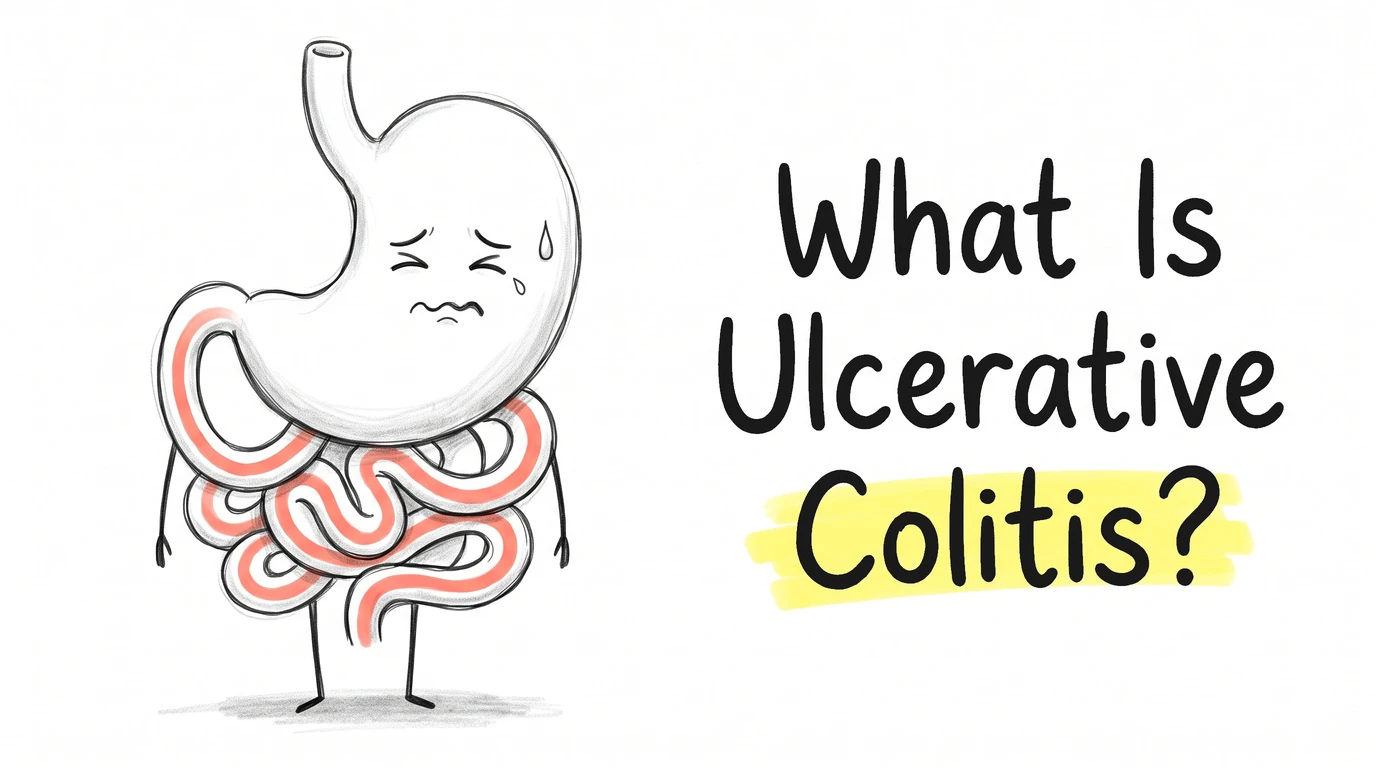
What ulcerative colitis is
The NHS describes ulcerative colitis as "a condition where parts of your large bowel (colon) and rectum become inflamed (swollen)," and says it's thought to be an autoimmune condition, meaning that the immune system (the body's defense against germs) attacks healthy parts of the body, in this case the lining of the colon.
It's one of the two main types of inflammatory bowel disease, or IBD. The other is Crohn's disease, and the two differ mostly in where they show up. Ulcerative colitis stays in the colon and rectum and inflames only the innermost lining, while Crohn's can appear anywhere from the mouth to the anus and go through the whole thickness of the bowel wall. The Crohn's & Colitis Foundation (the main US patient charity for IBD) adds that in ulcerative colitis, "the inflammation begins in the rectum and extends up the colon in a continuous manner," so it doesn't leave the healthy stretches in between that Crohn's can.
How far up the colon it reaches gives each type its name. Cleveland Clinic lists three: ulcerative proctitis (only the rectum), left-sided colitis (the left side of the colon), and pancolitis (the entire colon). The type can change over time, and Crohn's & Colitis UK (the UK's national charity for IBD) says that "1 in 10 people with proctitis will later develop Colitis that affects most of their colon."
If you're trying to tell it apart from IBS, which shares a lot of its symptoms but doesn't damage the gut, we have a guide to IBS versus IBD.
Nothing you did caused it
The Crohn's & Colitis Foundation's booklet for newly diagnosed patients says it in the second person: "Nothing that you did made you get ulcerative colitis. You didn't catch it from anyone. It wasn't something that you ate or drank that brought the symptoms on. So, above all, don't blame yourself!"
Nobody knows exactly what causes it. NIDDK lists four things that may play a part (your genes, an immune system that reacts abnormally, the microbes living in your gut, and your environment), and neither diet nor stress is on that list.
Stress is more complicated than that, though. The Foundation says that "there is no evidence that stress causes ulcerative colitis," but causing the disease and setting off a flare (a stretch when symptoms come back) are two separate questions. After the Great East Japan Earthquake, researchers at 13 hospitals in the damaged area compared 546 people with ulcerative colitis in the two months before and after the quake, and the relapse rate was "about twice that of the corresponding period in the previous year." Among 357 people with Crohn's at the same hospitals, it didn't change. Cleveland Clinic draws the same line: stress and diet "don't increase your risk of developing UC, but they can trigger a symptom flare-up."
If you took Accutane for acne and have wondered whether it caused this, the research found at most a small rise in ulcerative colitis risk in the first six months of taking it, and we went through that evidence in a separate article.
Who gets it
NIDDK estimates that 600,000 to 900,000 people in the US have ulcerative colitis, and says it's more likely to start "between the ages of 15 and 30, although the disease may develop in people of any age." Having a parent, brother, or sister with IBD makes it more likely.
Among kids and teens, it's the less common of the two types. A study of US insurance records found that in children aged 2 to 17, Crohn's was "twice as prevalent" as ulcerative colitis, while in adults the two were about equally common. When ulcerative colitis does start in childhood, it tends to hit harder. The 2025 European guideline on treating it in children (written by ESPGHAN, the European society of children's gut doctors, together with the European Crohn's and Colitis Organisation) says that in kids it "is more extensive and more likely to be severe than adult-onset UC."
What it feels like
The NHS lists the common symptoms as:
- diarrhea, which may have blood, mucus, or pus in it
- stomach pain, especially in the lower left side, which may ease after you poop
- needing to go often, urgently, or during the night
- feeling like you need to go even when your bowel is empty
- bleeding from your bottom
- a lot of gas, or feeling bloated
It also lists feeling very tired, being less hungry than usual, losing weight without trying, and, less expectedly, constipation.
Most people go back and forth between flares and remission (when symptoms fade or disappear). NIDDK says that remission "can last for weeks or years," and the NHS says a flare can last "anywhere from a few days to several months."
During a flare, it can reach past the gut. The NHS lists swollen or painful joints, a fever, red eyes that itch or hurt, mouth ulcers, and swollen red or darker patches of skin. In kids and teens, NIDDK adds growth problems, including "slowed growth, short stature, or delayed puberty."
None of this list can tell you whether you have ulcerative colitis. The Crohn's & Colitis Foundation notes that "several conditions have symptoms that are similar to IBD," which is why it takes tests to diagnose. If symptoms like these keep coming back, especially blood in your poop, see a doctor.
How it gets diagnosed
The NHS lists blood tests, a stool sample, scans, and a colonoscopy (a thin, flexible tube with a camera on the end, passed into your bottom to look at the bowel). During the colonoscopy, the doctor takes a biopsy (a tiny sample of the lining) to test. The stool test checks for fecal calprotectin, a protein that shows up when the intestines are inflamed, and it's also used "to exclude infection," according to the Crohn's & Colitis Foundation, since a gut infection can look a lot like a flare.
It's the same colonoscopy used for Crohn's, and our Crohn's article walks through the prep and the procedure.
How it's treated
NIDDK says that which medicines you get depends on how severe it is and how much of the colon is involved, and most of them have two jobs: getting a flare under control, then keeping it away.
For mild to moderate ulcerative colitis, the first medicines are usually aminosalicylates, often called 5-ASAs (e.g., mesalamine, which the NHS calls mesalazine). The 2025 children's guideline recommends taking them by mouth "as first-line induction and maintenance therapy for mild-to-moderate UC," and says that combining the pills with rectal 5-ASA (an enema or a suppository) "is more effective" than pills alone. Nobody is excited about the rectal part, but the inflammation starts in the rectum, so that's where the medicine goes.
Steroids like prednisone come in when a flare is more serious or 5-ASAs aren't enough. They work fast, but NIDDK says that doctors "typically don't prescribe corticosteroids for long-term use or to maintain remission," because long-term use can cause serious side effects. The children's guideline lists impaired growth and osteoporosis (weak bones) among them.
For moderate to severe disease, there are immunosuppressants (medicines that turn down the immune system) and what the NHS calls "medicines that block specific proteins that cause inflammation," a group that includes biologics.
The NHS says to keep taking your medicines "even if you're currently feeling well," and not to take NSAIDs like ibuprofen or aspirin unless a doctor prescribes them, since they can trigger flares. For mild pain, NIDDK suggests acetaminophen (Tylenol) instead. (We wrote about why ibuprofen is hard on your stomach in general.)
Can surgery cure it?
Cleveland Clinic writes that "the only 'cure' for UC is surgery to remove your colon and rectum," and puts the word cure in quotation marks. The NHS avoids the word and says that removing the large bowel "stops your ulcerative colitis from coming back," while Crohn's & Colitis UK, describing the same operation, says, "Right now, there is no cure for Colitis."
Surgery can end the inflammation in the gut because ulcerative colitis only lives in the colon and rectum, so removing both leaves nothing for it to inflame. Crohn's works the other way, since it can come back somewhere else in the digestive tract after the damaged part is removed. A 2021 review of population studies found that about 31% of people with Crohn's who'd had one bowel operation needed another within ten years.
Removing the colon also means, in the NHS's words, that "your body needs a different way to pass out poo," and there are two ways to do it. An ileostomy connects the small intestine to an opening in your stomach (a stoma), and poop collects in a bag attached outside your body. An ileo-anal pouch, often called a J-pouch, builds an internal pouch out of the end of the small intestine and connects it to your bottom, so you can poop the usual way. NIDDK notes that the J-pouch "most often requires two or three operations." The pouch can also get inflamed itself, which is called pouchitis. In a study of 129 children and teens who had a J-pouch made at 17 hospitals, 67% developed pouchitis at some point during about three years of follow-up, although 74% had pouches rated good or excellent at their last check-up. In adults, a review of 26 studies put the share of pouches that eventually fail (and have to be removed or bypassed) at about 6%.
Surgery also doesn't always stop the problems outside the gut. In a Swiss study of people who had their colon removed for IBD, the joint, eye, and skin problems that come with the disease stopped completely in 58.1% of the people with ulcerative colitis who'd had them, and 13.5% of the people in the study developed one of those problems for the first time after surgery.
Most people with ulcerative colitis never have surgery. The same 2021 review found that among people diagnosed since 2000, 7% had their colon removed within five years. The number is higher when the disease starts in childhood: about 21% within ten years, which lines up with Cleveland Clinic's estimate that "about 20% of children with ulcerative colitis will need surgery." The review also found that the risk has dropped over the decades.
What happens long-term
Ulcerative colitis raises your risk of colorectal cancer (cancer of the colon or rectum), and "can ulcerative colitis cause cancer" is one of the first things Google suggests. NIDDK says the risk is higher the more of the colon is affected, the more severe it is, the younger it started, and the longer you've had it. Proctitis alone "does not increase your risk," according to Crohn's & Colitis UK.
For a teenager, the risk right now is small. The children's guideline says that the absolute risk of colorectal cancer in children under 18 "is low" and that it's "exceptionally rare before puberty." Over a lifetime, the added risk is the reason for screening: NIDDK says doctors typically recommend a colonoscopy "every 1 to 3 years, starting 8 years after ulcerative colitis started," since screening can find precancerous cells before they turn into cancer.
A study that followed 96,447 people with ulcerative colitis in Denmark and Sweden, some of them as far back as 1969, found that each year about 1.3 in every 1,000 of them were diagnosed with colorectal cancer, compared with about 0.8 in every 1,000 people without it. The authors concluded that "these excess risks have declined substantially over time," which means that an average stretching back to 1969 is higher than the risk for someone diagnosed now.
On life expectancy, Crohn's & Colitis UK gives both answers: "Some researchers have found that people with Colitis live just as long as people without Colitis. Others have found that people with Colitis might have a slightly shorter life expectancy." The charity adds that people with it "can generally expect to live a long life."
A Swedish study that followed 4,671 people diagnosed with ulcerative colitis as kids (the average age of everyone in the study was 30 by the end) found that their risk of dying was about four times that of people the same age without it. The absolute numbers were small: across all of the children with IBD in the study, there were 2.1 deaths a year for every 1,000 patients, compared with 0.7 for every 1,000 of their peers. The authors also found that the relative risk hadn't gone down as newer drugs arrived.
Anxiety and depression are common too. The children's guideline notes rates "as high as 25%" in people with IBD, and recommends that children's IBD centers offer psychological support. If your care team doesn't bring it up, you can.
What doesn't work (or isn't ready yet)
A few treatments come up constantly online.
Probiotics
The American Gastroenterological Association recommends them for ulcerative colitis "only in the context of a clinical trial." That matches what we found about probiotics in general.
Fecal transplants
A fecal transplant puts stool from a healthy donor into someone's gut. A 2023 Cochrane review (a study of studies, from the group that sets the standard for these reviews) found that they "may increase" remission in ulcerative colitis, on low-certainty evidence. The children's guideline says they "should not be routinely used" in kids, and that the treatment "has not been approved by the FDA for the treatment of IBD." Donor stool can also carry infections. The FDA has reported serious E. coli infections in six patients who received fecal transplant material from one company's donors, and two deaths in patients who got material from one of those donors, while noting that "it is not known if STEC infection contributed to these deaths." Don't try it yourself.
Turmeric and other supplements
The children's guideline says curcumin (the active compound in turmeric), aloe vera, omega-3, glutamine, and several others "should not be used as a single agent" to treat ulcerative colitis in children. It does allow that curcumin may be considered as an add-on alongside standard medicine, but a review that pooled seven earlier reviews of curcumin in ulcerative colitis found that "none of the reported outcomes were supported by high-certainty evidence."
Cannabis
The Cochrane review of cannabis for ulcerative colitis found only two trials, with 92 adults between them. In the larger one, 24% of people taking cannabidiol (CBD) capsules were in remission after 10 weeks, compared with 26% on a placebo, and CRP (a blood marker of inflammation) came out about the same in both groups. By the review's own summary, "no firm conclusions" can be drawn about whether cannabis helps.
Worm eggs
In a 2005 trial of 54 people, eggs from a pig whipworm improved ulcerative colitis in 43.3% of the people who took them, compared with 16.7% on a placebo. When a 2024 trial tested it again in 119 people, 30% of the people taking the eggs were in remission after 24 weeks, compared with 34% on the placebo, and the trial's authors called the eggs "not superior" to it.
A diet that fixes it
The Crohn's & Colitis Foundation says that "there is no one single diet or eating plan that will work for everyone with ulcerative colitis." The American Gastroenterological Association's guidance on diet in IBD says that "no diet has consistently been found to decrease the rate of flares in adults with IBD," and then adds one exception: "A diet low in red and processed meat may reduce ulcerative colitis flares." Plenty of people find specific foods set off their symptoms, and the NHS suggests keeping a food diary and talking to your doctor before cutting anything out.
School
In the US, ulcerative colitis can qualify you for accommodations at a public school under Section 504, and the Department of Education has a factsheet on IBD specifically. It says that a condition "that is episodic or in remission is a disability if it would substantially limit a major life activity when active," and its list of accommodations includes "allowing the student to leave class to use the restroom as needed" and "pausing the clock if the student needs to use the restroom during an exam." Our Crohn's article goes through the rest of it, and all of it applies to ulcerative colitis too.
If your friend has it
Don't give them diet advice. Their doctor already has, and the Foundation's point about there being no one diet that works for everyone is one they've probably heard many times.
Don't reduce it to the bathroom, and don't tell them they don't look sick. Keep inviting them, believe them when they cancel, and don't make them explain.
When to get help right away
The NHS says to get an urgent appointment if you have symptoms along with very bad or bloody diarrhea, a high temperature, a fast heartbeat, or if you can't fart or poop. It says to get emergency care (in the US, call 911 or go to the ER) for severe stomach pain, bleeding from your bottom that won't stop, a lot of blood or large clots when you poop, or vomiting blood or something that looks like coffee grounds.
Sources
- NHS, Ulcerative colitis (reviewed 20 August 2026)
- NIDDK, Definition & Facts of Ulcerative Colitis
- NIDDK, Symptoms & Causes of Ulcerative Colitis
- NIDDK, Treatment for Ulcerative Colitis
- Cleveland Clinic, Ulcerative Colitis
- Crohn's & Colitis UK, Ulcerative Colitis (last updated April 2025)
- Crohn's & Colitis Foundation, Living with Ulcerative Colitis (brochure)
- Wine E et al., Management of paediatric ulcerative colitis, part 1: Ambulatory care, an updated evidence-based consensus guideline from ESPGHAN and ECCO, Journal of Pediatric Gastroenterology and Nutrition, 2025
- Shiga H et al., Life-event stress induced by the Great East Japan Earthquake was associated with relapse in ulcerative colitis but not Crohn's disease, BMJ Open, 2013
- Ye Y et al., Prevalence of Inflammatory Bowel Disease in Pediatric and Adult Populations, United States 2007-2016, Inflammatory Bowel Diseases, 2020
- Tsai L et al., Contemporary Risk of Surgery in Patients With Ulcerative Colitis and Crohn's Disease, Clinical Gastroenterology and Hepatology, 2021
- Olén O et al., Colorectal cancer in ulcerative colitis: a Scandinavian population-based cohort study, The Lancet, 2020
- Imdad A et al., Fecal transplantation for treatment of inflammatory bowel disease, Cochrane Database of Systematic Reviews, 2023
- Su GL et al., AGA Clinical Practice Guidelines on the Role of Probiotics in the Management of Gastrointestinal Disorders, 2020
- Orlanski-Meyer E et al., Outcomes Following Pouch Formation in Paediatric Ulcerative Colitis: A Study From the Porto Group of ESPGHAN, Journal of Pediatric Gastroenterology and Nutrition, 2020
- Alsafi Z, Snell A, Segal JP, Prevalence of 'pouch failure' of the ileoanal pouch in ulcerative colitis: a systematic review and meta-analysis, International Journal of Colorectal Disease, 2022
- Roth R et al., The impact of colectomy on the course of extraintestinal manifestations in Swiss inflammatory bowel disease cohort study patients, United European Gastroenterology Journal, 2021
- Olén O et al., Increased Mortality of Patients With Childhood-Onset Inflammatory Bowel Diseases, Compared With the General Population, Gastroenterology, 2019
- FDA, Fecal Microbiota for Transplantation: Safety Alert, Risk of Serious Adverse Events Likely Due to Transmission of Pathogenic Organisms (2020)
- Huang J et al., The Complementary and Alternative Roles of Curcumin in Treatment of Ulcerative Colitis: An Umbrella Review, Nutrition Reviews
- Kafil TS et al., Cannabis for the treatment of ulcerative colitis, Cochrane Database of Systematic Reviews, 2018
- Summers RW et al., Trichuris suis therapy for active ulcerative colitis: a randomized controlled trial, Gastroenterology, 2005
- Prosberg MV et al., Probiotic Treatment of Ulcerative Colitis With Trichuris Suis Ova: A Randomised, Double-blinded, Placebo-controlled Clinical Trial, Journal of Crohn's and Colitis, 2024
- Hashash JG et al., AGA Clinical Practice Update on Diet and Nutritional Therapies in Patients With Inflammatory Bowel Disease: Expert Review, Gastroenterology, 2024
- US Department of Education, Office for Civil Rights, Section 504 Protections for Students with Inflammatory Bowel Disease


.svg)
.webp)
.webp)



.webp)


.webp)
.webp)