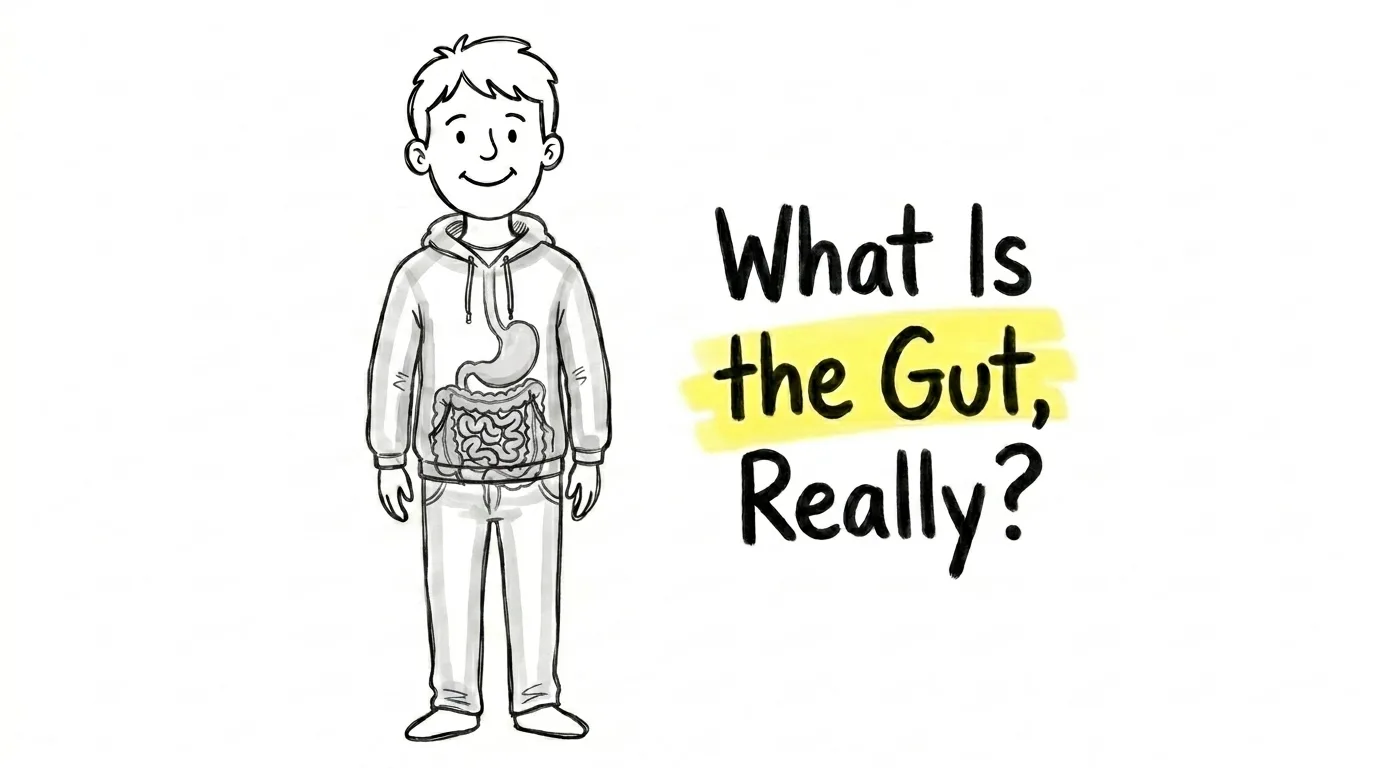
Inside you, right now, is a tube about 30 feet long. It’s threaded through the middle of you like the laces in your sneakers. This might sound like something I just made up, but it’s actually true. It’s called your gut.
That tube runs in one continuous line from your mouth down to the other end, and its job is to turn the food you eat into fuel your body can use. Everything you’ve ever eaten has traveled through it.
To see what it does, let’s follow a single bite of food from one end to the other.
It starts before you swallow
Digestion begins the very moment food lands in your mouth. Two things go to work at once:
Your teeth handle the obvious part—crushing and grinding food into smaller pieces. This matters more than it sounds. By chewing your food, you’re breaking your food up into multiple little pieces. More pieces means more surface area, and that gives the next stage of digestion more to work with.
Next, your saliva does its thing. Mixed into it is an enzyme (a protein that speeds up a specific chemical reaction) called amylase. Amylase has one job: it goes after starch, the carbohydrate packed into foods like bread, rice, and pasta. As your saliva coats your food, the amylase starts breaking that starch down into sugar, before you’ve even swallowed.
If your bite doesn’t have much starch, say you’re eating a piece of chicken or an apple, this step doesn’t apply, and the real work on it waits for later stops. That’s an important pattern worth remembering as we go: different parts of your gut are built to handle different kinds of food.
You can actually taste amylase working. Try this out: put a plain cracker on your tongue and don’t chew it. Just wait. After about a minute it starts tasting slightly sweet, because the amylase is breaking the starch in it down into sugar, right there in your mouth.
Down the hatch
Once you swallow, the food drops into your esophagus, the tube connecting your throat to your stomach. But the food doesn’t just fall down because of gravity. The walls of the esophagus grab it and squeeze, pushing it along in slow, rolling waves. This squeezing motion is called peristalsis, and it shows up all throughout your gut, not just here.
It’s strong enough that gravity barely matters. You could hang upside down off a set of monkey bars, swallow a sip of water, and it would still travel “up” to your stomach. Astronauts eat the same way in zero gravity. The muscles do all the work to push the food down, not gravity.
The acid bath
The esophagus drops your food into your stomach, a stretchy, muscular bag that sits just under your ribs and holds everything you just ate. When it’s empty, your stomach is about the size of your fist, but it can balloon to hold a liter or more when you eat a big meal—that’s why one dinner can keep you full for hours instead of running straight through you. The stomach holds your food and works on it slowly, in 2 ways.
First, it churns. The thick muscle walls squeeze and twist, mashing your food into a soupy mush. Second, it pours in gastric acid, which is mostly hydrochloric acid and incredibly strong, strong enough to burn through metal. That acid kills most of the bacteria you swallow and goes after proteins, the nutrient your teeth and saliva couldn’t touch. Remember the pattern: the mouth took care of starch, and now the stomach takes on protein.
You might be wondering: if the acid is strong enough to burn through metal, why doesn’t it burn through your stomach? Because your stomach coats its own walls in a thick layer of mucus that works like a shield, and it replaces that lining constantly. Without it, your stomach would start digesting itself.
By the time the stomach does its job, your bite is unrecognizable. What went in as food leaves as a warm, soupy liquid called chyme, and that’s what gets squeezed into the next stop.
Where the real work happens
Next, the chyme moves into your small intestine, and despite the name, there’s nothing small about it. It’s around 20 feet long, the longest part of your whole gut, and folded up to fit below your stomach. This is where most of digestion finishes, and where nearly all the nutrients in your food finally cross into your blood.
Two things show up to help. From your liver comes bile, a yellow-green fluid that breaks fat into tiny droplets, the same way dish soap cuts through grease on a pan. Those smaller droplets are easier for your enzymes to reach and break down, which is the same surface-area trick your teeth pulled back in your mouth. From your pancreas come more enzymes, plus bicarbonate (AKA the same compound as baking soda), which cancels out the stomach acid riding along in the chyme so the small intestine doesn’t get burned. There’s your pattern one more time: starch in the mouth, protein in the stomach, and fat in the small intestine.
Once your food is broken all the way down, the small intestine gets to work absorbing it, and the way it’s built for that job is the coolest part. Its inner wall isn’t smooth. It’s carpeted in millions of tiny finger-shaped bumps called villi, and each of those bumps is covered in even smaller ones. All those layers of bumps turn the narrow tube that is your small intestine into a massive surface for soaking up nutrients. Flattened out completely, the lining of your small intestine would cover around 350 to 400 square feet, about the floor of a small apartment, all packed inside your belly.
Here’s something you might not realize. Up to this point, your food hasn’t truly been inside you. No, I’m not kidding. Your gut is a tube that runs straight through your body, open at both ends, so everything you swallow is really just passing through a tunnel. It only becomes part of you at this exact moment, when nutrients cross the wall of the small intestine and into your blood. Everything before this, the chewing and the acid and the churning, was just breaking your food down small enough to make it through this one wall.
The last stretch
Whatever’s left after the small intestine then moves into your large intestine. By now, the valuable stuff is mostly gone. The nutrients have already crossed into your blood. What arrives here is mostly water, plus the parts of your food your body can’t break down, like fiber (the tough material in plants—like fruits, vegetables, beans, and whole grains—that your enzymes can’t digest).
The large intestine’s first job is to reclaim that water. It pulls most of it back into your body, slowly turning the leftover slurry into something more solid.
Its second job is where things get interesting. Your large intestine is home to trillions of bacteria and other microbes, a whole community living inside you called your gut microbiome. That might sound alarming, but most of them are helping you, in more ways than one. They finish off some of the fiber your own body couldn’t digest, and in the process they make certain vitamins your body needs and other compounds that keep the gut lining healthy. There’s a lot more to say about these microbes, enough that they’ll get their own article, but for now just know your large intestine is more of a thriving ecosystem than the waste pipe most people picture.
The end of the line
Once the water’s been pulled back and the microbes have taken their share, what remains is waste. It gets stored in the last section of your gut until you’re ready to head to the bathroom, and then it leaves. Start to finish, the whole journey from first bite to exit usually takes somewhere between one and three days, although it’s different for everyone, and faster or slower is perfectly normal in most cases.
Why any of this matters
So your gut breaks down your food and pulls the useful parts into your blood. That’s the job it's known for, but it quietly does a second one that almost nobody talks about.
Lining the walls of your gut is a network of around 500 million nerve cells. That’s more neurons than there are in a cat’s brain, all woven into a tube you never think about. The network is so large, and handles so much on its own, that scientists gave it its own name: the enteric nervous system, or your second brain. It can run digestion without ever checking in with the brain in your head, which is part of why you don’t have to think about a single step you just read for it to happen.
Your two brains aren’t separate, though. They’re wired together and talking to each other all day long. You’ve definitely felt this conversation before. Butterflies before a test? Your stomach dropping at bad news? That queasy feeling before you walk on stage? That’s your head and your gut talking. It works in reverse too. A struggling gut can worsen your mood, not just your digestion.
Here’s the part that surprises people the most. Serotonin, one of the chemicals tied to how you feel, is made almost entirely in your gut, not your brain. Around 90% of it is produced down there. Scientists are still working out exactly what that gut serotonin does and how much it influences your mood, so anyone selling a simple answer is getting ahead of the science. But the connection between your gut and how you feel is real, and you can’t avoid it.
That’s why your gut is worth understanding. It feeds you, it talks to your brain, it reacts to your stress, and it has a hand in how you feel from one day to the next. Not bad for a 30-foot tube you’ve never given a second thought.

.svg)
.webp)
.webp)



.webp)


.webp)
.webp)