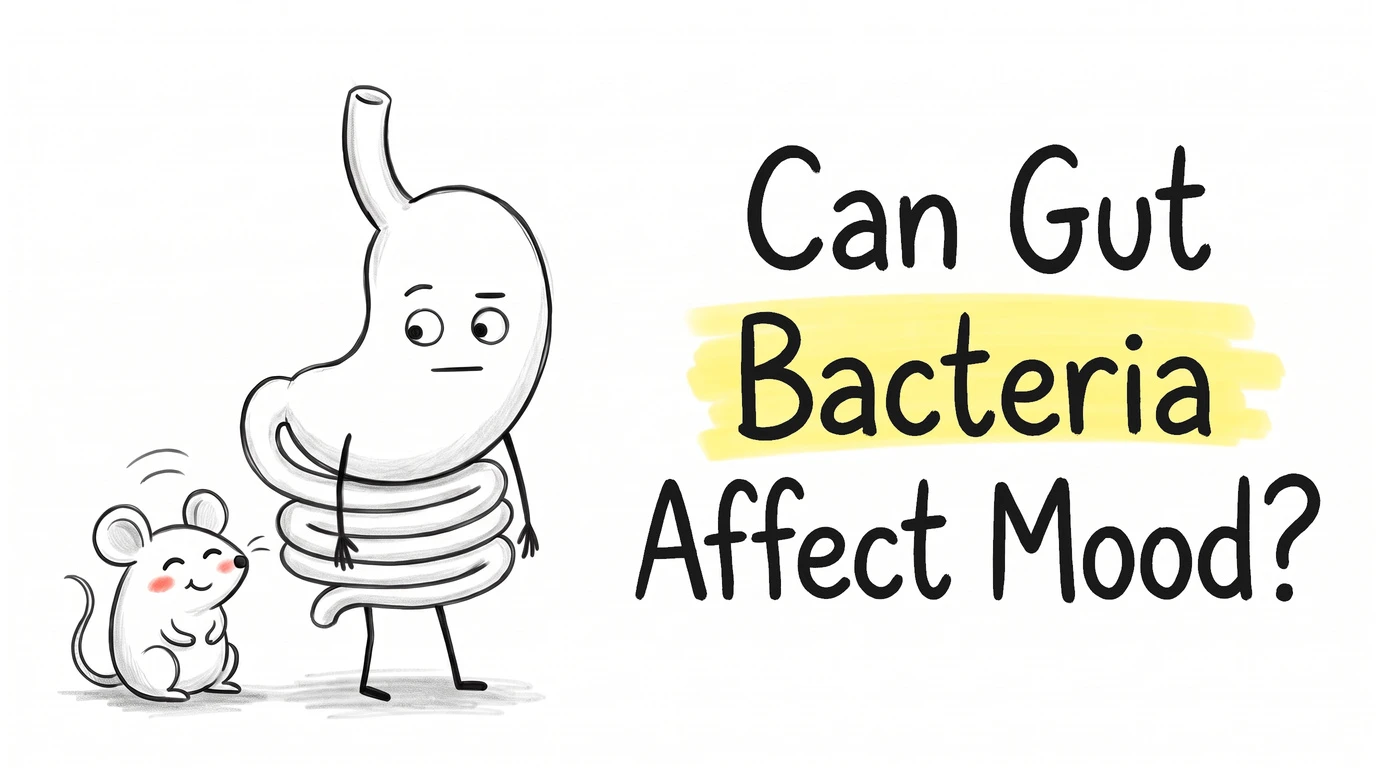
If you type "can gut bacteria" into Google, the second suggestion is "cause anxiety." "Can your gut cause depression" and "does gut bacteria affect mood" come up too. On Reddit, a post in r/Microbiome titled "Wtf Probiotics cured my anxiety, dry eye, stomach pain ughhhh" has more than a thousand upvotes, and a post in r/Anxiety warns that "Probiotics can CAUSE anxiety and really bad panic attacks, so be careful."
Your gut bacteria probably do have some effect on your brain, and the strongest evidence for that comes from mice and rats. If you're asking whether a probiotic will lift your mood when you're basically healthy, the trials in healthy people found close to nothing. Probiotics look more promising as an add-on for adults already being treated for depression, and even there, the Canadian group that writes depression treatment guidelines ranks them as a third-line option.
How bacteria in your gut could reach your brain
Your gut and your brain are connected by the vagus nerve (a long nerve running from your brainstem down to your gut), the same line behind the butterflies you get before a test. In 2011, a team that included scientists at University College Cork in Ireland fed mice a strain of bacteria called Lactobacillus rhamnosus JB-1. The mice showed less "anxiety- and depression-related behavior" and lower levels of a stress hormone. When the researchers cut the vagus nerve in another group of mice, the bacteria stopped having any effect.
You've probably also heard that most of your serotonin (a chemical messenger tied to mood) is made in your gut. Cleveland Clinic puts it at about 90%. A 2021 review in the International Journal of Molecular Sciences notes that "Serotonin cannot cross the blood-brain barrier" (the filter that keeps most things in your blood out of your brain), so the serotonin in your gut and the serotonin in your brain are two separate supplies.
What happens when gut bacteria get moved
In 2016, the Cork group collected stool from 34 people with major depression and 33 people without it, then transplanted some of it into rats whose own gut bacteria had been wiped out. Rats that got bacteria from the depressed patients developed "anhedonia and anxiety-like behaviours" (anhedonia means losing interest in things you'd normally enjoy). From those rats, the authors concluded that gut bacteria "may play a causal role" in depression.
In people, most of the evidence comes from snapshots, where researchers measure everyone's gut bacteria once and compare. A study of 1,054 people in Belgium's Flemish Gut Flora Project found that two groups of bacteria, Coprococcus and Dialister, were lower in people with depression, "even after correcting for the confounding effects of antidepressants," meaning that the researchers checked that the medications weren't behind the difference.
The same missing bacteria, Coprococcus included, also show up in bipolar disorder, schizophrenia, and anxiety, according to a 2021 review in JAMA Psychiatry that pooled 59 studies. The authors found "little evidence of disorder specificity," which means that the pattern isn't specific to depression. A snapshot also can't tell you which came first: the bacteria changing, or the illness.
Does a probiotic change your mood?
The Cork group went on to test JB-1, the strain from the mouse study, on 29 healthy men. Each man took the probiotic for one stretch and a placebo (a pill with nothing active in it) for another, without knowing which was which. The researchers found "no overall effect of probiotic treatment on measures of mood, anxiety, stress or sleep quality." They titled the paper "Lost in translation?" The gut-brain page from NCCIH (the NIH center that studies complementary health products) still describes the 2011 mouse experiment and never mentions the trial in people.
A 2019 review pooled 34 trials of probiotics and prebiotics (fibers that feed your gut bacteria) for depression and anxiety. Prebiotics "did not differ from placebo." Probiotics had a small effect overall, and it came almost entirely from people who were already sick. In trials that screened out anyone with a psychiatric disorder, the authors wrote, the effect on depression "was essentially zero."
Kids and teens have been studied far less. A 2025 review of trials in 3 to 19 year olds found 10 of them, with 408 participants between them, all in kids who had another condition, like autism, IBS, or anorexia, so none of them tested a healthy teenager. Three trials found that a probiotic or supplement helped with depression or anxiety, and seven didn't.
What about people who have depression?
In 23 trials of people with a clinical diagnosis of depression or anxiety (1,401 patients in all), probiotics produced "substantial reductions in depression symptoms and moderate reductions in anxiety symptoms," according to a 2025 review in Nutrition Reviews. The authors also reported "high heterogeneity," meaning that the trials disagreed a lot with each other, and they traced some of that to how long the trials ran and which probiotic mix they used.
The Canadian Network for Mood and Anxiety Treatments (the group that writes Canada's guidelines for treating depression) reviewed the same kind of trials and counted the results. Twelve trials found that probiotics helped, and eleven didn't. The group's 2025 recommendation is that probiotics "may be cautiously considered as third-line adjunctive treatments" (adjunctive means added on top of treatment you're already getting, and third-line means after the first two options). The group also wrote that probiotics "cannot currently be recommended as standalone treatments" for depression.
The UK's guideline for depression in children and young people doesn't mention probiotics or gut bacteria at all. Its only advice on food is that a young person with depression "should be offered advice about nutrition and the benefits of a balanced diet."
What's being sold
The FDA (Food and Drug Administration) sent warning letters to 10 companies for selling supplements that claimed to treat depression and other mental health conditions. One was a "Mood Boosting Probiotic" whose website said it contained "the ONLY prebiotic that's been proven to help with anxiety." Under federal law, products "intended to cure, treat, mitigate, or prevent disease are drugs," the FDA wrote, "even if they are labeled as dietary supplements," so they need FDA approval first.
The FTC (Federal Trade Commission, the agency that polices false advertising) has sued a company called Amare, which sells products including Kids Mood+. According to the FTC's complaint, the company claims its products "work across the entire gut-brain axis to increase or normalize neurotransmitters such as dopamine, serotonin, and GABA," and people selling them told parents they could treat depression in children, "including by reducing the risk of suicide." Those are the FTC's allegations, and the case hasn't been decided.
Health Canada has licensed one probiotic, a mix of Lactobacillus helveticus and Bifidobacterium longum whose licence is held by the probiotic company Lallemand Health Solutions, to say that it "helps promote a healthy mood balance" in people under mild to moderate stress, with "academic exams" as the example. The same licence tells anyone with "frequent anxiety or depression" to "consult a healthcare practitioner prior to use."
What you can do
One trial tested food directly. In SMILES, 67 adults with moderate to severe depression were randomly assigned to 12 weeks of either coaching toward "a modified Mediterranean diet" or social support. By the end, 32% of the diet group had reached remission (their depression scores dropped low enough to count as recovered), compared with 8% of the other group. The trial didn't measure anyone's gut bacteria, so it can't tell you whether the bacteria were the reason that people improved. It was also one small trial in adults.
If you've felt low or anxious for weeks, a probiotic isn't a substitute for talking to a doctor or someone you trust, and the Canadian guideline above says as much. If your stomach and your anxiety seem to flare together, anxiety and IBS are linked in both directions, so bring that up too.
Sources
- Bravo JA et al., Ingestion of Lactobacillus strain regulates emotional behavior and central GABA receptor expression in a mouse via the vagus nerve, PNAS, 2011
- Kelly JR et al., Lost in translation? The potential psychobiotic Lactobacillus rhamnosus (JB-1) fails to modulate stress or cognitive performance in healthy male subjects, Brain, Behavior, and Immunity, 2017
- Kelly JR et al., Transferring the blues: Depression-associated gut microbiota induces neurobehavioural changes in the rat, Journal of Psychiatric Research, 2016
- Valles-Colomer M et al., The neuroactive potential of the human gut microbiota in quality of life and depression, Nature Microbiology, 2019
- Nikolova VL et al., Perturbations in Gut Microbiota Composition in Psychiatric Disorders: A Review and Meta-analysis, JAMA Psychiatry, 2021
- Liu RT, Walsh RFL, Sheehan AE, Prebiotics and probiotics for depression and anxiety: A systematic review and meta-analysis of controlled clinical trials, Neuroscience & Biobehavioral Reviews, 2019
- Hu J et al., Effects of microbiota-based interventions on depression and anxiety in children and adolescents: A systematic review, Journal of Pediatric Gastroenterology and Nutrition, 2025
- Asad A et al., Effects of Prebiotics and Probiotics on Symptoms of Depression and Anxiety in Clinically Diagnosed Samples, Nutrition Reviews, 2025
- Bahji A et al., CANMAT Task Force Recommendations for the Use of Probiotics, Prebiotics, Synbiotics, and Fecal Microbiota Transplants in Adults With Major Depressive Disorder, Canadian Journal of Psychiatry, 2025
- Kanova M, Kohout P, Serotonin: Its Synthesis and Roles in the Healthy and the Critically Ill, International Journal of Molecular Sciences, 2021
- Cleveland Clinic, Serotonin
- NCCIH, 4 Fast Facts about the Gut-Brain Connection
- NICE, Depression in children and young people: identification and management (NG134)
- FDA, Warning Letter to Lifted Naturals, 2021
- FDA, FDA Sends Warning Letters to 10 Companies for Illegally Selling Dietary Supplements Claiming to Treat Depression and Mental Illness, 2021
- FTC, FTC Sues to Stop Amare Global Holdings from Misrepresenting the Health Benefits of Its Dietary Supplements for Children and Adults, 2026
- FTC, Complaint, FTC v. Amare Global Holdings
- Health Canada, Licensed Natural Health Products Database, NPN 80021343
- Jacka FN et al., A randomised controlled trial of dietary improvement for adults with major depression (the 'SMILES' trial), BMC Medicine, 2017

.svg)
.webp)
.webp)



.webp)


.webp)
.webp)