If you type "is a canker sore" into Google, it suggests "herpes," "contagious," "an std," and "a virus." If you type "do i have an ulcer," it offers "in my stomach," "in my mouth," "in my throat," "on my tongue," and "on my gum." One r/teenagers post blames canker sores on viruses ("they aren't even alive"), and another is from someone relieved to finally learn the difference, "so now i can stop worrying abt accidentally giving my friends herpes."
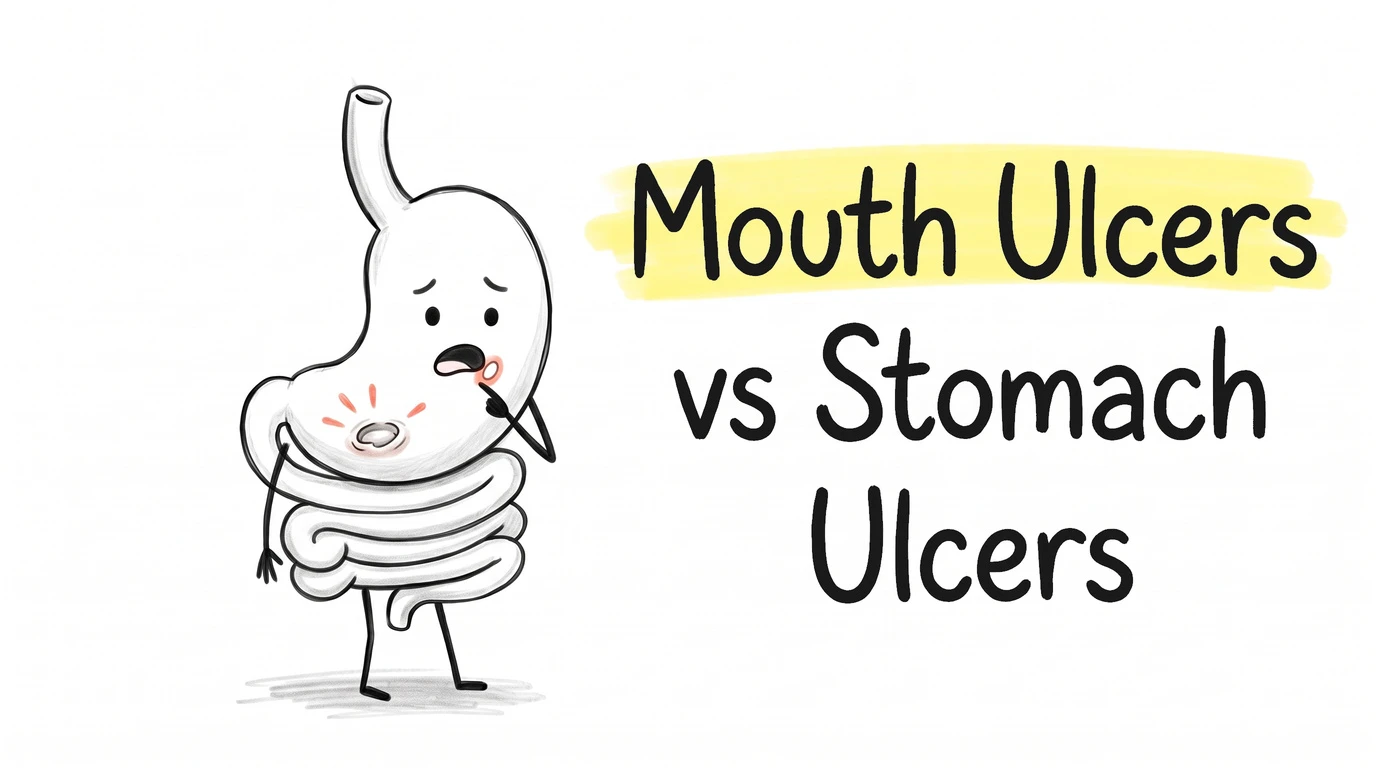
A canker sore is a small wound in the lining of your mouth that heals by itself, and you can't pass it to anyone. It has its own causes, separate from the ones behind a stomach ulcer, though a few gut conditions can show up as sores in your mouth first.
Why are both called ulcers?
"Ulcer" just means a sore where a lining has broken open, and doctors add where it is. MedlinePlus (the National Library of Medicine's health site) calls a canker sore "a painful, open sore in the mouth," and its medical name is an aphthous ulcer. NIDDK (the US government's institute for digestive diseases) defines a peptic ulcer as "a sore on the lining of your stomach or duodenum" (the first stretch of your small intestine, right after the stomach).
Most stomach ulcers come from a bacterium called H. pylori or from painkillers like ibuprofen, which Do Ulcers Come From Stress? covers in full. Canker sores "do not have a known cause," according to NIDCR (the US government's institute for dental research). The British Society for Oral Medicine says that "there is likely to be an immunological factor involved," meaning that your own immune system probably plays a part.
The same society puts canker sores at "up to 20% of the population at any given time," and NIDCR says that they're "most common during puberty." The NHS lists the usual triggers: biting the inside of your cheek, braces or a sharp tooth, burns from hot food, "feeling tired, stressed or anxious," and an irritating toothpaste. It also lists low iron, zinc, folic acid, vitamin B, or vitamin D. Genes matter too. The British Society for Oral Medicine says that "nearly half the people who suffer from mouth ulcers have a close relative with the same problem." NIDCR says that they usually go away on their own in one to two weeks.
Is a canker sore herpes?
No. Herpes causes cold sores (NIDCR calls them fever blisters), which come from the herpes simplex virus and form "on the outside of the mouth around the lips." NIDCR calls fever blisters "very contagious" and says that "canker sores are not contagious." The virus is common, and NIDCR estimates that around 60% of US adults carry it.
Cleveland Clinic describes a canker sore as a "round white or yellow ulcer" inside your mouth and a cold sore as a "cluster of fluid-filled blisters that develop into ulcers." The NHS adds that cold sores "often begin with a tingling, itching or burning sensation."
People still mix them up, partly because the NHS says that cold sores "can also appear as a small group of pinhead-sized ulcers inside the mouth." And one uncommon type of canker sore, which shows up as a cluster of tiny sores, is called herpetiform because it looks like herpes. The British Society for Oral Medicine says, "Despite their name, they are not caused by a herpes virus." If you can't tell which one you have, NIDCR says that "a doctor can usually diagnose canker sores and fever blisters by looking at them."
Can a stomach problem cause mouth ulcers?
Neither NIDCR nor the NHS lists a stomach ulcer anywhere among the causes of canker sores. A few things do show up on both sides, though.
H. pylori
H. pylori is the one people ask about, since it causes most stomach ulcers. A 2023 meta-analysis (a study that pools the results of many earlier studies) combined 15 studies with 1,137 people, and people with recurring canker sores were more likely to carry H. pylori, at 1.83 times the odds. All 15 were case-control studies (they compare people who already have sores with people who don't), so they can't show which came first. The link also disappeared in the studies that tested for the bacteria with an antibody test. The authors conclude only that the evidence "does not rule out an association."
Celiac disease
The American College of Gastroenterology's 2013 celiac guideline lists "oral aphthous ulcers" among the conditions where celiac disease is more than twice as common as in everyone else. A 2026 review of 22 studies put the risk of recurring canker sores at 2.45 times higher in people with celiac disease, and the authors warned that their number is "likely" an "overestimation of the true effect size," because small studies that found nothing tend not to get published. What Is Celiac Disease? covers the rest of it.
Crohn's disease
Cleveland Clinic's list of Crohn's symptoms runs from belly pain and diarrhea to "blood in your poop and mouth sores" (more in What Is Crohn's Disease?). The NHS says that several mouth ulcers at once can be a symptom of "Crohn's disease and coeliac disease."
Ibuprofen and other NSAIDs
NSAIDs (the group of painkillers that includes ibuprofen and naproxen) turn up on both lists. The NHS names "some NSAIDs" among the medicines that can trigger mouth ulcers, and NIDDK names NSAIDs as one of the two most common causes of stomach ulcers (Why Does Ibuprofen Hurt My Stomach? explains how).
When it's worth a doctor visit
None of this means that one canker sore points to a gut disease. The NHS says that you should see a GP if you get ulcers anywhere else on your body, like your skin or genitals, or "painful, red or swollen joints."
What about an ulcer in your throat?
It might just be a canker sore, since MedlinePlus lists "the back of your throat" among the places they form. Lower down, in your esophagus (the tube that carries food from your throat to your stomach), one known cause is doxycycline, an antibiotic prescribed for acne. The FDA-approved label reports "rare instances of esophagitis and esophageal ulcerations" with pills in its drug family, and says that "most of these patients took medications immediately before going to bed." America's Poison Centers explains that the damage happens "when capsules or tablets get stuck in the esophagus (food pipe) and cause tissue damage."
A 2025 report from a hospital in Turkey described four teenagers, ages 14 to 17, who all took doxycycline for acne and came in with pain when swallowing. An endoscopy (a camera on a thin tube) found ulcers in the esophagus in all four, and all four healed without lasting damage. The authors write that doxycycline "is responsible for more than 50% of the cases" of pill-caused esophagus damage. The label's advice is "to drink fluids liberally" with each dose, so take it with a full glass of water and not right before you lie down. If swallowing starts to hurt while you're on it, tell whoever prescribed it.
What actually helps a canker sore?
The NHS says that mouth ulcers need time and "there's no quick fix." What it does recommend is a salt mouthwash: dissolve "half a teaspoon of salt in a glass of warm water," rinse, and spit it out. That's different from putting salt straight onto the sore. It also suggests a soft toothbrush and skipping very spicy, salty, or acidic food and anything crunchy like chips or toast. A pharmacist can sell you a numbing gel, an antimicrobial mouthwash, or a steroid lozenge.
The NHS tells you to avoid toothpaste with sodium lauryl sulfate (SLS, the ingredient that makes it foam), but the trials disagree. In a 1994 study, 10 people went from 14.3 ulcers over three months to 5.1 after switching to an SLS-free toothpaste. A 1999 trial with 47 people at a UK dental hospital found that "none of the ulcer parameters measured was significantly affected."
Quitting smoking can set them off for a while. In a study of 1,234 smokers who quit, about 40% developed mouth ulcers, mostly in the first two weeks, and 60% of those cleared up within four weeks. That study was about cigarettes, so it can't tell you whether quitting a vape does the same thing.
The trial usually cited for vitamin B12 had 58 adults with recurring canker sores. In that trial, a daily 1,000 mcg tablet under the tongue for six months left 74.1% ulcer-free in the last month, against 32.0% on a placebo (a fake pill). The study was small, and Solgar, the supplement company that made the tablets, paid for part of it.
See a dentist or GP if a mouth ulcer lasts longer than three weeks, looks different from ones you've had before, sits near the back of your throat, or bleeds and gets more painful. The NHS says that most are harmless but that "a long-lasting mouth ulcer is sometimes a sign of mouth cancer," so a sore that won't heal should get looked at. For the stomach kind, the warning signs are in Do Ulcers Come From Stress?
Sources
- MedlinePlus (National Library of Medicine), Canker sore (medical encyclopedia)
- NIDDK, Definition & Facts for Peptic Ulcers (Stomach or Duodenal Ulcers)
- NIDDK, Symptoms & Causes of Peptic Ulcers
- MedlinePlus (National Library of Medicine), Canker Sores
- NIDCR, Fever Blisters & Canker Sores
- British Society for Oral Medicine, Recurrent Aphthous Stomatitis (Recurrent Mouth Ulcers), patient information leaflet
- NHS, Mouth ulcers
- Cleveland Clinic, Canker Sores vs. Cold Sores: Know the Difference
- Shen J et al., The relationship between Helicobacter pylori infection and recurrent aphthous stomatitis: a systematic review and meta-analysis, Clinical Oral Investigations, 2023
- Rubio-Tapia A et al., ACG Clinical Guideline: Diagnosis and Management of Celiac Disease, Am J Gastroenterol, 2013
- Zhao Y, Feng W, Relative risk of oral manifestations with celiac disease: a systematic review and meta-analysis, BMC Gastroenterology, 2026
- Cleveland Clinic, Crohn's Disease
- DailyMed (NLM), Doxycycline Hyclate label
- America's Poison Centers (Poison Control), What is pill esophagitis?
- Dincer BT, Urganci N, Gulec SG, Drug-induced Esophagitis as Rare Cause of Dysphagia in Adolescent Patients: Four Case Reports, Sisli Etfal Hastanesi Tip Bulteni, 2025
- Herlofson BB, Barkvoll P, Sodium lauryl sulfate and recurrent aphthous ulcers. A preliminary study, Acta Odontologica Scandinavica, 1994
- Healy CM et al., The effect of a sodium lauryl sulfate-free dentifrice on patients with recurrent oral ulceration, Oral Diseases, 1999
- McRobbie H, Hajek P, Gillison F, The relationship between smoking cessation and mouth ulcers, Nicotine & Tobacco Research, 2004
- Volkov I et al., Effectiveness of Vitamin B12 in Treating Recurrent Aphthous Stomatitis: a randomized, double-blind, placebo-controlled trial, J Am Board Fam Med, 2009


.svg)
.webp)
.webp)



.webp)


.webp)
.webp)