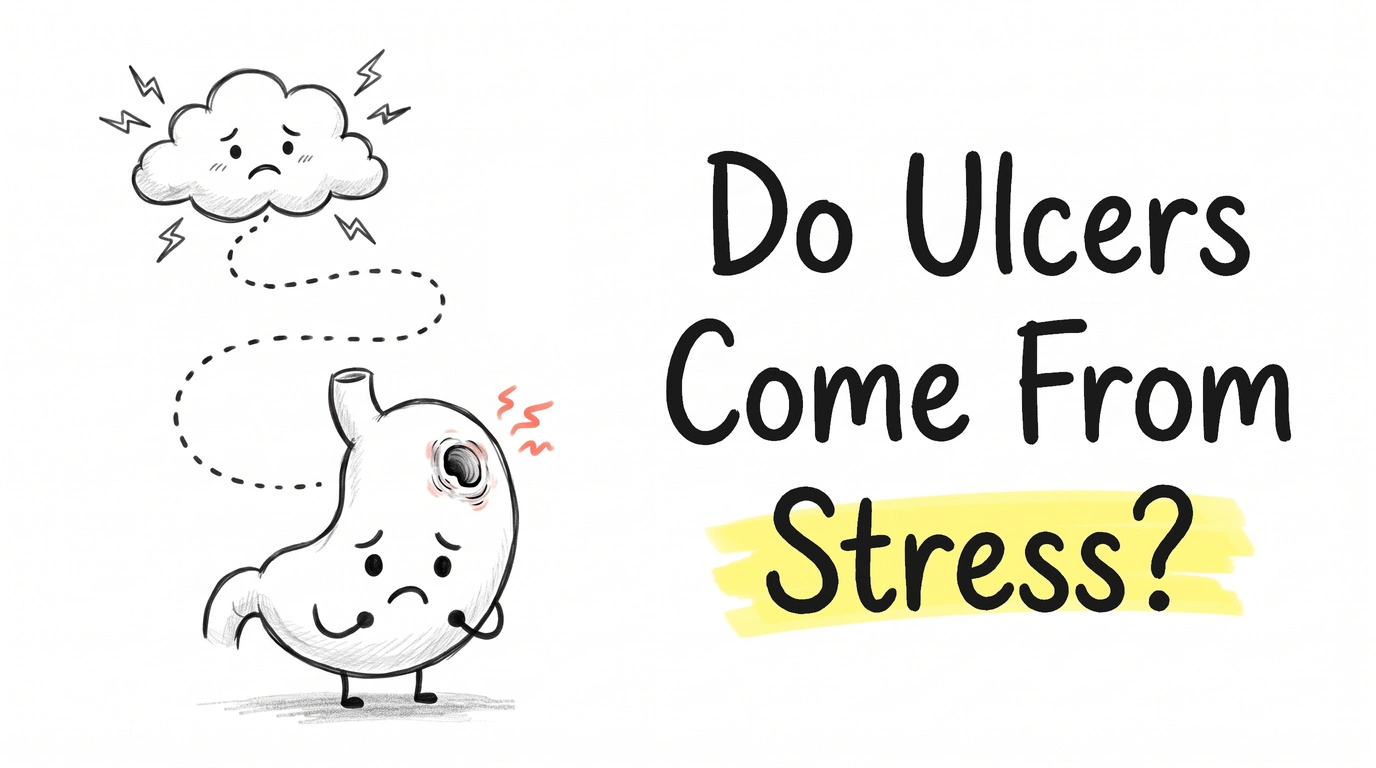
If you type "do ulcers come from" into Google, the first thing it offers you is "stress." In the spring of 1997 the CDC put the same question to 2,512 American adults. Sixty percent said that ulcers were caused by too much stress, 17% said spicy food, and 27% said a bacterial infection. The youngest people surveyed were the furthest off: among 18 to 24 year olds, 78% blamed stress and 12% named an infection.
Most peptic ulcers come from a bacterial infection or from a painkiller sold in every drugstore in the country. Stress does show up in the research, and it shows up more strongly than the usual myth-busting version admits, though it sits a long way behind those two.
What an ulcer actually is
A peptic ulcer is an open sore in the lining of your stomach or in the first stretch of your small intestine, which is called the duodenum (the short curved section that food enters as soon as it leaves the stomach). The Danish researchers who ran one of the big stress studies only counted a case when there was "a distinct breach in the mucosa," meaning a visible break in the wall, confirmed on an endoscopy report or an X-ray. Cleveland Clinic puts about 80% of peptic ulcers in the duodenum and about 20% in the stomach itself.
If you arrived here because of the white sore that keeps showing up inside of your lip, that one lives in a different organ and this article has nothing to say about it. If you type "can you get an ulcer from" instead, the list still starts with "stress," and it also offers "can you get an ulcer from biting your lip" and "can you get an ulcer from kissing."
NIDDK notes that "many people who have peptic ulcers don't have any symptoms." Some people find out only once the ulcer causes a complication.
The two things behind almost all of them
"The most common causes of peptic ulcers are Helicobacter pylori (H. pylori) infection and nonsteroidal anti-inflammatory drugs (NSAIDs)," NIDDK's page says. "Other causes of peptic ulcers are uncommon or rare."
How rare is the leftover category? A meta-analysis published in August 2026 pooled 92 studies covering 60,816 patients across 32 countries and found that 13.0% of peptic ulcers were neither H. pylori related nor NSAID related, with a confidence interval running from 10.4% to 16.2%. A large 2002 review in The Lancet put the same point in one sentence: "Peptic-ulcer disease is rare in H pylori negative non-NSAID takers."
H. pylori is a bacterium that lives in the lining of the stomach, and it is extremely common. A meta-analysis of 184 studies from 62 countries concluded that more than half of the world's population is infected, and the World Health Organization's cancer agency gives the same figure of "over 50%." Most people who carry it get it in childhood and never know. MedlinePlus states it plainly: "many people who have these bacteria in their stomach do not develop an ulcer." Susan Levenstein, a gastroenterologist who has spent her career on this question, puts the share of infected people who ever get one at around 20%. The same infection is also the main cause of stomach cancer, which is why a cancer agency is the body counting how common it is, and what that means for someone your age is its own article.
Whether you personally have it is a different question, and nobody has measured your age group in the United States recently. The most recent nationally representative US figure covering teenagers comes from NHANES III, where 24.8% of 6 to 19 year olds carried antibodies to H. pylori. That fieldwork ran from 1988 to 1991, so a 16 year old in that sample was born around 1973, and infection rates in developed countries have fallen since. A study of 421 healthy Slovenian children and adolescents between 2019 and 2022, using a stool test that detects current infection, found 10.9% positive. Cleveland Clinic puts US children under 10 at about 5%.
NSAIDs are the painkillers in your medicine cabinet that bring down swelling, and Mayo Clinic names the ones you would recognize: "ibuprofen (Advil, Motrin IB, others), naproxen sodium (Aleve, Anaprox DS, others), ketoprofen and others. They do not include acetaminophen (Tylenol, others)." Tylenol works on pain through a different route and does not carry the same ulcer risk.
They cause ulcers for the same reason they work. Your stomach lining keeps itself intact using prostaglandins, the signaling chemicals that ibuprofen blocks to stop your headache, so you cannot get the pain relief without also turning down the system that repairs your stomach. The mechanism has its own article here, along with what a study of coated aspirin showed about whether keeping the pill off of your stomach helps and the dose where the risk starts to move: Why Does Ibuprofen Hurt My Stomach?
Having both at once is worse than having either. In that Lancet review, H. pylori infection alone raised the risk of a bleeding ulcer 1.79-fold and NSAID use alone raised it 4.85-fold, and the two together raised it 6.13-fold.
That does not mean that taking ibuprofen for cramps or a rolled ankle will put a hole in your stomach. The American College of Gastroenterology's 2009 guideline sorts NSAID users by risk factors (previous ulcer, age over 65, high doses, long-term use, steroids or blood thinners alongside) and says that "patients without risk factors are at low risk for NSAID-related peptic ulcer complications and no protective measures are required." A healthy teenager taking a normal dose for a few days has none of those. What nobody has published is an actual number for that situation, so anyone who gives you one is guessing.
The doctor who drank it
Before 1984, according to the CDC's own summary of the era, "the major causes of PUD were considered to be excess acid, diet, smoking, and stress." Treatment matched the theory. Barry Marshall, describing the options he had as a young doctor, wrote that antacids worked out to "about a bucketful taken over four weeks," and that an actual cure "required removal of the lower third of the stomach by surgery," after which around 10% of patients "became 'gastric cripples', unable to enjoy food for the rest of their lives."
Marshall and the pathologist Robin Warren thought that a spiral bacterium they kept finding in stomach biopsies was doing the damage. Marshall could not get the medical community to take it seriously. In his Nobel lecture he described the reaction: "I realized then that the medical understanding of ulcer disease was akin to a religion. No amount of logical reasoning could budge what people knew in their hearts to be true."
So in 1984 he drank it.
He skipped breakfast, took a dose of an acid-reducing drug, and a colleague scraped a four-day culture plate of the bacteria into a broth. "I fasted until 10 am when Neil handed me a 200 ml beaker about one quarter full of the cloudy brown liquid. I drank it down in one gulp then fasted for the rest of the day." Within a week he was waking up at dawn to vomit, sleeping badly, and being told by his wife that he had "a putrid breath." An endoscopy on day 10 found the bacteria and found inflammation.
The retelling you usually get says that he gave himself an ulcer and then cured it with antibiotics. Both halves are wrong, and the paper he published in 1985 says so. What he produced was gastritis, meaning inflammation of the stomach lining without a sore in it, and the paper describes it as "a mild illness" that "lasted 14 days" and proposes only that this kind of infection "may progress to a chronic infection which predisposes to peptic ulceration." His second endoscopy found the bacteria gone before he took a single antibiotic tablet, which he says he swallowed afterward and which would not have cleared the infection on its own anyway.
The Nobel Assembly gave Marshall and Warren the 2005 prize in Physiology or Medicine "for their discovery of the bacterium Helicobacter pylori and its role in gastritis and peptic ulcer disease," and the press release spelled out what changed: peptic ulcer disease is "no longer a chronic, frequently disabling condition, but a disease that can be cured by a short regimen of antibiotics and acid secretion inhibitors."
Where stress fits
Stress kept showing up in the data after the bacteria were found.
A US study followed 4,511 adults with no history of ulcer for 13 years. Over that time 208 of them developed one. Among the people who described themselves as stressed at the start, 7.2% developed an ulcer; among the people who did not, 4.0% did. After adjusting for age, sex, education, smoking, and regular aspirin use, the stressed group was 1.8 times more likely to get an ulcer, and the more stress people reported, the higher the risk climbed, stepping up through 1.4, 1.9, 2.3, 2.4, and 2.9 across five increasing levels.
A Danish study followed 3,379 adults for 11 to 12 years, scored their stress on a 0 to 10 scale, and confirmed every ulcer against radiology and endoscopy reports. Ulcers turned up in 3.5% of the highest-stress third and 1.6% of the lowest-stress third, an adjusted odds ratio of 2.2. The researchers also checked stored blood samples for H. pylori antibodies, and reported that "the risk for ulcer related to stress was similar among subjects who were H pylori seropositive, those who were H pylori seronegative, and those exposed to neither H pylori nor nonsteroidal anti-inflammatory drugs."
The stress effect in that Danish study shrank each time another variable went into the model, and it shrank most once smoking, NSAID use, and lack of exercise were added, landing at a per-point odds ratio of 1.11 with a confidence interval of 1.01 to 1.23. Levenstein, reviewing the whole literature, estimated that somewhere between 17% and 44% of stress's influence on ulcers runs through behavior: stressed people smoke more, sleep less, eat at random hours, drink more, and reach for painkillers more often. The Danish authors said the same thing in their own conclusion, that stress raised ulcer incidence "in part by influencing health risk behaviors."
Two findings cut against all of it. A Finnish study of 13,888 twin pairs found that high stress predicted ulcers in men, with a relative risk of 3.2, until the researchers ran the stricter analysis comparing twins in the same pair against each other, which removes shared genes and shared upbringing from the picture. In that analysis stress did not survive at all, and only smoking and regular painkiller use did. And a Korean study of national insurance records ran the question in both directions across roughly 127,000 ulcer patients and 30,000 people with depression, and found the arrow pointing backwards harder than forwards: having an ulcer raised the odds of a later depression diagnosis 1.68-fold, while having depression raised the odds of a later ulcer only 1.14-fold. Having a painful stomach condition for months is itself stressful, which fits those numbers at least as well as the other direction does.
Every study here was done on adults. The closest anyone has come to your age group is a Swedish cohort that assessed 233,093 men for stress resilience at military conscription around age 18 and then tracked their ulcer diagnoses between ages 28 and 57, and that one adjusted for neither smoking nor painkiller use nor H. pylori.
Stress ulcers in intensive care
Medicine does use the phrase "stress ulcer," and it means something with no connection to midterms. The American Society of Health-System Pharmacists and the Society of Critical Care Medicine define it for the patients it happens to: "Critically ill adults can develop stress-related mucosal damage from gastrointestinal hypoperfusion and reperfusion injury." Hypoperfusion means that not enough blood is reaching the tissue, which happens in people who are in shock, on a ventilator, badly burned, or bleeding.
A study of 2,252 intensive care patients found serious gastrointestinal bleeding in 1.5% of them, and the two things that predicted it were respiratory failure and a blood-clotting problem.
Spicy food got its own experiment
In 1988, researchers fed 12 healthy volunteers four different meals in random order and then looked inside their stomachs with a camera each time. The meals were unpeppered steak and fries, the same bland meal plus 1,950 mg of aspirin, a Mexican meal containing 30 grams of jalapeños, and pepperoni pizza.
Eleven of the 12 people who ate the bland meal with aspirin came back with multiple gastric erosions, scored as severe injury. The median damage score for the other three meals, jalapeños included, was zero. The researchers then ground up about 30 grams of fresh jalapeños and put them directly into people's stomachs, and found no visible damage 24 hours later.
Spicy food can still hurt if your stomach is already sore. Cleveland Clinic puts it this way: "Foods don't cause peptic ulcers, but some can make symptoms worse, especially spicy or acidic foods." The NHS tells people with an ulcer to avoid whatever triggers their own symptoms, which for some people is spicy food and for others is coffee, chocolate, or anything fatty.
How you would know, and what to do
The main symptom is pain in the upper part of your abdomen, somewhere between your belly button and your breastbone. NIDDK describes it as "dull or burning," coming and going over time, sometimes worse when your stomach is empty or at night, and sometimes briefly better after you eat. The standard clinical reference adds a timing clue: pain from a stomach ulcer tends to arrive 15 to 30 minutes after a meal, while pain from a duodenal ulcer tends to show up 2 to 3 hours after one.
A few signs mean that you stop reading and get help the same day. NIDDK lists them: "black or tarry stool, or red or maroon blood mixed with your stool," "red blood in your vomit or vomit that looks like coffee grounds," "sudden, sharp, or severe abdominal pain that doesn't go away," and "feeling dizzy or fainting." Vomit that looks like coffee grounds is blood that has been sitting in stomach acid long enough to turn brown and grainy. Black, tarry, foul-smelling stool is the same blood having traveled the other direction. Neither one looks like blood.
What you should not do is walk into a doctor's office asking for an H. pylori test because your stomach hurts. The joint European and North American pediatric gastroenterology guideline recommends that testing "in children with functional abdominal pain, a disorder of gut-brain interaction (DGBI), is not indicated," and adds that "current evidence indicates that H. pylori infection does not cause symptoms in children in the absence of PUD and/or erosions." Recurrent stomach pain in a teenager is common and usually is not an ulcer, a positive test in that situation does not explain the pain, and chasing it can land you in an unnecessary endoscopy. Describe your symptoms and let the doctor decide what to test.
If it does turn out to be an ulcer, it gets fixed. Testing for H. pylori can be done by breathing into a container or handing over a stool sample. Treatment is two or more antibiotics plus a drug that shuts down acid production, and NIDDK's line on it is that "taking medicines and treating the underlying cause heals most ulcers," usually within a few weeks. Finish the full course even after you feel fine, because bacteria that survive a half-taken course of antibiotics are the ones that learn to resist them.
So if your stomach has been burning through a stressful stretch of school, the stress is worth dealing with on its own terms, and the research gives you a decent reason to take it seriously.
Sources
- NIDDK, Symptoms & Causes of Peptic Ulcers (Stomach or Duodenal Ulcers)
- NIDDK, Diagnosis of Peptic Ulcers
- NIDDK, Treatment for Peptic Ulcers
- MedlinePlus (NLM/NIH), Peptic ulcer (medical encyclopedia)
- Mayo Clinic, Peptic ulcer: Symptoms and causes
- Cleveland Clinic, Peptic Ulcer Disease
- Cleveland Clinic, H. Pylori Infection
- NHS, Stomach ulcer
- CDC, Knowledge About Causes of Peptic Ulcer Disease, United States, March-April 1997, MMWR 1997;46(42):985-987
- Watanabe J et al., Meta-Analysis: Prevalence of Non-Helicobacter pylori, Non-NSAID Peptic Ulcer Disease, Aliment Pharmacol Ther, 2026
- Huang JQ, Sridhar S, Hunt RH, Role of Helicobacter pylori infection and non-steroidal anti-inflammatory drugs in peptic-ulcer disease: a meta-analysis, The Lancet, 2002
- Hooi JKY et al., Global Prevalence of Helicobacter pylori Infection: Systematic Review and Meta-Analysis, Gastroenterology, 2017
- IARC Monographs Volume 100B, Helicobacter pylori, WHO International Agency for Research on Cancer, 2012
- Staat MA et al., A population-based serologic survey of Helicobacter pylori infection in children and adolescents in the United States, J Infect Dis, 1996
- Šterbenc A et al., Prevalence of Helicobacter pylori infection among Slovenian children and adolescents, Helicobacter, 2024
- Lanza FL, Chan FKL, Quigley EMM, Guidelines for Prevention of NSAID-Related Ulcer Complications, American College of Gastroenterology, Am J Gastroenterol, 2009
- Malik TF, Gnanapandithan K, Singh K, Peptic Ulcer Disease, StatPearls (NCBI Bookshelf), 2023
- Marshall BJ, Armstrong JA, McGechie DB, Glancy RJ, Attempt to fulfil Koch's postulates for pyloric Campylobacter, Med J Aust, 1985
- Marshall BJ, Helicobacter Connections, Nobel Lecture, December 8, 2005
- The Nobel Prize in Physiology or Medicine 2005, press release, Nobel Assembly at Karolinska Institutet
- Anda RF et al., Self-perceived stress and the risk of peptic ulcer disease, Arch Intern Med, 1992
- Levenstein S, Rosenstock S, Jacobsen RK, Jorgensen T, Psychological stress increases risk for peptic ulcer, regardless of Helicobacter pylori infection or use of nonsteroidal anti-inflammatory drugs, Clin Gastroenterol Hepatol, 2015
- Levenstein S, The Very Model of a Modern Etiology: A Biopsychosocial View of Peptic Ulcer, Psychosomatic Medicine, 2000
- Räihä I et al., Lifestyle, stress, and genes in peptic ulcer disease: a nationwide twin cohort study, Arch Intern Med, 1998
- Kim SY, Min C, Oh DJ, Choi HG, Bidirectional association between depression and peptic ulcers, Scientific Reports, 2020
- Melinder C et al., Stress resilience and the risk of peptic ulcer disease, Aliment Pharmacol Ther, 2015
- SCCM/ASHP, Guideline for the prevention of stress-related gastrointestinal bleeding in critically ill adults, 2024
- Cook DJ et al., Risk factors for gastrointestinal bleeding in critically ill patients, N Engl J Med, 1994
- Graham DY, Smith JL, Opekun AR, Spicy food and the stomach. Evaluation by videoendoscopy, JAMA, 1988
- Homan M et al., Updated joint ESPGHAN/NASPGHAN guidelines for management of Helicobacter pylori infection in children and adolescents, J Pediatr Gastroenterol Nutr, 2024


.svg)
.webp)
.webp)



.webp)


.webp)
.webp)