If you type "is bread ultra processed" into Google, it offers to finish the question with sourdough, homemade, white, and Dave's. For yogurt, you get Greek, Chobani, Activia, Fage, and Siggi's. Protein powder gets whey, pea, and vegan. Most of the searches are about one food at a time, usually something that's already in the kitchen.
Ultra-processed food is most of what young people in the US eat. A 2021 study in JAMA (one of the main US medical journals) used national survey data to track kids and teens aged 2 to 19, and found that the share of their calories coming from ultra-processed food rose from 61.4% in 1999 to 67.0% in 2018. Over the same years, the share from unprocessed or minimally processed food fell from 28.8% to 23.5%.
For a healthy teenager, though, no study has shown that ultra-processed food as a whole damages the gut. The clearest link is with Crohn's disease in adults, and it's a link rather than proof. The evidence on the additives people worry about most comes mostly from mice and from a handful of small human trials that disagree with each other.
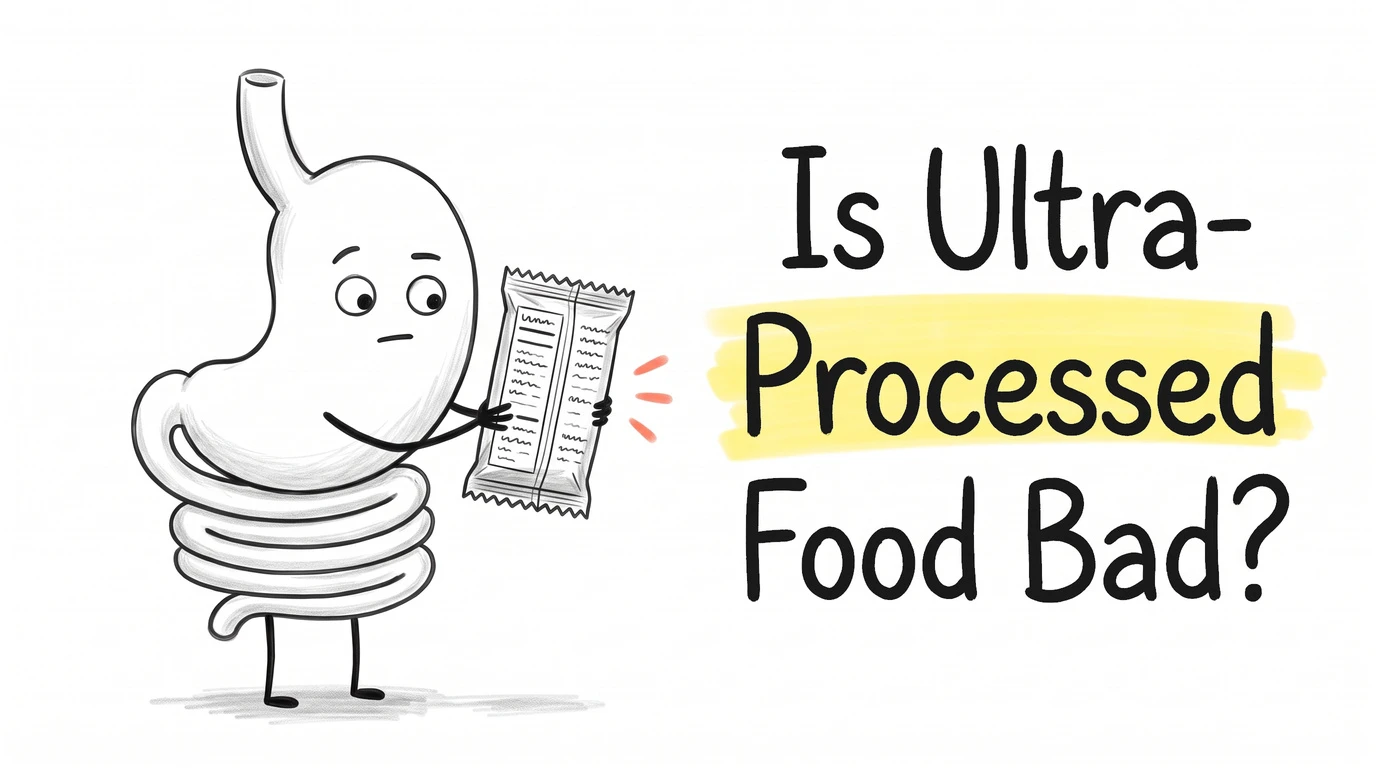
What makes a food "ultra-processed"?
The term comes from NOVA, a system built by researchers at the University of São Paulo in Brazil that sorts food by how it was made instead of by the nutrients in it. It has four groups:
- Group 1 is unprocessed or minimally processed food, meaning food "as it comes from nature," like fruit, vegetables, eggs, milk, and plain meat.
- Group 2 is cooking ingredients pulled out of group 1 foods, like oil, butter, sugar, and salt.
- Group 3 is processed foods, which are group 1 foods with group 2 ingredients added, like "canned vegetables or fish, fruit in syrup, and artisan-type cheeses and bread."
- Group 4 is ultra-processed foods, which NOVA's creators describe as "not really foods but formulations of substances obtained by fractionating foods" (breaking foods down into parts like sugar, oils, and protein isolates) and then adding "colors, flavors, emulsifiers, thickeners, and other additives." Their list includes soft drinks, packaged snacks, ice cream, breakfast cereals, chicken nuggets, and "packaged bread and other bakery products."
So a loaf from a bakery counts as processed, and the sliced loaf in a bag at the grocery store usually counts as ultra-processed, even when it's whole grain. Some large studies even track "ultra-processed dark breads and whole-grain breads" as their own category.
The US has no official definition. In 2025, the FDA (Food and Drug Administration) and the USDA asked the public for help writing one, and their notice says that "there is no single, universally accepted definition of UPFs." Even with NOVA's rules in hand, experts sort the same foods differently. In a 2022 study, researchers in France gave 159 food and nutrition specialists a list of 120 grocery products, ingredient lists included, and asked them to assign each one to a NOVA group. On the agreement scale the researchers used, where 1 means everyone gave the same answer, they scored 0.32, and plain unsweetened dairy products ended up in all four groups. The authors concluded that NOVA's criteria "do not currently allow foods to be unequivocally defined as ultra-processed." (The study got less than 5% of its funding from a French fund that is partly sponsored by the food industry.)
What does the research say about your gut?
Most of the gut research on ultra-processed food is about IBD (inflammatory bowel disease, where the immune system attacks the gut over and over for years). The two main types are Crohn's disease and ulcerative colitis, and they're different from IBS, which IBS vs IBD: What's the Difference? walks through.
The biggest single study is PURE, which followed 116,087 adults aged 35 to 70 in 21 countries for about 10 years. People who ate five or more servings of ultra-processed food a day had an 82% higher risk of being diagnosed with IBD than people who ate less than one. That sounds large, but only 467 of the 116,087 got IBD at all, which is about 4 in every 1,000. The foods behind the link were soft drinks, sweets, salty snacks, and processed meat. White meat, unprocessed red meat, dairy, starches, fruit, vegetables, and beans weren't linked to IBD.
A 2023 review pooled PURE with four other long-term studies, covering more than a million people. Higher ultra-processed food intake went with a 71% higher risk of Crohn's disease, and there was no link with ulcerative colitis. SACN (the committee that advises the UK government on nutrition) points to another review where the Crohn's link disappeared once the researchers counted only studies that followed healthy people forward in time, rather than asking people who were already sick what they used to eat.
These are all cohort studies (researchers track a big group of people and see who gets sick), so they can't show that the food caused anything. People who eat a lot of ultra-processed food also differ in income, exercise, and plenty of other ways that are hard to fully adjust for.
For IBS, the main study is a French one of 33,343 adults, which found that people in the top quarter for ultra-processed food had 25% higher odds of IBS than people in the bottom quarter. Diet and symptoms were measured at the same time, though, so there's no way to tell which came first. People with IBS might end up choosing different foods because of their symptoms.
What about emulsifiers?
Emulsifiers are the additives that keep oil and water mixed, which is how ice cream stays smooth and salad dressing doesn't separate. They're one of the ingredients NOVA uses to flag a food as ultra-processed, and "are emulsifiers bad for your gut" is one of Google's top suggestions when you start typing the question.
The worry started in mice, where emulsifiers changed gut bacteria in ways that led to colitis (inflammation of the colon). The first human test came in 2022, when 16 healthy adults lived on a controlled diet for 11 days and seven of them got 15 grams a day of carboxymethylcellulose (a common emulsifier). The authors note that this dose "likely exceeds" what most people eat. The emulsifier "modestly increased" stomach discomfort after meals and made their gut bacteria less diverse. In two of the seven, bacteria moved into the inner mucus layer, which normally keeps gut bacteria away from the gut wall (the same barrier that Is Leaky Gut Real? covers).
The UK's ADDapt trial then tested the idea on 154 people who already had active Crohn's disease. After 8 weeks on a low-emulsifier diet, 49% saw their symptoms improve, compared with 31% of a group eating the same diet with emulsifiers added back in. It's been presented at a conference but hasn't come out as a full paper yet. A smaller trial at Monash University in Australia came out the other way. It gave 24 people with Crohn's a healthy diet with or without added emulsifiers for 4 weeks and found no difference, and its authors wrote that "recommendations to avoid emulsifiers in patients with active CD are not supported." Neither trial included healthy people, so neither one says what emulsifiers do to a gut without disease.
Is it the processing or what comes with it?
SACN reviewed the evidence in 2023 and again in 2025. It called the links between ultra-processed food and poor health "concerning," but said that it's still "unclear whether these foods are inherently unhealthy due to processing or because a large majority of (ultra-) processed foods are high in calories, saturated fat, salt and/or free sugars."
In a 2019 NIH study (the National Institutes of Health, the US government's medical research agency), 20 adults lived at an NIH hospital for four weeks and ate an ultra-processed diet for two weeks and an unprocessed one for the other two, with both diets matched for calories, sugar, salt, and fiber. On the ultra-processed diet, people ate about 508 more calories a day. The study was built to measure eating and weight, and it didn't look at the gut.
Kevin Whelan, the King's College London professor who led the ADDapt trial, points out that ultra-processed foods "can be cheap and tasty, and they can be easy to prepare," which matters when you're sick, and that they're "often high in energy and protein which is good if IBD is making you malnourished." In his words, "it is not as easy as saying all UPF are always bad."
What can you actually do?
Start with the foods that showed up in the PURE study (soda, sweets, salty snacks, and processed meat) rather than with the yogurt or the bread. SACN's advice is that "most people are likely to benefit from reducing their consumption of processed foods high in energy, saturated fat, salt and free sugars and low in fibre," which leaves plain yogurt and whole-grain bread alone.
The 2025 to 2030 US Dietary Guidelines say that teens should be "significantly limiting sugary drinks and energy drinks and avoiding highly processed foods," and that "vegetables, fruits, fermented foods (e.g., sauerkraut, kimchi, kefir, miso), and high-fiber foods support a diverse microbiome." Fiber is the part most teens are missing, and How to Improve Your Gut Health has the daily amounts. If you want to spot emulsifiers, look for names like carboxymethylcellulose, polysorbate 80, and carrageenan on the label (The 10 Worst Foods for Your Gut Health lists where they tend to show up).
If you have IBD, the American Gastroenterological Association (the main group of gut doctors in the US) advises "a Mediterranean diet rich in a variety of fresh fruits and vegetables, monounsaturated fats, complex carbohydrates, and lean proteins and low in ultra-processed foods, added sugar, and salt." Work out any changes with your doctor or a dietitian rather than cutting foods on your own. What Is Crohn's Disease? has more on how the disease works.
Sources
- Wang L, Martínez Steele E, Du M, et al., Trends in Consumption of Ultraprocessed Foods Among US Youths Aged 2-19 Years, 1999-2018, JAMA, 2021
- NUPENS, University of São Paulo, Food Classification Nova
- FDA and USDA, Ultra-Processed Foods; Request for Information, Federal Register, 2025
- Braesco V, Souchon I, Sauvant P, et al., Ultra-processed foods: how functional is the NOVA system?, European Journal of Clinical Nutrition, 2022
- Narula N, Wong ECL, Dehghan M, et al., Association of ultra-processed food intake with risk of inflammatory bowel disease: prospective cohort study, BMJ, 2021
- Narula N, Chang NH, Mohammad D, et al., Food Processing and Risk of Inflammatory Bowel Disease: A Systematic Review and Meta-Analysis, Clinical Gastroenterology and Hepatology, 2023
- Scientific Advisory Committee on Nutrition, Processed foods and health: SACN's rapid evidence update, 2025
- Schnabel L, Buscail C, Sabate JM, et al., Association Between Ultra-Processed Food Consumption and Functional Gastrointestinal Disorders: Results From the French NutriNet-Santé Cohort, American Journal of Gastroenterology, 2018
- Chassaing B, Compher C, Bonhomme B, et al., Randomized Controlled-Feeding Study of Dietary Emulsifier Carboxymethylcellulose Reveals Detrimental Impacts on the Gut Microbiota and Metabolome, Gastroenterology, 2022
- Bancil A, et al., Emulsifier restriction is an effective therapy for active Crohn's disease: the ADDapt trial, Journal of Crohn's and Colitis (ECCO 2025 abstract DOP097), 2025
- Fitzpatrick JA, Gibson PR, Taylor KM, et al., Clinical Trial: The Effects of Emulsifiers in the Food Supply on Disease Activity in Crohn's Disease, Alimentary Pharmacology & Therapeutics, 2025
- Hall KD, Ayuketah A, Brychta R, et al., Ultra-Processed Diets Cause Excess Calorie Intake and Weight Gain: An Inpatient Randomized Controlled Trial of Ad Libitum Food Intake, Cell Metabolism, 2019
- Crohn's & Colitis UK, AGM 2023: Ultra-processed foods, questions and answers (with Professor Kevin Whelan), 2023
- HHS and USDA, Dietary Guidelines for Americans, 2025-2030
- American Gastroenterological Association, Diet and Nutritional Therapies in Patients With IBD


.svg)
.webp)
.webp)



.webp)


.webp)
.webp)