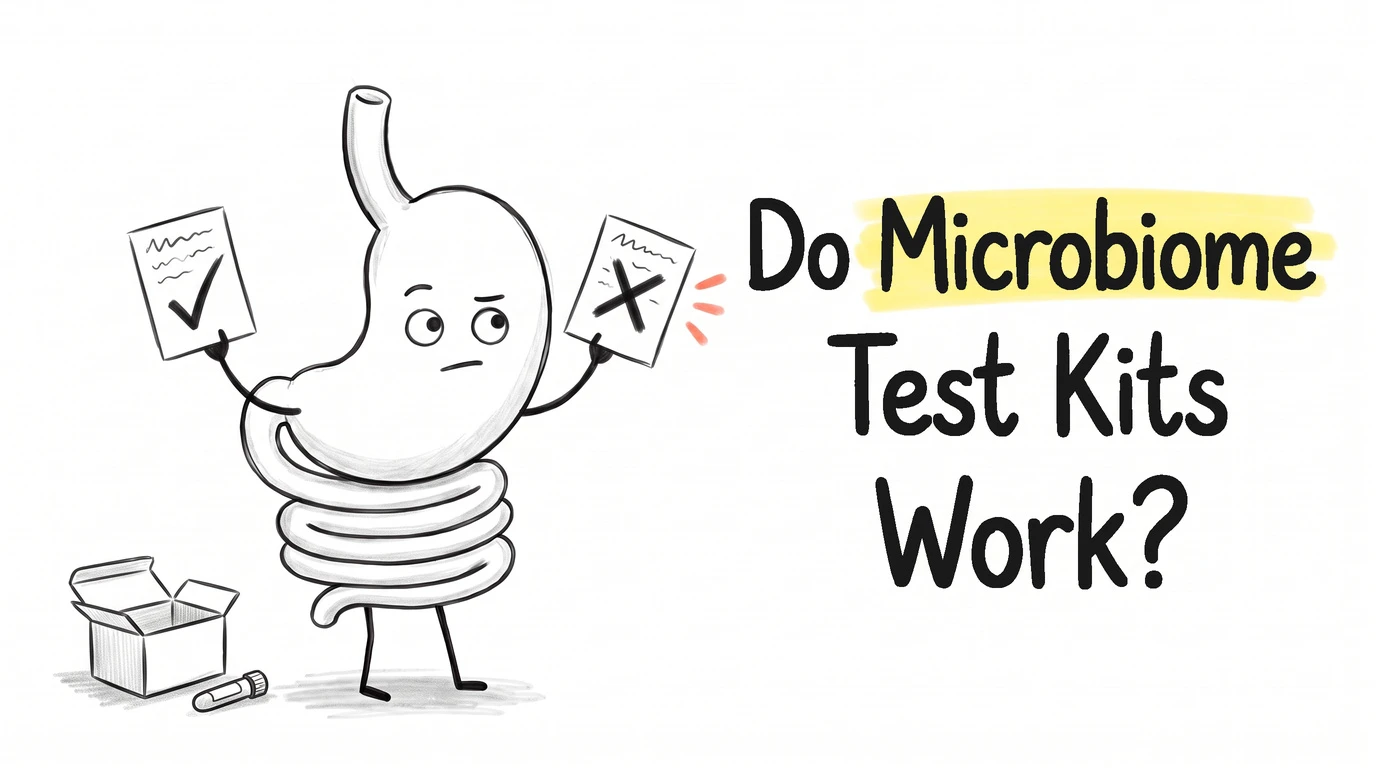
If you type "are gut microbiome tests" into Google, it finishes the thought with "worth it," "legit," and "accurate." The suggestions for "is viome" are "legit," "worth it," and "a reputable company." The kits run from about $229 to $485. You swipe a little poop onto a collector, mail it off, and a few weeks later you get back a report full of scores, usually with foods and supplements to buy.
The lab can find bacterial DNA in your sample, but it can't yet tell you what that DNA means, because the company you pick changes the result about as much as whose poop it is, nobody has agreed on what a healthy result looks like, and the main group of gut doctors in the UK says outright that it doesn't recommend these tests.
What's in the report?
The lab pulls DNA out of your sample and reads it to work out which bacteria are there and in what amounts (all of those microbes together are your microbiome). Then it compares your list to a group of other people and turns the comparison into scores. Viome's $279 gut test promises "25+ gut health scores," and the same checkout page offers personalized supplements on a subscription, with the "first charge when your test results are ready."
What happened when scientists sent the same poop to seven companies?
Researchers at NIST (the US government lab in charge of measurement standards) took stool from one donor, blended it so every portion was the same, and ordered three kits from each of seven companies, 21 kits in all. Their 2026 paper lists what came back.
The number of bacterial species the companies reported ranged from 20 to 1,701. Only three groups of bacteria (genera, the level above species) showed up in every analysis. Every company reported on C. diff (a bacterium that can cause severe diarrhea), and "three indicate C. difficile was present and the other four reported absence." One company rated two of its kits healthy and the third unhealthy, even though all three held the same poop.
The authors wrote that the variation "between providers was on the same scale as biological variability between different donors." Switching companies changed the results about as much as switching to a different person's poop.
Most of the companies were consistent with themselves, with each one's three kits landing in a fairly tight range. They just disagreed with each other. The study also can't say which company got it right, since the sample had no known correct answer to check against, and it kept every company anonymous, so you can't use it to pick a brand.
Is there even a healthy result to compare against?
The British Dietetic Association (the UK's professional body for dietitians) says that "we don't know what a healthy microbiome is yet," and a team led by University of Maryland researchers wrote in Science in 2024 that there is "no consensus about what constitutes a healthy human microbiome composition in any population or subpopulation." The NIST team found "no standard practice for selecting a comparative 'healthy' population" among the companies they tested, so some graded customers against the company's own earlier customers and others against public research datasets.
The Firmicutes-to-Bacteroidetes ratio (how much of one big family of gut bacteria you have compared to another) was once pitched as a sign of obesity. When a 2014 reanalysis went back to the large datasets, it "found no difference between obese versus lean individuals" in either group and concluded there is "no simple taxonomic signature of obesity." A 2025 international consensus statement for doctors now says "the reporting of Firmicutes-to-Bacteroidetes ratio in the microbiome testing is discouraged," and that there's "insufficient evidence to include any dysbiosis index" (a single score for how "off" your bacteria are).
A 2021 study collected daily stool samples from 20 healthy adult women in Belgium for six weeks. For "78% of microbial genera," the swing from day to day inside one person was bigger than the difference between people, "with up to 100-fold shifts." One Reddit user in r/Microbiome described Viome naming cabbage one of their top superfoods, eating "an absolutely unreasonable amount of cabbage," and then retesting and being told to avoid cabbage because of gas. That's one person's story, and there's no way to know whether their gut changed or the test did.
Where does the money go?
The Science paper counted the companies selling these tests and found that "approximately 45% of the companies we identified sell supplements that they recommend to consumers on the basis of their test results." The NIST team saw it in their own reports, with companies recommending "costly supplements (e.g., probiotics) that are sold by the same company and for which there is very little clinical evidence for efficacy." Ombre's $229.99 test comes with "probiotic recommendations," and Viome's supplement plan starts billing the day your results arrive. For most gut problems, the main group of US gut doctors doesn't recommend probiotics in the first place.
Many companies advertise that their lab is CLIA-certified (the US lab-quality program run by the Centers for Medicare & Medicaid Services), but CMS says its program "does not address the clinical validity of any test," meaning it doesn't check whether a result says anything true about your health. A 2025 legal review by the same Maryland group found that the FDA has "largely ignored this group of tests," most likely because the agency sees them as low-risk wellness products.
Has acting on a report ever helped anyone?
ZOE, a company that sells a gut test and a nutrition app, ran the closest thing to a test of whether following a report helps. In its trial, 347 US adults (average age 52, mostly women) either followed personalized food scores for 18 weeks or got the standard US government diet advice. The personalized scores came from four inputs: blood sugar responses, blood fat responses, a stool sample, and health history. The personalized group's triglycerides (a kind of fat in your blood) dropped a little more, and their LDL cholesterol, the trial's other main target, didn't differ from the control group's.
ZOE paid for the trial, and "the study funder contributed, as part of the scientific advisory board, to study design, data collection and analysis, and the writing of the manuscript." The stool sample was one input out of four, so the trial can't tell you whether the microbiome part did anything. The personalized group also ended up eating about 162 fewer calories a day. None of the people in it were teenagers.
What do gut doctors say?
The British Society of Gastroenterology (the main group of gut doctors in the UK) wrote in 2026 that "we do not know enough about what 'normal' looks like in the microbiome," and "we therefore do not recommend commercial gut microbiome testing at present." The 2025 consensus statement, written by 69 experts from 18 countries and published in The Lancet Gastroenterology & Hepatology, says that patients asking for a test on their own, without a doctor recommending it, "is discouraged," and that personal trainers and coaches shouldn't be ordering them either. Cleveland Clinic's patient page says that "clinical healthcare providers generally don't use or recommend these tests."
Everlywell's $485 Jona test says on its own product page that it's "not recommended for individuals who are pregnant or under the age of 18."
What should you do instead?
If your gut is bothering you, that's a doctor visit rather than a mail-in kit. The NIST team warned that for people with chronic gut problems, confusing results could "result in the delay of appropriate medical care." The stool tests doctors order each look for one thing, like calprotectin, which shows whether your intestines are inflamed.
If you feel fine and you're just curious, the NIST paper notes that most of these companies' advice comes down to "healthier eating habits," which is the same ground our guide to improving your gut health covers for free.
Sources
- Servetas SL, Gierz KS, Hoffmann D, Ravel J, Jackson SA, Evaluating the analytical performance of direct-to-consumer gut microbiome testing services, Communications Biology, 2026
- Hoffmann DE et al., The DTC microbiome testing industry needs more regulation, Science, 2024
- Hoffmann DE et al., Is the current regulatory framework for direct-to-consumer microbiome-based tests sufficient to protect consumers from medical, economic, and dignitary harms?, Journal of Law and the Biosciences, 2025
- Porcari S et al., International consensus statement on microbiome testing in clinical practice, Lancet Gastroenterology & Hepatology, 2025 (author manuscript)
- British Society of Gastroenterology, Gut Microbiota for Health Expert Panel, Statements and FAQ for media enquiries, 2026
- British Dietetic Association, Commercial gut microbiome testing, 2021
- Finucane MM et al., A Taxonomic Signature of Obesity in the Microbiome? Getting to the Guts of the Matter, PLOS ONE, 2014
- Vandeputte D et al., Temporal variability in quantitative human gut microbiome profiles and implications for clinical research, Nature Communications, 2021
- Bermingham KM et al., Effects of a personalized nutrition program on cardiometabolic health: a randomized controlled trial, Nature Medicine, 2024
- Centers for Medicare & Medicaid Services, Laboratory Developed Tests (LDTs) Frequently Asked Questions
- Cleveland Clinic, Gut Microbiome
- Viome, Gut Intelligence Test
- Ombre, Gut Health Test
- Everlywell, Jona Gut Microbiome Test
- r/Microbiome, "Viome Feels Like an AI Wellness Horoscope"

.svg)
.webp)
.webp)



.webp)


.webp)
.webp)