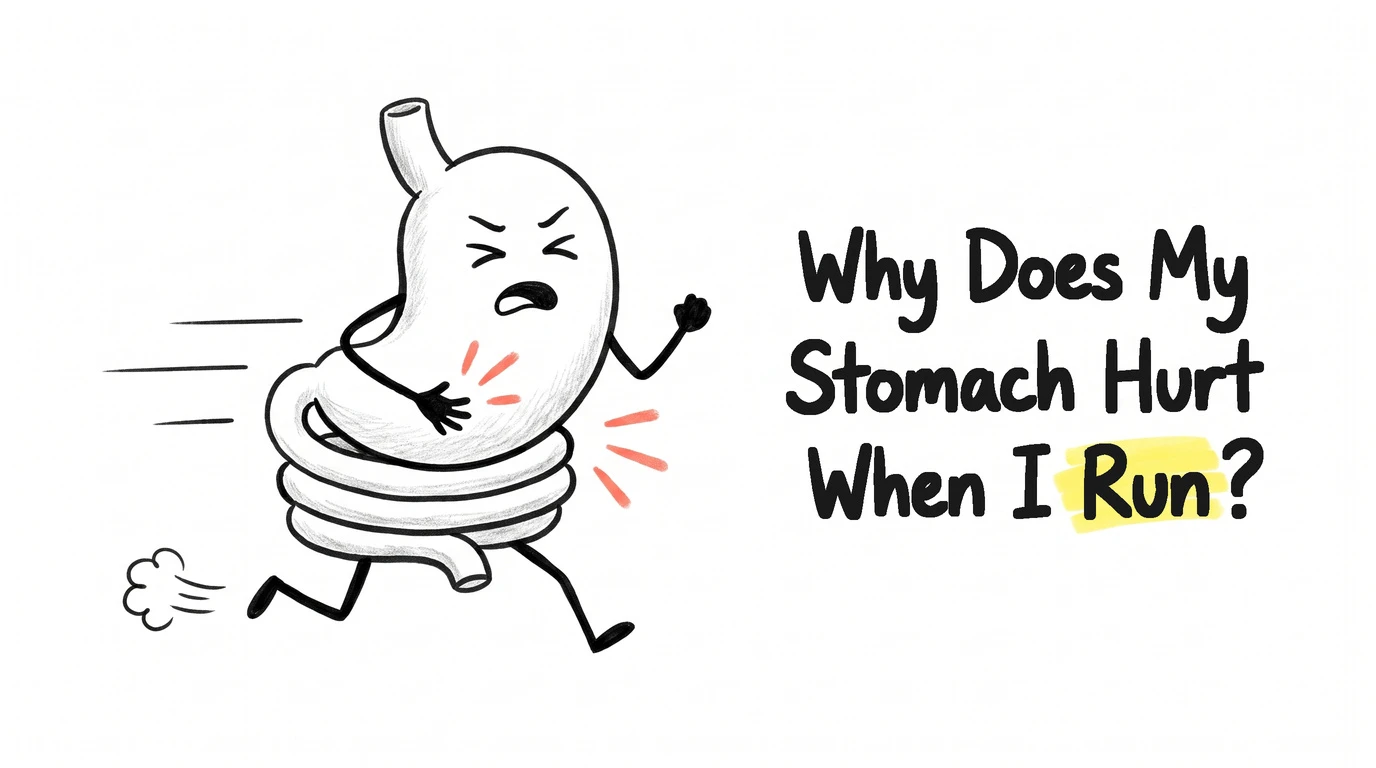
If you start typing "why does my stomach hurt when I run" into Google, it finishes the question for you: when I run fast, after eating, after drinking water, in the morning, or jump. Those are mostly questions about two different problems, and they have different answers.
A side stitch is the sharp pain under the edge of your ribs, usually on one side, that shows up a few minutes in and fades soon after you stop. Nobody has proven what causes it, and the best current explanation points at the lining of your belly instead of a cramping muscle. Runner's gut is the other one: cramps, bloating, nausea, or a sudden need to find a bathroom. It comes from a mix of less blood reaching your gut, a lot of bouncing, and what you ate beforehand, and it mostly shows up in long or hard efforts rather than a normal practice run.
Which one do you have?
The researchers who've done most of the work on stitches are Darren Morton and Robin Callister, in Australia. Their 2015 review of the whole field (a paper that pulls together everything published on a topic) describes the stitch as most common "along the costal border," which is the bottom edge of your rib cage, on the side. It feels "sharp or stabbing when severe, and cramping, aching, or pulling when less intense." Some people also get a sharp pain at the tip of one shoulder at the same time. Right side stitches have been reported up to twice as often as left side ones, though the review notes that left side pain "may be more prevalent among the young."
Runner's gut sits lower and feels more like a stomach problem: gas, a churning feeling, an urge to poop, nausea, or heartburn. Mayo Clinic calls the diarrhea version "runner's diarrhea," and runners online call it runner's trots.
Stitches are mostly a young person's problem
In a survey of 965 people who played regular sports, Morton and Callister found that 77% of active people under 20 had gotten a stitch in the past year, compared with only 40% of people over 40. Both how often people get stitches and how bad they are drop as you get older. In a single running race, about one in five runners gets one.
Being fit helps a little. According to the review, "well trained athletes are not immune from the condition, although they may experience it less frequently." Stitches are uncommon before about age 10.
Running isn't even the worst sport for them. Swimmers reported stitches more often than runners did (75% versus 69%), followed by horse riders (62%).
Why do you get a side stitch?
Morton and Callister list seven theories that people have proposed, and they write that the cause of ETAP (exercise-related transient abdominal pain, the research name for a stitch) "remains speculative." A few of the popular explanations have already been tested and failed.
Your diaphragm cramping
This is the explanation you'll find on Cleveland Clinic's page. Your diaphragm is the dome-shaped muscle under your lungs that does most of your breathing, so if it were starved of blood or cramping, breathing in should get harder. When researchers had people with a stitch blow into a breathing test mid-pain, they "found no compromise in any spirometry measures," and much earlier, X-ray video showed the diaphragm moving "full and unrestricted" during a stitch. The review concludes that a diaphragm starved of blood is unlikely to be the cause.
A muscle cramp in your side
A cramping muscle fires off a lot of electrical activity, which you can measure with sensors on the skin. At the spot where people's stitches hurt, that activity "was not elevated," which the review says "convincingly discredited the muscular cramp theory."
Your organs tugging on their ligaments
The idea is that your liver, stomach, and spleen bounce with every step and pull on the ligaments that hang them from your diaphragm. Some of the evidence fits it, since eating first makes stitches more likely and some people get relief from a tight belt. Cleveland Clinic points out its weakness, though: it "doesn't explain why side stitches frequently occur in swimming." Swimmers don't bounce.
The lining of your belly
Morton and Callister's best guess is irritation of the parietal peritoneum (a thin, slippery lining on the inside of your belly wall, sitting against a matching layer that wraps your organs, like two sheets of wet plastic wrap). The idea is that a full stomach or a lot of twisting presses those layers together and creates friction. That would explain why a big meal makes it worse, why swimming causes it (lots of twisting with your body stretched out), and why it goes away soon after you stop moving. It could also explain the age pattern, since kids have "a proportionally larger peritoneal surface area than that of adults." Morton and Callister call this "speculative" themselves, but they say it best explains the features of a stitch.
What actually helps a stitch
In one trial, 40 active people in their early twenties ran on a treadmill four times after drinking nothing, flavored water, a sports drink, or fruit juice. The juice (11% sugar, much more concentrated than your blood) caused more stitches and bloating, and there was "no difference between the water and sports drink." In a smaller trial, only the concentrated drinks (flat Coca-Cola and a sugar solution) kept making the pain worse as the run went on. So if a stitch hits after you drink water, the amount is a more likely problem than the water. Large amounts of any drink can set one off, soda and juice are the worst, and the 40-person trial found that people got better at tolerating fluids the more times they practiced.
For food, the review's advice is to skip large meals and drinks for at least 2 hours before exercise, and possibly 3 to 4 hours if you get stitches a lot. Posture may matter too. In 159 active people with an average age of 18.6, those with kyphosis (a rounded upper back) were more likely to get stitches and had worse ones.
Once a stitch starts, the tricks people use are deep breathing (40% of the stitch sufferers Morton and Callister surveyed), pushing on the spot (31%), stretching it (22%), and bending forward (18%). The review calls these "equivocal," meaning that the evidence for them is mixed, and says that "the most effective strategy for relieving ETAP remains to stop exercising." Cleveland Clinic suggests slowing down, which is easier to pull off in a race than stopping.
Timing your exhale to land on your left foot is all over running forums. One popular post on Reddit's r/running swears by it because it relieves "the strain on something (can't remember the reasoning)." No study has tested it, and Morton and Callister's review of the field doesn't mention it.
Why does running make you have to poop?
Mayo Clinic's answer starts with "the cause of runner's diarrhea isn't clear." Its list of likely causes is "the physical jostling of the organs, decreased blood flow to the intestines, changes in intestinal hormone secretion, increased amount or introduction of new food, and pre-race anxiety and stress."
The blood flow part is the one you'll read about most. During all-out exercise, the blood going to your gut can drop "by up to 80%" so that your muscles and skin get more. A 2014 review in the journal Sports Medicine says that this "may be linked to nausea, vomiting, abdominal pain, and diarrhea, although convincing evidence for this is lacking." The same review says that gut symptoms are "more common in runners than in cyclists," likely because of the repeated pounding.
Of 1,281 people surveyed after a long recreational race, 45% had at least one gut complaint during the run and 11% had a serious one. The serious ones were more common in younger runners, in women, and in people who weren't used to drinking while they ran. Those numbers are from a long race. Most of the research on runner's gut comes from marathons, triathlons, and ultramarathons, and a 2025 position statement from Sports Dietitians Australia notes that nausea is "rarely reported in lesser exercise loads."
The same statement pushes back on the idea that running mostly means diarrhea. "Despite mainstream dogma" tying exercise to diarrhea, it says, upper-gut symptoms (nausea, bloating, belching, and heartburn) keep getting reported more often, both in lab studies and at real events. Heartburn during exercise has its own section in our heartburn article.
Pre-race nerves may be part of it, since they can set your gut off the same way butterflies before a test do. The Sports Dietitians Australia statement found that only one controlled study has tested anxiety directly, and in that one, runners' anxiety scores "were not correlated" with their gut symptoms.
What to eat before you run
Nemours KidsHealth, writing for teen athletes, says to eat a meal "three to four hours before activity" with plenty of carbs and "some protein but keep the fat low because it can cause an upset stomach." With three hours or less to go, it suggests a lighter snack like fruit, crackers, or bread, and says to avoid "carbonated (fizzy) drinks or juice."
Mayo Clinic's list for people who get runner's diarrhea is stricter:
- For at least a day before, go easy on "high-fiber and gas-producing foods, such as beans, bran, fruit and salad," and on sugar alcohols like sorbitol, which are in sugar-free gum and candy (the sugar-free candy article explains why).
- For three to six hours before, limit caffeine and high-fat foods (caffeine's effect on your gut gets its own article).
- For at least two hours before, don't eat anything.
- Avoid ibuprofen and naproxen, which Mayo says have "been shown to increase the incidence of gastrointestinal complaints" (what taking ibuprofen before a workout actually does).
- Wear loose clothes, since a tight waistband "may aggravate diarrhea."
Most of this advice comes from runners' experience rather than from experiments. The 2014 Sports Medicine review says its own tips "are based on limited research." The Sports Dietitians Australia statement grades eating low-fiber before exercise as backed by "only field observational data and case study approach evidence," with "no controlled experimental trial data available." Mayo and the 2014 review both say to try out any new food or drink during practice first, and Mayo says to "especially avoid introducing a new gel or bar on race day."
When it's more than a stitch
A stitch fades quickly once you stop. Pain that doesn't, or that comes with other symptoms, is a different situation. Cleveland Clinic says to "always seek medical care if your abdominal pain is unexplained, severe or doesn't stop," and to see a doctor if belly pain comes with blood in your poop, a fever that won't go away, or vomiting that doesn't stop. The Sports Dietitians Australia statement lists "fecal blood loss and acute colitis" (colitis means inflamed colon) among the exercise gut problems that need medical attention.
If your stomach bothers you on runs and also on days you don't run, it's worth mentioning to a doctor, because the same symptoms can come from something like IBS or an intolerance, and what's wrong with my gut covers where to start.
Sources
- Morton D, Callister R, Exercise-Related Transient Abdominal Pain (ETAP), Sports Medicine, 2015
- de Oliveira EP, Burini RC, Jeukendrup A, Gastrointestinal Complaints During Exercise: Prevalence, Etiology, and Nutritional Recommendations, Sports Medicine, 2014
- Costa RJS et al., Sports Dietitians Australia and Ultra Sports Science Foundation Joint Position Statement: A Practitioner Guide to the Prevention and Management of Exercise-Associated Gastrointestinal Perturbations and Symptoms, Sports Medicine, 2025
- ter Steege RW, Van der Palen J, Kolkman JJ, Prevalence of gastrointestinal complaints in runners competing in a long-distance run, Scandinavian Journal of Gastroenterology, 2008
- Mayo Clinic Sports Medicine, How can I prevent runner's diarrhea?
- Cleveland Clinic, Why Do I Sometimes Get a Side Stitch When I Run?
- Cleveland Clinic, Abdominal Pain
- Nemours KidsHealth, A Guide to Eating for Sports (for Teens)


.svg)
.webp)
.webp)



.webp)


.webp)
.webp)