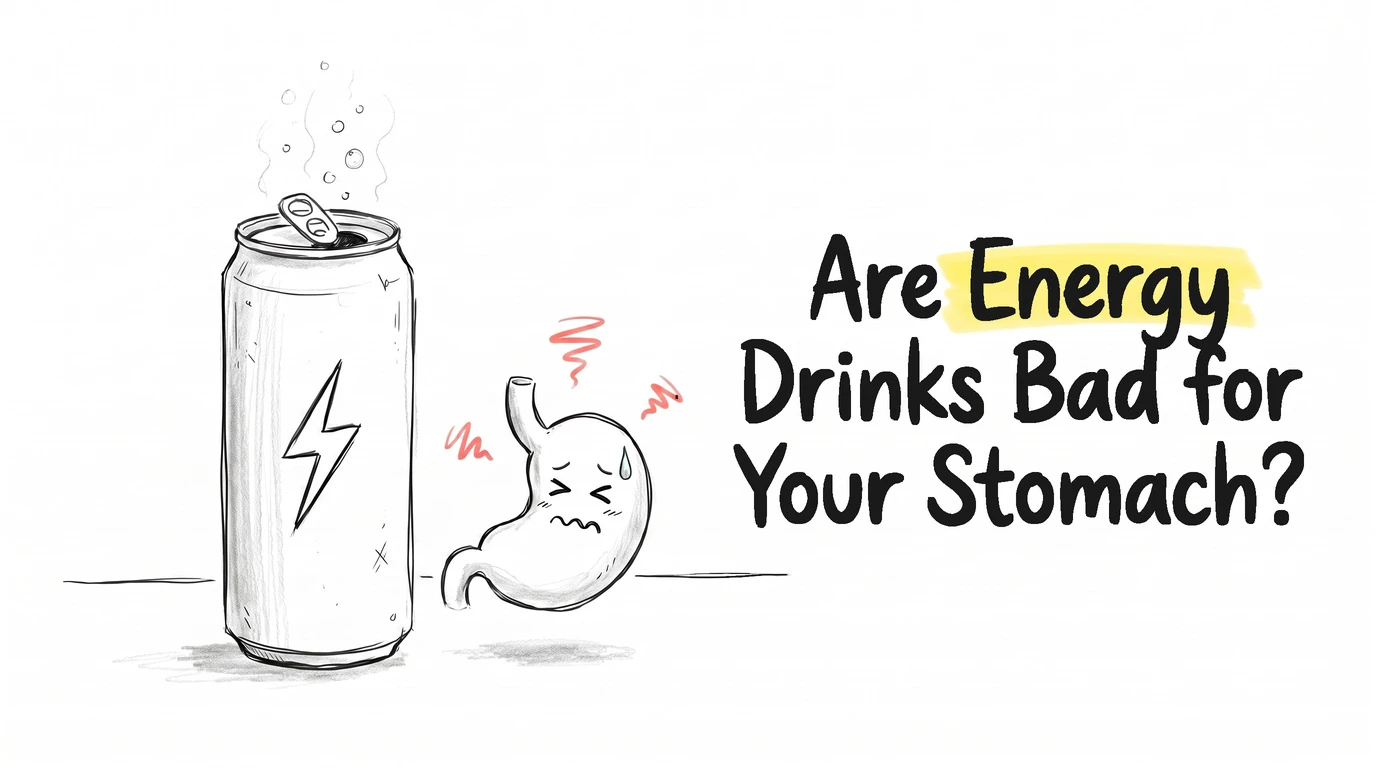
Half a can before practice, and twenty minutes later you're cramping or looking for a bathroom. It happens to enough people that when you type "why does Celsius" into Google, the first thing it suggests is "make me poop." So what is it about an energy drink that does that?
Start with what's in the can
A 12 oz Celsius or Alani Nu has 200 mg of caffeine, and so does a can of Prime Energy. A Bang has 300 mg, a 16 oz Monster has 160, and a 12 oz Red Bull has 114. The FDA (Food and Drug Administration) lists 12 oz of brewed coffee at anywhere from 113 to 247 mg, so the caffeine in these drinks isn't unusual. What's different is that one can holds as much as 300 mg, it's cold and sweet and easy to finish in five minutes, and it's sold to teenagers. Prime's own product page says "For Ages 18+."
The FDA says that 400 mg a day is the amount "not generally associated with negative effects," but that number is for adults, and the FDA doesn't give one for anyone under 18. Two other agencies do. Europe's food safety agency (EFSA) uses 3 mg per kilogram of body weight for kids and teens, and Health Canada uses 2.5. If you weigh 132 pounds (60 kg), that works out to somewhere between 150 and 180 mg a day from everything combined, which means that one 200 mg can puts you over before you've had anything else. Canada doesn't allow more than 180 mg in one serving of an energy drink, so that can couldn't be sold there at that size. The US has no limit.
Why it sends you to the bathroom
The closest research is about coffee. In a study of 99 volunteers aged 17 to 27, 29% said that coffee made them need to go. The researchers then measured what was happening inside the colon (your large intestine), and in the people who'd said that coffee did that to them, activity picked up within four minutes of drinking it. In the people who'd said it didn't, nothing changed, and plain hot water did nothing for anyone.
Decaf set it off too, so caffeine can't be the whole explanation. A second team tracked the colon for ten hours and found caffeinated coffee "60% stronger than water and 23% stronger than decaffeinated coffee," which was about as strong as eating a 1,000-calorie meal.
So caffeine is part of it, it only happens in some people, and eating anything gets your colon moving too. All of that research used coffee, though. An energy drink is cold and carbonated, it has none of the hundreds of other compounds that are in coffee, and no study has tested one this way.
The heartburn explanation you'll see everywhere
If you look up why energy drinks cause heartburn, you'll read that caffeine relaxes the ring of muscle between your esophagus (the tube from your throat to your stomach) and your stomach, which lets acid back up. The American College of Gastroenterology, one of the main groups of gut doctors in the US, doesn't back that up. Its current guideline on reflux puts coffee and caffeine in the group of things that had little to no effect on that muscle in lab studies. Chocolate, peppermint, high-fat food, alcohol, and tobacco are the ones that did loosen it.
In 1994, researchers put caffeine in plain water and measured the acid in people's esophagus. Regular coffee caused reflux, decaf caused less, and caffeine in water caused none. They concluded that "caffeine does not seem to be responsible for gastro-oesophageal reflux which must be attributed to other components of coffee." An energy drink is a lot closer to caffeine in water than it is to coffee.
The bubbles are a better suspect. When researchers measured 18 healthy adults, a cold carbonated cola cut the resting pressure of that muscle roughly in half. So is the acid, since citric acid is usually the second or third ingredient on the label.
Neither one is proven to cause symptoms, though. A review of the research on carbonated drinks concluded that "there is no evidence that carbonated beverages directly cause oesophageal damage," and it didn't find a consistent link to heartburn symptoms either. The bubbles change something that you can measure in a lab, and whether you'd feel it probably depends on the person.
The sweetener claim
If you ask online why sugar-free energy drinks bother people's stomachs, the most common answer is that sucralose (the sweetener in most of them) destroys your gut bacteria. That idea comes mostly from one 2014 study. The part of it done in mice was large, but the part done in humans was seven people, and only four of them showed the effect.
Two human trials since then went looking for the same thing and didn't find it. In one, 46 healthy adults were split into four groups, and the groups given saccharin, another sweetener, took the maximum safe daily amount for two weeks. The other trial used everyday amounts of sucralose and aspartame. A larger study in 2022 from the original team did find changes, so it isn't settled. None of these studies measured whether anybody's stomach hurt.
You might also see a scarier version that names a chemical, sucralose-6-acetate (an impurity left over from how sucralose is made), and says that it breaks down your stomach lining. The impurity exists and so does the study, but the study was done on cells in dishes with no people involved, and the tissue it tested came from the colon, which food doesn't reach until it's already been through your stomach and your whole small intestine. In February 2026, Europe's food safety agency reviewed that exact paper and found no safety concerns about DNA damage from sucralose or its impurities, and it left the daily amount that it considers safe unchanged.
Sugar alcohols like erythritol at least come with a number. In a trial of 64 volunteers aged 18 to 24, drinking 20 g or 35 g of erythritol was "tolerated well, without any symptoms," and it took 50 g to cause nausea and a gurgling stomach. Erythritol is in some of these drinks (it's the third ingredient in Monster Zero Ultra), but USDA label data puts that whole 16 oz can at roughly 4 to 5 grams of carbohydrates, and erythritol is one of those carbohydrates, so there's nowhere near 50 g in there.
No study has tested an actual energy drink
No trial has ever given people an energy drink and compared their stomach symptoms to a group that didn't get one.
The closest thing is a review that pooled 32 studies and 96,549 people, where 18.7% of energy drink users reported some kind of stomach upset. You'll see that number quoted a lot, and on its own it doesn't tell you much, because most of those studies just asked people about their symptoms and never compared them to people who don't drink energy drinks. Plenty of teenagers get stomach aches for other reasons.
The same review did make that comparison in its randomized trials (studies where people are randomly assigned to get the drink or not). Energy drinks clearly raised the odds of insomnia and of feeling jittery. For stomach pain, the result was so uncertain that it could have meant a big effect or no effect at all.
Two claims you can ignore
"The American Academy of Pediatrics says energy drinks have no place in the diet of children."
That line is from a 2011 report that the AAP retired in July 2021, and articles still quote it as current. What is current is a January 2025 statement from the AAP, the American Heart Association, the Academy of Nutrition and Dietetics, and the American Academy of Pediatric Dentistry, which says that "all children and adolescents should avoid consuming energy drinks." The reasons they give are caffeine, sugar, sleep, blood pressure, and teeth. Digestion isn't one of them.
"Erythritol is dangerous."
The study behind those headlines was about blood clots and heart attacks in people getting their hearts evaluated, and the part where anyone consumed erythritol for the study involved eight volunteers. It didn't look at digestion at all. The FDA's read is that "the observational studies cited in the paper did not establish a causal link."
What helps
Know your dose and count everything, because a can plus a coffee plus a pre-workout adds up fast. Eat something first, and drink it over an hour instead of in five minutes. If your problem is burning instead of cramping, suspect the bubbles and the acid before the caffeine, and try a non-carbonated source to see if anything changes. Pay attention to whether one specific drink does it or all of them do, too. A lot of people find that it's one brand or one flavor, which points at an ingredient instead of at caffeine.
When it's worth seeing a doctor
Stomach trouble that keeps coming back deserves attention no matter what caused it. Why Does My Stomach Hurt After Eating? goes through the warning signs in full. Go see a doctor if you have blood in your stool or black stool, unexplained weight loss, pain that wakes you at night, trouble swallowing, vomiting that won't stop, or pain that keeps getting worse. Heartburn more than twice a week for weeks on end is its own reason to go (doctors call it GERD, short for gastroesophageal reflux disease).
Chest pain, a racing or irregular heartbeat, or feeling faint after an energy drink isn't a stomach question, and it isn't something to wait out.
If your stomach hurts after an energy drink, the popular explanations probably aren't why. It's more likely the size of the dose, the bubbles, the acid, and how fast you drank it, and some people react more than others no matter what.
Sources
- FDA, Spilling the Beans: How Much Caffeine is Too Much?
- EFSA, Caffeine
- Health Canada, Caffeine in Foods
- Health Canada, Caffeinated energy drinks: what you should know
- Celsius, Essential Facts
- Alani Nu, Energy Drink
- Prime, Energy - Original
- Bang Energy
- Monster Energy, Original Green
- Red Bull, How much caffeine is in a can of Red Bull Energy Drink?
- USDA FoodData Central
- Brown, Cann & Read, Effect of coffee on distal colon function, Gut 1990
- Rao et al., Is coffee a colonic stimulant?, Eur J Gastroenterol Hepatol 1998
- Wendl et al., Effect of decaffeination of coffee or tea on gastro-oesophageal reflux, Aliment Pharmacol Ther 1994
- Katz et al., ACG Clinical Guideline for the Diagnosis and Management of GERD, 2022
- Shukla et al., Effect of carbonated beverage on the lower esophageal sphincter, Indian J Gastroenterol 2012
- Johnson et al., Systematic review: the effects of carbonated beverages on GERD, Aliment Pharmacol Ther 2010
- Suez et al., Artificial sweeteners induce glucose intolerance by altering the gut microbiota, Nature 2014
- Suez et al., Personalized microbiome-driven effects of non-nutritive sweeteners on human glucose tolerance, Cell 2022
- Serrano et al., High-dose saccharin supplementation does not induce gut microbiota changes, Microbiome 2021
- Ahmad, Friel & Mackay, The effects of non-nutritive artificial sweeteners on the gut microbiome, Nutrients 2020
- Storey et al., Gastrointestinal tolerance of erythritol and xylitol ingested in a liquid, Eur J Clin Nutr 2007
- Witkowski et al., The artificial sweetener erythritol and cardiovascular event risk, Nature Medicine 2023
- Schiffman et al., Toxicological and pharmacokinetic properties of sucralose-6-acetate, J Toxicol Environ Health B 2023
- EFSA, Re-evaluation of sucralose (E 955) as a food additive, EFSA Journal February 2026
- Nadeem et al., The Effects of Energy Drinks on Physiologic and Athletic Performance, Sports Health 2021
- Healthy Eating Research, Ages 5-18 Beverage Recommendations, January 2025
- FDA, Aspartame and Other Sweeteners in Food


.svg)
.webp)
.webp)



.webp)


.webp)
.webp)