If you type "why does sugar free" into Google, the first two things it suggests are "make you poop" and "give me diarrhea." If you type "sugar free gummy bears," it offers "amazon review" and, a few lines down, "reviews funny."
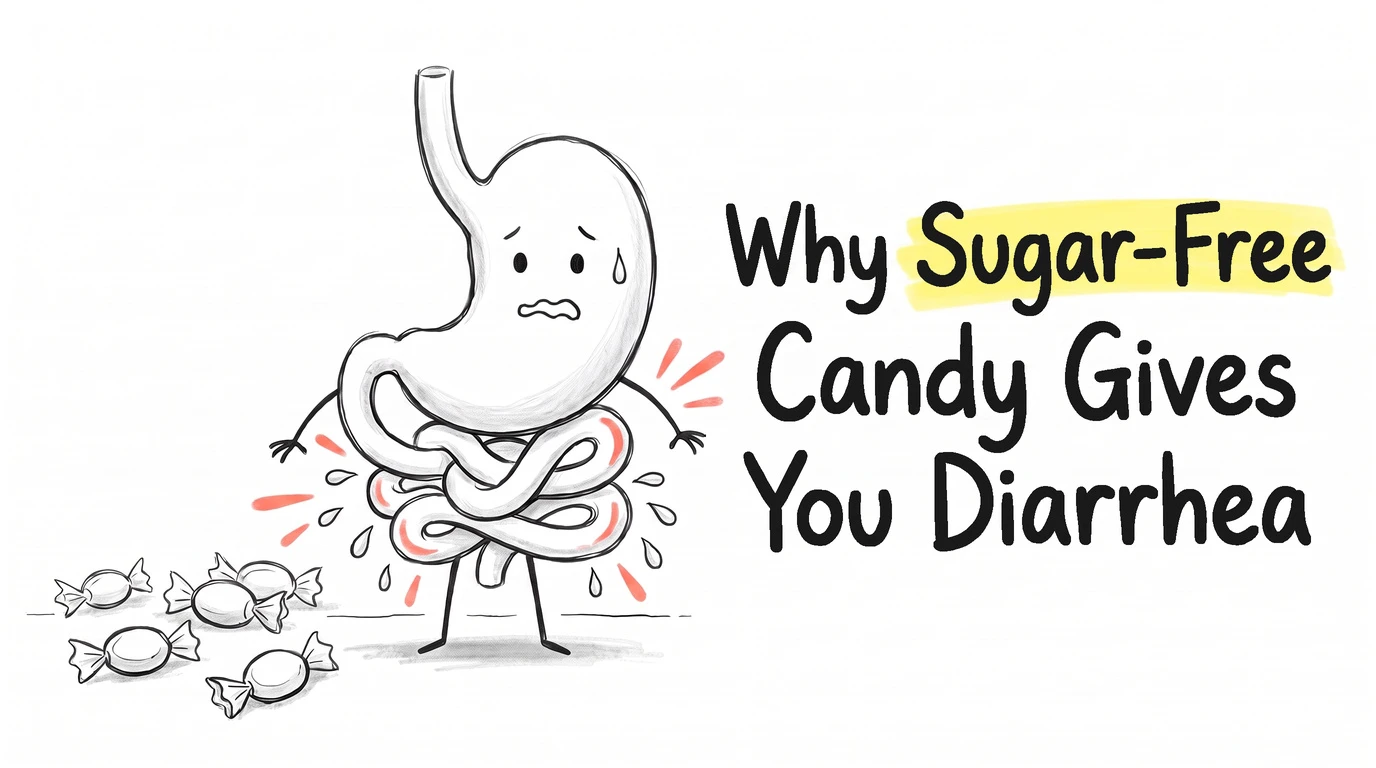
Sugar-free candy gets its sweetness from sugar alcohols, the ingredients on the label that end in "-ol" (e.g., maltitol, sorbitol, xylitol, and erythritol). Your small intestine absorbs only part of most of them, and the rest moves on to your colon (the last stretch of your intestines), where it pulls in water and feeds your gut bacteria. A little of it causes nothing or some gas, and a lot of it causes diarrhea. Where "a lot" starts depends on which sugar alcohol it is, how much of it you eat at once, and your own gut.
What "sugar-free" means on a label
The FDA (the US agency that regulates food labels) lets a food call itself sugar free when a serving has less than 0.5 grams of sugars, and its definition of sugars only covers simple ones like glucose, fructose, lactose, and sucrose (table sugar). Sugar alcohols are their own category, which is how a candy can be sugar-free and still be mostly sweetener by weight. The name comes from chemistry: the FDA defines them as sugar molecules with one small chemical group swapped for another.
The FDA does require any package that makes a claim about sugar to list the grams of sugar alcohol on its Nutrition Facts panel, so that's where to look. Hershey's Zero Sugar lists maltitol as its first ingredient and 16 grams of sugar alcohols in a four-piece serving, with about 4.5 servings in the bag. Werther's Original Sugar Free Chewy Caramels list 21 grams in five pieces that weigh 30 grams altogether, so more than two-thirds of each caramel is maltitol, isomalt, and sorbitol syrup.
Where it goes after you swallow it
A 2003 review of the research in Nutrition Research Reviews estimated that only about 10% of erythritol reaches the large intestine, while maltitol's absorption is about 45% "by consensus," sorbitol's ranges anywhere from 25 to 80%, and about 90% of isomalt ends up fermented in the colon.
According to Monash University's FODMAP team (the Australian researchers behind the low-FODMAP diet for IBS), sugar alcohols that make it that far "have an osmotic effect, dragging water through the bowel," and they "can be fermented by intestinal bacteria which produces gas." Osmosis is water moving toward wherever dissolved stuff is more concentrated, the same reason that salting cucumber slices pulls water out of them. The extra water loosens your poop, and the fermenting makes the gas and the rumbling.
The gas usually shows up first. In a small 1983 study that gave seven healthy adults sorbitol, most had gas and bloating after 10 grams and "severe symptoms (cramps, diarrhea)" after 20 grams.
How much does it take?
Researchers test these sweeteners one at a time, usually in a single sitting, and several of the trials below were run on university students aged 18 to 24.
Xylitol
In a 2007 trial of 64 students, 35 grams of xylitol in water made people pass watery poop more often than sugar did, and 50 grams added nausea, bloating, cramps, and rumbling on top of that.
Maltitol
In a 1996 trial, 59 students each ate 100-gram milk chocolate bars sweetened with maltitol, and even at 40 grams it only caused mild gas, rumbling, and cramps. The authors wrote that maltitol "did not have any laxative effect" at either 30 or 40 grams.
Boiled sweets did worse in a 2002 trial from the same university, which used candy made with Lycasin HBC, a hydrogenated starch syrup that the 2003 review files under maltitol syrups (a mix that's at least half maltitol, plus smaller amounts of other sugar alcohols). In adults, 25 grams of it only increased stomach rumbling, but 40 grams increased how often people went and how many of them passed watery poop.
When 12 healthy volunteers in a French study took maltitol spread through the day, diarrhea set in at about 92 grams a day on average (compared with about 106 grams for regular sugar). Nobody has tested a whole bag of chocolate eaten on the couch, so a 72-gram bag sits between the doses that caused nothing in the chocolate trial and the ones that caused diarrhea in the French one.
Erythritol
Erythritol took the biggest doses to cause trouble. In the same 2007 student trial that tested xylitol, 20 and 35 grams of erythritol were "tolerated well, without any symptoms," and 50 grams only brought on nausea and rumbling. Europe's food safety agency still reviewed erythritol in 2023 and set its safe daily limit at 0.5 grams per kilogram of body weight because of diarrhea (about 30 grams for someone who weighs 132 pounds), and it wrote that "this is the first time that an ADI is derived for a food additive based on an immediate adverse effect such as diarrhoea." (An ADI, or acceptable daily intake, is the amount a regulator considers safe to eat every day.)
Why your friend can eat the whole bag
The 2003 review notes that "individuals vary in the magnitude of their response to polyol ingestion" (polyol is the scientific name for sugar alcohols), and a 2017 systematic review (a study of studies) by doctors at Henry Ford Health and the University of Michigan found that symptoms rise with the dose in both healthy people and people with IBS.
In a 2014 Monash trial, 21 healthy adults and 20 adults with IBS (irritable bowel syndrome) were given 10 grams of sorbitol or mannitol, with plain glucose as the comparison. Only a third of the healthy people fully absorbed the sorbitol, yet only the IBS group had a significant rise in symptoms, and their symptoms were unrelated to how much of the sugar alcohol they'd absorbed.
A 2024 study in mice offers one possible reason the difference exists. In mice, a history of antibiotics plus a high-fat diet wiped out much of a group of gut bacteria called Clostridia, which left their microbes worse at breaking down sorbitol, and the sorbitol intolerance lasted long afterward. That hasn't been tested in people.
Whether you get used to sugar alcohols is less clear. The 2003 review says that adaptation "usually improves gastrointestinal tolerance," but the French maltitol study found no change after nine days of eating it daily.
Gum and protein bars count too
When the Monash team measured foods for its 2014 study, sugar-free gum was one of the ones with sorbitol in it. The IBS guideline from NICE (the body that writes health guidelines for England) says that "people with diarrhoea should avoid sorbitol, an artificial sweetener found in sugar-free sweets (including chewing gum) and drinks." A stick is a small dose, but a daily habit adds up. In 2008, gastroenterologists at the Charité hospital in Berlin published a case report in the BMJ titled "Severe weight loss caused by chewing gum."
Protein bars use the same sweeteners at smaller doses. Barebells bars list maltitol and 6 grams of sugar alcohol per bar, and the brand's own nutrition page adds "Excessive consumption may cause a laxative effect (due to maltitol)." Quest's cookie dough bar has 6 grams from erythritol. A single bar is nowhere near the trial doses, but a second bar or a protein shake sweetened the same way adds to it.
What can you actually do?
Read the "-ol" and the grams
The sugar alcohol line gives you the grams, and the ingredient list tells you which one it is. Erythritol takes a lot more to cause trouble than xylitol, sorbitol, or maltitol syrup. A missing warning doesn't mean much, since the FDA only requires "Excess consumption may have a laxative effect" on foods that could deliver 50 grams of sorbitol or 20 grams of mannitol in a day.
Spread it out, and eat it with food
According to the 2003 review, tolerance is best "when polyols are consumed at regular intervals throughout the day," and eating them "in or with other foods will also improve tolerance by delaying stomach emptying." Albanese, which sells sugar-free gummy bears, puts it more simply on its product page: "Everyone's tolerance is different, so start slow."
When to see a doctor
NIDDK (the US government's institute for digestive diseases) says that "sugar alcohols commonly found in sugar-free candies and gum may also cause diarrhea in some people," and it says to see a doctor right away for diarrhea lasting more than two days, six or more loose stools a day, a high fever, severe belly pain, or blood in your stool. If loose stools keep coming back and you chew gum or eat sugar-free snacks every day, tell the doctor about the habit. A 1983 paper in Gastroenterology called sorbitol intolerance "an unappreciated cause" of gut complaints, and doctors writing in the BMJ in 2008 said that sorbitol intake "should be considered in patients with bowel problems, chronic diarrhoea, and weight loss."
Sources
- US Food and Drug Administration, 21 CFR 101.60, Nutrient content claims for the calorie content of foods (via Cornell Legal Information Institute)
- US Food and Drug Administration, 21 CFR 101.9, Nutrition labeling of food (via Cornell Legal Information Institute)
- US Food and Drug Administration, 21 CFR 184.1835, Sorbitol (via Cornell Legal Information Institute)
- US Food and Drug Administration, 21 CFR 180.25, Mannitol (via Cornell Legal Information Institute)
- Hershey's, Zero Sugar Chocolate Candy, 5.1 oz bag
- Storck, Werther's Original Sugar Free Chewy Caramels nutritional information
- Livesey G, Health potential of polyols as sugar replacers, with emphasis on low glycaemic properties, Nutrition Research Reviews, 2003
- Monash FODMAP, What are polyols?
- Hyams JS, Sorbitol intolerance: an unappreciated cause of functional gastrointestinal complaints, Gastroenterology, 1983
- Storey D et al., Gastrointestinal tolerance of erythritol and xylitol ingested in a liquid, European Journal of Clinical Nutrition, 2007
- Koutsou GA et al., Dose-related gastrointestinal response to the ingestion of either isomalt, lactitol or maltitol in milk chocolate, European Journal of Clinical Nutrition, 1996
- Lee A et al., The comparative gastrointestinal responses of children and adults following consumption of sweets formulated with sucrose, isomalt and lycasin HBC, European Journal of Clinical Nutrition, 2002
- Imfeld TN, Clinical caries studies with polyalcohols: a literature review, Schweizer Monatsschrift für Zahnmedizin, 1994
- Ruskoné-Fourmestraux A et al., A digestive tolerance study of maltitol after occasional and regular consumption in healthy humans, European Journal of Clinical Nutrition, 2003
- EFSA Panel on Food Additives and Flavourings, Re-evaluation of erythritol (E 968) as a food additive, EFSA Journal, 2023
- Lenhart A, Chey WD, A Systematic Review of the Effects of Polyols on Gastrointestinal Health and Irritable Bowel Syndrome, Advances in Nutrition, 2017
- Yao CK et al., Dietary sorbitol and mannitol: food content and distinct absorption patterns between healthy individuals and patients with irritable bowel syndrome, Journal of Human Nutrition and Dietetics, 2014
- Lee JY et al., High fat intake sustains sorbitol intolerance after antibiotic-mediated Clostridia depletion from the gut microbiota, Cell, 2024
- NICE, Irritable bowel syndrome in adults: diagnosis and management (CG61)
- Bauditz J et al., Severe weight loss caused by chewing gum, BMJ, 2008
- Barebells, Nutrition values
- Quest Nutrition, Chocolate Chip Cookie Dough Protein Bar
- Albanese Candy, Zero Sugar 12 Flavor Gummi Bears
- NIDDK, Symptoms & Causes of Diarrhea


.svg)
.webp)
.webp)



.webp)


.webp)
.webp)