If you type "why does my stomach growl" into Google, it offers to finish the sentence with "so much," "after I eat," and "when I'm not hungry." If you type "stomach growling in class," two of the suggestions are "reddit" and "anxiety."
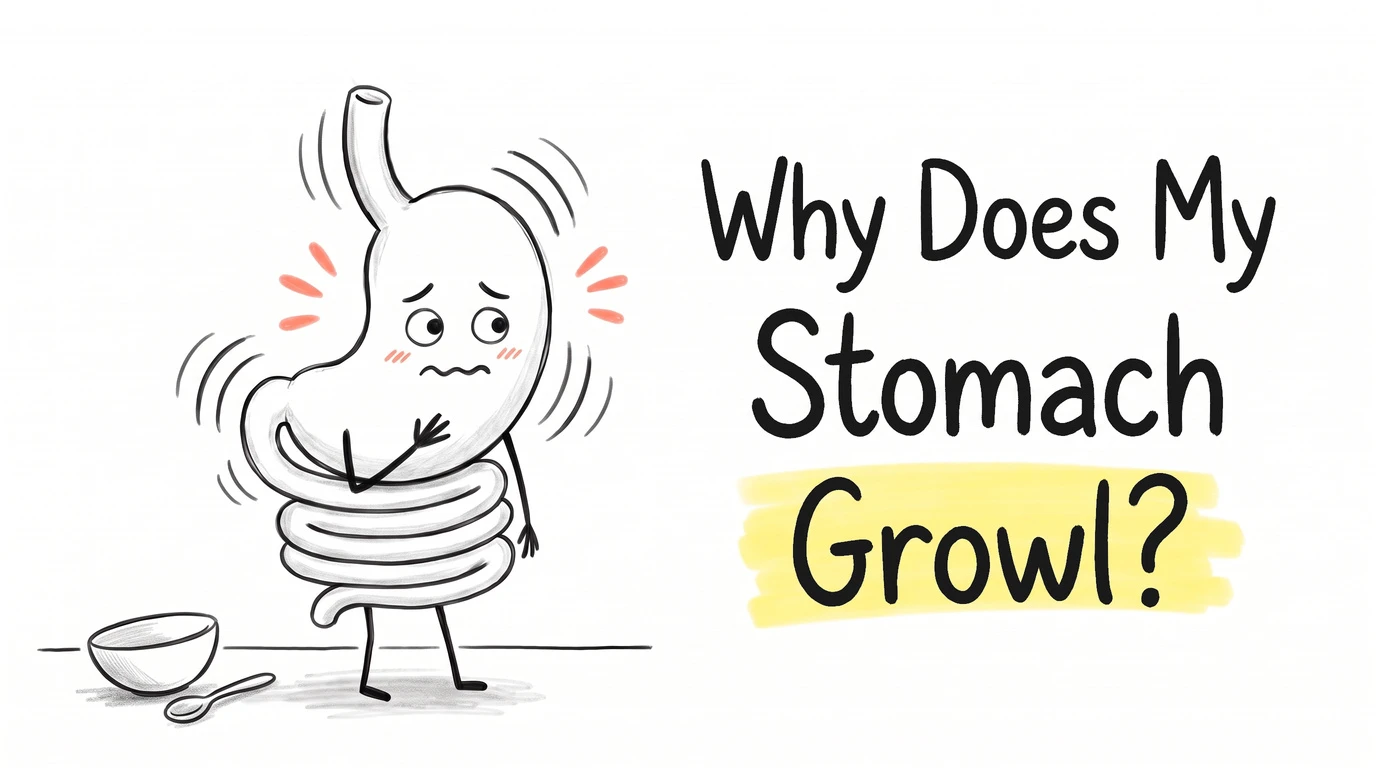
Growling is gas and liquid being squeezed through your stomach and small intestine. It happens whether you're hungry or not. The loud version on an empty stomach comes from a cleaning wave that rolls through your gut about every hour and a half between meals, and the growl after you eat is just digestion. On its own, with no pain or other symptoms, it's normal.
What's making the noise
MedlinePlus (the US National Library of Medicine's health encyclopedia) explains that your intestines are hollow, "so bowel sounds echo through the abdomen much like the sounds heard from water pipes." The medical name is borborygmi, from a Greek word that the Online Etymology Dictionary marks as "imitative," meaning that it was made up to sound like the rumble it describes.
Most of the evidence points at gas bubbles. In a small 2010 study, researchers in Taiwan filmed the inside of eight people's guts with ultrasound and X-ray video while recording sound, and matched 24 bubbling noises to "freely oscillating bubbles," with bigger bubbles making lower-pitched sounds. Mark Andrews, a physiology professor who wrote Scientific American's explainer on growling, says that the noise "doesn't only come from the stomach but, just as often, can be heard coming from the small intestines."
Nobody has pinned it down much further than that. Harvard Health Publishing (Harvard Medical School's consumer health site) says that "the exact source of bowel sounds is uncertain," and that gas pushed around by the intestine's muscles is the leading explanation.
Why an empty stomach is the loudest
Between meals, a wave of squeezing called the migrating motor complex sweeps from your stomach through your small intestine, clearing out whatever's left behind (the gum article walks through it step by step). In a study from the University of Leuven in Belgium, one full cycle took about 95 minutes on average. Andrews writes that growling is "typically louder when the stomach and intestines are empty," because there's no food inside to muffle it, and that once you eat, the wave stops.
The Leuven team also measured hunger. In healthy volunteers who hadn't eaten, hunger ratings went up during the strongest part of the wave, but only when it started in the stomach. When it started in the duodenum (the first stretch of the small intestine, right after the stomach), hunger wasn't significantly higher than during the calmer parts of the cycle. A drug that set off an early wave in the stomach roughly doubled people's hunger scores, and a different drug that set one off lower down didn't raise hunger. The researchers concluded that the stomach version of the wave "is a hunger signal from GIT in man" (GIT means the gastrointestinal tract). All of these findings come from the same lab.
WebMD credits the growl to ghrelin (a hormone your stomach releases when it's empty, often called the hunger hormone), which it says "tells your intestines and stomach to contract." Dr. Christine Lee, a gastroenterologist at Cleveland Clinic, tells the same story on the clinic's podcast. When the Leuven group took blood samples across the whole cycle, though, it was a different gut hormone, motilin, that tracked the wave. Motilin rose about 35% right before a wave started in the stomach, while ghrelin levels didn't differ significantly from one part of the cycle to the next. In the hunger study, giving people motilin set off an early wave and made them hungrier, and giving them ghrelin didn't.
Why it growls when you're not hungry
MedlinePlus says that louder, more active gut sounds can happen "with diarrhea or after eating." Andrews writes that the gut squeezes harder "in the presence of food," so it makes noise at both ends of the cycle. In a 2013 study that recorded the gut sounds of eight healthy adults over long stretches, bowel sounds "continued even after the most recently consumed food had been nearly completely digested."
NIDDK (the US government's institute for digestive diseases) lists "stomach 'growling' or rumbling sounds" among the symptoms of lactose intolerance. In a study of 341 adults in China, most with IBS (irritable bowel syndrome), the more hydrogen gas people's gut bacteria made from a dose of lactose, the more likely they were to report rumbling. Lee, the Cleveland Clinic gastroenterologist, names beans, broccoli, dairy, and fizzy drinks as foods that make extra gas and noise (the gas article has more on why), and the sugar alcohols in sugar-free candy are their own story.
Why it seems to happen during every test
If you're in a silent room, you'll hear every growl, and if you're nervous, your gut may also be making more of them. Lee says that stress "can make some people's intestines just go into spasms," while other people's guts slow down instead. Your gut and brain are wired together, which is the same reason you get butterflies in your stomach before a presentation.
Can you stop it?
WebMD and MedicineNet both tell you to sip water or have a snack, and neither points to a study showing that it works. Eating does end the cleaning wave, so if you skipped breakfast, eating breakfast is the most likely way to quiet a hungry growl during first period. It won't do anything for a growl that comes from digestion.
Lee's advice is to chew with your mouth closed and chew thoroughly, because "the less air you swallow in, the less air accumulation" builds up in your intestines. If you're eating a lot less than usual and your stomach growls all day, the Leuven research suggests that the growl comes from the same wave that makes you hungry, so treat it as hunger.
When it's worth seeing a doctor
If "it's just sound alone," Lee says, "then that's generally very benign." She says that growling becomes worth a visit when it comes with pain, fever, or changes in your bowel habits (like switching between constipation and diarrhea, or bloody diarrhea). MedlinePlus lists bleeding from your rectum, nausea, vomiting, and diarrhea or constipation that doesn't go away as reasons to contact a provider.
Harvard Health adds that when someone has stomach pain, doctors "worry more when borborygmi and flatus are absent than when they are present," because their absence could point to a tear in the bowel or a section of it that has stopped working.
Sources
- MedlinePlus (US National Library of Medicine), Abdominal sounds, reviewed 2024
- Robert H. Shmerling, MD, Stomach growling and other digestive noise, Harvard Health Publishing, updated 2026
- Mark A. W. Andrews, Why does your stomach growl when you are hungry?, Scientific American, 2002
- Christine Lee, MD, Can You Silence a Growling Stomach?, Cleveland Clinic Health Essentials podcast
- NIDDK, Symptoms & Causes of Lactose Intolerance
- WebMD, Why Does My Stomach Growl?
- MedicineNet, Is Stomach Rumbling a Good Sign?
- Online Etymology Dictionary, borborygmus
- Tack J et al., Motilin-induced gastric contractions signal hunger in man, Gut, 2016
- Deloose E et al., Endogenous motilin, but not ghrelin plasma levels fluctuate in accordance with gastric phase III activity of the migrating motor complex in man, Neurogastroenterology and Motility, 2015
- Liu CJ et al., Oscillating gas bubbles as the origin of bowel sounds, Chinese Journal of Physiology, 2010
- Sakata O et al., Temporal changes in occurrence frequency of bowel sounds both in fasting state and after eating, Journal of Artificial Organs, 2013
- Zhu Y et al., Bloating and distention in irritable bowel syndrome: the role of gas production and visceral sensation after lactose ingestion, American Journal of Gastroenterology, 2013


.svg)
.webp)
.webp)



.webp)


.webp)
.webp)