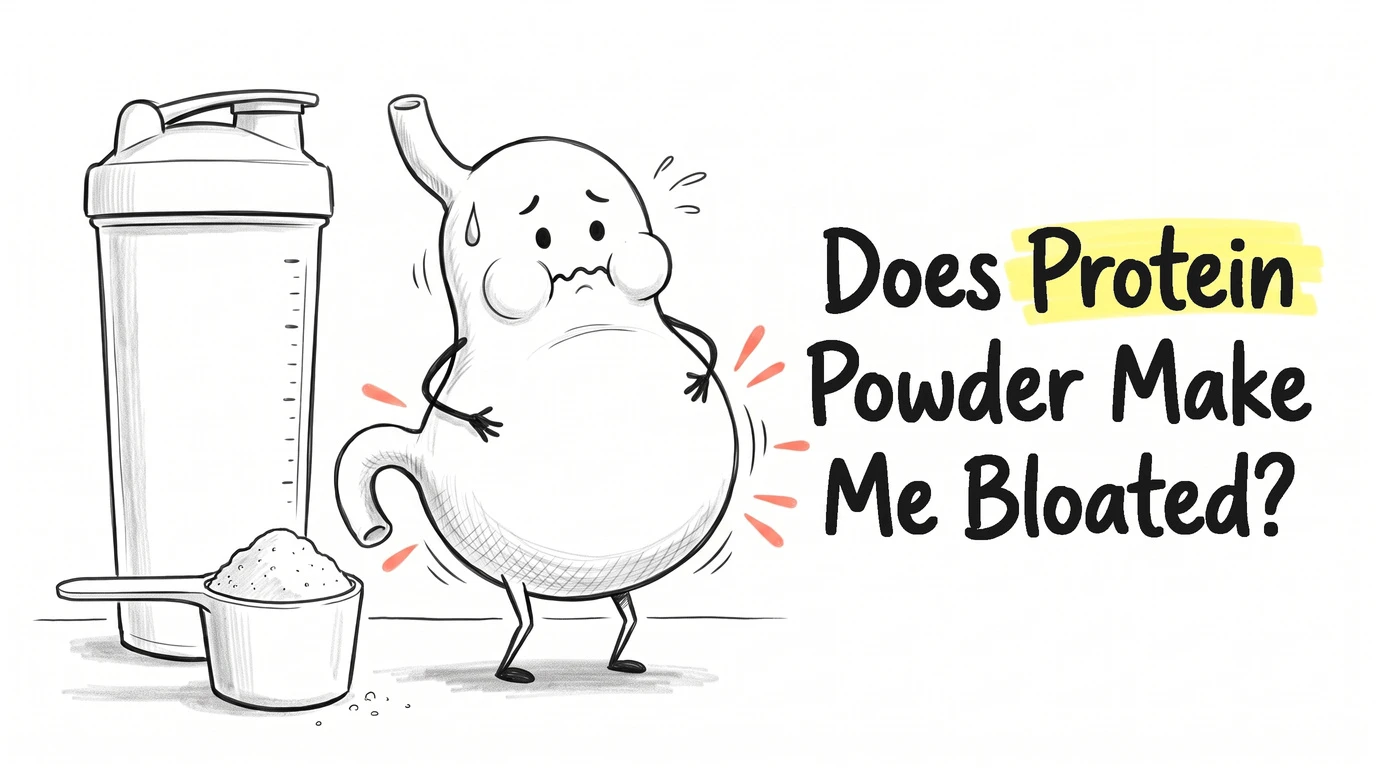
If you type "why does protein powder make me" into Google, the first suggestions are "bloated," "gassy," "poop," "constipated," and "feel sick." The research points less at the protein and more at what comes with it: something else in the scoop, the milk you mixed it into, or, with creatine, the size of the dose.
Lactose, in the powder and in the milk
Whey can carry some of milk's sugar, lactose, along with it. NIDDK (the US government's institute for digestive diseases) lists "protein powders and bars" among the foods where lactose hides, and says that "whey" on an ingredient list means the product contains lactose. If your body doesn't make much lactase (the enzyme that breaks lactose down), the lactose reaches your gut bacteria undigested and they ferment it. The lactose article covers how to tell whether that's you.
On r/teenagers, one post just asks, "Do you use protein powder with milk or water?" Your answer changes how much lactose you're drinking. NIDDK puts the lactose in about one cup of milk at 12 grams, and says that many people with lactose intolerance can handle that much "without symptoms or with only mild symptoms." In a small 2001 trial, 10 adults who don't digest lactose well drank two servings of a milk-based supplement powder mixed into fat-free milk, which added up to 27 grams of lactose. Their gas went from about 10 times a day to 30. A ready-to-drink version with 18 grams didn't raise it by a significant amount. Neither one caused a significant increase in bloating, belly pain, or diarrhea, so in that trial lactose mostly meant more gas. The researchers also found that an over-the-counter lactase product cut the lactose in the liquid version by 80% when left in overnight.
Whey isolate is filtered further than whey concentrate. Dymatize says its ISO100 is "filtered to remove excess lactose," but the page doesn't say how much is left or call the powder lactose-free.
Everything else in the scoop
If you read the back of a few tubs, the protein has company. The label on Optimum Nutrition's Gold Standard 100% Whey lists two artificial sweeteners, acesulfame potassium and sucralose. Premier Protein's vanilla shake adds "cellulose gel and cellulose gum" plus carrageenan. RYSE's powder lists "Organic Agave Inulin" and a "Gum Blend" under the words "Easy to Digest."
Inulin is the one to watch for. It's a fiber your gut bacteria ferment, and in a 2022 trial in 19 adults with IBS, 20 grams of it produced the biggest rise in colonic gas of anything tested, measured on MRI scans. Everyone in that trial had IBS, so the size of the effect may not match yours. The fiber-maxxing article goes into how much fiber is too much.
Orgain's support page explains that the shiny crystals some people find in its powder are erythritol, a sugar alcohol. NIDDK lists sweeteners ending in "-ol" among the carbohydrates your small intestine doesn't fully digest, which is why sugar-free gum can wreck your stomach. They aren't all equal, though. In a 2007 trial of 64 university students aged 18 to 24, 50 grams of xylitol in a drink brought on bloating, nausea, and watery poop, while 50 grams of erythritol only raised nausea and stomach rumbling. The FDA requires foods likely to deliver 50 grams of sorbitol, or 20 grams of mannitol, in a day to carry the warning "Excess consumption may have a laxative effect." The sugar-free candy article covers the rest.
How much you take at once
A lot of gym advice assumes that one meal can only use so much protein. The authors of a 2023 study in Cell Reports Medicine describe that belief, that the body's response to protein "has an upper limit," as lacking "scientific proof," and they tested it by giving healthy young men either 25 or 100 grams of protein and tracked where it went with isotope tracers (labeled versions of the protein that researchers can follow through the body). The 100 grams was still being digested and absorbed 12 hours later, and the authors wrote that "larger amounts of protein" need "a more prolonged period to allow full digestion." That study didn't ask anyone whether they felt bloated, so it settles where the protein goes and not how the shake feels. The International Society of Sports Nutrition (a group of sports nutrition researchers) suggests 20 to 40 grams of protein per serving.
Sometimes it isn't the powder
In a 2013 trial of 37 adults who believed that gluten made them sick, whey protein was used as the comparison, the thing that was supposed to do nothing. Symptoms got worse "to a similar degree" on gluten and on whey. In a second, shorter round, symptoms went up by about the same amount whether people got gluten, whey, or no added protein at all. Everyone in that trial had IBS and was expecting a reaction, so it can't tell you much about a healthy 16-year-old. It does mean that some of what gets blamed on a powder can show up without the powder. The gluten article walks through that trial.
Creatine: water or gas?
Google's suggestions for "does creatine make you bloated" include "in face," "at first," and "in the stomach," and "creatine bloating myth" is a suggestion too. The answer depends on which kind of bloated you mean.
The water
Creatine makes your body hold on to some extra water, at least at first. The International Society of Sports Nutrition's position on creatine says that in early studies, loading (about 20 grams a day for five to seven days) caused "short-term fluid retention" of about half a liter to a liter, and a 2021 paper by the same group calls water retention "in the early stages (first several days)" the most common side effect. Over longer periods, that paper says, several studies found no change in body water relative to muscle.
Where the water ends up is less clear. In a 2003 trial of 32 lifters in their early twenties, loading raised total body water, but "fluid distribution was not changed," meaning the share inside cells versus outside stayed the same. In a 2023 trial of 30 women, loading during the second half of the menstrual cycle raised water inside and outside of cells alike.
The gut
Creatine can cause diarrhea, and the dose per sitting matters more than the dose per day. In a 2008 trial, 59 soccer players took either 10 grams of creatine at once, two 5-gram doses, or a placebo (a powder with nothing active in it) for four weeks. Diarrhea hit 55.6% of the 10-grams-at-once group, 28.6% of the split-dose group, and 35% of the placebo group. The split dose did no worse than placebo. The International Society of Sports Nutrition now recommends keeping servings at or under 10 grams, since "dosages of greater than 10 grams may potentially lead to gastrointestinal distress (i.e., diarrhea)," and says that you don't have to load at all, since 3 to 5 grams a day also raises the creatine in your muscles.
A 2026 review of 684 creatine trials, with more than 12,800 people, found that creatine "does not increase the risk of gastrointestinal" side effects compared to placebo, even at high doses. Several of its authors advise creatine manufacturers, which the paper discloses.
The HCl pitch
Creatine HCl is sold as the version that doesn't bloat you. CON-CRĒT, the company behind the patented form, says it has none of the side effects of other creatines, "such as water retention, bloat, or puffiness," and Gorilla Mind calls its HCl product "stomach-friendly." A 2025 trial that compared HCl with regular creatine monohydrate in 31 handball and softball players aged 18 to 28 measured strength and body composition, not stomachs, and concluded that "claims of Cr-HCl superiority are unfounded and misleading."
Should you be taking this stuff?
The American Academy of Pediatrics (the main group of children's doctors in the US) says that protein supplements, creatine, and caffeine are the performance supplements teens use most. It says there's "no performance benefit of protein supplement if diet provides adequate protein," and that creatine "has not been evaluated specifically in the pediatric population." Sports Dietitians Australia, in a fact sheet for athletes aged 12 to 18, calls performance supplements in teens "unwarranted and hazardous," and suggests food like "milk-based drinks, yoghurt with fruit, or a meat and salad roll" after training. The International Society of Sports Nutrition goes the other way on creatine, calling it safe for teens "based on the limited evidence." Whatever you decide, the FDA "does not have the authority to approve dietary supplements before they are marketed," so no one reviews a tub for safety before it goes on sale.
What to try
- Mix it with water. A cup of milk adds about 12 grams of lactose, per NIDDK.
- Read the ingredient list, not the front. Look for "whey" or "milk," inulin, gums, and sweeteners ending in "-ol."
- Take less at a time. For creatine, the International Society of Sports Nutrition's numbers are 3 to 5 grams a day, and no single serving over 10.
- Change one thing at a time. If you switch powder, liquid, and dose in the same week, you won't know which one fixed it.
If your stomach still bothers you after you've stopped the powder, see a doctor. NIDDK says to do the same if gas comes with belly pain, constipation, diarrhea, or weight loss, and the article on being gassy covers the rest of the warning signs.
Sources
- NIDDK, Eating, Diet, & Nutrition for Lactose Intolerance
- Suarez FL, Zumarraga LM, Furne JK, Levitt MD, Nutritional supplements used in weight-reduction programs increase intestinal gas in persons who malabsorb lactose, Journal of the American Dietetic Association, 2001
- Dymatize, ISO100 Gourmet Vanilla
- Optimum Nutrition Gold Standard 100% Whey, Extreme Milk Chocolate (Costco listing)
- Premier Protein, Vanilla Protein Shake
- RYSE, Loaded Protein
- Gunn D et al., Psyllium reduces inulin-induced colonic gas production in IBS, Gut, 2022
- Storey D et al., Gastrointestinal tolerance of erythritol and xylitol ingested in a liquid, European Journal of Clinical Nutrition, 2007
- NIDDK, Eating, Diet, & Nutrition for Gas in the Digestive Tract
- NIDDK, Symptoms & Causes of Gas in the Digestive Tract
- Orgain, Ingredients FAQ
- 21 CFR 184.1835, Sorbitol
- 21 CFR 180.25, Mannitol
- Trommelen J et al., The anabolic response to protein ingestion during recovery from exercise has no upper limit in magnitude and duration in vivo in humans, Cell Reports Medicine, 2023
- Jäger R et al., International Society of Sports Nutrition Position Stand: protein and exercise, JISSN, 2017
- Biesiekierski JR et al., No effects of gluten in patients with self-reported non-celiac gluten sensitivity after dietary reduction of FODMAPs, Gastroenterology, 2013
- Kreider RB et al., International Society of Sports Nutrition position stand: safety and efficacy of creatine supplementation, JISSN, 2017
- Antonio J et al., Common questions and misconceptions about creatine supplementation, JISSN, 2021
- Powers ME et al., Creatine supplementation increases total body water without altering fluid distribution, Journal of Athletic Training, 2003
- Moore SR et al., Creatine loading and fluid compartments across the menstrual cycle, Nutrients, 2023
- Ostojic SM, Ahmetovic Z, Gastrointestinal distress after creatine supplementation in athletes: are side effects dose dependent?, Research in Sports Medicine, 2008
- Gonzalez DE et al., Creatine supplementation dose and duration are not associated with increased side effects, Sports, 2026
- CON-CRĒT, Frequently Asked Questions
- Gorilla Mind, Creatine HCl
- Londoño-Velásquez et al., Creatine monohydrate vs creatine HCl in elite team-sport athletes, JISSN (conference abstract), 2025
- LaBotz M, Griesemer BA, AAP Council on Sports Medicine and Fitness, Use of Performance-Enhancing Substances, Pediatrics, 2016
- Sports Dietitians Australia, Nutrition for the Adolescent Athlete (fact sheet)
- FDA, Questions and Answers on Dietary Supplements


.svg)
.webp)
.webp)



.webp)


.webp)
.webp)