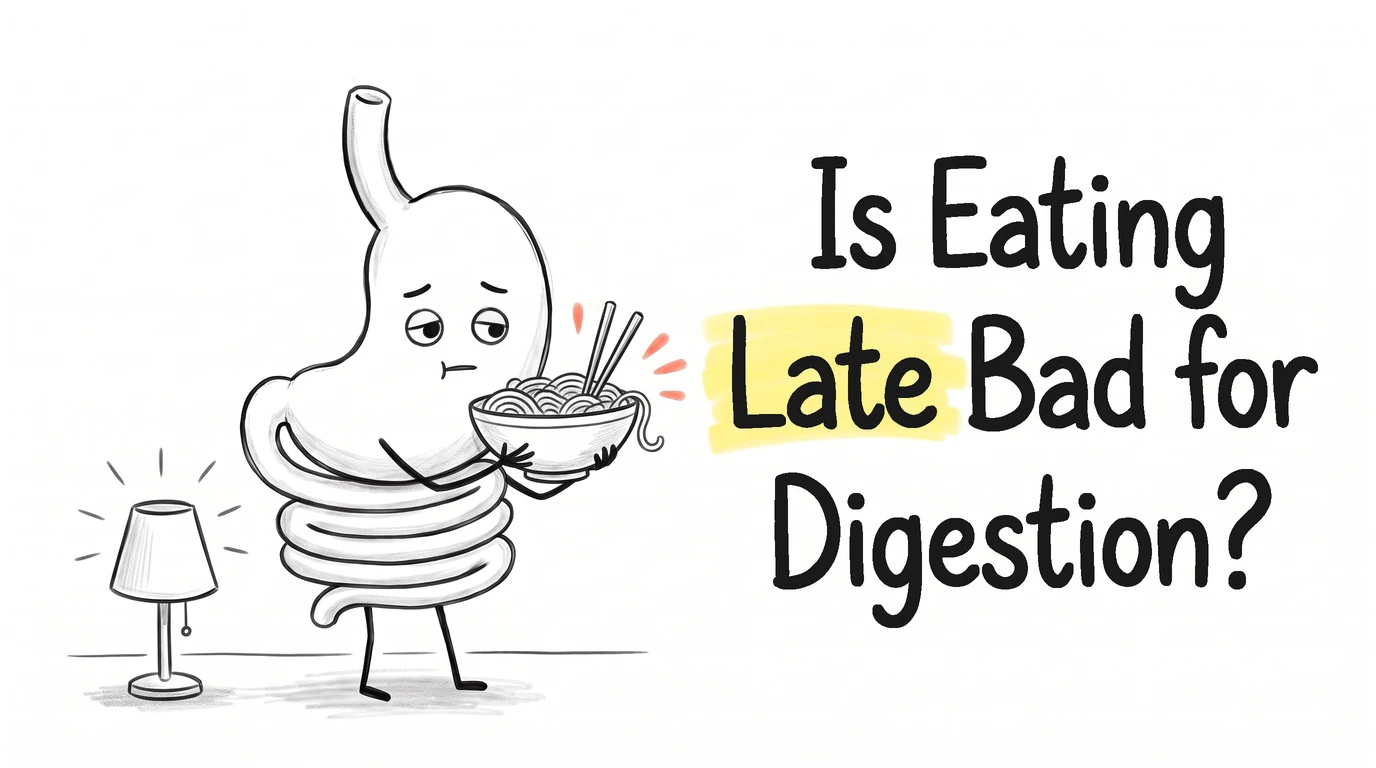
Type "is it bad to eat at 2am" into Google and it finishes the sentence with whatever's in your kitchen: cereal, chips, ramen, rice, fruit. "Does food digest while you sleep" and "eating late at night causes weight gain true or false" sit right next to it, so plenty of people asking already suspect that the rule they've heard is shakier than it sounds.
For digestion, late eating matters mostly because of heartburn. Your gut keeps working while you sleep, just more slowly, and the trouble starts when a big or greasy meal meets a flat mattress. Weight is a separate question with split results, and all of the research on it was done in adults.
Does food digest while you sleep?
Yes, on a slower schedule. In a 1987 study, researchers fed 16 healthy men the same meal at 8 a.m. and at 8 p.m. and tracked how fast it left their stomachs. Solid food took 53.6% longer to empty in the evening, while liquids emptied at the same speed either time.
Your colon (the last stretch of your gut, where stool takes shape) slows down even more. A 2020 review in the Journal of Clinical Gastroenterology pulled together years of pressure recordings taken inside the colon: "sleep is known to strongly inhibit both propagating and nonpropagating colonic motor activity," which means that the squeezes that push stool along and the ones that mix it both drop off at night. Activity nearly doubles once you wake up, which is part of why most people go in the morning.
Where late eating causes trouble
Heartburn happens when stomach acid escapes up into your esophagus (the tube that carries food from your mouth down to your stomach). A ring of muscle at the bottom of the esophagus is supposed to keep the acid in, and when you're upright, gravity helps it out. If you lie down on a full stomach, you lose the gravity part.
What you ate may matter as much as when you ate it. In a 1992 Swiss study, eight healthy volunteers with no reflux problems wore an acid sensor in their esophagus overnight on two nights: once after a light meal at 7:30 p.m., and once after a high-fat meal with chocolate and peppermint at 9:30 p.m. After the light meal, the median share of the night with acid in the esophagus was 0%. After the heavy meal it was 7.9%. The heavy meal was also the later one, so the study can't separate the two, and the researchers wrote that both "meal composition and timing" affect the result.
In people who already have reflux, timing by itself does show up. When 30 adults with reflux ate the same meal two hours before bed on one night and six hours before on another, the acid monitor picked up more reflux after the late meal, but their symptom scores came out the same. Our article on heartburn in teens goes through that trial along with the rest of the bedtime advice, and why your stomach hurts after eating covers the other common causes of pain after a meal.
How long should you wait before bed?
Four health bodies give four slightly different numbers:
- NIDDK (the US government's institute for digestive diseases): "at least 3 hours before you lie down or go to bed," for people whose reflux symptoms show up at night
- The NHS (England's public health service), on indigestion: "do not eat 3 to 4 hours before going to bed"
- Mayo Clinic's heartburn page: "Wait 2 to 3 hours," and further down the same page, "at least two hours before bedtime"
- The American College of Gastroenterology (the main professional group for gut doctors in the US): "We suggest avoiding meals within 2-3 hours of bedtime"
The American College of Gastroenterology grades its own advice as a "conditional recommendation, low level of evidence," and the support it cites is a single review from 2016. The American Gastroenterological Association makes the same suggestion from that same review and narrows it to people with a hiatal hernia (where part of the stomach pushes up through the muscle wall under your lungs) or with symptoms "following meals or during sleep."
All of those numbers are aimed at people who get heartburn. The American Academy of Sleep Medicine, the professional group for sleep doctors, writes its advice for everybody, and it doesn't include a number at all: "Don't eat a large meal before bedtime. If you are hungry at night, eat a light, healthy snack."
If heartburn keeps you up, a smaller and less greasy dinner a few hours before bed is the first thing worth trying. If it doesn't, none of this research says that a bowl of cereal at 11 is hurting your digestion.
Does a late dinner mess up your sleep?
In a 2020 trial at Johns Hopkins, 20 healthy adults with an average age of 26 ate the same dinner at 6 p.m. on one visit and at 10 p.m. on another, then slept in the lab from 11 p.m. to 7 a.m. wired to sleep monitors. The researchers found "similar total sleep time, sleep efficiency, latency, and sleep architecture" on both nights (latency is how long it takes you to fall asleep, and architecture is the pattern of light and deep sleep stages through the night).
A survey of 793 Australian university students leans the other way, slightly. Students who ate within three hours of bed were more likely to wake up at least once during the night, although they didn't take longer to fall asleep or sleep fewer hours. A one-time survey can't tell you which came first, since people who wake up at night might also be the ones snacking late. Our article on how sleep affects your gut covers the question from the other direction.
Does eating late make you gain weight?
A lot of what Google suggests for this question is about weight ("does late night eating cause belly fat," "eating late at night causes weight gain myth or fact"), and the trials on it don't agree.
In a tightly controlled 2022 trial at Brigham and Women's Hospital in Boston, 16 adults with overweight lived in a lab on two schedules, eating identical meals either early or about four hours later. On the late schedule they skipped breakfast and finished their last meal two and a half hours before bed. The chance of feeling hungry at any given moment doubled, from about 10% to about 20%, and they burned fewer calories while awake.
The same year, in the same journal, a team at the University of Aberdeen in Scotland put 30 adults with overweight or obesity on a big-breakfast diet for four weeks and a big-dinner diet for four weeks, with identical calories. They found "no difference in weight loss" and no difference in calories burned, although people were less hungry during the big-breakfast weeks. And in an older study of 7,147 American adults followed for 10 years, the share of food eaten after 5 p.m. was "unrelated" to how their weight changed.
A 2024 analysis in JAMA Network Open pooled the trials on meal timing and found that eating more of the day's calories earlier led to slightly more weight loss, about 1.75 kilograms (just under 4 pounds), an effect the authors called "small and of uncertain clinical importance." The Johns Hopkins trial found that blood sugar after the 10 p.m. dinner peaked 18% higher than after the 6 p.m. one, which is a short-term measurement from one night. Every study in this section was done in adults, most of them carrying extra weight, and none in teenagers.
Hunger is the most consistent finding across these trials. If what you're really asking is whether you're allowed to eat when you're hungry at night, the sleep doctors' answer is yes, as long as it's something light.
When late eating is something else
Night eating syndrome is a diagnosable condition, and it looks different from a late snack. Cleveland Clinic describes it as waking up in the middle of the night to eat "multiple times per night and more than four times per week" and eating "more than 25% of your daily food intake after dinner and before breakfast." If that sounds like you, bring it up with a doctor.
Sources
- Goo RH, Moore JG, Greenberg E, Alazraki NP, Circadian variation in gastric emptying of meals in humans, Gastroenterology, 1987
- Duboc H, Coffin B, Siproudhis L, Disruption of circadian rhythms and gut motility: an overview of underlying mechanisms and associated pathologies, Journal of Clinical Gastroenterology, 2020
- Castiglione F et al., Oesophageal pH-metry: should meals be standardized? Scandinavian Journal of Gastroenterology, 1992
- Piesman M et al., Nocturnal reflux episodes following the administration of a standardized meal. Does timing matter? American Journal of Gastroenterology, 2007
- NIDDK, Eating, Diet, & Nutrition for GER & GERD
- NHS, Indigestion
- Mayo Clinic, Heartburn: Diagnosis and treatment
- Katz PO et al., ACG Clinical Guideline for the Diagnosis and Management of Gastroesophageal Reflux Disease, American Journal of Gastroenterology, 2022
- Yadlapati R et al., AGA Clinical Practice Update on the Personalized Approach to the Evaluation and Management of GERD: Expert Review, Clinical Gastroenterology and Hepatology, 2022
- American Academy of Sleep Medicine, Healthy Sleep Habits
- Gu C et al., Metabolic Effects of Late Dinner in Healthy Volunteers: A Randomized Crossover Clinical Trial, Journal of Clinical Endocrinology & Metabolism, 2020
- Chung N, Bin YS, Cistulli PA, Chow CM, Does the Proximity of Meals to Bedtime Influence the Sleep of Young Adults? A Cross-Sectional Survey of University Students, International Journal of Environmental Research and Public Health, 2020
- Vujović N et al., Late isocaloric eating increases hunger, decreases energy expenditure, and modifies metabolic pathways in adults with overweight and obesity, Cell Metabolism, 2022
- Ruddick-Collins LC et al., Timing of daily calorie loading affects appetite and hunger responses without changes in energy metabolism in healthy subjects with obesity, Cell Metabolism, 2022
- Kant AK, Schatzkin A, Ballard-Barbash R, Evening eating and subsequent long-term weight change in a national cohort, International Journal of Obesity, 1997
- Liu HY et al., Meal Timing and Anthropometric and Metabolic Outcomes: A Systematic Review and Meta-Analysis, JAMA Network Open, 2024
- Cleveland Clinic, Night Eating Syndrome (NES)


.svg)
.webp)
.webp)



.webp)


.webp)
.webp)