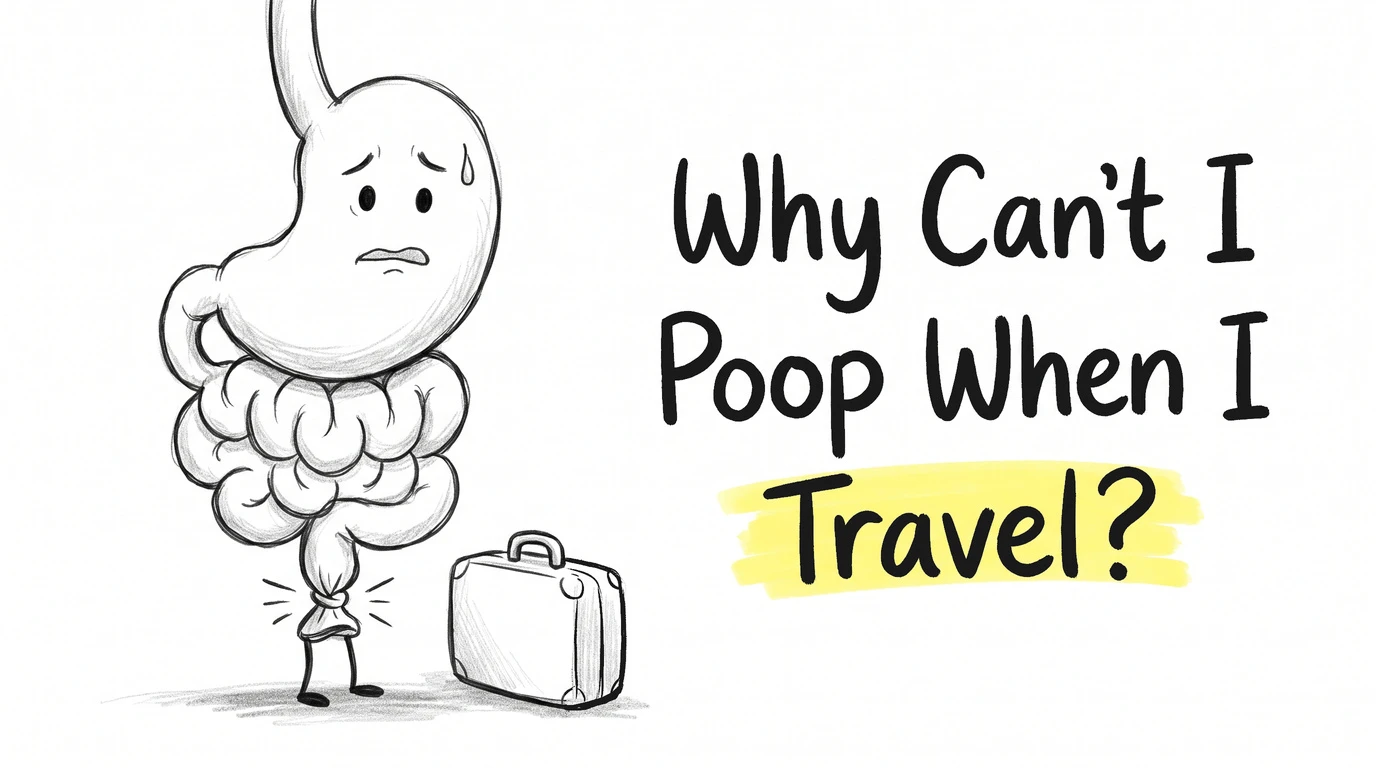
You land, you check in, and then nothing happens for three days. Or you get to camp on a Sunday and your body apparently decides to wait until Friday. Everyone you could ask about it is someone you would rather not ask.
The usual explanation you will find is that the plane dried you out. That one turns out to be the weakest part of the story.
It's real, and somebody measured it
In 2003, researchers followed 70 people flying from Europe to the United States for a short stay. As a 2020 review in the Journal of Clinical Gastroenterology describes the study, "65 subjects kept diaries on their bowel habits, had stool samples evaluated for consistency according to a standardized methodology, and had their colonic transit time (CTT) measured after ingesting radioactive tracers. Nearly 40% of the subjects complained of constipation and this was most pronounced during the first days of travel. The degree of constipation correlated with the degree of jetlag."
The radioactive tracers mean that the researchers were timing how long things took to move through, rather than only asking people how they felt.
A Danish team ran the only other dedicated study on this, following 30 adults on a one-week trip abroad in 2024. Across everybody, the first bowel movement abroad came a median of 6 hours later than their usual pattern. The people in the slowest quarter waited a median of 47 hours, against 24 hours for everyone else.
Stool did not get harder abroad, which contradicts how this normally gets explained. On the standard stool chart it trended slightly softer, and softer again on the way home. So whatever is happening, it is mostly about timing rather than about everything drying out.
The dehydration story does not hold up
Almost every page on this topic opens with dry cabin air. The chain goes: the cabin is dry, so you get dehydrated, so your colon pulls more water out of your stool, so it gets hard. Each link in that chain needs to be true.
The first link is where it breaks. The UK Civil Aviation Authority, which regulates aviation health and is not selling anything, says that cabin humidity runs "in the range 10 to 20% compared to that in buildings, which is in the order of 40 to 50%," and then says this: "contrary to a widely held belief, the low humidity in the aircraft cabin does not result in dehydration." Their number for how much extra fluid you actually lose is "approximately 150ml over an 8 hour flight, with no evidence of any change in plasma osmolality."
150 millilitres is about two thirds of a cup, spread over eight hours, with no measurable change in how concentrated your blood is. Your body handles that without noticing.
Cabin air is dry, and it is measurably drying to your skin. In a study of eight women on long-distance flights, cabin humidity "dropped to levels below 10% within 2 h after take-off," and skin hydration on the cheeks fell by up to 37%. Dry skin and dry eyes on a plane happen, and neither one tells you anything about your colon.
As for drinking extra water to fix it, the most cited review arguing that mild dehydration causes constipation was written by a sole author at the Nestlé Water Institute, which is the research arm of a bottled water company. Even that review notes that when children drink more water than they usually do, stool frequency and consistency do not change. We went through this evidence in more detail in the article on constipation generally.
While we are here: the bloated, gassy feeling on a plane is a separate thing. Gas expands as cabin pressure drops, which does happen, and it has nothing to do with whether you can have a bowel movement. Travel articles list the two together constantly as though they were one problem.
What is probably actually happening
Your morning window moved
Your colon is not equally active all day. Researchers recorded pressure inside the colon continuously for 528 hours across 25 healthy adults, and found activity lowest at night and this: "waking induced a threefold increase in motility, whereas meals induced a twofold increase."
Waking up does more than breakfast does. That is why most people's bowel habits cluster early. A UK study of 1,897 people found that "most defecations occurred in the early morning," and a Beijing survey of 1,952 people found 77% went in the morning.
So you have a roughly one-hour window each morning where your colon is doing most of its work, and at home you have built your whole routine around it without deciding to. You wake at the same time, you eat the same thing, you use the same bathroom, and you are usually alone.
Travel takes all four of those apart at once, with the 5 a.m. airport wake-up, the time zone shift, the day that starts with a car ride instead of breakfast, and the morning you spend on a bus. The urge arrives when you are somewhere you cannot act on it, and once you skip it, you are waiting for tomorrow.
You are holding it, probably more than you realize
In 1990, in a study that had nothing to do with travel, researchers had 12 healthy men deliberately suppress the urge to go for a week, with diet and activity held constant, then compared it against a normal week. The paper is titled "Can constipation be learned?" The results: bowel movements dropped from 8.9 a week to 3.7. Total transit time went from 28.8 hours to 53.1 hours. In the rectosigmoid, the last stretch before the exit, transit went from 8.8 hours to 32.1 hours.
Holding it nearly doubled how long everything took, in one week, in healthy people.
And travel gives you constant reasons to hold it: an airplane lavatory with a queue outside, a rest stop you would rather not touch, a host family with one bathroom, and a hotel room where the person you are traveling with is ten feet away on the other side of a door.
Stress, but not the way you would think
"Travel stress slows your digestion" sounds right and points the wrong way. When researchers applied stress to 12 people while recording colonic pressure directly, both psychological and physical stress increased colonic activity, and after psychological stress the activity stayed elevated. Acute stress speeds the colon up, which is why anxiety more often produces the opposite problem before a flight.
If stress is contributing here, it is doing it through the bathroom you are avoiding, not by slowing your gut down.
The food changes too, some
When researchers compared Greek students who stayed home against those who moved to Glasgow, the ones who moved showed "decreases in consumption frequency of fresh fruits" and "increases in consumption of snack foods." Nobody measured their fiber in grams or their bowel habits, so this is a documented dietary shift with an unmeasured effect, not a proven cause.
Using a bathroom that isn't yours
If you have ever been unable to go in someone else's house while being completely fine at home, that has a name.
Parcopresis is "the difficulty or inability to defecate in public restrooms because of overwhelming fear of perceived scrutiny." The phrase comes from a 2019 review in the Australian Journal of General Practice, which is direct about how little is known: "Little is known about parcopresis and prevalence of this condition has yet to be confirmed."
It is not an official diagnosis. The same review notes that the DSM-5 names its urinary sibling, paruresis or shy bladder, as an example of social anxiety disorder, while "parcopresis is yet to be classified in the DSM." There is no code for this in either major diagnostic manual.
The research on it is tiny. The quantitative literature amounts to a handful of papers, the largest being a study of 714 university students given ten restroom scenarios. In it, 16.78% avoided an available toilet for reasons that had nothing to do with germs, against 3.22% who avoided one over contamination fears. The authors' own conclusion is that "toilet avoidance is underpinned by social anxiety processes and affects at least 14.44% of university students." That sample was 73.2% female and averaged 28.79 years old, so it is older than most people reading this.
And none of it was done on travelers. Every study in this area is about public toilets at work or school. Hotels, hostels, camp, dorms, host families, and airplane bathrooms have not been studied at all. So the condition is real and named, the connection to travel is obvious to anyone who has experienced it, and nobody has actually measured that connection.
What people do about it in practice is more useful than the literature right now, and travelers describe the same improvised tactics independently: running the faucet or the shower, turning on the fan, and putting a layer of toilet paper in the bowl first. A student writing for other students put it plainly: "A layer of toilet paper is the perfect defense against that pesky 'plop.'"
If it is severe enough to shape where you will go and what you will do, the treatment that gets used is cognitive behavioral therapy with gradual exposure. The 2019 review says that "clinical trials have yet to be undertaken," and the published treatment evidence for parcopresis specifically is case reports.
Is a few days actually a problem?
Mostly no, and the diagnostic manuals say so by omission.
Rome V, the international standard for diagnosing gut disorders, requires adult symptoms to be "fulfilled for the past 3 months with symptom onset at least 6 months before diagnosis." The pediatric version needs a month. Its diagnostic criteria have no category for a bad week on vacation, because they were never built to classify one.
The UK's NICE guideline defines chronic constipation as "constipation lasting longer than 8 weeks." A week is not that.
In the Danish travel study, symptoms settled once people got home, without treatment.
There is a counterweight, though. NICE also warns that "without early diagnosis and treatment, an acute episode of constipation can lead to anal fissure and become chronic." Painful stool makes you avoid going, avoiding going makes the next one worse, and that loop can outlast the trip. So a few uncomfortable days is ordinary. A few uncomfortable days that you respond to by holding it more is how a vacation problem becomes a chronic one.
What actually helps
Protect the morning. Of everything here, this follows most directly from the physiology. If you can, wake with enough time to eat something and sit for ten minutes without rushing, in whatever bathroom you have. You are trying to use the window where your colon triples its activity rather than spending it in a taxi.
Go when the urge comes, even when it is inconvenient. The World Gastroenterology Organisation's 2025 guidance names this directly, recommending "responding promptly to the urge to defecate and adopting a squatting position." Skipping it is the thing with a measured cost.
Take the awkwardness seriously enough to plan around it. Find the lobby bathroom, the one by the pool, the one on a different floor. This is not a medical recommendation because nobody has studied it, and it works for the same reason the withholding studies work in reverse.
Coffee and breakfast, if that is already your routine. Eating roughly doubles colonic activity, and in a small study of 12 people both caffeinated and decaffeinated coffee stimulated the colon more than water did. Keep the routine you already have rather than inventing a new one on the road.
If you need something, know what it is for. For occasional use specifically, the 2023 joint guideline from the two main American gastroenterology societies gives a strong recommendation to bisacodyl or sodium picosulfate "short term or as rescue therapy," and describes it as "a good option for occasional use or rescue therapy." PEG (MiraLAX and similar) has the strongest recommendation of the over-the-counter options, and magnesium oxide and senna sit lower with weaker evidence behind them. This is worth a conversation with a parent or a pharmacist rather than grabbing something at an airport.
Two cautions on that. No professional guideline recommends taking a laxative preventively before a flight, despite how often that advice circulates, so if you see it, know that it comes from brand pages rather than from clinical guidance. And a stimulant laxative acts on its own schedule, which is a bad quality in something you take before eight hours in a middle seat.
What to skip
Travel probiotics. The evidence here is for travelers' diarrhea, where a meta-analysis of 11 randomized trials found a relative risk of 0.85. That is the opposite problem. Manufacturers market the same products for travel constipation on much thinner evidence, sitting right next to the diarrhea citations. On probiotics generally, we went through what the evidence actually shows.
The "internal shower" chia drink. Poison Control's page on the trend warns that "consumption of large amounts of chia seeds can result in an accumulation of chia seed gels and can cause obstruction of the human gastrointestinal tract," and describes a man who needed an endoscopy for a complete esophageal blockage after eating chia seeds with water. Chia is fine in food. Concentrated as a trend drink, it has a documented way to go wrong.
Drinking a lot of water because you think the plane dried you out. Covered above. Drink when you are thirsty.
Counting days and panicking. The number of days isn't what to watch, which is the next section.
When it's something else
No professional guideline anywhere sets a number of days as the threshold for worrying. They all use symptoms instead, and so should you.
Get seen the same day for vomiting, inability to pass stool or gas, severe abdominal pain, or a hard swollen belly. Those are signs of a blockage, which is the one urgent version of this.
Get it looked at, not urgently, for blood in your stool, unintentional weight loss, a change in your normal pattern that persists after you are home and back to your routine, or pain that keeps going. The World Gastroenterology Organisation's alarm list includes rectal bleeding, unintentional weight loss, iron-deficiency anemia, obstructive symptoms, and night-time symptoms.
And if it does not resolve within a week or two of being home, it was probably not the travel.
The short version
Travel constipation is real and measured: nearly 40% of travelers in one study, with the delay tracking how bad their jet lag was, and a median 6-hour delay to the first bowel movement in another.
The cabin-air explanation is the weakest one on offer. The aviation regulator says flying costs you about 150ml of extra fluid over eight hours and does not dehydrate you.
What is better supported is that travel moves the morning window when your colon does most of its work, and that it hands you a long list of bathrooms you would rather not use. Holding it for a week, measured in healthy people, nearly doubled transit time.
A few days is not a disorder, and no diagnostic manual has a category for it. Protect your mornings, go when you get the urge, find the empty bathroom, and treat vomiting or an inability to pass gas as the sign that this is something else.
Sources
- UK Civil Aviation Authority, Physiology of Flight (guidance for health professionals)
- Duboc H, Coffin B, Siproudhis L, Disruption of Circadian Rhythms and Gut Motility, Journal of Clinical Gastroenterology, 2020
- Mearin F, Zárate N, Sardi JA, Moreno-Osset E, Salis G, Traveler's constipation, Am J Gastroenterol, 2003;98(2):507-9
- Hansen SB, Reistrup H, Rosenberg J, Fonnes S, Traveler's Constipation: A Prospective Cohort Study, Journal of Clinical Medical Research, 2024
- Rao SS, Sadeghi P, Beaty J, Kavlock R, Ackerson K, Ambulatory 24-h colonic manometry in healthy humans, Am J Physiol Gastrointest Liver Physiol, 2001
- Heaton KW et al., Defecation frequency and timing, and stool form in the general population, Gut, 1992
- Fang X, Lu S, Pan G, An epidemiologic study of bowel habit in adult non-patient population in Beijing area, 2001
- Klauser AG, Voderholzer WA, Heinrich CA, Schindlbeck NE, Müller-Lissner SA, Behavioral modification of colonic function. Can constipation be learned? Dig Dis Sci, 1990
- Rao SS, Hatfield RA, Suls JM, Chamberlain MJ, Psychological and physical stress induce differential effects on human colonic motility, Am J Gastroenterol, 1998
- Rao SS, Welcher K, Zimmerman B, et al., Is coffee a colonic stimulant? Eur J Gastroenterol Hepatol, 1998
- Guéhenneux S et al., Skin surface hydration decreases rapidly during long distance flights, Skin Res Technol, 2012
- Kremmyda LS et al., Differentiating between the effect of rapid dietary acculturation and the effect of living away from home for the first time, Appetite, 2008
- Kuoch KLJ, Austin DW, Knowles SR, Latest thinking on paruresis and parcopresis: A new distinct diagnostic entity? Australian Journal of General Practice, 2019
- Knowles SR et al., Socio-cognitive processes are associated with parcopresis symptoms and public toilet avoidance in university students, Current Psychology, 2021
- Corsetti M et al., Bowel Disorders (Rome V), Gastroenterology, 2026
- Di Lorenzo C et al., Lower and Biliary Disorders of Gut–Brain Interaction: Child and Adolescent (Rome V), Gastroenterology, 2026
- NICE, Constipation in children and young people: diagnosis and management (CG99)
- Chang L, Chey WD, Imdad A, et al., AGA-ACG Clinical Practice Guideline: Pharmacological Management of Chronic Idiopathic Constipation, Gastroenterology, 2023
- World Gastroenterology Organisation, Global Cascade Approach to Diagnosis and Management of Chronic Constipation, 2025
- Probiotic prophylaxis for travelers' diarrhea, meta-analysis of 11 RCTs, Epidemiology and Health, 2018
- National Capital Poison Center, The "Internal Shower" Drink
- Arnaud MJ, Mild dehydration: a risk factor of constipation? Eur J Clin Nutr, 2003
- The Odyssey Online, A Beginner's Guide To Pooping In A Dorm Bathroom


.svg)
.webp)
.webp)



.webp)


.webp)
.webp)