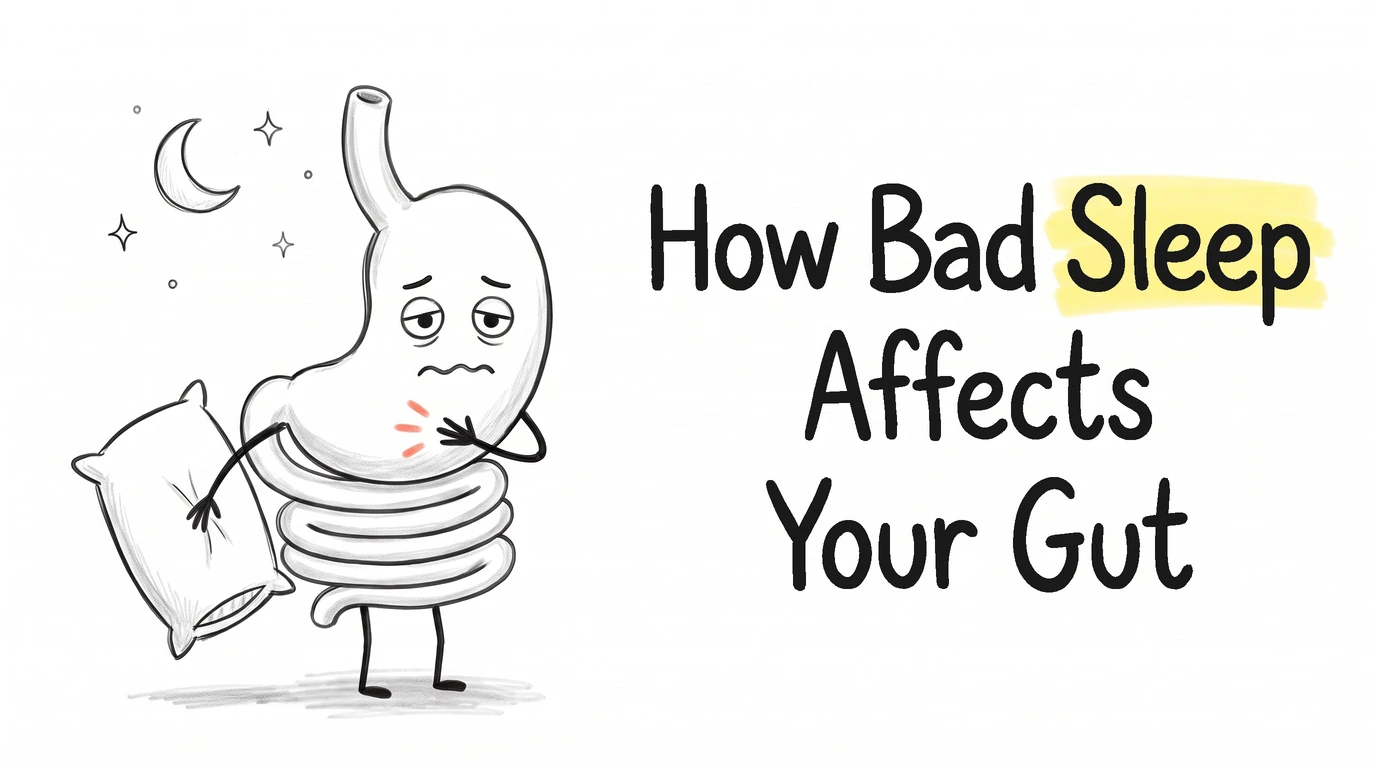
If you type "why does my stomach hurt when i" into Google, the first suggestion is "wake up." If you type "stomach hurts when i don't sleep," the suggestions run in both directions, from "can your stomach hurt from not sleeping" to "why can't i sleep when my stomach hurts."
Both of those questions have better evidence behind them than the one most sleep-and-gut content is about, which is your gut bacteria. In teenagers, short nights go along with more stomach aches. In adults with IBS (irritable bowel syndrome), a night that felt bad predicts more belly pain the next day. The idea that losing a night or two of sleep damages your microbiome (the bacteria living in your gut) rests on three small lab studies that don't agree with each other.
Short nights and stomach aches
Researchers in Norway surveyed 12,867 students aged 14 to 19 (90% of the students they invited) about how many hours they usually slept on a school night and what hurt. Under 8 hours counted as short sleep, and 59% of the girls and 52% of the boys fell under that line. Daily stomach pain was much less common, at 5% of girls and 2% of boys.
Students sleeping under 8 hours had 1.7 times the odds of daily stomach pain compared with the ones sleeping 8 or more. The same table lists symptoms of depression right next to it, at 5.5 times the odds, so depression symptoms had a much stronger link to daily stomach pain than short sleep did.
The survey caught everyone at a single moment, which means that it can't tell you which came first. A stomach that hurts at night could be what's cutting the sleep short.
Which one comes first?
To get at that, you have to follow the same people day by day. A team led from Queen Mary University of London had 80 adults with IBS log their symptoms on a phone app ten times a day for a week, rate their sleep every morning, and wear a wrist tracker at night. A bad night predicted more belly pain and more bowel symptoms the next day, "but not vice versa." A day of bad symptoms didn't predict a worse night.
The wrist trackers didn't predict next-day symptoms. Only how well people felt they had slept lined up with the next day's symptoms, and the authors wrote that "it is the perception of sleep quality that is most influential." An earlier and smaller study, in 24 women with IBS, found the same direction. It also found that on days with more gut symptoms, the trackers recorded more efficient sleep that night, which is the opposite of what you'd guess.
Both studies were in adults who already had IBS, so they tell you less about a healthy 16-year-old than about someone whose gut is already sensitive.
Reflux works differently, because lying down is part of the problem. The NHS says acid reflux symptoms "are often worse after eating, when lying down and when bending over." Our article on heartburn in teens goes through which of the bedtime advice actually has evidence under it.
What about your gut bacteria?
The first study to test this in people took nine young men in a Swedish lab and let them sleep from 2:45 to 7 a.m. for two nights, then compared that with two normal nights. A few groups of bacteria shifted, but the overall mix of bacteria didn't change, and the authors called the effect "subtle."
A University of Pennsylvania team gave healthy adults four hours in bed a night for five nights and found "no overt changes in the richness or composition" of their gut bacteria. They collected stool from 23 people, but only 11 of them produced samples the team could use.
The most extreme version came from the US Army, which kept 19 men around 20 years old to two hours of sleep a night for three nights. One measure of how many kinds of bacteria they had dropped by 21%. Two other measures of the same thing didn't change, and their gut lining didn't get any leakier (our leaky gut article covers which parts of that idea hold up).
Those three studies add up to 39 people whose samples got analyzed, almost all of them men and all of them adults in a lab. None of the three included a single teenager.
If you sleep in on weekends, the closest study followed 934 UK adults. The ones whose sleep shifted by an hour and a half or more between weekdays and weekends had differences in 17 kinds of gut bacteria, although when the researchers looked at each person's gut bacteria as a whole, the mix couldn't reliably tell the two groups apart. Part of the difference came down to food: the same group drank more sugary drinks and ate less fruit and fewer nuts. Several of the authors are founders of, employees of, or consultants to ZOE, the company behind the study.
The melatonin number and the sleep probiotics
You may have seen the claim that your gut makes 400 times more melatonin (the hormone that tells your body it's night) than your brain does. A researcher at the University of Adelaide traced that number back to a single measurement in rat intestines published in 1992, and found that studies since then have measured far less melatonin in the gut. His review concludes that the gut "may well not produce any."
Probiotics sold for sleep have been tested in people, and a review of 39 trials found that they improved scores on a standard sleep questionnaire by less than one point. The authors point out that the change usually counted as meaningful is about 2 to 3 points, and wrote that it's "premature to recommend probiotics" for sleep. The probiotic result lines up with what we found about probiotics in general.
Your colon keeps its own hours
Researchers put pressure sensors inside the colons of 25 healthy adults and recorded for 528 hours in total. Activity dropped at night, and "waking induced a threefold increase in motility, whereas meals induced a twofold increase." In that study, the biggest push of the day came from waking up, bigger than the push from breakfast.
The morning surge is the answer to "why do I poop when I wake up," and it shows up in everyday habits too: a study of 1,897 people in Bristol, England, found that "most defecations occurred in the early morning." Our article on travel constipation goes into what happens when that morning window moves.
What you can do
The American Academy of Sleep Medicine says that teenagers 13 to 18 "should sleep 8 to 10 hours per 24 hours on a regular basis," and that target holds whatever your gut is doing.
NIDDK (the US government's institute for digestive diseases) lists "getting enough sleep" as one of the lifestyle changes that may help IBS. The British Society of Gastroenterology notes that insomnia is "frequent" in people with IBS. NICE (the body that writes health guidelines for England) doesn't mention sleep anywhere in its IBS recommendations, which cover meals, fluids, fiber, exercise, and making time to relax.
If your stomach is reliably worse after short nights, mention the pattern to a doctor, including whether you woke up feeling rested, since that's what predicted symptoms in the phone-app study. The evidence doesn't back spending money on a sleep probiotic.
Stomach pain that keeps waking you up, or diarrhea at night, is a reason to get checked rather than wait it out. The British Society of Gastroenterology lists nighttime diarrhea among the "atypical features" of IBS that can call for more testing, and our guide to what's wrong with my gut covers the other signs that need a doctor.
Sources
- Haraldstad K, Stea TH, Associations between pain, self-efficacy, sleep duration, and symptoms of depression in adolescents: a cross-sectional survey, BMC Public Health, 2021
- Topan R et al., Poor Subjective Sleep Quality Predicts Symptoms in Irritable Bowel Syndrome Using the Experience Sampling Method, American Journal of Gastroenterology, 2024
- Buchanan DT et al., Sleep measures predict next-day symptoms in women with irritable bowel syndrome, Journal of Clinical Sleep Medicine, 2014
- NHS, Heartburn and acid reflux
- Benedict C et al., Gut microbiota and glucometabolic alterations in response to recurrent partial sleep deprivation in normal-weight young individuals, Molecular Metabolism, 2016
- Zhang SL et al., Human and rat gut microbiome composition is maintained following sleep restriction, PNAS, 2017
- Karl JP et al., Severe, short-term sleep restriction reduces gut microbiota community richness but does not alter intestinal permeability in healthy young men, Scientific Reports, 2023
- Bermingham KM et al., Exploring the relationship between social jetlag with gut microbial composition, diet and cardiometabolic health, in the ZOE PREDICT 1 cohort, European Journal of Nutrition, 2023
- Kennaway DJ, The mammalian gastro-intestinal tract is a NOT a major extra-pineal source of melatonin, Journal of Pineal Research, 2023
- Zhu K et al., Effects of probiotic supplementation on subjective and objective sleep outcomes: an updated systematic review and meta-analysis of 39 randomized controlled trials, Frontiers in Psychiatry, 2026
- Rao SS et al., Ambulatory 24-h colonic manometry in healthy humans, American Journal of Physiology, 2001
- Heaton KW et al., Defecation frequency and timing, and stool form in the general population: a prospective study, Gut, 1992
- American Academy of Sleep Medicine, Teen Sleep Duration Health Advisory
- NIDDK, Treatment for Irritable Bowel Syndrome
- Vasant DH et al., British Society of Gastroenterology guidelines on the management of irritable bowel syndrome, Gut, 2021
- NICE, Irritable bowel syndrome in adults: diagnosis and management (CG61), Recommendations

.svg)
.webp)
.webp)



.webp)


.webp)
.webp)