If you type "can h pylori be cured" into Google, the suggestions include "naturally," "without antibiotics," "with supplements," and "with probiotics." One post on r/HPylori starts with "My doctor swears we can eradicate with supplements only (no antibiotics)," and a few lines down the same person writes that after seven weeks of mastic gum and L. reuteri, their "symptoms have not gotten any better."
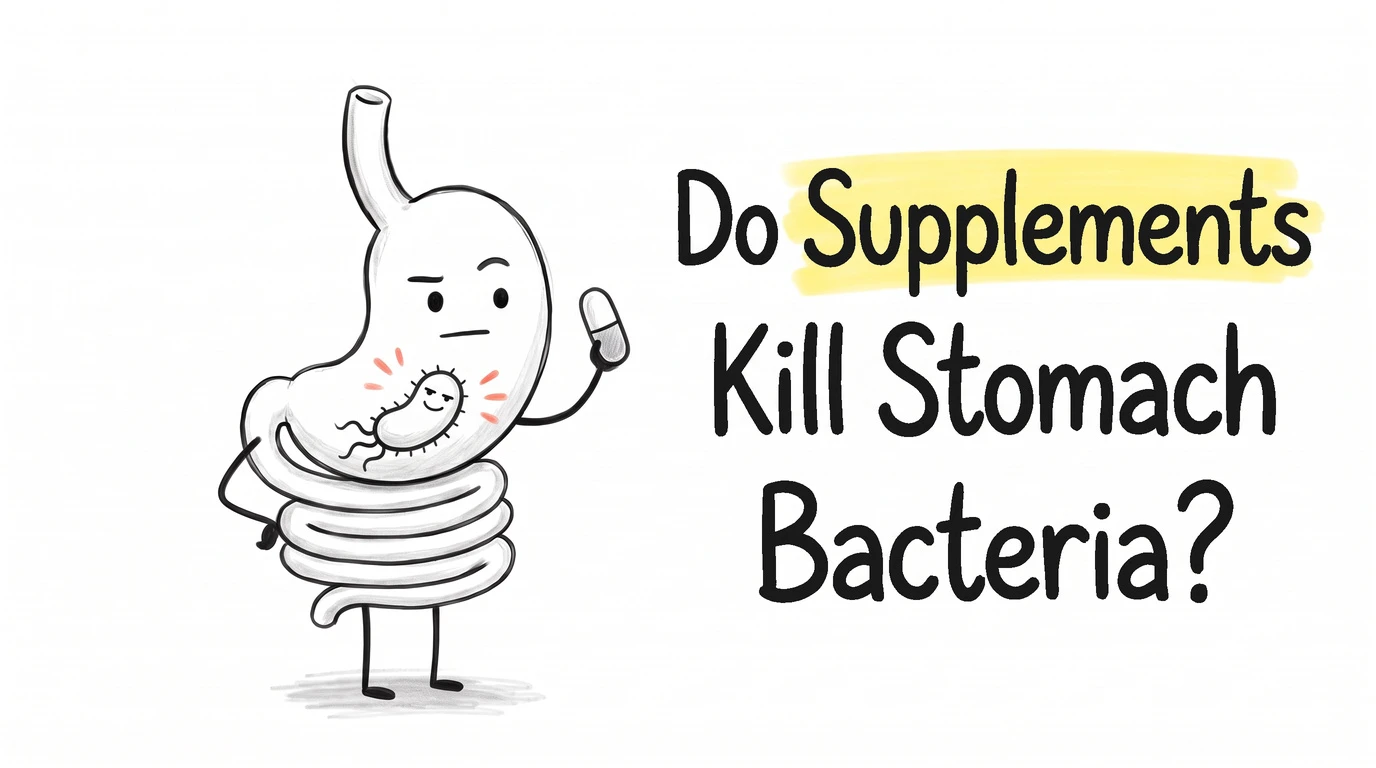
No supplement has been shown to clear H. pylori reliably on its own. A few seem to help a little when they're added to prescription antibiotics, mostly by making the antibiotics easier to get through, and the main group of US gut doctors doesn't recommend even that yet.
What treatment actually looks like
H. pylori is a bacterium that lives in the lining of your stomach and causes most stomach ulcers (the ulcer article covers how). NIDDK (the US government's institute for digestive diseases) says doctors treat it "with a combination of medicines," most often two or more antibiotics and a PPI, plus "in some cases, bismuth subsalicylate." A PPI (proton pump inhibitor) is a pill that turns down how much acid your stomach makes.
The American College of Gastroenterology, the group of US gut doctors whose guideline covers this, recommends "optimized BQT" as a first choice. BQT stands for bismuth quadruple therapy: a bismuth salt, two antibiotics, and a PPI taken together for two weeks. So bismuth, one of the ingredients you'll see on supplement bottles sold for H. pylori, is already part of prescription treatment.
The Maastricht consensus (the international report on H. pylori that European gut doctors work from) sets a high bar, saying that any treatment should "cure reliably H. pylori infection in the majority (eg, ≥90%) of patients."
Mastic gum
Mastic gum is a resin from the mastic tree, and if you type "does mastic gum" into Google, the second suggestion is "kill h pylori." Two small trials tested it alone.
In the UK, researchers gave nine infected people a gram of mastic four times a day for two weeks. Eight finished, and "all remained H. pylori positive."
In Greece, a trial split 52 people into four groups of 13. Mastic alone cleared the infection in 4 people at the lower dose and 5 at the higher dose. Mastic plus a PPI cleared it in nobody. Two antibiotics plus a PPI cleared it in 10. The authors still wrote that "mastic gum has bactericidal activity on H. pylori in vivo" (it kills the bacteria inside a living person), even though the drop in breath test readings in the mastic-only groups wasn't statistically significant.
The newest trial tried mastic as an add-on. A 2026 study in India gave 64 adults bismuth quadruple therapy, half of them with mastic gum on top. The mastic group cleared it more often (85% versus 67%), but with only 32 people per group, the difference "failed to reach statistical significance," which means that it could have come from chance. The mastic group did get more relief from stomach symptoms.
Probiotics
One strain you'll see on H. pylori products is Lactobacillus reuteri DSM17648, sold as Pylopass. In a 2013 study of 22 infected adults, it lowered their breath test readings (the test picks up an enzyme that the bacteria make, so a lower reading means fewer bacteria). The study was about lowering the amount of bacteria, and it never reported anyone being cured. Novonesis, the company that owns the strain, says it "supports the reduction of H. pylori." One Amazon listing for a $44 capsule built around it calls the product "a safe and effective alternative."
As an add-on to antibiotics, the results split. In a Russian trial sponsored by the strain's maker, 96.7% of people who took it alongside antibiotics were cured, versus 86.0% on a placebo (a fake pill). In an Iranian trial, adding a product containing the same strain, or a yeast probiotic called Saccharomyces boulardii, to standard treatment made no significant difference in cure rates (92.3% and 94.2% versus 86.5% with a placebo).
Saccharomyces boulardii has the most research behind it. A 2019 meta-analysis (a study that pools the results of many earlier studies) combined 18 trials and 3,592 patients. Adding it to antibiotics made a cure about 9% more likely and cut the side effects of treatment roughly in half, with diarrhea taking the biggest drop.
The American College of Gastroenterology looked at the same kind of evidence and says there is "insufficient evidence" that probiotics improve how well treatment works or how easy it is to tolerate. The Maastricht report says "certain probiotics (some Lactobacilli and S. boulardii)" do help with side effects, and that any boost in cure rates comes from those side effects going down "rather than through direct effects on H. pylori." Fewer people quit their antibiotics halfway through. The joint European and North American guideline for kids and teens says "it is not possible to make specific recommendations regarding probiotic therapy." Probiotics in general have a narrower track record than the marketing suggests.
Berberine, broccoli sprouts, and cranberry
A 2020 review pooled 13 trials with 2,111 patients in which berberine (a plant compound sold in capsules) was added to standard antibiotic treatment, and cure rates went up. The authors flagged the catch themselves: "All trials included were conducted in mainland China," which leaves it unclear whether the result holds elsewhere. Every trial in that review gave berberine alongside antibiotics, none instead of them. Our berberine article covers what else it does.
Broccoli sprouts are a source of sulforaphane, a compound the researchers call "powerfully bactericidal" against H. pylori. In a trial of 48 infected people, eating 70 grams of broccoli sprouts a day for eight weeks lowered the breath and stool test markers for H. pylori, while alfalfa sprouts did nothing. Then the sprouts stopped, and the researchers wrote that the "values recovered to their original levels 2 months after treatment was discontinued."
Cranberry juice got a bigger trial. In China, 189 infected adults drank two boxes of cranberry juice or a placebo drink every day for 90 days, and the authors concluded that cranberry can "suppress" the infection. By the end, 14 of 97 in the cranberry group tested negative, versus 5 of 92 on placebo. That difference was statistically significant, and it also means that 83 of the 97 cranberry drinkers still had H. pylori.
The resistance argument
Supplement sellers often point to antibiotic resistance, and that part is true. According to the American College of Gastroenterology, 20% to 30% of H. pylori in the US now resists clarithromycin, and resistance to levofloxacin is close to 40%. Older treatments relied on both of those antibiotics. The guideline's response is to steer doctors toward combinations that don't lean on those two drugs, which is why bismuth quadruple therapy sits at the top of the list. Antibiotic side effects, diarrhea most of all, are the part that probiotics have evidence for helping with.
How a supplement can fake a negative test
A lower breath test reading doesn't mean that the bacteria are gone, as the Pylopass and broccoli sprout studies show. Some things push the bacteria down far enough to hide them from a test for a while. The American College of Gastroenterology says PPIs "can result in false-negative urea breath tests and fecal antigen tests." The kids and teens guideline says to wait "at least 2 weeks after stopping PPIs and 4 weeks after stopping antibiotics and bismuth salts" before testing.
Some H. pylori supplements contain bismuth. A $47.90 BioMatrix product on Amazon lists "Bismuth Salts" in its name. If you take something like that and test a week later, a negative result may only mean that the bacteria were suppressed, and it can't tell you whether the infection is gone.
What the bottles are allowed to say
The $44 SuperSmart listing with "H. Pylori" in its name carries the line that the FDA requires on supplements making claims about the body: "This product is not intended to diagnose, treat, cure, or prevent any disease." In 2022 the FDA sent a warning letter to a honey seller whose site said that "studies have shown honey to be an effective treatment against the H. Pylori bacteria," since a product sold to treat a disease counts as a drug, and a drug can't be sold without approval.
Matula Tea, a South African herbal tea, calls itself "a treatment for Helicobacter pylori" taken as a "single, once-off 30-day course," at $169.50 a box. The evidence on its site is a 2006 lab report in which the tea was mixed with bacteria overnight, and "at a concentration of 50%, the inhibition of Helicobacter pylori bacterium is 93%." Its "over 98% success rate" comes from its refund numbers. The company says refunds and replacements "have never amounted to more than 1.65% of our total sales," so everyone who didn't ask for their money back counts as a success.
If you test positive
If your only symptom is stomach pain, you probably shouldn't be tested at all. For that kind of pain, the kids and teens guideline says that testing "is not indicated" (the ulcer article explains why). If you do test positive, the American College of Gastroenterology calls H. pylori "an infectious disease with the potential for serious clinical consequences, including gastric cancer" (stomach cancer, which our cancer article covers).
Take the full course of antibiotics, since NIDDK warns that if you stop early, "some bacteria may survive and persist in your stomach." If you want to try a probiotic for the side effects, ask whoever prescribed the antibiotics, since the guidelines disagree and your doctor knows your regimen. The American College of Gastroenterology says everyone treated should get a follow-up test "at least 4 weeks after completion of therapy," and that's the test that tells you whether it worked. If you've been taking a supplement with bismuth in it, stop it at least 4 weeks before that test, the same wait the kids and teens guideline gives for bismuth.
Sources
- Chey WD et al., ACG Clinical Guideline: Treatment of Helicobacter pylori Infection, American Journal of Gastroenterology, 2024
- Malfertheiner P et al., Management of Helicobacter pylori infection: the Maastricht VI/Florence consensus report, Gut, 2022
- Homan M et al., Updated joint ESPGHAN/NASPGHAN guidelines for management of Helicobacter pylori infection in children and adolescents, J Pediatr Gastroenterol Nutr, 2024
- NIDDK, Treatment for Peptic Ulcers (Stomach or Duodenal Ulcers)
- Bebb JR et al., Mastic gum has no effect on Helicobacter pylori load in vivo, J Antimicrob Chemother, 2003
- Dabos KJ et al., The effect of mastic gum on Helicobacter pylori: a randomized pilot study, Phytomedicine, 2010
- Tulsian V et al., Mastic gum as an adjunct therapy to standard bismuth quadruple therapy for Helicobacter pylori eradication: a randomized single-blind pilot study, Indian Journal of Gastroenterology, 2026
- Mehling H, Busjahn A, Non-viable Lactobacillus reuteri DSMZ 17648 (Pylopass) as a new approach to Helicobacter pylori control in humans, Nutrients, 2013
- Ivashkin V et al., Efficacy and Safety of Postbiotic Contained Inactivated Lactobacillus reuteri (Limosilactobacillus reuteri) DSM 17648 as Adjuvant Therapy in the Eradication of Helicobacter pylori in Adults With Functional Dyspepsia: A Randomized Double-Blind Placebo-Controlled Trial, Clinical and Translational Gastroenterology, 2024
- Naghibzadeh N et al., Investigating the effect of quadruple therapy with Saccharomyces boulardii or Lactobacillus reuteri strain (DSMZ 17648) supplements on eradication of Helicobacter pylori and treatments adverse effects: a double-blind placebo-controlled randomized clinical trial, BMC Gastroenterology, 2022
- Zhou BG et al., Saccharomyces boulardii as an adjuvant therapy for Helicobacter pylori eradication: a systematic review and meta-analysis, Helicobacter, 2019
- Berberine added to triple therapy for Helicobacter pylori: systematic review and meta-analysis, 2020
- Yanaka A et al., Dietary sulforaphane-rich broccoli sprouts reduce colonization and attenuate gastritis in Helicobacter pylori-infected mice and humans, Cancer Prevention Research, 2009
- Zhang L et al., Efficacy of cranberry juice on Helicobacter pylori infection: a double-blind, randomized placebo-controlled trial, Helicobacter, 2005
- Novonesis, Pylopass product page
- FDA, Warning Letter to Honey Feast, Inc., 2022
- Matula Tea, Clinical Tests


.svg)
.webp)
.webp)



.webp)


.webp)
.webp)