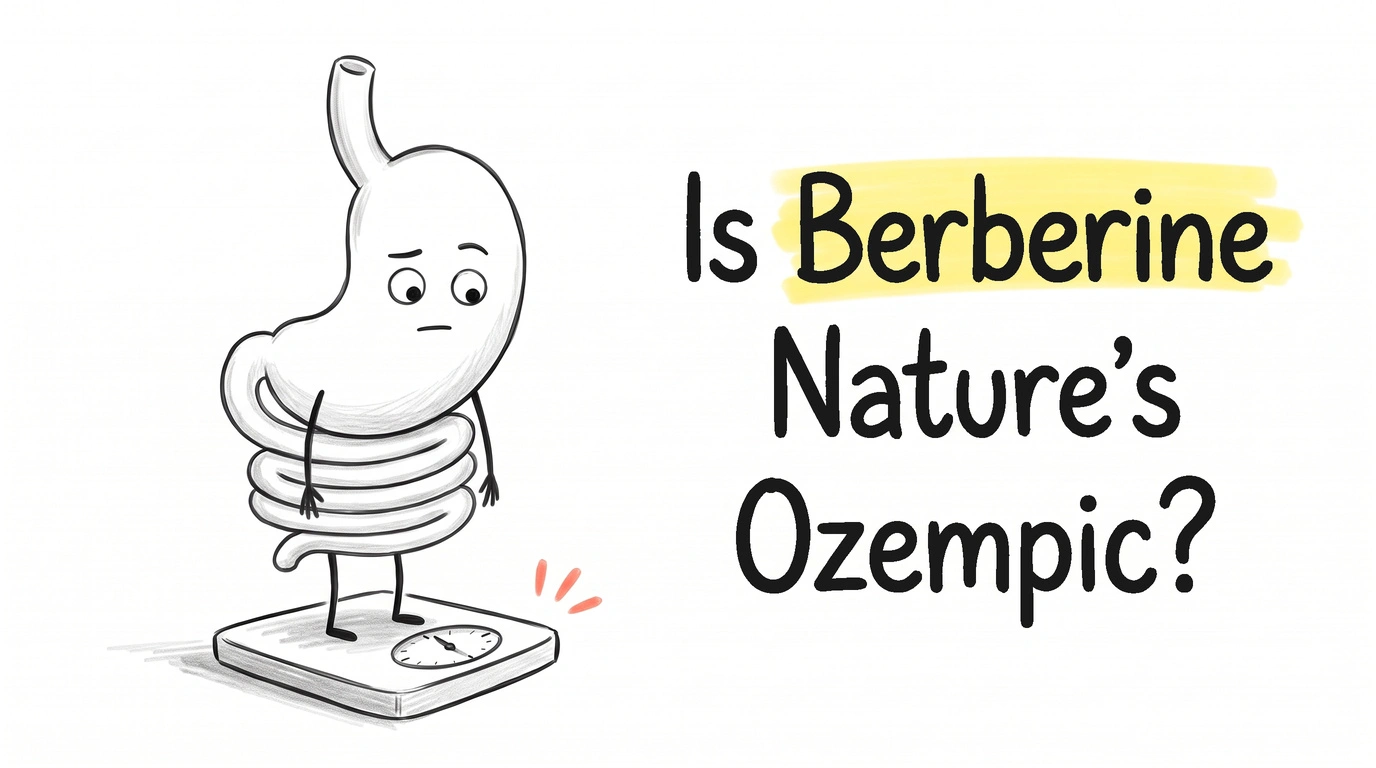
If you type "why does berberine" into Google, it finishes the question for you: cause diarrhea, make me poop, cause constipation, cause gas, make my stomach hurt. Seven of the ten suggestions are about your gut and none of them are about weight, which is odd for a supplement that TikTok spent 2023 calling "nature's Ozempic."
Berberine isn't nature's Ozempic. Dr. Lydia Alexander, who was president-elect of the Obesity Medicine Association (a professional group for doctors who treat obesity) at the time, told ABC7 in Los Angeles that "Nature's Ozempic is likely an overstatement. I would say that it is more akin to nature's metformin." Metformin is a diabetes pill, and it isn't approved for weight loss either. Berberine lowers blood sugar a little in people who have type 2 diabetes, it does very little for weight, and a lot of it stays in your gut.
What berberine is
Berberine is a compound found in plants like barberry, goldenseal, and Oregon grape. NCCIH (the part of the NIH that studies supplements and alternative medicine) says that plants containing it have been used in Ayurvedic and traditional Chinese medicine for "thousands of years," and a family doctor writing for the American Academy of Family Physicians notes that the traditional use was for diabetes and "gastrointestinal symptoms, primarily diarrhea."
In the US, it's sold as a dietary supplement, which means that the FDA "does NOT have the authority to approve dietary supplements for safety and effectiveness" before they go on sale. Nobody checks that it works, or that the capsule holds what the label says, before you can buy it.
How much weight people actually lose
A 2020 meta-analysis (a study that pools the results of many smaller studies) of 12 trials found that people taking berberine lost an average of 2.07 kg more than people who weren't, which is about four and a half pounds. Another 2020 meta-analysis, of 10 trials, came out the other way, with "no significant decline in body weight" (0.11 kg), though BMI and waist size did drop a little.
A bigger 2022 review by some of the same researchers, the one NCCIH cites on its berberine page, pooled more trials and got a smaller answer: 0.84 kg, or a little under two pounds. It found BMI (body mass index, a number based on your height and weight) dropping by 0.25. Dr. Justin Ryder, a pediatric obesity researcher at Northwestern University, gave CNN the same 0.25 figure for berberine against a placebo (a pill with nothing in it), and put semaglutide, the drug in Ozempic and Wegovy, at 4.61, which he called "18 times more effective than berberine." His verdict was "So, does berberine have an effect? The data would suggest yes. Is the effect meaningful? Probably not."
NCCIH says that the weight changes showed up mainly in people taking more than 1 gram a day for more than 8 weeks, that "many of the studies included in this review had a high risk of bias," and that most of the people in them already had "health problems, such as diabetes or fatty liver disease." Most of the studies were done in Asia, and "very few were done in North America." None of the trials behind these numbers were run on healthy teenagers.
A 2025 overview in BMC Complementary Medicine and Therapies graded 54 systematic reviews (studies of studies) on berberine, and "45 (83.3%) were judged critically low" for quality, the lowest rating on the scale.
Where it does something: blood sugar
In people who already have type 2 diabetes, berberine does lower blood sugar. In a small 2008 trial in Shanghai, 36 adults who had just been diagnosed with type 2 diabetes took either berberine or metformin for three months, and the authors reported that "the hypoglycemic effect of berberine was similar to that of metformin" (hypoglycemic meaning blood-sugar-lowering). Alexander described the evidence behind "nature's metformin" in the same terms, as "small studies of 30 to 40 patients."
The 2022 review found that HbA1c (a blood test that shows your average blood sugar over the last few months) dropped by 0.45 percentage points on berberine. NCCIH calls it "a modest effect on lowering blood glucose levels in people with type 2 diabetes." The American Academy of Family Physicians blog points out that berberine has never had the kind of large randomized trial "which new diabetes drugs need to undergo to obtain FDA approval." The American Diabetes Association's guideline for doctors says that herbs taken to lower blood sugar are "not recommended," and it doesn't name berberine in its list at all.
Metformin itself is approved "to improve glycemic control" in type 2 diabetes, according to its FDA label, and weight loss isn't one of its approved uses.
Why it isn't Ozempic
Ozempic copies a gut hormone called GLP-1, which slows your stomach down and tells your brain you're full (there's more on how that works in what Ozempic actually does to your stomach). That's where its weight loss comes from. Harvard Health describes semaglutide as a drug that can "dampen appetite and help people feel full," and says that for berberine, "Some people say it suppresses appetite and promotes weight loss, but there's no rigorous scientific evidence to support that claim."
Berberine works another way. UCLA Health explains that it triggers an enzyme called AMPK, "that controls metabolism and energy," instead of copying a hormone that controls appetite. Dr. Caroline Apovian, a Harvard obesity doctor who led the Endocrine Society's guideline on weight-loss drugs, told CNN, "As for it being nature's Ozempic, there's no evidence to suggest that is true."
What it does to your gut
Not much of the berberine you swallow makes it into your blood. A 2026 review of berberine's drug interactions describes "very low systemic exposure" (not much in your blood) alongside "high luminal" concentrations, meaning a lot of it sitting inside of your intestines.
NCCIH lists its most common side effects as "abdominal pain, constipation, diarrhea, nausea, and vomiting." In the 2008 Shanghai trial, 34.5% of the patients had "transient gastrointestinal adverse effects" (transient meaning that they went away), with gas the most common and most of it in the first four weeks. That figure includes people taking berberine on top of other diabetes drugs, and the authors write that "none of the patients suffered from severe gastrointestinal adverse events when berberine was used alone." The draft safety review from EFSA (the European Union's food safety agency) describes the same thing: "transient gastrointestinal symptoms such as constipation, diarrhoea, nausea, and abdominal pain." Constipation and diarrhea both show up on every one of those lists, which matches Reddit, where r/Berberine has threads called "Has anyone gotten really constipated on berberine?" and "so bloated and constipated," and r/Supplements has one asking "Push through Berberine diarrhea?"
Who shouldn't take it
Berberine changes how your liver breaks down some medications. Harvard Health says it can "alter how quickly the liver breaks down medications," including blood thinners and drugs that suppress the immune system, and NCCIH names cyclosporine (a drug that stops the body from rejecting a transplanted organ) as one that it's been shown to interact with. The 2026 interactions review adds low blood sugar to the list of risks when berberine is combined with other drugs, so if you take any prescription (especially one for diabetes), check with a doctor or pharmacist before adding berberine to it.
It's also unsafe for babies. NCCIH says berberine "should not be given to infants" because it can cause a buildup of bilirubin that can lead to brain damage, and that people who are pregnant or breastfeeding shouldn't use it.
EFSA's 2026 draft opinion concluded that "the available data do not allow establishing a safe intake for humans" for any of the berberine plants it looked at, partly because lab tests found signs that berberine can damage DNA in cells ("confirmation in vivo is lacking," meaning that nobody has shown it happens in a living body). France's food safety agency, ANSES, discourages berberine supplements for people with diabetes, liver or heart problems, anyone on other medications, and people who are pregnant or breastfeeding, and according to the UK's Committee on Toxicity, those recommendations "were extended to children and adolescents."
If you're thinking about trying it
The American Academy of Family Physicians writes that, as with all supplements, "it's impossible to know for sure whether the ingredients listed on the bottle accurately represent what's inside the bottle." Alexander's advice was to look for a third-party testing mark like USP or NSF on the bottle, which at least tells you that an outside lab checked what's in it.
If you're worried about your blood sugar because diabetes runs in your family, or because a doctor mentioned prediabetes, that's worth an appointment, where a blood test can show you where you actually stand.
Sources
- Dador D, "Berberine dietary supplements have been nicknamed 'nature's Ozempic,' but is it a fad?," ABC7 Los Angeles, 2023
- NCCIH, Berberine and Weight Loss: What You Need To Know, 2023
- NCCIH, In the News: Berberine, 2023
- NCCIH, Diabetes and Dietary Supplements: What You Need To Know, 2023
- Middleton J, Weight Loss Fad Berberine ("Nature's Ozempic") Lacks Rigorous Evidence, Has Potential Harms, AFP Community Blog, American Academy of Family Physicians, 2023
- FDA, FDA 101: Dietary Supplements
- Asbaghi O et al., The effect of berberine supplementation on obesity parameters, inflammation and liver function enzymes: a systematic review and meta-analysis of randomized controlled trials, Clinical Nutrition ESPEN, 2020
- Xiong P et al., The effect of berberine supplementation on obesity indices: a dose-response meta-analysis and systematic review of randomized controlled trials, Complementary Therapies in Clinical Practice, 2020
- Zamani M et al., The effects of berberine supplementation on cardiovascular risk factors in adults: a systematic review and dose-response meta-analysis, Frontiers in Nutrition, 2022
- LaMotte S, "Forget TikTok claims: 'Nature's Ozempic' is no such thing, experts say," CNN, 2023
- Shi L et al., Berberine and health outcomes: an overview of systematic reviews, BMC Complementary Medicine and Therapies, 2025
- Yin J, Xing H, Ye J, Efficacy of berberine in patients with type 2 diabetes mellitus, Metabolism, 2008
- American Diabetes Association, Standards of Care in Diabetes, Section 5, Diabetes Care, 2025
- Metformin hydrochloride tablets, FDA label, DailyMed
- Golen T, Can berberine help me lose weight?, Harvard Health Publishing, 2024
- Dumitru CN et al., Berberine-Drug Interactions: Mechanisms, Clinical Relevance and Risk Stratification, Pharmaceuticals, 2026
- UCLA Health, What to know about berberine, the so-called "nature's Ozempic"
- UK Committee on Toxicity, Draft Scientific Opinion on the safety of plant preparations containing berberine (EFSA draft opinion, summarized for the COT), 2026

.svg)
.webp)
.webp)



.webp)


.webp)
.webp)