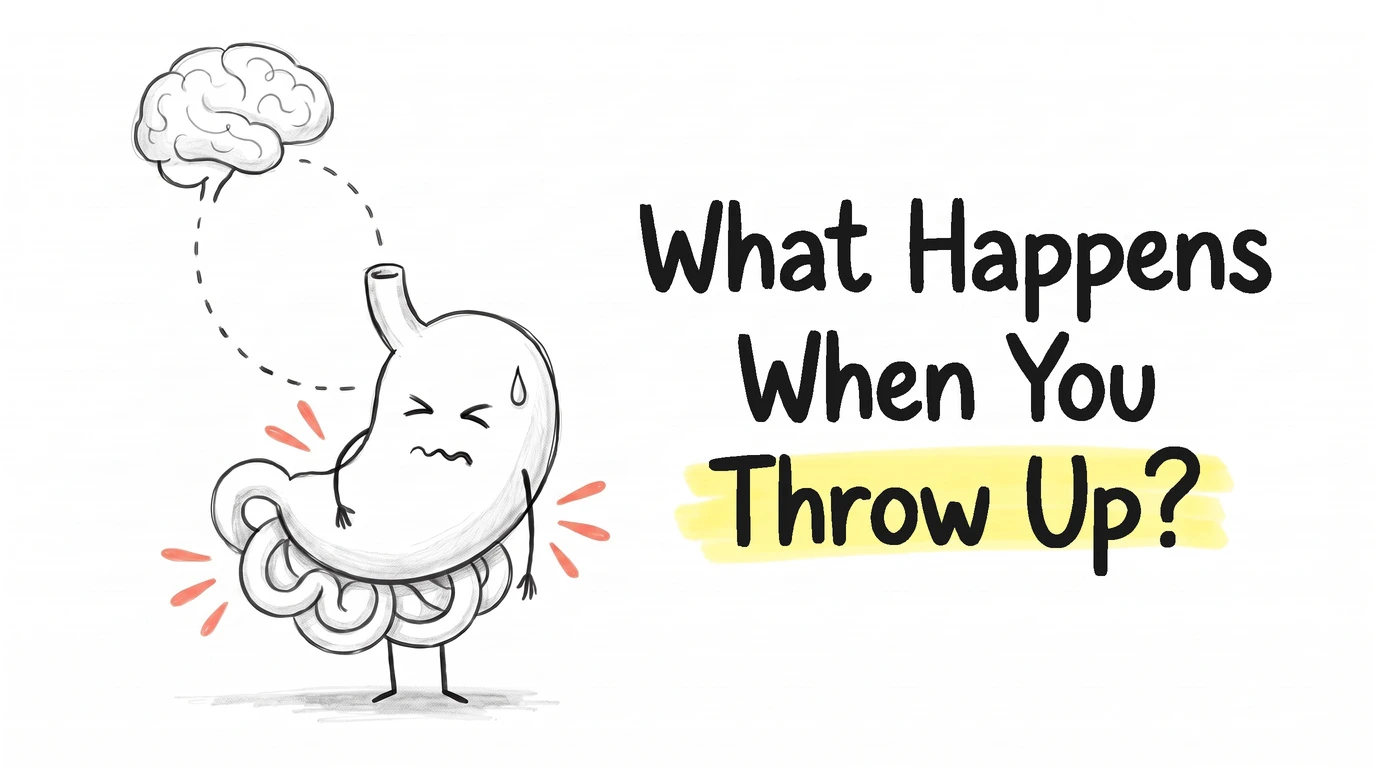
If you type "why does my mouth water before" into Google, the first thing it suggests is "i vomit." If you start typing "why does throwing up," it offers "make you feel better," "hurt," and "make you sweat," and "why is my throw up" ends in yellow, green, black, and foamy. Every one of those questions has an answer in how the reflex works, and most of the answers start in your brainstem (the stalk at the base of your brain that runs things you never think about, like breathing).
Where does the signal come from?
Vomiting can be set off from several directions, and a 2021 review from Western University of Health Sciences in California lists them: something irritating inside of your gut, a toxin or drug in your blood, motion that confuses your sense of balance, problems in other organs, and your own thoughts and emotions.
In your gut, cells in the lining called enterochromaffin cells make more than 90% of your body's serotonin (a chemical messenger), and when they sense something irritating, like a virus or spoiled food, they release it. According to the 2021 review, that serotonin switches on the vagus nerve, the long cable between your gut and your brain that the butterflies article covers, and the vagus carries the alarm up to the brainstem.
The blood route runs through a tiny patch of the brainstem called the area postrema, which doctors also call the chemoreceptor trigger zone. Most of your brain sits behind a barrier that keeps things in your blood out, and the 2021 review points out that the area postrema lacks it. StatPearls (a reference textbook for doctors, published through the National Library of Medicine) explains that blood moves through it slowly and its tiny blood vessels are leaky, so it gets a long look at whatever is circulating. When it picks up a toxin, it passes the signal on.
For motion sickness, the most widely accepted explanation, per StatPearls, is a mismatch: your eyes, your inner ear, and your body disagree about whether you're moving, which is why riding in a car or playing a VR game can do it.
Is there a vomiting center in your brain?
For decades the textbook answer was yes. In 1949 and 1951, two researchers named Borison and Wang, working with a cat and then with dogs, proposed a single "vomiting center" in the brainstem. A 1983 study that went looking for it with electrical stimulation couldn't find one spot. A 2012 review in the Annals of Palliative Medicine puts it bluntly: "There is no well-defined discrete vomiting center." What exists is a spread-out network of nerve cells that fire in a set order, which the review calls the "emetic complex" (emesis is the medical word for vomiting). StatPearls agrees that there is "no segregated 'vomiting center.'" The consumer version of the Merck Manual still uses the old phrase, so you'll keep seeing it.
A lot of this map comes from animals. Rats and mice are the standard lab animals, but the 2021 review notes that they "lack a vomiting reflex and the capacity to vomit," so researchers studying the reflex itself have used dogs, cats, ferrets, and shrews instead.
Why do you sweat and drool before you throw up?
The network that runs the heave also runs the warning signs, and they fire together with the queasy feeling. The 2012 review lists going pale, sweating, a heart rate that speeds up or slows down, and extra fluid in your upper digestive tract. It even names a piece of the emetic complex the "prodromal-sign center" (prodromal means the signs that come before). StatPearls's list for motion sickness adds yawning, drowsiness, and "increased salivation."
The explanation for the drool you'll find almost everywhere online, including a top answer on Reddit's explainlikeimfive, is that your body makes extra spit to protect your teeth from the acid coming up. Neither the 2012 review nor the 2021 one gives the drool a purpose, though. They list it as a sign and stop there.
The order isn't fixed, either. According to the 2012 review, "vomiting can occur without any preceding nausea," and nausea can come and go without you ever throwing up.
What your body does during the heave
Retching (dry heaving) comes first for most people. The 2012 review describes it as gasping movements with your airway closed while your belly muscles squeeze, so the push from below meets a pull from your chest and nothing comes out. Vomiting itself is your belly muscles and diaphragm (the sheet of muscle under your lungs) contracting together while the top of your stomach opens. Your stomach isn't really the one pushing.
What comes up usually looks like what you last ate. The Merck Manual says that when bile (a digestive fluid from your liver) is in it, vomit turns "bitter and yellow-green." Red means blood, and vomit that looks like coffee grounds means blood that has been partly digested. Both of those need a doctor right away.
The burning in your throat afterward comes from the acid. Cleveland Clinic explains that your stomach lining can handle its own acid, but your throat can't, and that "the esophagus is a muscle like any other," so the strain of heaving can leave it sore too.
Why does throwing up make you feel better?
Getting rid of something is what the reflex is for. The 2021 review calls nausea and vomiting "essential protective defense processes," a way to get rid of something harmful before your body absorbs it. Dr. Matthew Goldman, a family medicine doctor at Cleveland Clinic, puts it the same way: "Throwing up is often your body's way of expelling something it considers harmful."
The relief itself doesn't appear to have been studied in healthy people. The closest work comes from cancer patients on chemotherapy, where a 2002 review from the University of Rochester found that anti-vomiting drugs that worked well against vomiting did no better than older drugs against nausea, which fits the 2012 review's point that the two can happen separately.
Should you brush your teeth after?
The American Dental Association tells dentists that their patients "should be cautioned against brushing their teeth immediately after vomiting," and suggests rinsing "with water, a sodium bicarbonate rinse, or milk" instead. The ADA's site for the public says to wait an hour after acidic food before brushing.
That waiting advice traces back mostly to a 1999 Swiss study in which seven women wore slabs of human tooth enamel in their mouths after the slabs had been soaked in acid. Waiting an hour before brushing meant less wear. A 2007 German study of five people found the opposite, that waiting two hours "had no protective effect," while fluoride toothpaste helped. In 2020, a systematic review (a study of studies, where researchers pool every solid paper on a question) found that waiting didn't reduce wear on human enamel at all. It only helped in the studies that used cow teeth as a stand-in for human ones. Its conclusion was that waiting alone "is not capable of preventing erosive enamel wear," and that fluoride toothpaste made a difference.
The review was about acidic food and drinks, and the two single studies used citric acid (the acid in lemons), so none of this research tested vomit itself. The ADA's rinse doesn't depend on any of that timing research, and fluoride toothpaste helped in both the 2007 study and the 2020 review.
When throwing up keeps happening
Throwing up once from a stomach bug usually passes in a day or two. Food Poisoning vs a Stomach Bug covers what's likely behind it, and What to Eat When You Have a Stomach Bug covers what to drink so you don't get dehydrated.
Vomiting that keeps coming back in bouts has other causes. Rome IV (the international standard for diagnosing gut disorders) recognizes cannabinoid hyperemesis syndrome, repeated vomiting episodes after long-term cannabis use that go away when the cannabis stops. People with it often find that hot showers help. Cleveland Clinic says it happens more in adults "who've been using cannabis since their adolescent years," and that the only known permanent treatment "is to stop cannabis use completely."
If you've swallowed something that might be poisonous, don't make yourself throw up. Poison Control's instruction is "Do not induce vomiting," and its number is 1-800-222-1222.
MedlinePlus (the National Library of Medicine's health site) says to get medical care if you've been vomiting for longer than 24 hours, can't keep any fluids down for 12 hours or more, haven't peed in 8 or more hours, have a headache or stiff neck, have severe belly pain, or have thrown up 3 or more times in one day. Go to the emergency room for blood or coffee-ground material in your vomit. The NHS (the UK's national health service) adds green vomit in adults, a sudden severe headache, and a stiff neck with pain when you look at bright lights to its emergency list.
Sources
- Zhong W et al., Mechanisms of Nausea and Vomiting: Current Knowledge and Recent Advances in Intracellular Emetic Signaling Systems, International Journal of Molecular Sciences, 2021
- Smith HS, Smith EJ, Smith AR, Pathophysiology of nausea and vomiting in palliative medicine, Annals of Palliative Medicine, 2012
- StatPearls, Physiology, Chemoreceptor Trigger Zone, NCBI Bookshelf, 2023
- StatPearls, Motion Sickness, NCBI Bookshelf, 2023
- Merck Manual Consumer Version, Nausea and Vomiting in Adults
- Cleveland Clinic, Here's What To Eat or Drink After Throwing Up
- Cleveland Clinic, How To Heal a Sore Throat After Throwing Up
- Morrow GR et al., Nausea and emesis: evidence for a biobehavioral perspective, Supportive Care in Cancer, 2002
- American Dental Association, Dental Erosion (ADA Library)
- American Dental Association, Dietary Acids and Your Teeth (MouthHealthy)
- Jaeggi T, Lussi A, Toothbrush abrasion of erosively altered enamel after intraoral exposure to saliva: an in situ study, Caries Research, 1999
- Ganss C et al., Efficacy of waiting periods and topical fluoride treatment on toothbrush abrasion of eroded enamel in situ, Caries Research, 2007
- Hong DW et al., Does delayed toothbrushing after the consumption of erosive foodstuffs or beverages decrease erosive tooth wear? A systematic review and meta-analysis, Clinical Oral Investigations, 2020
- Rome Foundation, Rome IV Diagnostic Criteria for Disorders of Gut-Brain Interaction
- Cleveland Clinic, Cannabis Hyperemesis Syndrome (CHS)
- Poison Control (National Capital Poison Center), First aid for poisonings
- MedlinePlus, Nausea and vomiting - adults
- NHS, Diarrhoea and vomiting
- Reddit r/explainlikeimfive, ELI5: why does your mouth water before you throw up?


.svg)
.webp)
.webp)



.webp)


.webp)
.webp)