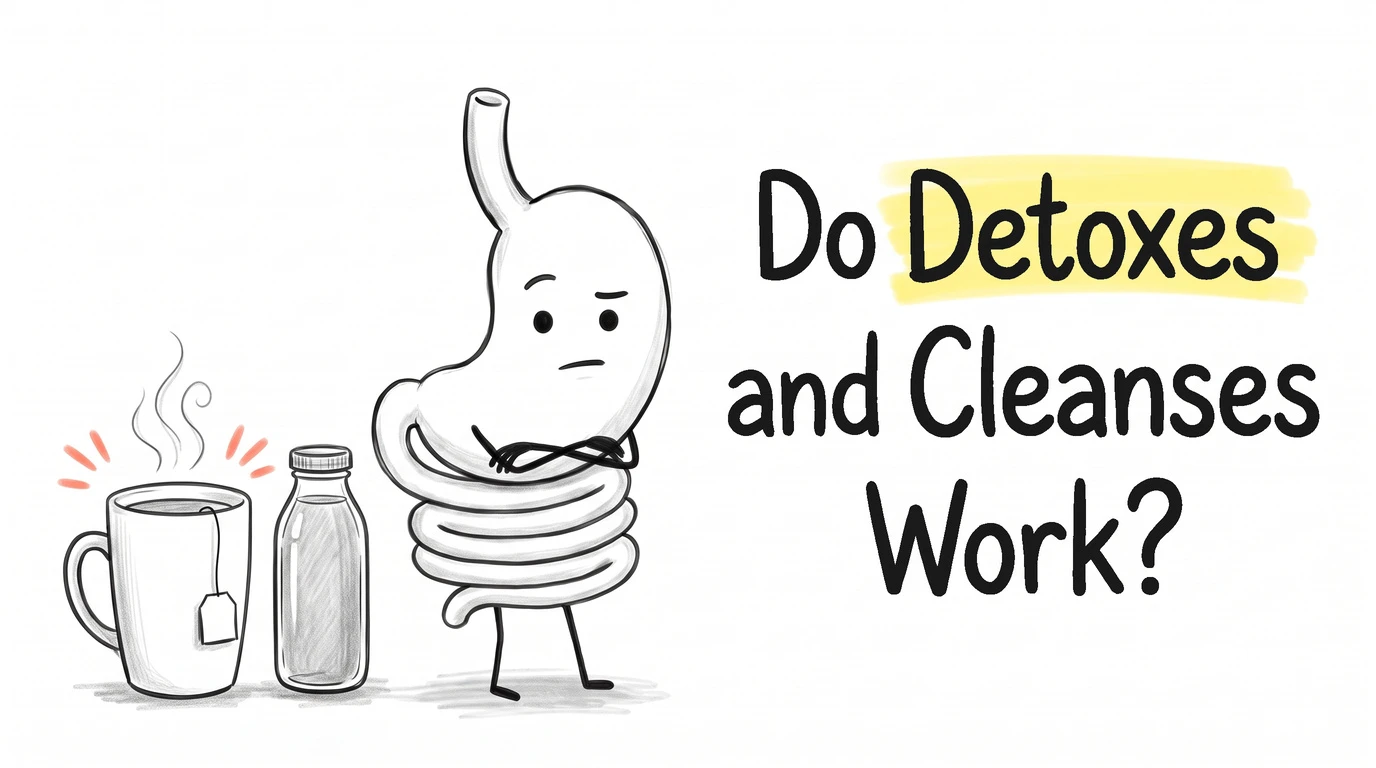
If you start typing "does detox" into Google, it finishes with "does detox tea work," "does detox make you poop," and "does detoxing make you tired." Type "how to detox your" and it offers your liver, your kidneys, your gut, and your lungs. The searches lead to the same handful of products: juice cleanses (a few days of nothing but bottled juice), detox teas, colon cleanse pills, colonics (water pumped into your colon through a tube), and foot pads that turn brown overnight.
Your liver and kidneys already do the job these products advertise, and none of the products has good evidence that it removes a specific toxin from a healthy person. The British Dietetic Association (the UK's professional body for dietitians) says it in one line: "The whole idea of detox is nonsense." The effects people notice during a cleanse do happen (the extra trips to the bathroom, the tiredness, the lower number on the scale), but each one has a plainer explanation than toxins leaving.
Where do toxins actually go?
KidsHealth (the teen health site from Nemours, a US children's health system) defines a toxin as "a chemical or poison that has harmful effects on the body," and says toxins can come from food, water, farming chemicals, and "even from the air we breathe." Your body deals with them constantly. According to Johns Hopkins Medicine, "all the blood leaving the stomach and intestines passes through the liver" before it goes anywhere else. The liver clears the blood of "drugs and other poisonous substances" and turns "poisonous ammonia" (a leftover from breaking down protein) into urea, which leaves in your pee.
Whatever the liver breaks down leaves one of two ways. Some goes into bile (a fluid the liver makes to help digest fat) and out in your poop. The rest goes back into the blood, where the kidneys filter it out. NIDDK (the US government's institute for digestive and kidney diseases) says that healthy kidneys filter "about a half cup of blood every minute," which adds up to "about 150 quarts of blood" a day.
The BDA makes one exception, for people with "a serious medical condition." If your liver or kidneys stop working, that's a job for a doctor, because "there are no pills or specific drinks, patches or lotions that can do a better or 'magic' job."
What's in a detox tea?
Usually, it's a laxative. The BDA says that "'detox' teas work by acting as a laxative whose use is not without risk." Flat Tummy Tea's evening "Cleanse Tea," one half of its "2-Step Detox," lists organic senna (leaf and pods) as its first ingredient. Senna is also the main ingredient in Smooth Move, a tea sold as a constipation remedy, and the two labels handle it very differently. Smooth Move's maker says it "should be used for less than one week at a time, unless otherwise directed by a physician." Flat Tummy's program runs four weeks, with the senna tea every other evening in week one and every third evening after that.
Colon cleanse pills work the same way. Dr. Tobias's Colon 14 Day Cleanse ($19.99) says that it will "cleanse toxins and waste from your body" without naming a single toxin, and its formula includes senna and cascara sagrada, another plant laxative. Its own label says to take it "for no more than 7 days continuously" and that it isn't intended for "children under the age of 18."
KidsHealth warns that "laxatives and enemas can cause problems like dehydration and electrolyte and water imbalances." Electrolytes are minerals like sodium and potassium that your nerves and muscles need to work. One case report describes a previously healthy 51-year-old woman who ended up in intensive care with dangerously low sodium after drinking an over-the-counter detox tea regularly, and the doctors who wrote it up point to "a growing number of reports" like hers (Why Am I Always Constipated? has more on laxatives).
Some detox products have had worse things in them than senna. NCCIH (the NIH's center for complementary and integrative health) says that the FDA and FTC have taken action against detox and cleanse products that "contained hidden ingredients and may pose a significant health risk." In 2020, the FTC (Federal Trade Commission, the agency that polices false advertising) went after Teami, a detox tea promoted in paid Instagram posts by Cardi B and others. It said that the company claimed "without reliable scientific evidence" that its 30 Day Detox Pack would help people lose weight.
What happens during a juice cleanse?
Juice cleanses have at least one study showing a measurable change. Researchers at UCLA put 20 healthy adults on nothing but juice for three days (six bottles a day from Pressed Juicery, about 1,310 calories in total). Pressed's own website says that juice cleanses may help "flush out toxins." By day four, the volunteers had lost an average of 1.7 kilograms (just under 4 pounds), and the mix of bacteria in their poop had shifted. Two weeks after going back to normal food, they were still lighter than when they started, and the bacteria had partly shifted back. The study had no comparison group, so there's no way to tell how much came from the juice itself and how much from three days of eating almost nothing solid. The study also didn't measure any toxins.
A 2015 review in the BDA's journal couldn't find a single randomized controlled trial of a commercial detox diet, writing that "no randomised controlled trials have been conducted to assess the effectiveness of commercial detox diets in humans" (a randomized controlled trial splits people by chance into a group that gets the diet and a group that doesn't, which is how you tell whether the diet did anything). The same review found "a handful of clinical studies" suggesting detox diets might help the liver or clear some long-lasting pollutants, and said that those studies were "hampered by flawed methodologies and small sample sizes."
Most of the weight that comes off fast on a detox diet is "largely water and glycogen (the body's carbohydrate stores), rather than fat," according to the BDA, and KidsHealth adds that some of it "may be muscle." NCCIH cites a 2017 review that found juicing and detox diets can cause weight loss at first because you're eating so little, "but they tend to lead to weight gain once a person resumes a normal diet."
If you've searched "why does detoxing cause headaches," you're feeling what happens when you stop eating. NCCIH says that "fasting can cause headaches, fainting, weakness, and dehydration," and the BDA lists feeling "tired and dizzy, irritable, unable to concentrate." The Academy of Nutrition and Dietetics (the main professional group for US dietitians) goes further: your body detoxifies "around the clock using important nutrients from the diet," and fasting "may actually suppress detoxification pathways in the body."
Spinach, other leafy greens, and beets are high in oxalate (a natural compound that can form kidney stones), and NCCIH notes that some cleanse juices are made from them, so people prone to kidney stones should limit them. Doctors have reported a few cases of kidney failure from juicing, including a 65-year-old woman on a "green smoothie cleanse" whose kidneys failed for good. The patients in those reports weren't typical teenagers: they were in their 60s, or already had kidney disease, or had other risk factors (e.g., earlier stomach surgery or a long course of antibiotics), so it's a rare outcome for a healthy high schooler. KidsHealth's advice for teens covers juice cleanses along with every other kind: "Detox diets are not recommended for teens," because you need "enough calories and protein to support normal growth and energy levels."
What about colonics?
A colonic is a procedure where, as Cleveland Clinic describes it, "a tube is inserted into your rectum" and "large amounts of water (or other substances like coffee or herbal solutions)" are used to flush out your colon. The idea behind it goes back to "an ancient theory that the body poisons itself by retaining waste products," and Cleveland Clinic says "there's no scientific evidence to back up this theory." Anuradha Bhama, a colorectal surgeon (a surgeon who operates on the colon and rectum) there, says that a colonic is "not something that you need to do to maintain the health of your colon," and that "for some people, colonic hydrotherapy can actually be dangerous." In rare cases, it can tear a hole in the colon.
A 2009 systematic review (a study of studies, where researchers collect every paper on a question) in the American Journal of Gastroenterology looked for any good evidence that colon cleansing helps. It found no eligible studies on its effect on "general health" or on conditions like IBS, asthma, or arthritis. It did find reports of "electrolyte imbalances, septicemia, colitis, rectal perforation, and death." In one outbreak of amebiasis (an infection from a single-celled parasite) traced to colonic irrigation at a single clinic, at least 36 people were infected, 10 needed part of their colon removed, and six died.
If you've seen videos of rope-like "worms" coming out after a cleanse, Do Parasite Cleanses Work? covers what those actually are.
What do the companies say they remove?
In 2009, the Voice of Young Science network (a group of early-career scientists run by the UK charity Sense About Science) contacted the makers of 15 detox products, from smoothies and shampoos to foot patches. They wrote that "no one we contacted was able to provide any evidence for their claims, or give a comprehensive definition of what they meant by 'detox'." When they asked one foot patch company whether the brown color was just the powder inside the pad getting wet from sweat, the answer was "Yes the footpads turning brown is due to the ingredients getting wet."
In the US, the FTC took one foot pad company to court. Kinoki's ads said that its pads could "remove toxins, metabolic wastes, heavy metals, and chemicals from the body" overnight. The FTC said that the company "falsely claimed to have scientific proof," and in 2010 a federal judge banned the marketers from selling "any dietary supplement, food, drug, or medical device."
Are there toxins your body can't clear quickly?
Yes, a few. PFAS are a family of industrial chemicals that the body gets rid of very slowly. In Ronneby, Sweden, the drinking water was contaminated with PFAS from firefighting foam used at a nearby air base. In a University of Gothenburg study of 10 residents, PFAS levels "fell by a few percent" over 12 weeks without treatment and dropped by "at most 40%" for one type while people took a prescription cholesterol medicine that speeds up how fast PFAS leaves the body. The medicine was a prescription, given by doctors to people with unusually heavy exposure, and even then the lead researcher, Axel Andersson, says that the study only measured how fast PFAS left, "not whether there are any health benefits" from getting it out faster.
Why do people feel better on a cleanse?
The BDA lists "avoiding caffeine and alcohol" among the things detox diets often involve, and it points out that people "often say they feel better when detoxing and connect that feeling to what they are/are not eating," and that "not smoking, drinking less alcohol, getting enough sleep, fresh air and exercise" is "more likely to be the cause of feeling better than any 'detox' pills, lotions, teas or other drinks."
If what you're after is less bloating or more regular poops, How to Get Rid of Bloating and How to Improve Your Gut Health cover what helps. The BDA recommends at least five portions of fruits and vegetables a day and staying hydrated with "water and sugar-free drinks," and it caps fruit juice and smoothies at "150ml per day" (about two-thirds of a cup), which is a lot less than six bottles.
The Academy of Nutrition and Dietetics says that detox programs "may pose a risk" for some people, including "those with eating disorders," and KidsHealth says not to try one if you have an eating disorder. If a cleanse is mostly about losing weight fast, or laxative teas have started to feel like something you need, talk to a doctor, a registered dietitian, or someone you trust.
Sources
- British Dietetic Association, Detox diets: Food Fact Sheet, 2025
- NIH National Center for Complementary and Integrative Health, "Detoxes" and "Cleanses": What You Need To Know, updated March 2025
- Nemours KidsHealth, Are Detox Diets Safe? (for Teens)
- Academy of Nutrition and Dietetics, What's the Deal with Detox Diets?
- Johns Hopkins Medicine, Liver: Anatomy and Functions
- NIDDK, Your Kidneys & How They Work
- Flat Tummy Co, Flat Tummy Tea 2-Step Detox product page
- Traditional Medicinals, Smooth Move tea product page
- Dr. Tobias, Colon 14 Day Cleanse product page
- Gillett et al., Acute Severe Hyponatremia Following Use of "Detox Tea," Cureus, 2021
- Federal Trade Commission, Tea Marketer Misled Consumers, Didn't Adequately Disclose Payments to Well-Known Influencers, FTC Alleges, 2020
- Henning et al., Health benefit of vegetable/fruit juice-based diet: Role of microbiome, Scientific Reports, 2017
- Pressed, Cleanse Guide
- Klein and Kiat, Detox diets for toxin elimination and weight management: a critical review of the evidence, Journal of Human Nutrition and Dietetics, 2015
- Makkapati et al., "Green Smoothie Cleanse" Causing Acute Oxalate Nephropathy, American Journal of Kidney Diseases, 2018
- Getting et al., Oxalate nephropathy due to 'juicing': case report and review, American Journal of Medicine, 2013
- Acute Oxalate Nephropathy Caused by Excessive Vegetable Juicing and Concomitant Volume Depletion, Case Reports in Nephrology, 2022
- Cleveland Clinic, Why You Should Avoid Colon Cleansing
- American Family Physician, Colon Cleansing and Body Detoxification: Any Evidence of Benefit or Harm? (summary of Acosta and Cash, American Journal of Gastroenterology, 2009), 2010
- Sense About Science, The Detox Dossier (Voice of Young Science), 2009
- Federal Trade Commission, At FTC's Request, Judge Imposes Ban on Marketers of Detox Foot Pads, 2010
- Medical Xpress / University of Gothenburg, PFAS may be eliminated from the body faster with certain medicines, study suggests, 2025

.svg)
.webp)
.webp)



.webp)


.webp)
.webp)