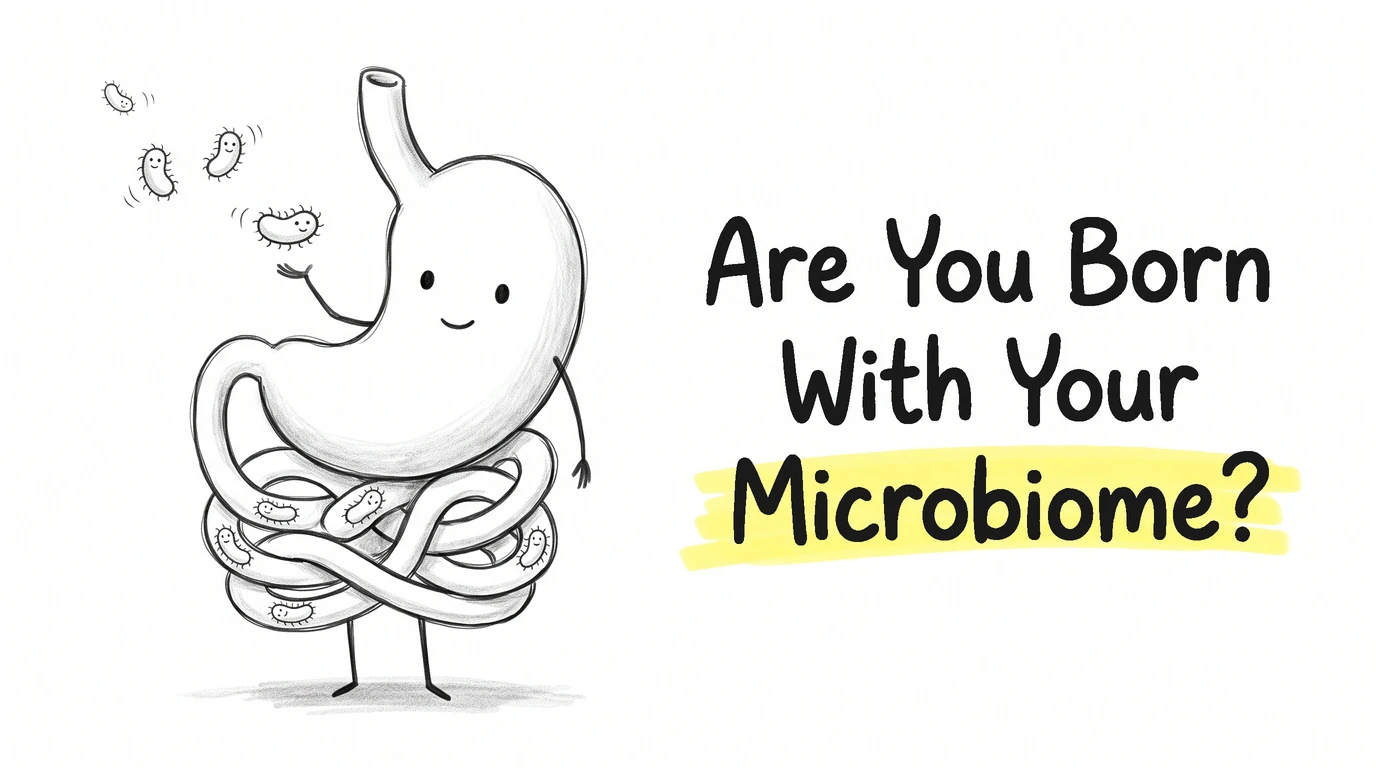
Someone on Reddit's explainlikeimfive once asked: if the sperm and egg that make a baby "are 100 percent human DNA," where do all the other living things inside of us come from? Google gets it from both directions. If you type "are babies born with gut bacteria," the next suggestion down is "are babies born without gut bacteria."
You weren't born with your microbiome (the trillions of bacteria and other microbes living in your gut, which Meet Your Microbiome walks through). You picked it up during birth and in the months and years after, a lot of it from your mom, and by around age 3 it looked a lot like an adult's. How you were born made a difference at the start. Whether that difference still matters by the time you're a teenager is the part researchers are still arguing about.
Was the womb sterile?
For a few years it looked like babies might start collecting bacteria before birth, because a 2014 study reported finding a microbiome in the placenta (the organ that connects a baby to its mother during pregnancy).
That finding didn't hold up. A 2019 study in the journal Nature tested placentas from 537 women and concluded that "the human placenta does not have a resident microbiome." Almost all of the bacterial DNA the team picked up came from bacteria the baby meets during labor and delivery, or from contamination in the lab's own chemicals, which is a common problem when a sample has almost no bacteria in it to begin with. The one exception was group B strep, which turned up in about 5% of placentas collected before labor started (ACOG says that 20% of pregnant women carry it by the end of pregnancy).
A 2023 review in Nature went back through all of the evidence and concluded that it is "strongly in favour of the 'sterile womb' hypothesis." The authors added that it's "impossible to disprove" the occasional live microbe in a healthy fetus, so the answer is close to certain rather than proven. ACOG (the American College of Obstetricians and Gynecologists, the main group of pregnancy doctors in the US) puts it the same way: the gut of a fetus "is believed to be sterile."
Where your first bacteria came from
ACOG names three routes from mother to baby: "during birth, skin-to-skin contact after birth, and breastfeeding."
The idea that how you're born decides your bacteria goes back to a 2010 study. Babies born vaginally picked up bacteria resembling their mother's vaginal bacteria, and babies born by C-section picked up bacteria "similar to those found on the skin surface." That study gets cited constantly, and it included 10 babies (four born vaginally and six by C-section), all sampled within their first day.
The birth canal bacteria also don't seem to stay. A 2018 study followed 25 moms and their babies for four months and found that bacteria from the mom's skin and vagina "colonize only transiently," meaning they show up and then fade out. The strains from the mom's gut were "more persistent," and the babies kept picking up new microbes from their moms well after birth.
Breast milk shaped things more than birth did. The TEDDY study, which followed 903 kids from 3 months to almost 4 years old, found that getting breast milk was "the most significant factor" in what a baby's gut bacteria looked like. Once breast milk stopped, the gut microbiome matured faster.
When it started looking like yours
TEDDY found three phases: a developmental phase from 3 to 14 months, a transitional phase from 15 to 30 months, and a stable phase from 31 to 46 months. A 2012 study of kids in the US, Malawi, and Venezuela saw the same timing in all three places, with gut bacteria shifting "towards an adult-like configuration" within the first three years.
Your mom's bacteria don't vanish once that happens. A 2023 study in Nature compared more than 9,700 microbiome samples at the strain level (a strain is a specific variety within a species, like a breed within a species of dog). When a baby and mom carried the same species in the first year, about half of the time it was the exact same strain. The share dropped to 27% between ages 1 and 3 and then held at about 19% for kids and teens up to 18. For comparison, people 4 and older who live in the same household share about 12%.
Does being born by C-section still matter?
A 2017 study that followed 81 babies found "no discernable differences" in gut bacteria by C-section at 6 weeks old. ACOG cites a review that found the difference "disappeared after 6 months." The Baby Biome Study in the UK, which followed 596 babies, found the biggest difference at 4 days old, and it shrank with age but was still measurable in samples taken later in the first year. The same study found a smaller version of the C-section pattern in vaginally born babies whose moms got antibiotics during labor, and in babies who weren't breastfed, so some of what gets blamed on the C-section comes from antibiotics and feeding. The three studies don't agree on when the difference goes away, and none of them followed kids past the first year.
Kids born by C-section had 21% higher odds of asthma up to age 12 (across 13 studies and nearly 888,000 children) and 59% higher odds of obesity up to age 5, in a 2018 review that pooled studies from high-income countries. Odds aren't the same as chances, and the authors wrote that they were "unable to adjust for confounding factors" (other differences between the families, like the mom's health, that could explain the result on their own), so "causation cannot be inferred." They also noted that in most of the individual studies, adjusting for other factors didn't change the results much.
NICHD (the part of the NIH that studies children's health) funded a study that found higher rates of wheezing and food allergy in kids born by emergency C-section and no link for kids born by planned C-section, and it concluded that missing the microbes in the birth canal "may not have a strong role." A Swedish study of 87,500 sibling pairs found a similar split for asthma. When brothers and sisters from the same family were compared, the link with planned C-sections disappeared, and the authors wrote that the leftover link with emergency C-sections suggests "no causal effect due to vaginal microflora" and more likely comes from whatever made the emergency C-section necessary.
For weight, a Swedish study of 97,291 young men found no link between C-section and obesity at age 18 once it accounted for things like the mother's weight before pregnancy, which explained "most of the crude association."
BMC Medicine published a 2023 analysis comparing sibling studies with ordinary ones across many health outcomes. Ordinary studies put the extra odds for C-section babies at about 14%, and sibling studies at about 8%, and the authors argue that sibling studies "may underestimate" the link, partly because a mom is a different age at each birth and that doesn't always get adjusted for. So kids born by C-section do have somewhat higher rates of a few conditions, and nobody has shown that gut bacteria are the reason.
SelfDecode, a company that sells DNA tests, tells adults born by C-section that their weight is "a metabolic setup that began the moment you were born." The page links to one research paper, and it's about building genetic risk scores from DNA.
What about vaginal seeding?
If you search "c section microbiome," Google suggests "seeding" and "swab." Vaginal seeding means soaking a gauze or swab in fluid from the mother's vagina and wiping it on a C-section newborn's mouth, nose, or skin. ACOG "does not recommend or encourage vaginal seeding" outside of approved research. When it made that call, the entire evidence base was "a single pilot study in which only four infants underwent seeding," and ACOG warned about the "risk of transferring pathogenic organisms" (infections the mom may not know she has) to the baby. The position was reaffirmed in 2025.
What shapes your gut now
The strains you carry as an adult are fairly steady. A 2013 study that tracked 37 adults for up to five years found that about 60% of each person's roughly 200 strains stayed put. Which microbes are most common shifts much faster. In a 2014 study, 11 adults switched to either a plant-based diet or an animal-based one (meat, eggs, and cheese), and their gut communities changed within a day of the new food reaching the lower gut, then went back to normal 2 days after the diet ended.
Genetics "have a minor role," according to a 2018 study of 1,046 healthy people, which also found that people who "share a household" had similar microbiomes even when they weren't related, and that diet, medications, and body measurements were tied to more than 20% of the differences between people.
What you eat, how often you take antibiotics you don't need, and who you live with all keep shaping your gut, and How to Improve Your Gut Health covers the changes that help.
Sources
- de Goffau MC et al., Human placenta has no microbiome but can contain potential pathogens, Nature, 2019
- Kennedy KM et al., Questioning the fetal microbiome illustrates pitfalls of low-biomass microbial studies, Nature, 2023
- American College of Obstetricians and Gynecologists, Committee Opinion No. 725: Vaginal Seeding (reaffirmed 2025)
- Dominguez-Bello MG et al., Delivery mode shapes the acquisition and structure of the initial microbiota across multiple body habitats in newborns, PNAS, 2010
- Ferretti P et al., Mother-to-Infant Microbial Transmission from Different Body Sites Shapes the Developing Infant Gut Microbiome, Cell Host & Microbe, 2018
- Stewart CJ et al., Temporal development of the gut microbiome in early childhood from the TEDDY study, Nature, 2018
- Yatsunenko T et al., Human gut microbiome viewed across age and geography, Nature, 2012
- Valles-Colomer M et al., The person-to-person transmission landscape of the gut and oral microbiomes, Nature, 2023
- Chu DM et al., Maturation of the infant microbiome community structure and function across multiple body sites and in relation to mode of delivery, Nature Medicine, 2017
- Shao Y et al., Stunted microbiota and opportunistic pathogen colonization in caesarean-section birth, Nature, 2019
- Keag OE, Norman JE, Stock SJ, Long-term risks and benefits associated with cesarean delivery for mother, baby, and subsequent pregnancies, PLOS Medicine, 2018
- NICHD, Emergency cesarean delivery may increase child's risk for asthma, food allergy, 2019
- Almqvist C et al., The impact of birth mode of delivery on childhood asthma and allergic diseases: a sibling study, Clinical & Experimental Allergy, 2012
- Elective and nonelective cesarean section and obesity among young adult male offspring: a Swedish population-based cohort study, PLOS Medicine, 2019
- Yu HZ et al., Association of caesarean delivery with offspring health outcomes in full-cohort versus sibling-comparison studies, BMC Medicine, 2023
- SelfDecode, Born via C-Section, Struggling with Weight? Your Microbiome Tells the Story
- Faith JJ et al., The long-term stability of the human gut microbiota, Science, 2013
- David LA et al., Diet rapidly and reproducibly alters the human gut microbiome, Nature, 2014
- Rothschild D et al., Environment dominates over host genetics in shaping human gut microbiota, Nature, 2018

.svg)
.webp)
.webp)



.webp)


.webp)
.webp)