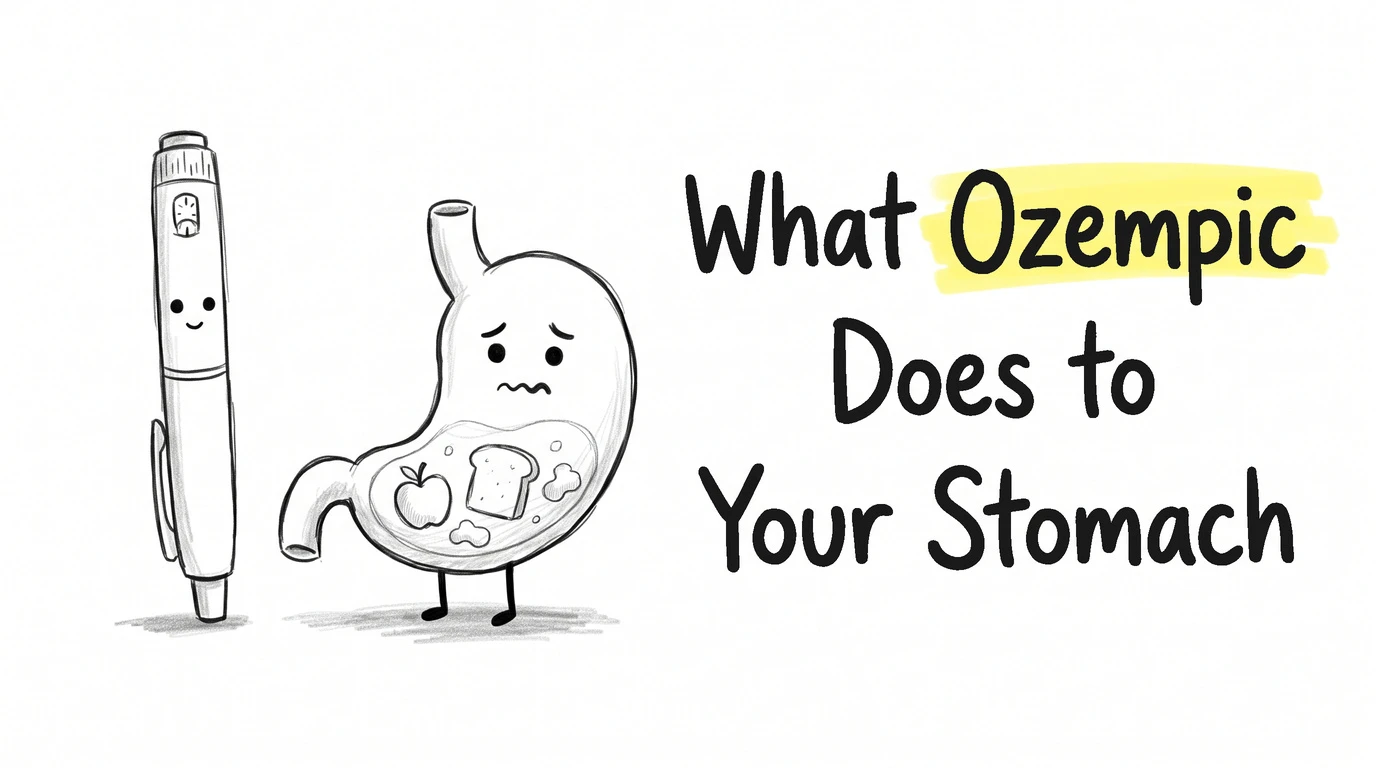
In June 2023, the American Society of Anesthesiologists told its members to start asking patients whether they were on Ozempic before putting them under. Anesthesiologists had been finding food in people's stomachs after the standard pre-surgery fast, which matters because anything still sitting in there can come back up and go into the lungs while somebody is sedated. The guidance says that "delayed gastric emptying from GLP-1 agonists can increase the risk of regurgitation and pulmonary aspiration of gastric contents during general anesthesia and deep sedation," and tells doctors to consider holding a weekly drug "a week prior to the procedure/surgery."
Ozempic's own FDA label now carries the same warning, under a heading about pulmonary aspiration: "OZEMPIC delays gastric emptying."
The hormone the drug is copying
Your intestine makes a hormone called GLP-1, short for glucagon-like peptide-1. It comes out of cells called L-cells, and they sit near the end of the line rather than at the start. The ileum is the last stretch of your small intestine, and as one of the standard reviews of the hormone puts it, "the density of L-cells is relatively low in the proximal small bowel and increases distally along the gut, with greatest density in the ileum and colon."
They release it when food shows up. Sugars, fats, proteins, and certain amino acids all set it off, and in healthy people carbohydrate or protein produces a peak in the blood about 30 to 60 minutes after eating, while fat produces a slower one that lasts over two hours.
That timing tells you what the hormone is for. It is one of the signals your gut sends up when a meal has made it far enough along, and part of what it does in response is to slow down whatever is still behind it.
A GLP-1 receptor agonist (a drug that switches on the same receptor the hormone does) takes that signal and holds it on. Semaglutide, sold as Ozempic and Wegovy, and tirzepatide, sold as Mounjaro and Zepbound, are the ones you have heard of. Instead of a pulse after a meal, you get a steady press on the same button for a week at a time.
What it does to a meal
Novo Nordisk's own FDA-approved label for Ozempic says it plainly in the pharmacology section: "Semaglutide causes a delay of early postprandial gastric emptying, thereby reducing the rate at which glucose appears in the circulation postprandially." Postprandial means after eating, and gastric emptying is exactly what it sounds like, the rate at which your stomach hands food off to your small intestine.
The way it does that runs through your nervous system. A 2018 study in the Journal of Clinical Endocrinology and Metabolism put sixteen healthy male volunteers between 18 and 55 on an infusion of GLP-1 and measured the pressure waves in their stomachs and upper intestines directly. The receptor turned out to sit on the nerve cells woven through the gut wall (the myenteric neurons), rather than on the muscle itself. The authors concluded that GLP-1 works "through GLP-1R at myenteric neurons," which means that the drug is not squeezing or relaxing your stomach the way a muscle relaxant would. It is talking to the wiring that tells the muscle what to do.
A 2024 systematic review in the American Journal of Gastroenterology pooled fifteen studies that had measured how long this actually takes. In the five that used scintigraphy (a scan that tracks a radioactive-tagged meal through you, which is the most accurate method available), the time for half of a meal to leave the stomach was 138.4 minutes on a GLP-1 drug against 95.0 minutes on placebo, a pooled difference of 36 minutes across 247 people.
The other ten studies in that same review, covering 411 people, used the acetaminophen absorption test (a cheaper method that tracks how fast a dose of Tylenol shows up in your blood, since it is only absorbed once it has left the stomach), and those studies found "no significant delay in gastric emptying." One review, two methods, two answers, which is a decent sign that the size of the effect depends partly on how you go looking for it. Thirty-six minutes is a measurable delay and also about the length of a lunch period, which is roughly what the authors concluded when they went with the scintigraphy result and still called it "of limited magnitude relative to standard periprocedural fasting periods."
The numbers, in teenagers
Most of what gets quoted about these drugs comes from trials in adults in their fifties. There is one published trial in adolescents, and because the FDA approved Wegovy down to age 12 on the strength of it, its adverse-event table is printed on the label.
STEP TEENS ran 201 participants aged 12 to 17 for 68 weeks, two-thirds on semaglutide and one-third on placebo. Percentages, drug against placebo:
| Wegovy (n=133) | Placebo (n=67) |
|---|
| Nausea | 42% | 18% |
| Vomiting | 36% | 10% |
| Diarrhea | 22% | 19% |
| Abdominal pain | 15% | 6% |
| Constipation | 6% | 2% |
| Eructation (burping) | 4% | 0% |
| Cholelithiasis (gallstones) | 4% | 0% |
Start with the placebo column. Nearly one in five teenagers who got an injection of nothing at all reported nausea, and 19% of them reported diarrhea against 22% on the drug, which is close enough to be noise. Some of what a person on a GLP-1 drug feels is the drug, and some of it is what happens when you spend 68 weeks paying close attention to your own stomach.
Nausea and vomiting are a different story, since those columns are two to four times apart. In the trial's own words, gastrointestinal problems were the most frequent adverse events on semaglutide, "occurring in 62% of participants, as compared with 42% in the placebo group." They were also brief: the paper gives a "median duration, 2 to 3 days for nausea, vomiting, and diarrhea."
Adults on the same drug report more of everything except diarrhea, at 44% nausea, 30% diarrhea, 24% vomiting, and 24% constipation against a placebo group at 16%, 16%, 6%, and 11%.
Constipation and diarrhea both go up, which sounds contradictory until you remember that the drug is acting on nerves along the whole length of the gut and not just on the stomach. And burping is on every one of these labels under the word eructation, which is the medical term for it, at 7% in adults against under 1% on placebo. Food sitting in a stomach longer is the explanation you will find everywhere online for why those burps smell like eggs. It is a reasonable guess, and nobody has published a study that measured it.
Why the first few months are the worst
Nobody starts on the full dose. In STEP TEENS, "the dose of semaglutide was escalated over a period of 16 weeks from 0.25 mg to 2.4 mg or to the maximum dose that did not cause unacceptable adverse events," which is almost four months of climbing before anyone reaches the number on the box.
In the teen trial, the prevalence of nausea, diarrhea, and vomiting "peaked during or shortly after the 16-week dose-escalation period." Ozempic's label says the same thing about adults: "The majority of reports of nausea, vomiting, and/or diarrhea occurred during dose escalation."
Whether your gut fully adapts afterward is genuinely unsettled. A 2025 review in Endocrinology describes tachyphylaxis (a drug effect fading with continued exposure) as something that shows up "even after only 4 to 24 hours of continuous exposure," and notes that tirzepatide's effect on emptying "may be diminished after 23 days of treatment." But the same review says the slowing, "while still significant, is less marked," and the meta-analysis above found that treatment duration made no measurable difference across its fifteen studies. What the evidence supports is partial adaptation with a residue left over. Nobody has shown that the effect goes away.
Stomach paralysis
If you search any of this, you will hit the phrase "Ozempic stomach paralysis," and it traces to one paper. In October 2023 a research letter in JAMA compared people prescribed GLP-1 drugs for weight loss against people prescribed a different weight-loss drug, using an insurance claims database, and reported an adjusted hazard ratio of 3.7 for gastroparesis (95% CI 1.15 to 11.9), 9.1 for pancreatitis (95% CI 1.25 to 66), and 4.2 for bowel obstruction (95% CI 1.02 to 17.4). Biliary disease came in at 1.5 and was not statistically significant. Most of the people in it weren't on Ozempic's drug at all: 4,144 were taking liraglutide, an older daily injection, and 613 were taking semaglutide.
A hazard ratio of 9.1 sounds enormous until you read what sits next to it, which is a confidence interval (the range the true number is probably in) running from 1.25 all the way up to 66. An interval that wide is what you get when a study counted a handful of events, and it means that 9.1 is a rough guess wearing a decimal point rather than a measurement.
The American College of Gastroenterology published a commentary on the study six weeks later, by Philip Schoenfeld and Sonali Paul, who declared no relevant conflicts of interest. Their read: "This is a hypothesis-generating study and should not be considered a study that answers a question." Their conclusion is that "current data is insufficient to support a causal link between GLP-1 receptor agonists and gastroparesis or bowel obstruction."
A 2026 systematic review in PLoS One went looking for every published case of gastroparesis tied to these drugs anywhere in the world and found twelve case reports covering thirteen patients, of whom six had the scan that formally confirms the diagnosis. In nearly all of them, symptoms improved once the drug was stopped, gastric emptying normalized on repeat scans, and most recovered "within days to weeks."
Thirteen documented patients worldwide is a small number, and a case report only exists if a doctor wrote one up, so the true count is higher. Set it against the anesthesia finding, though: a 2025 study in Endoscopy International Open looked at 152 patients on these drugs having an upper endoscopy (a camera down the throat) and found retained food in the stomach in 12.5% of them against 1.3% of matched controls, rising to 23% among the people taking the drug for weight loss specifically. Six of those procedures were called off on the spot.
The FDA label sits between the two findings. Ozempic "is not recommended in patients with severe gastroparesis," and ileus, intestinal obstruction, and severe constipation including fecal impaction are all listed under postmarketing experience, which is the section for things reported after a drug is approved and where nobody can calculate a rate. A stomach emptying late is common enough to have changed how anesthesiologists work. A stomach that stays that way after the drug stops is rare enough that the world's published cases fit in one small table.
Hunger is a separate question
If these drugs slow your stomach, and a slow stomach keeps you full, then the slowing should be the reason people eat less on them. The Australian group that has spent years measuring gastric emptying on these drugs tested that idea and wrote that "there does not appear to be a relationship between the magnitude of the decrease in energy intake and the delay in gastric emptying."
Two people can have the same delay and eat wildly different amounts. Whatever drives the appetite change is mostly happening somewhere other than your stomach, probably in the brain, where these receptors also sit. Nobody has published a figure splitting how much of the effect comes from the gut and how much from the brain. So the sentence you will see under every video about these drugs, that they work by slowing your stomach down, describes something that genuinely happens and has never been shown to do the job it gets credit for. The slowing explains the side effects above. The hunger is a different mechanism, and it is less settled than the marketing suggests.
If someone you know is on one
One thing this article has skirted, and it is not the question in the title: of the four brand names you actually hear, only Wegovy is approved for anyone under 18, at 12 and up, and Saxenda (a daily injection in the same family) at 12 and up with a body weight over 60 kg. Ozempic, Mounjaro, and Zepbound all carry the same line, that safety and effectiveness "have not been established in pediatric patients." A 2025 preprint analyzing electronic health records found that among 2,090,467 adolescents who met the BMI criteria for obesity, 0.9% had ever received a GLP-1 prescription, with the rate climbing from 0.12% to 1.38% between December 2022 and July 2025. The rate is rising fast, and it is still under one in fifty of the teenagers who would qualify on paper.
If you are the one taking it, the first four months are worse than what comes after, by design, because the dose is still climbing. Nausea, vomiting, and diarrhea in that window ran a median of two to three days at a stretch in the teen trial rather than being constant, so a bad week during an increase is not a forecast of the year. Every one of the thirteen documented gastroparesis patients got better after somebody stopped the drug, which is the argument for telling a prescriber when vomiting is severe or will not settle instead of pushing through it.
The last one has nothing to do with how you feel. Tell a doctor before any procedure that involves sedation, wisdom teeth included, that you are on one of these drugs. Your stomach may not be empty when everyone in the room is assuming that it is.
Sources
- Ozempic (semaglutide) prescribing information, Novo Nordisk, revised 10/2025 (PDF)
- Wegovy (semaglutide) prescribing information, Novo Nordisk, revised 2025 (PDF)
- Saxenda (liraglutide) prescribing information, Novo Nordisk, 2025 (PDF)
- Mounjaro (tirzepatide) prescribing information, Eli Lilly, 2025 (PDF)
- Zepbound (tirzepatide) prescribing information, Eli Lilly, 2026 (PDF)
- American Society of Anesthesiologists, Consensus-Based Guidance on Preoperative Management of Patients on GLP-1 Receptor Agonists, June 29, 2023
- Weghuber D et al., Once-Weekly Semaglutide in Adolescents with Obesity (STEP TEENS), New England Journal of Medicine, 2022
- Hiramoto B et al., Quantified Metrics of Gastric Emptying Delay by GLP-1 Agonists: A Systematic Review and Meta-Analysis, American Journal of Gastroenterology, 2024
- Halim MA et al., Glucagon-Like Peptide-1 Inhibits Prandial Gastrointestinal Motility Through Myenteric Neuronal Mechanisms in Humans, Journal of Clinical Endocrinology and Metabolism, 2018
- Müller TD et al., Glucagon-like peptide 1 (GLP-1), Molecular Metabolism, 2019
- Jalleh RJ et al., Physiology and Pharmacology of Effects of GLP-1-based Therapies on Gastric, Biliary and Intestinal Motility, Endocrinology, 2025
- Schoenfeld P, Paul S, GLP-1 Receptor Agonists and Risk of Gastrointestinal Adverse Events, American College of Gastroenterology Evidence-Based GI, November 15, 2023
- Sodhi M et al., Risk of Gastrointestinal Adverse Events Associated With Glucagon-Like Peptide-1 Receptor Agonists for Weight Loss, JAMA, 2023
- Olubodun T et al., Gastroparesis induced by glucagon-like peptide-1 receptor agonists: A systematic review, PLoS One, 2026
- Gu GH et al., Association of semaglutide with retained gastric contents on endoscopy, Endoscopy International Open, 2025
- Kim C et al., Prescribing of GLP-1 Receptor Agonists for Adolescents with Obesity and Associated Disparities, medRxiv preprint, October 7, 2025


.svg)
.webp)
.webp)



.webp)


.webp)
.webp)