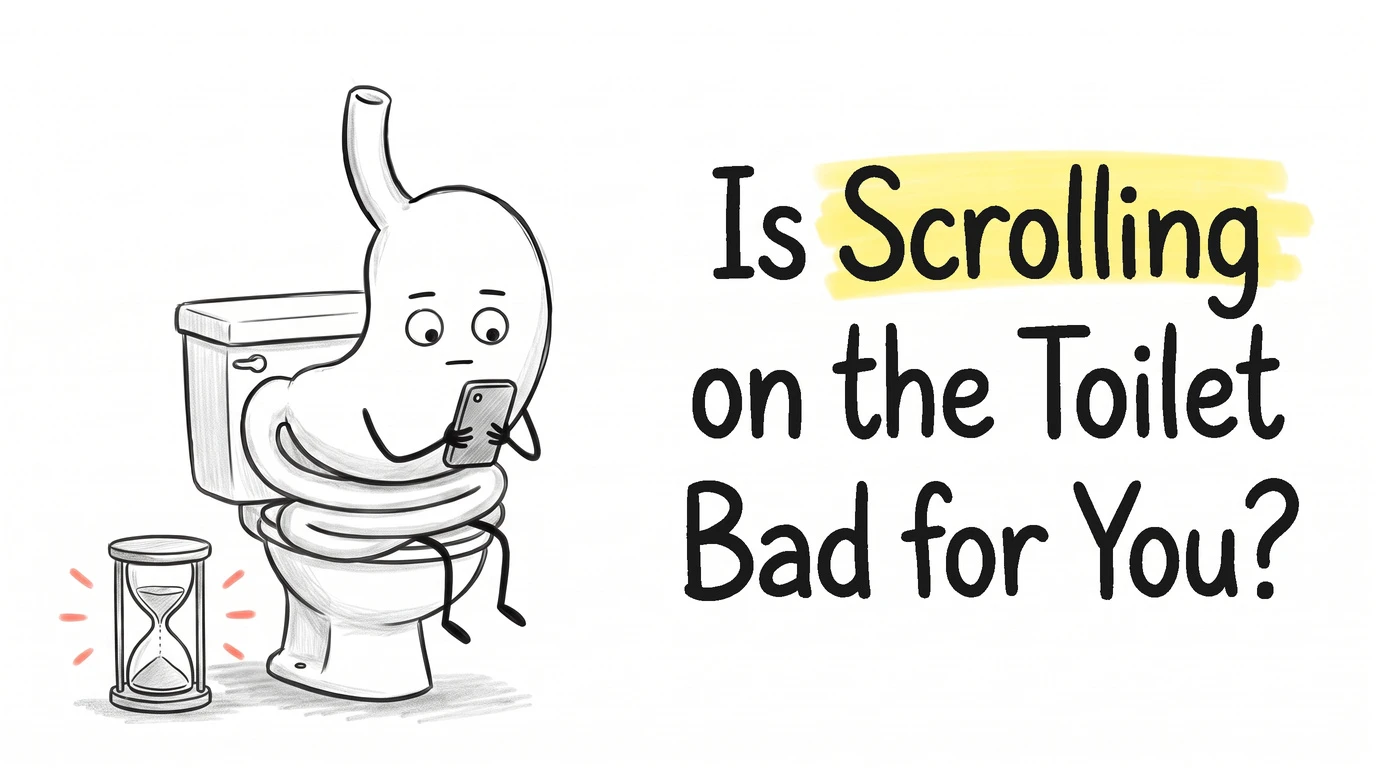
In 2025 a study went around saying that using your phone on the toilet raises your risk of hemorrhoids by 46%, and for about a week it was on every screen in the country. If you happened to read that on your phone, on the toilet, you were exactly the person it was written to scare.
The NHS describes piles (the British word for hemorrhoids) as "swollen blood vessels," and on the same page adds: "It's not clear what causes them."
What the study actually found
Researchers at Beth Israel Deaconess in Boston surveyed 125 people who were about to get a screening colonoscopy, asked them about their phone habits, and then read the colonoscopy reports to see who had hemorrhoids. Two thirds of them used a phone on the toilet, and those people sat longer: 37.3% stayed more than five minutes, against 7.1% of the people who left the phone outside.
Among phone users, 50.6% had hemorrhoids. Among non-users, 38.1% did, and that difference was not statistically significant (p = 0.257, and below 0.05 is the usual bar for calling a result unlikely to be chance). The 46% only shows up after the authors ran a model adjusting for age, sex, BMI, exercise, straining, and fiber, and even then it came in at p = 0.044, barely under the line, with no confidence interval printed anywhere in the paper.
Who was in it
Screening colonoscopies in the US start at 45, so the youngest person in the study was 45 years old. The authors flag it themselves: their group "may not be representative of the general population."
Hemorrhoids climb steeply with age. A Korean study of 194,620 adults found them in 12.1% of people in their twenties and 22.0% of people aged 60 to 70. The youngest group in a study of nearly 200,000 people was 20 to 29, so if you're in high school, almost nobody has measured this in people your age. Johns Hopkins lists being between 45 and 65 as a risk factor, and says that about half of people have hemorrhoids by 50.
A Mayo Clinic surgeon with no connection to the study put it carefully to NBC News: "I am seeing younger, earlier- and middle-aged people having more hemorrhoidal complaints, but I can't tie it to smartphones."
Doctors were also telling people to get off the toilet long before this study existed. The American College of Gastroenterology told clinicians in 2021 to discourage "sitting on the toilet for a prolonged time, which includes reading and use of cellphone," and the European guideline that gives the same advice grades it as expert opinion and admits that "no systematic reviews or (randomized) trials were found." The five-minute and ten-minute limits you see quoted everywhere come from individual doctors, not from studies.
Where the germ number came from
You've probably seen the line that your phone carries ten times more bacteria than a toilet seat. It gets credited to a University of Arizona microbiologist who did call phones germy in a 2006 interview, but he never said ten times.
Snopes went looking for where the number came from and found a 2012 article on a site called MyHealthNewsDaily, written by a reporter who later confirmed that the ten-times figure was their own line rather than anything from a study. The Today show picked it up. A university blog post linked to the Today segment, and that post has since been deleted. People have been repeating that number for more than a decade, and one person made it up.
Your phone does carry bacteria, because everything you touch does. The closest study to your age swabbed 27 phones belonging to Estonian students aged 16 to 18 and found bacteria on every one, mostly Micrococcus luteus and Acinetobacter lwoffii, which are ordinary skin bacteria that are living on you right now. Washing your hands is the step that does the work here. The researchers were careful to say that they never checked whether a single student got sick, and there's no published case of a healthy person catching an illness from their own phone outside of a hospital either.
Why your legs go numb
A chair spreads your weight across your whole backside. A toilet seat concentrates it onto a thin ring under your thighs, which presses on the nerves running through there, and after a while those nerves stop reporting in. There's a published case of a woman who got tingling in both legs after five to ten minutes of sitting and reading on the toilet, and it stopped once she cut her visits short. That's one person, which is about as thin as medical evidence gets, but you've felt it yourself, and that's reason enough to stand up.
What to do
Get up when you're done. Nobody has proven that five minutes is the cutoff, but scrolling on a hard ring for twenty minutes has nothing going for it anyway.
If the bathroom is where you go to get ten minutes when nobody can ask you anything, which for plenty of people is exactly what it is, finish up first and take the rest of those ten minutes to your bed or the couch. Nobody is going to find you there either, and your legs won't go numb.
And if you're bleeding, don't decide on your own that it's hemorrhoids. In a 55-year-old that guess is usually right. At your age it isn't, because hemorrhoids are uncommon in teenagers, and bleeding can also come from fissures, infections, inflammatory bowel disease, or polyps. Get it looked at.
Sources
- Ramprasad C, Wu C, Chang J, et al. "Smartphone use on the toilet and the risk of hemorrhoids." PLOS ONE 20(9): e0329983, 2025
- Hong YS, Jung KU, Rampal S, et al. "Risk factors for hemorrhoidal disease among healthy young and middle-aged Korean adults." Scientific Reports 12, 129 (2022)
- Wald A, Bharucha AE, Limketkai B, et al. "ACG Clinical Guidelines: Management of Benign Anorectal Disorders." American Journal of Gastroenterology 116:1987-2008, 2021.
- van Tol RR, Kleijnen J, Watson AJM, et al. "European Society of ColoProctology: guideline for haemorrhoidal disease." Colorectal Disease 22:650-662, 2020.
- Johns Hopkins Medicine. "Hemorrhoids."
- NHS. "Piles (haemorrhoids)." Last reviewed 1 April 2026
- NBC News. "Phone use and hemorrhoids," quoting Robert Cima MD
- Snopes. "Are cellphones really dirtier than toilet seats? Here's what we found."
- "High level bacterial contamination of secondary school students' mobile phones." GERMS, 2017
- Espinosa J, Lucerna A, Schuitema H. "Case Report: Toilet Seat Neuropathy." International Journal of BioMed Research, 2022.



.svg)
.webp)
.webp)



.webp)


.webp)
.webp)