If you type "why does olipop" into Google, most of what it offers to finish the sentence is a complaint: "hurt my stomach," "make me gassy," "give me diarrhea," "make me bloated." If you type "does olipop," one of the suggestions is "have probiotics," which it doesn't. These sodas are sold on what they do for your gut, and a lot of the people drinking them are searching for what they're doing to it.
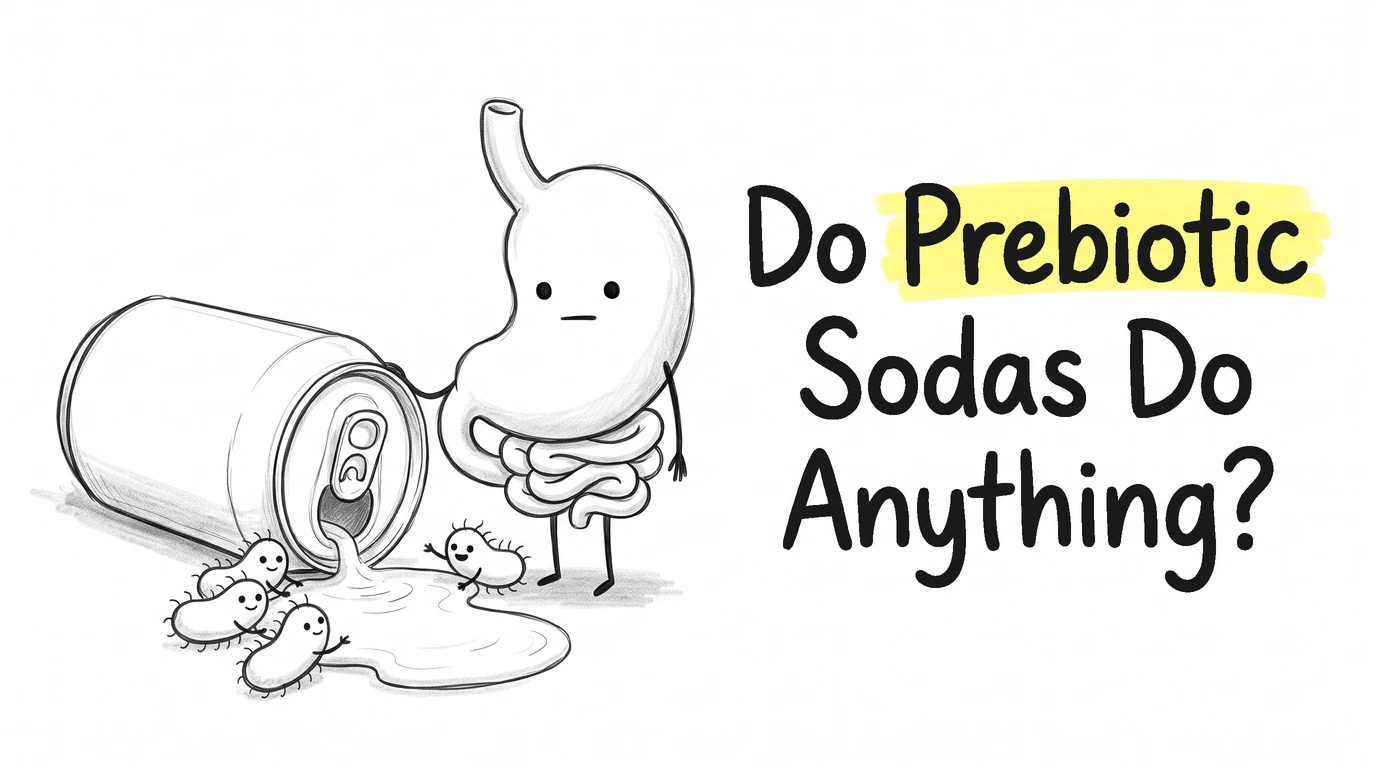
Nobody has shown that a prebiotic soda does anything for your gut, mostly because nobody has published a gut test of one. The fiber in a can is near or under the amounts researchers tie to a benefit, the gut studies that Poppi and Olipop registered on their own sodas have never posted results, and the one published study of an Olipop measured blood sugar instead. What these drinks clearly do is cut most of the sugar out of a regular soda.
What's in the can?
A prebiotic is food for the bacteria already living in your gut, usually a fiber they can ferment (break down for energy, the way yeast breaks down the sugar in bread dough). A probiotic is the bacteria themselves. Prebiotic sodas have fiber and no live bacteria, so the people searching "does olipop have probiotics" have the two words mixed up. (Our explainer on prebiotics, probiotics, postbiotics, and synbiotics sorts out all four.)
Here's what the labels say, per 12-ounce can:
- Olipop Vintage Cola: 9 grams of fiber from a blend that includes cassava root fiber, chicory root inulin, and Jerusalem artichoke inulin (inulin is a fermentable fiber, and chicory root is where most of it comes from), plus 5 grams of sugar, stevia, and 50 milligrams of caffeine.
- Poppi Classic Cola: 3 grams of fiber from cassava root fiber and agave inulin, plus 5 grams of sugar, apple cider vinegar, stevia, and 40 milligrams of caffeine.
- Coca-Cola: "A 12-ounce can of Coke contains 39 grams of sugar," according to Coca-Cola's own site, and no fiber.
The fiber moves around a lot between brands and flavors. A registered dietitian at Cleveland Clinic puts it at "about 2 to 9 grams per can."
Is one can's worth of fiber enough to matter?
It's borderline at best. ISAPP (the International Scientific Association for Probiotics and Prebiotics, the main scientific group that studies both) says that there's no official daily amount of prebiotics anyone is supposed to get, and that most of them need more than 3 grams a day "to confer a health benefit." Hannah Holscher, a nutrition professor at the University of Illinois, put the floor for any benefit at about 3 grams and said that relieving constipation generally takes at least 12 grams of inulin. (The article quoting her notes that she has taken speaking fees from a company that makes prebiotic fibers.)
In the European Union, health claims on food are "prohibited unless they are authorised," and the EU has approved this one for chicory inulin: "Chicory inulin contributes to normal bowel function by increasing stool frequency." The claim is only allowed on food that gives you "at least a daily intake of 12 g of native chicory inulin." A can of Poppi has 3 grams of fiber total. A can of Olipop has 9, and only part of that is inulin.
Small doses can still move the bacteria, though. In a 2006 trial in Paris, 40 healthy adults took a short-chain cousin of inulin (short-chain fructo-oligosaccharides, or FOS) for a week, and even the smallest dose, 2.5 grams a day, raised the count of bifidobacteria (a group of gut bacteria that these fibers feed) in their stool. The same trial found that bloating was worse than on a placebo (a look-alike powder with nothing active in it) at 2.5 and 5 grams. It counted bacteria and tracked symptoms, but it didn't test whether anyone's digestion actually got better, and the fiber came as a powder rather than in a soda.
Has anyone tested the sodas themselves?
Researchers at the University of North Carolina analyzed 108 prebiotic sodas sold in the US and found that the average can had 5 grams of fiber and 5 grams of sugar. One of the researchers, Carlos Soto Díaz, said that "there is currently no research specifically examining the effects of prebiotic sodas on gut health," and that "consumers should not assume that drinking them will provide a meaningful gut health benefit."
Poppi did start a gut study of its own. ClinicalTrials.gov (the US government's registry, where researchers list a study before running it) has a Poppi-sponsored study titled "Study to Evaluate the Efficacy of Poppi Apple Cider Vinegar Prebiotic Soda to Improve Gut Health In Participants." It enrolled 38 people in a single group, with no placebo and nobody blinded (everyone knew what they were drinking), and it set out to measure IBS symptoms, bowel movements, and skin over four weeks. The registry lists it as completed in May 2022, and no results have ever been posted.
Olipop has the one published study. Thirty adults, with an average age of 46 and an average BMI in the overweight range, drank either an Olipop-style soda (3 grams of sugar, 6 grams of fiber) or a regular soda (39 grams of sugar) at lunch, and their blood sugar rose less after the Olipop. Olipop sponsored it, and it appeared in the journal Food and Humanity. It measured blood sugar rather than anything in the gut, and the soda it beat had 13 times the sugar, so the study can't separate what the fiber did from what the missing sugar did. Olipop has registered three more studies of its soda, including one on stomach symptoms in people taking GLP-1 drugs like Ozempic. As of this writing, none has posted results.
Eamonn Quigley, a gastroenterologist at Houston Methodist, put it this way: "We currently don't have enough evidence about these prebiotic sodas to evaluate the claims made by the manufacturers."
What happened in court?
In 2024, a Poppi customer filed a class action arguing that 2 grams of prebiotic fiber per can was too little to do anything, and that "a consumer would need to drink more than four Poppi sodas in a day to realize any potential health benefits." Poppi settled for $8.9 million. It denied doing anything wrong, and the settlement says that Poppi had already chosen to remove "any and all references to gut health" from its labels in late 2023. Poppi's website now lists "prebiotics" and "apple cider vinegar" as features and doesn't use the word gut.
A near-copy of the lawsuit hit Olipop in 2025, arguing that 6 to 9 grams of fiber is "too low to cause any meaningful digestive health benefits." The customer who filed it dropped the case about four months later, so no court ever ruled on the science. Olipop's website still calls the drink "a leading research-backed functional beverage" that supports "your gut microbiome, and digestive health."
Both complaints were written by lawyers trying to win, so they're arguments rather than findings. Nothing stops a company from making claims like Olipop's, though, because the FDA (Food and Drug Administration) "does not require conventional food manufacturers to notify FDA about their structure/function claims," the legal category for claims like the FDA's own example, "fiber maintains bowel regularity." A soda can call itself good for digestion without anyone at the FDA reviewing it first.
Why do they make some people gassy?
Monash University's FODMAP team (the group that developed the low-FODMAP diet for IBS) warns that when companies add inulin, chicory root, or similar fibers to boost prebiotic content, "in some individuals with IBS, this can cause unwanted symptoms such as gas, bloating and abdominal distension," and that "even very small amounts of these ingredients will contribute significantly" to a food's FODMAP load. If you don't usually eat much fiber, two cans in an afternoon is a fast jump, and our article on fiber-maxxing covers how quickly your gut can handle more. If you're gassy either way, why am I so gassy goes through the other causes.
So should you drink them?
If you're swapping out a regular soda, you're cutting about 34 grams of sugar per can, and Soto Díaz said that they may be a better choice for someone replacing regular soda. If you'd otherwise drink something low in sugar, he said that they could be the less healthy option.
Both brands use stevia, and a 2025 joint statement from the Academy of Nutrition and Dietetics, the American Academy of Pediatrics, the American Academy of Pediatric Dentistry, and the American Heart Association lists "beverages with non-sugar sweeteners" as "Not Recommended" for ages 5 to 18. The cola flavors also have caffeine, and the current Dietary Guidelines for Americans tell 11- to 18-year-olds to "avoid caffeinated beverages."
For the gut itself, the same Dietary Guidelines point to "vegetables, fruits, fermented foods (e.g., sauerkraut, kimchi, kefir, miso), and high-fiber foods," and never mention added-fiber drinks. Cleveland Clinic's advice, from dietitian Julia Zumpano, is to treat them as "a healthy treat or a once-in-a-while supplement," and she says that "when you have a diet rich in high-fiber foods, you won't need prebiotic soda." Marion Nestle, a nutrition professor emerita at NYU, told people worried about their microbiome to eat vegetables ("Vegetables would do wonders") and said that the sodas themselves aren't likely to hurt you or help you.
Sources
- OLIPOP, Vintage Cola product page and nutrition facts
- OLIPOP, Digestive Health
- Poppi, Classic Cola product page and nutrition facts
- Poppi, Why poppi?
- The Coca-Cola Company, Coca-Cola Original
- Zumpano J, Are Prebiotic Sodas Good for You?, Cleveland Clinic Health Essentials, 2024
- ISAPP, The Science of Prebiotics, Cereal Foods World, 2020
- Callahan A, Are Prebiotic Sodas Good for Gut Health?, University of Illinois Department of Food Science and Human Nutrition, 2024
- European Commission, Commission Regulation (EU) 2015/2314 (chicory inulin health claim), 2015
- Bouhnik Y et al., The capacity of short-chain fructo-oligosaccharides to stimulate faecal bifidobacteria: a dose-response relationship study in healthy humans, Nutrition Journal, 2006
- Nutrition Insight, Prebiotic sodas under the microscope (interview with Carlos Soto Díaz, UNC Chapel Hill), 2026
- ClinicalTrials.gov, NCT05418439, Study to Evaluate the Efficacy of Poppi Apple Cider Vinegar Prebiotic Soda to Improve Gut Health In Participants
- Prebiotic soda lowers postprandial glucose compared to traditional soda pop: a randomized controlled trial, Food and Humanity, 2026 (preprint on medRxiv)
- ClinicalTrials.gov, NCT06427915, Studying Glucose and Appetite Response With Alternatives to Soda Pop
- ClinicalTrials.gov, NCT07298135, NCT07362563, and NCT07744360 (Olipop-sponsored, no results posted)
- Houston Methodist, Do Prebiotic Sodas Benefit Your Health?, 2025
- Cobbs v. VNGR Beverage, LLC, Class Action Complaint, N.D. Cal., 2024
- In re VNGR Beverage, LLC Litigation, Settlement Agreement, N.D. Cal. No. 4:24-cv-03229-HSG
- Somers v. Olipop, Inc., Class Action Complaint, E.D.N.Y. No. 1:25-cv-06933
- Somers v. Olipop, Inc., docket
- FDA, Structure/Function Claims
- Rhys-Jones D, Collins L, Label Reading and FODMAPs, Monash FODMAP
- Healthy Eating Research, Healthy Beverage Recommendations for School-Age Children and Adolescents, 2025
- HHS and USDA, Dietary Guidelines for Americans, 2025-2030


.svg)
.webp)
.webp)



.webp)


.webp)
.webp)